Aravind Srinivas is the co-founder and CEO of Perplexity AI, a company that shifted the tech industry's focus from traditional link-based search engines to direct answer engines. With a background in reinforcement learning at DeepMind and OpenAI, his insights center on execution speed, the limitations of large language models, and the value of human curiosity. This profile collects his perspectives on competing with tech incumbents, building AI products, and the mechanics of knowledge discovery.
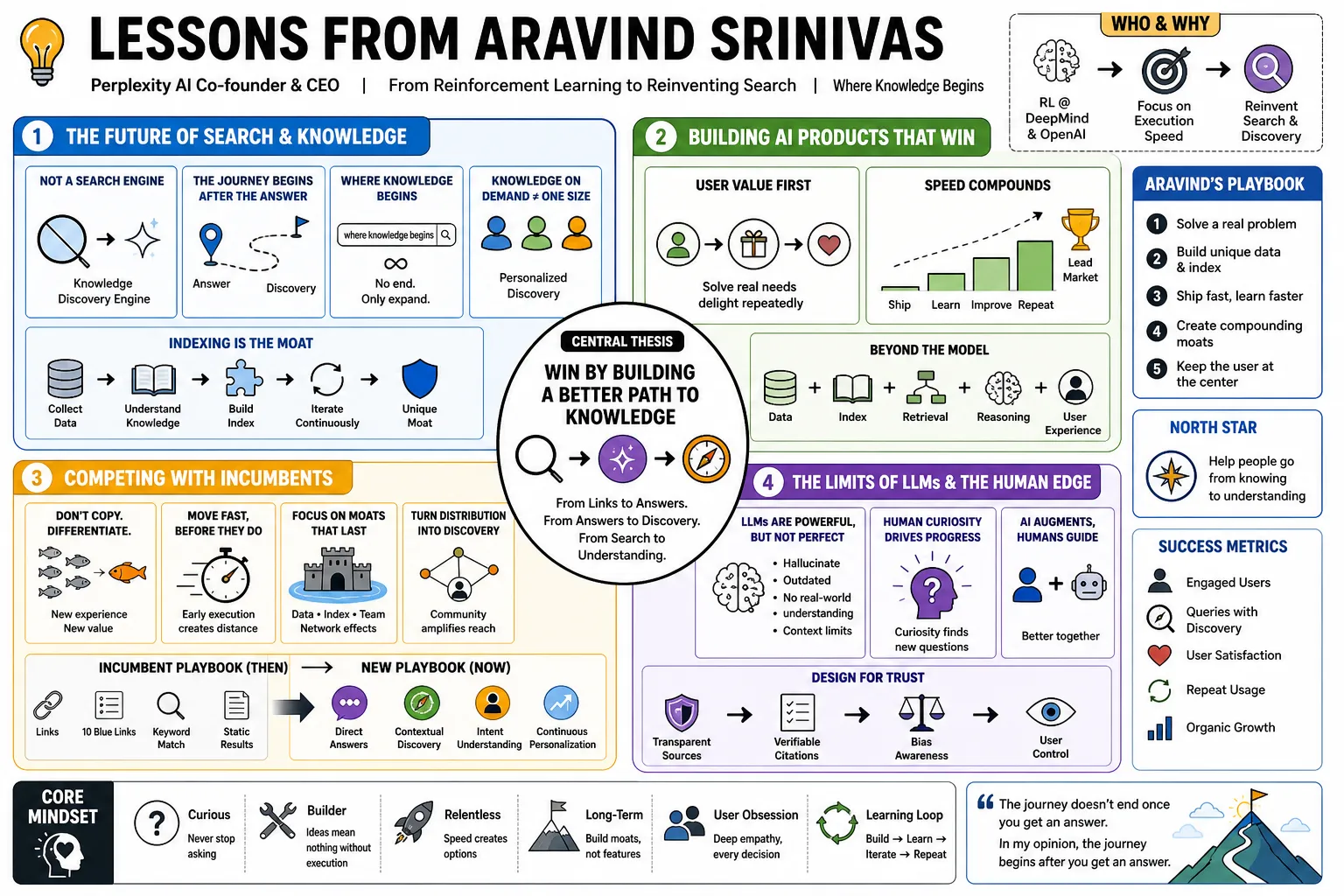
Part 1: The Future of Search and Knowledge
- On the nature of search: "I think of Perplexity as a knowledge discovery engine, neither a search engine... The journey doesn't end once you get an answer. In my opinion, the journey begins after you get an answer." — Source: [Invest Like the Best]
- On the philosophy of the search bar: "That's why in the search bar, we say 'where knowledge begins,' because there's no end to knowledge. You can only expand and grow." — Source: [Lex Fridman Podcast]
- On indexing knowledge: "Building an index is harder than building an LLM. Not because of cost, but because of time and knowledge. You can only do it by building, getting data, and iterating." — Source: [The Economic Times]
- On personalized discovery: "Knowledge on demand personalized to you is a trillion-dollar opportunity." — Source: [The Logan Bartlett Show]
- On navigating the web: "The web is a treasure trove, but you need the GPS. It's much easier having a tool like ours to go find the right knowledge at the right time." — Source: [The Logan Bartlett Show]
- On transitioning from links to answers: Perplexity's core philosophy involves moving away from a list of links, where the user does the work, to a synthesized answer with citations, where the AI does the heavy lifting. — Source: [Invest Like the Best]
- On knowledge as a resource: "Knowledge is more valuable than wealth... You can probably focus on wealth and your net worth... but at some point it taps out. On the other hand, there is no end to knowledge." — Source: [Stanford Seminar]
- On the ultimate company goal: Inspired by Amazon's customer-centricity, Perplexity's long-term objective is to operate as the world's most knowledge-centric company. — Source: [X]
- On infinite curiosity: "The results are not the end, they are doorways to sharper questions." — Source: [X]
- On the naming of the company: "It's one of the worst names you can pick for a consumer company. 100% aware of it... Maybe we can do something like the company will still be called Perplexity, but the product can be called something else." — Source: [Singju Post]
Part 2: Artificial General Intelligence (AGI) and Reasoning
- On inference compute: "AGI will be limited by inference compute, not compute for pre-training or post-training." — Source: [Ann Jose Blog]
- On the next breakthrough: "If we can achieve that amount of inference compute, where it leads to a dramatically better answer as you apply more inference compute, I think that will be the beginning of real reasoning breakthroughs." — Source: [Lex Fridman Podcast]
- On the Einstein analogy: "Can you have a conversation with an AI where it feels like you talked to Einstein or Feynman, where you ask them a hard question, they're like, 'I don't know,' and then after a week, they did a lot of research... and they come back and just blow your mind." — Source: [Liu Jiacai]
- On defining AGI via academia: He defines AGI by asking what it takes to create new knowledge at the level of a PhD student in an academic institution, resulting in an impactful research paper. — Source: [Liu Jiacai]
- On the Galileo AI: "Can you build an AI that's like Galileo or Copernicus? Where it questions our current understanding." — Source: [Ann Jose Blog]
- On decoupling reasoning from facts: "Is there a way to decouple reasoning and facts? Can we build a small language model that has a good level of common sense reasoning and can be applied iteratively such that it bootstraps its own reasoning?" — Source: [Liu Jiacai]
- On emergent intelligence: "Intelligence just emerges from training on a lot of data on the internet... instead of the traditional approach, they approached what it means to be intelligent in a very different way." — Source: [HBS Entrepreneurship Summit]
- On action versus reasoning: "LLMs can reason. But only agents can do." — Source: [X]
- On the human edge in problem-solving: "AI could help humans solve an existing problem but it is very different from AI solving it autonomously... The edge lies with the humans because it was a human who identified the problem in the first place." — Source: [Financial Express]
Part 3: Competing with Big Tech
- On doing what Google won't: "We do not have to beat them, neither do we have to take them on... the best way to actually make a dent in the search space is to not try to do what Google does, but try to do something they don't want to do." — Source: [Ann Jose Blog]
- On the business model conflict: "Google's algorithms are optimized to keep users clicking on links... This is a trillion-dollar opportunity." — Source: [Medium]
- On Google's trilemma: Google lacks alignment between its shareholders, its advertisers, and its core search users. This stifles their innovation, leaving an opening for AI-native answer engines. — Source: [The Logan Bartlett Show]
- On the default monopoly: "Every contender in the space should be an option for the default AI. And Google cannot pay their way in to be the default. Especially when they don't even have the best system." — Source: [HBS Entrepreneurship Summit]
- On public company problems: Google faces "public company problems," specifically a reliance on ad revenue that makes it difficult to cannibalize their own search business with a direct answer engine. — Source: [Invest Like the Best]
- On the inevitability of cloning: "If your company is something that can make revenue on the scale of hundreds of millions of dollars... you should always assume that a model company will copy it." — Source: [Entrepreneur Magazine]
- On big tech advantages: "They raise like tens of billions or close to 50 billion and they need to justify all that CapEx spend, and they need to keep searching for new ways to make money. They will copy anything that’s good." — Source: [Business Insider]
- On the illusion of safety: "You’ve got to live with that fear, sleep with it, and you have to embrace it." — Source: [NDTV]
- On David vs Goliath dynamics: Startups must compete with the massive compensation and resource packages offered by giants like Google and Meta, making culture and speed their only primary weapons. — Source: [Invest Like the Best]
Part 4: Product Philosophy and User Experience
- On the role of citations: "Every sentence you write in a paper should be backed with a citation... Perplexity merges search engines and LLMs to generate answers with citations from credible sources." — Source: [Lex Fridman Podcast]
- On defensibility through product: "Defensibility comes from the product experience and the user's trust." While models commoditize, handling citations, latency, and user intent creates a data flywheel. — Source: [Invest Like the Best]
- On user effort: "A better product should be one that allows you to be more lazy, not less." The ultimate user experience anticipates needs before a query is finished. — Source: [Invest Like the Best]
- On earning trust via transparency: Users will tolerate friction, like waiting slightly longer for a search, if showing the underlying sources increases their confidence in the answer. — Source: [Unicorn Success]
- On opinionated building: "The only way to build something truly great is to be extremely opinionated about what you’re building." — Source: [LiveMint]
- On imperfect launches: Embracing imperfection is the top skill for a CEO; launch an 80-percent perfect product to learn from the market quickly rather than waiting for completion. — Source: [Financial Express]
- On solving painful problems: Prioritize speed to usefulness over theoretical perfection. Early products should be narrow but painful problem solvers rather than generalized intelligence systems. — Source: [Unicorn Success]
- On product magic: Working backward from the customer experience to the technology is essential; starting with a technology and trying to figure out where to sell it never works. — Source: [HBS Entrepreneurship Summit]
- On hardware integration: "The biggest threat to a data center is if the intelligence can be packed locally on a chip that's running on the device." — Source: [Financial Express]
Part 5: Startup Strategy and Speed
- On execution as a moat: "Execution is the only strategy." In the rapidly evolving AI space, having a unique strategy is less important than the speed and quality of execution. — Source: [Invest Like the Best]
- On the startup advantage: "I feel like the only real advantage that a startup has relative to an incumbent is speed." — Source: [The Logan Bartlett Show]
- On adapting to reality: "How many iterations on your initial idea? How many interactions with reality? How fast can you change?" Adaptability outweighs foresight. — Source: [Substack]
- On owning distribution: Relying on third parties for distribution is a trap. Owning the direct relationship with the user is the only way to build a lasting consumer brand. — Source: [HBS Entrepreneurship Summit]
- On the illusion of strategic hacking: "Work incredibly hard and there’s no substitute for it. Don’t overthink or act like you’re too smart, trying to strategically hack your way to building a company." — Source: [Entrepreneur Magazine]
- On persistence: "It’s only over when you think it’s over. Until then, you can always figure out a way." — Source: [HBS Entrepreneurship Summit]
- On precise focus: "You have to have very precise focus and just go after it... if you cannot do everything, the people will lose faith in you; they think you don't really have any clarity." — Source: [The Logan Bartlett Show]
- On action over deliberation: An extreme bias for action is required. In a startup, the cost of moving slowly is almost always higher than the cost of making a mistake. — Source: [Business Insider]
- On building an identity: "Realize that your moat comes from moving fast and building your own identity around what you're doing because users at the end care." — Source: [Entrepreneur Magazine]
Part 6: Building a Company and Fundraising
- On the core emotion: "Every company should stand for a core human emotion. Ours is curiosity. OpenAI stands for intelligence. We stand for curiosity — because AI isn't intrinsically curious. Humans are." — Source: [Substack]
- On the Series A pitch deck: "Famously, the Series A was the only time I made a pitch deck. After that, I just wrote a memo and invited investors to ask anything they wanted." — Source: [Hindustan Times]
- On bypassing traditional pitches: "I’ve never done a pitch deck for any of the other Perplexity funding rounds. I just write a memo, and I tell them you can do a Q&A... I’ll spend two hours with you." — Source: [Business Insider]
- On using AI for diligence: "If they wanted deeper data, they could ask Perplexity — it already knows everything." — Source: [LiveMint]
- On eating your own dog food: During a fundraise, he put an investor's email into his product and prompted it to "Answer it like Aravind," sending the generated link to secure the wire transfer the next day. — Source: [Hindustan Times]
- On building real businesses: "Fundamentally, every company that raises capital has to eventually build a business... I would bet on those who are serious about building a business rather than just training models." — Source: [The Logan Bartlett Show]
- On the model training game: Simply training models is a losing game because as soon as you finish a run, a better model often comes out. The real value is the product built on top of it. — Source: [The Logan Bartlett Show]
- On the future landscape: "We could see 100+ AI startups valued over $10B in our future." — Source: [The Logan Bartlett Show]
- On the venture mindset: Traditional risk-averse investing fails in AI; the mindset must be that 95 percent of investments will fail, but the successful fraction will return 1,000 times the capital. — Source: [Inshorts]
Part 7: AI's Impact on the Individual and Society
- On doomscrolling vs learning: "Spend less time doomscrolling on Instagram; spend more time using the AIs... People who really are at the frontier of using AIs are going to be way more employable than people who are not." — Source: [The Economic Times]
- On the scale of empowerment: "You are already smarter and more empowered than, say, the President of the U.S. was even 20 years ago because of access to AI." — Source: [The Logan Bartlett Show]
- On the one-person unicorn: "Iteration is everything... A one-person unicorn is possible in the future." AI acts as the ultimate leverage for individual builders. — Source: [Substack]
- On automating drudgery: "AI will make us even more human." By automating the drudgery of searching and synthesizing information, AI allows humans to focus on their innate curiosity. — Source: [Invest Like the Best]
- On the speed of adaptation: "Human race has never been extremely fast at adapting. The field of AI is moving in cycles of three to six months." — Source: [The Economic Times]
- On academic integrity: When asked about using AI tools to automatically complete online ethics courses, the response must be an absolute and uncompromising refusal to build or endorse such behavior. — Source: [X]
- On job displacement: AI-triggered job displacement could lead to a glorious future where people are freed from jobs they don't enjoy to start their own specialized businesses. — Source: [India Times]
- On the real AI risk: "The biggest risk of AI is not about AI going rogue and taking over the world... It is really about who has access to the compute—it risks concentrating power in a few individuals, corporations, or states." — Source: [Ann Jose Blog]
- On curiosity's spark: "Did AI pose a question and try to go to solve it? No. The curiosity of the human that led to even considering that it is important for them to think about conjecture." — Source: [Liu Jiacai]
- On returning to core subjects: As AI handles routine software generation, computer science is heading back to its fundamental roots in mathematics and physics. — Source: [NewsBytes App]
Part 8: Engineering, Talent, and Research
- On the GPU talent war: "I tried to hire a very senior researcher from Meta, and you know what they said? 'Come back to me when you have 10,000 H100 GPUs.'" — Source: [Business Insider]
- On DeepMind's culture: "During my PhD years, DeepMind was the king... DeepMind had a very British culture... research scientists were at a higher status, research engineers were at a lower status." — Source: [HBS Entrepreneurship Summit]
- On OpenAI's pivot: "Initially OpenAI's mistake was copying DeepMind... The people that DeepMind wouldn't hire are the ones who changed OpenAI's destiny like Alec Radford and Dario Amodei." — Source: [HBS Entrepreneurship Summit]
- On the scale hypothesis: OpenAI realized their success was not through clever algorithmic tweaking in thousands of simulations, but just scaling up the simplest architectures. — Source: [HBS Entrepreneurship Summit]
- On chips on shoulders: When hiring, look for people with some chips on their shoulders—individuals who feel they have something to prove and are driven by hunger rather than just salary. — Source: [Unicorn Success]
- On the unemployable founder: "Some people are unemployable. They just don't listen to what the boss tells them to do. I'm one of them." He now considers customers to be his true boss. — Source: [UC Berkeley]
- On depth as a skill: Young founders should go deep in at least one hard domain. Treat depth as a transferable skill: mastering one hard domain makes it easier to switch and learn another later. — Source: [Idea2Grow]
- On industry vs academia: For many, it is better to spend a few years in industry before pursuing a PhD to become a better engineer, as the best researchers are those who are also exceptional engineers. — Source: [The Logan Bartlett Show]
- On doing the grunt work: Leaders shouldn't be too smart for detail work. Understanding the nuances of the data pipeline is necessary for high-level technical decision-making. — Source: [HBS Entrepreneurship Summit]
- On the explore vs exploit trade-off: Researchers must constantly balance deep-diving into a specific problem with having the freedom to explore entirely new, unconventional paradigms. — Source: [HBS Entrepreneurship Summit]