Archana Agrawal turned a background in software development into a career in go-to-market leadership. She helped build the marketing engine at Atlassian and served as CMO of Airtable before becoming President of Intercom. She has also served on MongoDB's board of directors. Her work spans product-led growth, customer-centered marketing, operational design, and the shift from seat-based software to AI services sold on outcomes. — MongoDB — 2026 Annual Report and Proxy Statement. — First Round Review — From Developer to CMO. — GTMnow — Outcome Pricing with Archana Agrawal.
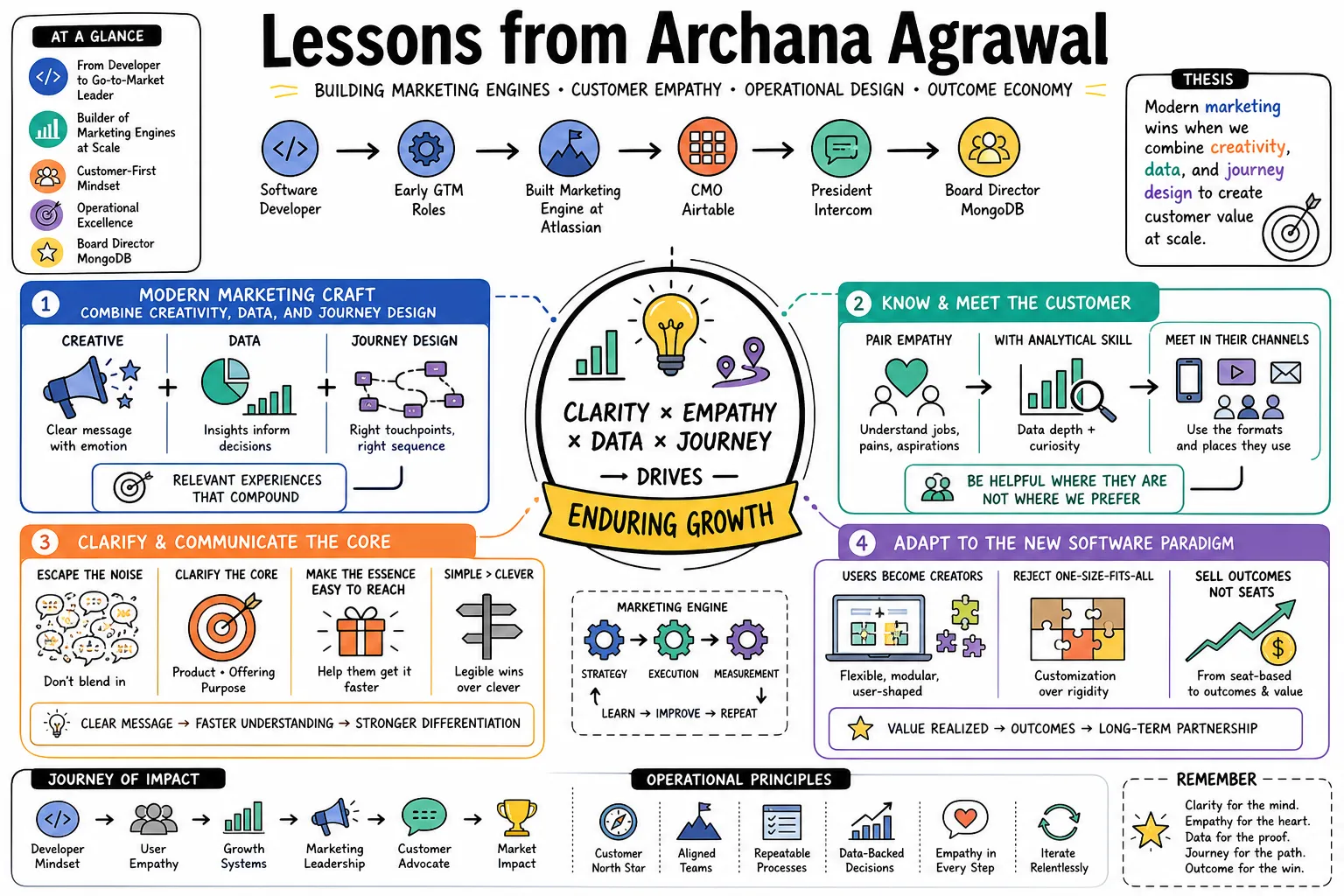
The Modern Marketing Craft
- On Combine Creativity, Data, and Journey Design: Modern marketing is not one discipline; it blends creative messaging, data-informed touchpoints, and deliberate customer-journey design. — First Round Review — From Developer to CMO.
- On Pair Empathy with Analytical Skill: Strong marketers need customer empathy and communication range alongside a serious data background. — First Round Review — From Developer to CMO.
- On Escape the Noise by Clarifying the Core: Differentiation starts by making the product, offering, and company purpose legible without forcing buyers to dig through layers of generic messaging. — First Round Review — From Developer to CMO.
- On Meet Customers in Their Channels: A data-informed channel strategy begins with the formats and places customers already use rather than the marketer's preferred medium. — First Round Review — From Developer to CMO.
- On Expect Software Users to Become Creators: Agrawal sees software users becoming creators who want tools they can shape themselves rather than rigid, one-size-fits-all offerings. — First Round Review — From Developer to CMO.
- On Teach Horizontal Products Through Use Cases: A broad platform becomes easier to understand when its story is anchored in concrete jobs such as campaign management, content operations, or roadmapping. — First Round Review — From Developer to CMO.
- On Let Customer Language Shape the Program: Customer conversations should influence messaging, program design, and which ideas are emphasized as the market changes. — SaaStr — Building a Marketing Engine to Drive Scale.
Product-Led Growth and the Customer Journey
- On Treat the Journey as Marketing's Product: The customer journey can be managed as marketing's own product, with deliberate ownership of each surface and transition. — First Round Review — From Developer to CMO.
- On Share Activation and Expansion Ownership: In product-led growth, product and marketing both touch activation, expansion, and the other surfaces that move users toward value. — First Round Review — From Developer to CMO.
- On Treat Customer Contact as a Bug: When a customer must ask for help during trial, purchase, or adoption, examine which part of the journey failed to explain itself. — First Round Review — From Developer to CMO.
- On Remove Friction Through Better Design: Marketing should redesign the journey so avoidable confusion and handoffs disappear rather than simply staffing around them. — First Round Review — From Developer to CMO.
- On Read Usage Before Funnel Metrics: Agrawal looks at product usage before bookings, conversion, traffic, or MQL because it reveals value delivery closer to the source. — First Round Review — From Developer to CMO.
- On Invest in Community Beyond Immediate ROI: A user community can be strategically valuable even when its near-term return is difficult to express in a conventional business case. — First Round Review — From Developer to CMO.
- On Give Users Access and Voice: Community becomes powerful when users can connect with one another and reach company leaders and product teams directly. — First Round Review — From Developer to CMO.
Operational Design and Team Leadership
- On Design Teams to Break Silos: Organizational design should make cross-functional experimentation easier rather than reinforcing departmental boundaries. — First Round Review — From Developer to CMO.
- On Review Top Goals Every Week: A weekly leadership cadence helps teams see where they are ahead, where they are behind, and where effort must change. — First Round Review — From Developer to CMO.
- On Use Core Meetings for Hard Problems: Cross-functional leadership time should focus on big rocks, resource constraints, and sequencing rather than routine status recitation. — First Round Review — From Developer to CMO.
- On Group Work to Improve Leverage: Sequence and bundle related initiatives so the team's time is used as a coherent portfolio rather than a list of disconnected requests. — First Round Review — From Developer to CMO.
- On Build Operational Excellence into the Tools: The operating system should reduce time lost to status updates and verbal synchronization so people can spend more time on the work itself. — Airtable — CMO Conversations with Archana Agrawal.
- On Protect Agility as Change Accelerates: When digital transformation speeds up across industries, maintaining organizational agility becomes a core capability rather than a temporary response. — Airtable — CMO Conversations with Archana Agrawal.
- On Launch from Customer Evidence: Readiness for a launch should be judged by customer feedback and evidence, not only by an internal shipping calendar. — SaaStr — Building a Marketing Engine to Drive Scale.
- On Keep Operations Flexible: Marketing systems must remain adaptable because customer buying behavior and the available channels continue to change. — SaaStr — Building a Marketing Engine to Drive Scale.
- On Prevent Manual Work from Fragmenting the System: When manual tasks dominate, data silos and broken workflows make customer-focused decisions harder. — SaaStr — Building a Marketing Engine to Drive Scale.
AI and the Economics of Customer Service
- On Challenge the Old Service Trade-Off: Agrawal argues that AI can challenge the traditional choice between service quality, speed, and cost; this is her operating thesis, not a guarantee for every implementation. — Intercom — Off Script: Customer Service Economics.
- On Connect Service Quality to Business Outcomes: Agrawal advises evaluating support costs alongside customer experience, retention, and repeat business rather than treating cost reduction as an isolated goal. — Intercom — Off Script: Customer Service Economics.
- On Route by Complexity, Urgency, and Personalization: Decide between AI and human intervention based on the nature of the question rather than one blanket automation rule. — Intercom — Off Script: Customer Service Economics.
- On Adopt AI in Stages: Agrawal describes a spectrum from automating repeated tasks to integrating AI across workflows and the customer-service function. Organizations can start small rather than adopting everything at once. — Intercom — Off Script: Customer Service Economics.
- On Shift Human Teams Toward Proactive Work: Agrawal expects AI handling routine requests to free human teams for more proactive, consultative, creative, and revenue-oriented work. — Intercom — Off Script: Customer Service Economics.
- On Expect Handle Time to Rise: Average handle time may increase when AI removes simple queries and leaves human agents with the hardest cases. — Intercom — Off Script: Customer Service Economics.
- On Measure Success Through Subsequent Behavior: Service quality may need inference-based metrics that examine what customers do after an answer, not only how quickly the interaction ended. — Intercom — Off Script: Customer Service Economics.
- On Improve AI Through Content and Context: Agrawal recommends continuous improvement through better content and context for AI agents, with the aim of improving resolution rates over time. — Intercom — Off Script: Customer Service Economics.
Building an AI-Native Go-to-Market
- On Outcome Software Requires an Operating-Model Shift: Moving from seat-based software to outcome-based software changes sales, success, support, professional services, metering, billing, and pricing together. — GTMnow — Outcome Pricing with Archana Agrawal.
- On Sell the Automation Plan: Sales discovery moves from counting seats toward understanding support volume, automation appetite, and the customer's transition plan. — GTMnow — Outcome Pricing with Archana Agrawal.
- On Price the Resolution: Agrawal describes charging for resolved customer queries rather than seats or activity, linking payment to the outcome the customer is buying. — GTMnow — Outcome Pricing with Archana Agrawal.
- On Tune the Whole Go-to-Market System: Agrawal describes coordinating changes across go-to-market functions at the same time, rather than advancing one part of the system while leaving another behind. — GTMnow — Outcome Pricing with Archana Agrawal.
- On Expect Go-to-Market to Become the Bottleneck: Agrawal emphasizes continuous enablement as products change rapidly. She agrees with the interviewer's observation that go-to-market adaptation can become the bottleneck. — GTMnow — Outcome Pricing with Archana Agrawal.
- On Support Both Self-Serve and Enterprise: Agrawal describes serving both self-serve adoption and enterprise buying, with product education and nudges alongside consultative sales and implementation support. — GTMnow — Outcome Pricing with Archana Agrawal.
- On Back Outcome Claims with Guarantees: Agrawal presents guarantees as a signal of vendor confidence and partnership. Fin's separate resolution-rate guarantee applies to an eligible high-volume customer program, not every customer or every missed target. — GTMnow — Outcome Pricing with Archana Agrawal.