Archie Abrams discussed his work as Shopify's VP of Product and Head of Growth in a 2024 interview, following product and growth roles at Udemy and Lyft. He describes different decision-making approaches for core product and growth: long-term product conviction alongside data-informed experiments and ongoing measurement. These lessons cover marketplace growth, customer value, experimentation, and leading teams through change. — YouTube — Shopify's Growth with Archie Abrams.
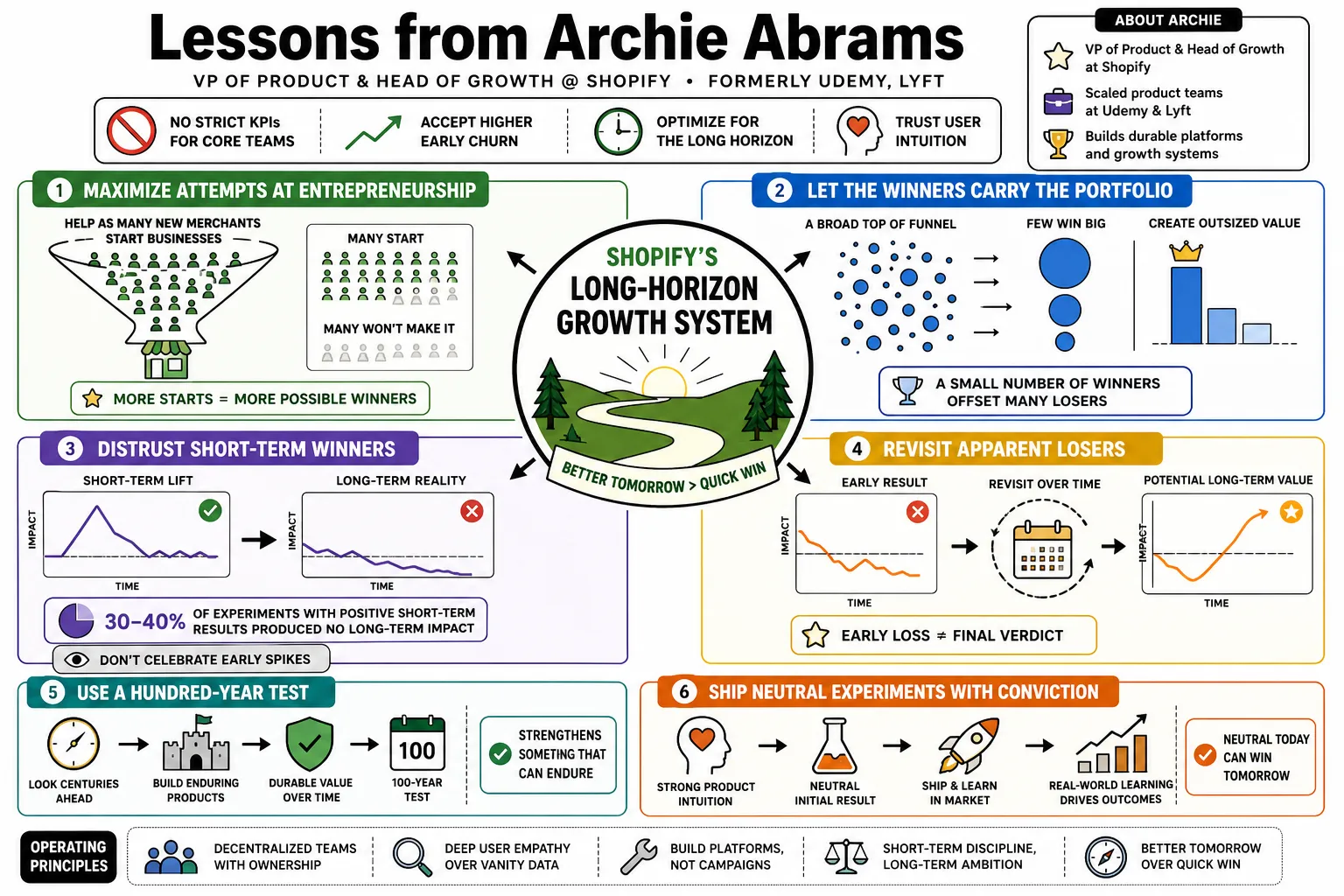
Shopify's Long-Horizon Growth System
- On Maximize Attempts at Entrepreneurship: Shopify optimizes for helping as many new merchants as possible start businesses, even though many of those businesses will fail. — YouTube — Shopify's Growth with Archie Abrams.
- On Let the Winners Carry the Portfolio: A broad top of funnel can work when a small number of highly successful merchants generate enough value to offset many unsuccessful attempts. — YouTube — Shopify's Growth with Archie Abrams.
- On Distrust Short-Term Winners: Abrams estimates that roughly 30–40% of experiments showing early lift at Shopify did not produce the expected long-term impact; this is his account, not a universal benchmark. — YouTube — Shopify's Growth with Archie Abrams.
- On Use a Hundred-Year Test: Evaluate decisions by whether they strengthen a product or service that can endure, not whether they produce an attractive immediate result. — YouTube — Shopify's Growth with Archie Abrams.
- On Ship Neutral Experiments with Conviction: When product intuition suggests an idea is beneficial, a neutral initial result need not prevent the team from launching and learning from the market. — YouTube — Shopify's Growth with Archie Abrams.
- On Audit Monetary Friction: Trial length, incentives, and other monetary friction should be reviewed regularly because they shape user behavior and retention. — YouTube — Shopify's Growth with Archie Abrams.
- On Separate Growth R&D from Growth Marketing: Shopify divides growth into a product-oriented group spanning product, design, engineering, and data, and a marketing group spanning paid, SEO, email, and content. — YouTube — Shopify's Growth with Archie Abrams.
- On Place Support Inside Growth: Abrams places the product tooling and self-serve experience for customer support within growth. He distinguishes this work from the human support advisers themselves. — YouTube — Shopify's Growth with Archie Abrams.
Marketplace Experimentation and Lifetime Value
- On Lead with a Specific Product: Abrams describes acquiring students through a specific course that addresses their immediate need, then introducing the broader marketplace after that first purchase. — Instapage — Marketplace Platforms and A/B Testing.
- On Include Supply-Side Outcomes: Abrams uses instructor cohorts and the distribution of students they attract to understand which suppliers need help, rather than judging marketplace growth only through aggregate results. — Growth Hacker TV — Growing Udemy with Archie Abrams.
- On Evolve the Testing Strategy: Abrams emphasizes learning by trying approaches in the business itself and adapting them to its particular situation rather than following a fixed playbook. — Growth Hacker TV — Growing Udemy with Archie Abrams.
- On Move Beyond Exhausted Micro-Tests: Abrams cautions that teams without enough traffic can waste time pursuing tiny lifts across many tests. He recommends focusing experimentation on changes that could matter to the business. — Instapage — Marketplace Platforms and A/B Testing.
- On Stop Tests with Impractical Time Horizons: Abrams advises being data-informed without insisting on an A/B test for every decision: limited traffic can make small effects impractical to measure. — Instapage — Marketplace Platforms and A/B Testing.
- On Match the Landing Experience to the Promise: Abrams describes keeping acquisition specific to the course and the student's need, rather than asking a broad marketplace brand to explain everything at the first touch. — Instapage — Marketplace Platforms and A/B Testing.
- On Follow the User Beyond the Session: Abrams advises examining later customer value, not just immediate conversion, because a local experiment can shift when a purchase occurs rather than increase lifetime revenue. — Instapage — Marketplace Platforms and A/B Testing.
- On Follow Experiment Cohorts Over Time: Abrams describes revisiting experiment participants beyond the initial session, including later purchase behavior, to distinguish lasting gains from revenue merely brought forward. — Instapage — Marketplace Platforms and A/B Testing.
- On Detect Revenue Shifted Forward: An apparent conversion win may only move a future purchase into the current session without increasing total customer value. — Instapage — Marketplace Platforms and A/B Testing.
- On Broaden the User's View of the Marketplace: Abrams observed that students who explored more of Udemy's course catalog performed better later, suggesting that early merchandising should expand their understanding of the marketplace. — Instapage — Marketplace Platforms and A/B Testing.
- On Optimize for the Drivers of Lifetime Value: Testing should move the mechanisms that create durable customer value rather than over-optimizing revenue from one visit. — Instapage — Marketplace Platforms and A/B Testing.
- On Balance Growth and Design Perspectives: Abrams credits early involvement from design with counterbalancing growth's focus on conversion and revenue, keeping the user experience in the experiment discussion. — Instapage — Marketplace Platforms and A/B Testing.
- On Split Demand Growth from Supply Quality: Udemy treated student acquisition and retention as a growth problem, while instructor supply required a different team focused on content quality and community. — Instapage — Marketplace Platforms and A/B Testing.
Building a Marketplace Growth Engine
- On Prioritize the Right Projects Every Day: Growth leadership combines disciplined prioritization with a willingness to do whatever practical work the selected project requires. — Growth Hacker TV — Growing Udemy with Archie Abrams.
- On Stay Close to the Raw Data: Writing queries and examining the database directly helps a growth leader understand what is actually driving revenue. — Growth Hacker TV — Growing Udemy with Archie Abrams.
- On Run Cohort Analysis Continuously: Abrams describes running instructor cohort analysis regularly to see how many students instructors bring in over time, then investigating the patterns behind changes. — Growth Hacker TV — Growing Udemy with Archie Abrams.
- On Inspect the Distribution Inside the Cohort: Averages can hide that a small group produces most results, so examine who is contributing and who is not. — Growth Hacker TV — Growing Udemy with Archie Abrams.
- On Raise the Long Tail: When top suppliers are already near their natural limits, the larger opportunity may be helping many smaller suppliers improve modestly. — Growth Hacker TV — Growing Udemy with Archie Abrams.
- On Keep LTV and Acquisition Cost Connected: Abrams treats acquisition spending and lifetime value as linked, with margins and customer retention shaping which channels the business can afford. — Growth Hacker TV — Growing Udemy with Archie Abrams.
- On Use Paid Acquisition to Reinforce Scale: A marketplace can use paid channels to amplify its catalog advantage instead of treating advertising as an isolated acquisition machine. — Growth Hacker TV — Growing Udemy with Archie Abrams.
- On Win SEO Through the Long Tail: Abrams argues that a large marketplace can gain long-tail search traffic from its many specific pages; this is a strategy to investigate, not a guarantee that catalog size alone earns rankings. — Growth Hacker TV — Growing Udemy with Archie Abrams.
- On Turn Community Activity into Searchable Content: Abrams describes testing lecture transcriptions and exploring richer student-created text to expand Udemy's searchable content. He presents these as initiatives under evaluation, not already-proven results. — Growth Hacker TV — Growing Udemy with Archie Abrams.
- On Treat Virality as an Acquisition-Cost Lever: For an ecommerce marketplace, referrals may lower blended acquisition cost without becoming the entire growth strategy. — Growth Hacker TV — Growing Udemy with Archie Abrams.
- On Respect Supplier Ownership in Product Tests: Abrams cautions that changes to course landing pages can unsettle instructors who expect control over how their courses are presented. — Growth Hacker TV — Growing Udemy with Archie Abrams.
- On Test in Surfaces the Platform Controls: In the early Udemy interview, Abrams describes concentrating tests in email and general discovery, where the platform had more control and fewer conflicts with instructors' expectations. — Growth Hacker TV — Growing Udemy with Archie Abrams.
- On Merchandise Early Emails: Abrams describes merchandising relevant courses in early emails while new users are still learning what Udemy offers. — Growth Hacker TV — Growing Udemy with Archie Abrams.
- On Use First-Visit Interest to Personalize: The first course page a visitor sees provides a signal that can guide the content and merchandising in later messages. — Growth Hacker TV — Growing Udemy with Archie Abrams.
Leading Through a Company Pivot
- On Lead the Team Through Sudden Change: A product leader's job includes guiding the team when strategy, leadership, partners, engineering, or design changes unexpectedly. — Products That Count — Shipping During a Company Pivot.
- On Expect a Productivity Recovery Period: After major change, output takes time to stabilize, so leaders should restore direction without pretending disruption has no cost. — Products That Count — Shipping During a Company Pivot.
- On Own, Communicate, Teach, and Live the Change: Abrams organizes change leadership into four actions: own the situation, communicate it, teach it, and embody it. — Products That Count — Shipping During a Company Pivot.
- On Separate Control from Concern: During a pivot, distinguish what you control from what you can only influence or worry about. — Products That Count — Shipping During a Company Pivot.
- On Manage Your Presence: A leader cannot control every cause of change but can control mental state, body language, timeliness, communication, and presence. — Products That Count — Shipping During a Company Pivot.