Arianna Huffington founded The Huffington Post and later Thrive Global, where she is CEO. Her essays and interviews connect sustainable performance with sleep, recovery, and deliberate daily habits. Her writing on AI argues for preserving human agency; her co-authored health-coaching proposal describes intended benefits, not established clinical results. — Thrive Global — Arianna Huffington. — TIME — AI-Driven Behavior Change Could Transform Health Care. — TIME — Recursive Self-Improvement Is the Human Skill We Need.
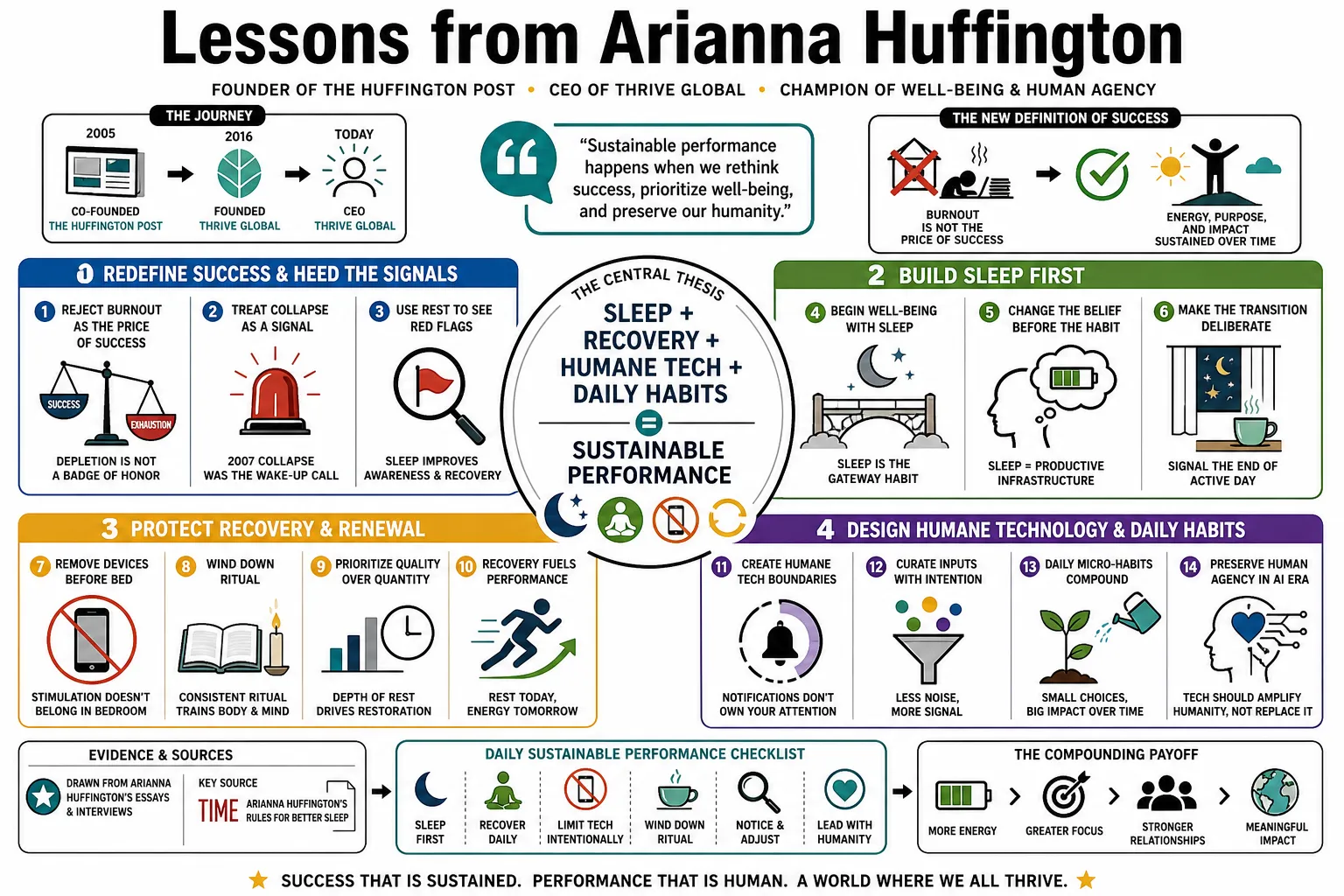
Sleep, Recovery, and Sustainable Performance
- On Reject Burnout as the Price of Success: A definition of success that requires exhaustion is flawed because it treats human depletion as proof of commitment. — TIME — 6 Rules for Better Sleep, According to Arianna Huffington
- On Treat Collapse as a Signal: Huffington's 2007 collapse turned chronic sleep deprivation from an abstract risk into an unmistakable physical warning. — TIME — 6 Rules for Better Sleep, According to Arianna Huffington
- On Begin Well-Being with Sleep: Sleep is the gateway habit: without it, attempts to improve the rest of life start from a depleted base. — TIME — 6 Rules for Better Sleep, According to Arianna Huffington
- On Change the Belief Before the Habit: Durable sleep habits become easier once sleep is understood as productive infrastructure rather than lost time. — TIME — 6 Rules for Better Sleep, According to Arianna Huffington
- On Use Rest to See Red Flags: Huffington reports that, after prioritizing sleep, she became better at recognizing warning signs and rebounding from setbacks. This is her account of the change, not a guarantee of the same result for everyone. — TIME — 6 Rules for Better Sleep, According to Arianna Huffington.
- On Remove Devices Before Bed: Disconnect from electronic devices before bedtime so stimulation does not follow you into the sleep environment. — TIME — 6 Rules for Better Sleep, According to Arianna Huffington
- On Make the Transition Deliberate: Huffington treats the transition to sleep as a deliberate ritual, with a bath at its center, rather than carrying the working day straight into bed. — TIME — 6 Rules for Better Sleep, According to Arianna Huffington.
- On Use Clothing as a Sleep Cue: Huffington recommends changing into dedicated sleepwear as a repeatable signal that the active day is over. — TIME — 6 Rules for Better Sleep, According to Arianna Huffington.
- On Design the Room for Sleep: Huffington recommends a dark, quiet, cool bedroom so the surroundings support sleep. — TIME — 6 Rules for Better Sleep, According to Arianna Huffington.
- On Break the Caffeine Cycle: Huffington avoids afternoon caffeine because she sees a cycle in which using it to fight fatigue makes falling asleep harder and leaves her reaching for more the next day. — TIME — 6 Rules for Better Sleep, According to Arianna Huffington.
Leadership, Focus, and Burnout
- On Cognitive Energy Is Finite: Leadership quality depends on where limited cognitive energy is spent and how deliberately it is renewed. — Thrive Global — The Clarifying Moment Elon Musk Has Given Us
- On Do Not Model Humans as Machines: The industrial assumption that more operating hours always produce more output misunderstands how human performance works. — Thrive Global — The Clarifying Moment Elon Musk Has Given Us
- On Connect Recovery to Judgment: Huffington connects recovery with consequential decision-making, citing the U.S. Army's emphasis on sleep for judgment and situational awareness. — Thrive Global — The Clarifying Moment Elon Musk Has Given Us.
- On Treat Sleep as Readiness: Drawing on the U.S. Army's sleep guidance, Huffington treats rest as part of readiness, not merely time away from work: alertness and higher-order thinking both matter. — Thrive Global — The Clarifying Moment Elon Musk Has Given Us.
- On Make Rest a Leadership Practice: Huffington endorses Admiral Jim Stavridis's argument that commanders should make room for sleep because rested leadership supports ethical and tactical judgment. — Thrive Global — The Clarifying Moment Elon Musk Has Given Us.
- On Stop Wearing Deprivation as a Badge: Huffington challenges the habit of treating too little sleep as toughness, citing coach Matt Dixon's rejection of that badge among high-performing executives. — Thrive Global — The Clarifying Moment Elon Musk Has Given Us.
- On Count the Opportunity Cost of Distraction: A leader's wasted attention imposes cognitive opportunity costs even when the individual distraction looks trivial. — Thrive Global — The Clarifying Moment Elon Musk Has Given Us
- On Focus Requires Refusal: Huffington draws on Steve Jobs's emphasis on saying no: protecting focus means refusing distractions so attention can go toward important products and work. — Thrive Global — The Clarifying Moment Elon Musk Has Given Us.
- On Burnout Damages More Than Health: In her 2022 critique of Musk's leadership at Twitter, Huffington argues that exhausted, distracted leadership can carry monetary, brand, and opportunity costs—not just a personal health cost. — Thrive Global — The Clarifying Moment Elon Musk Has Given Us.
Behavior Change and Everyday Health
- On Treat Behavior Change as Medicine: In their 2024 essay, Huffington and Sam Altman argue that changing daily behaviors should complement medical care in preventing and managing disease. They present a case for an AI health coach, not clinical proof that the proposed coach works. — TIME — AI-Driven Behavior Change Could Transform Health Care.
- On Build Around Five Daily Behaviors: Huffington and Altman organize their proposed health coaching around five daily behaviors: sleep, food, movement, stress management, and social connection. — TIME — AI-Driven Behavior Change Could Transform Health Care.
- On Make Guidance Personal: Their proposed coach would adapt suggestions to the preferences, patterns, and personal information a user chooses to share, rather than treating everyone as an identical medical profile. — TIME — AI-Driven Behavior Change Could Transform Health Care.
- On Make the Next Action Specific: Huffington and Altman illustrate personalization with concrete suggestions tied to a person's day, such as a walk after school pickup, rather than a generic instruction to be healthier. — TIME — AI-Driven Behavior Change Could Transform Health Care.
- On Democratize Practical Support: They argue that personalized AI coaching could make everyday habit support more accessible to people who cannot afford trainers, chefs, and life coaches. That is an access goal, not a demonstrated outcome. — TIME — AI-Driven Behavior Change Could Transform Health Care.
- On Remember the Time Between Visits: Huffington and Altman emphasize the time between appointments: their proposed coach is meant to support daily choices, not replace clinicians. — TIME — AI-Driven Behavior Change Could Transform Health Care.
- On Expect Depletion to Distort Choice: Huffington and Altman argue that depletion and stress can make short-term comforts such as scrolling or emotional eating more tempting, and that daily support should account for this vulnerability. — TIME — AI-Driven Behavior Change Could Transform Health Care.
- On Use Technology to Strengthen Choice: Their design goal is to use personalized nudges to help people make healthier choices, rather than build another tool that competes for their attention. — TIME — AI-Driven Behavior Change Could Transform Health Care.
- On Look Beyond Productivity: Huffington and Altman propose judging AI by its potential contribution to healthier, longer lives, not only by time saved or productivity gained. These benefits remain an aspiration in the essay. — TIME — AI-Driven Behavior Change Could Transform Health Care.
- On Put Personal Data to Work for the Person: They propose incentives that put a person's shared health information to work for that person's benefit, rather than using data chiefly to capture attention. — TIME — AI-Driven Behavior Change Could Transform Health Care.
- On Pair Innovation with Safeguards: Huffington and Altman say their vision requires privacy and security safeguards, individual empowerment, and rigorous safety and efficacy standards—not innovation alone. — TIME — AI-Driven Behavior Change Could Transform Health Care.
Human Agency in the AI Era
- On Preserve the Human Drive to Improve: As machines become better at self-improvement, people should not neglect their own capacity to grow, improve, and evolve. — TIME — Recursive Self-Improvement Is the Human Skill We Need
- On Let Each Gain Improve the Next: Huffington describes recursive growth as improvement in the process of improving: one gain should make the next gain easier, rather than merely add another isolated achievement. — TIME — Recursive Self-Improvement Is the Human Skill We Need.
- On Ask Who You Are Becoming: Self-improvement should examine identity and direction, not only survival, competition, or efficiency. — TIME — Recursive Self-Improvement Is the Human Skill We Need
- On Use Self-Knowledge as a Feedback Loop: Introspection improves the self doing the introspection, allowing one layer of understanding to unlock another. — TIME — Recursive Self-Improvement Is the Human Skill We Need
- On Resist the Unexamined Life: Frenetic routines make it easy to move continuously without pausing to evaluate the person those routines are creating. — TIME — Recursive Self-Improvement Is the Human Skill We Need
- On Protect the Improvement Loop from Distraction: Technology can replace reflection with engagement loops that reward outrage, division, and perpetual scrolling. — TIME — Recursive Self-Improvement Is the Human Skill We Need
- On Nurture the Better Parts of Human Nature: Human nature contains competing tendencies, and the ones that dominate are the ones repeatedly reinforced. — TIME — Recursive Self-Improvement Is the Human Skill We Need
- On Keep Judgment as a Human Advantage: Drawing on Marina Favaro and Jack Clark's analysis, Huffington emphasizes human judgment: deciding which problems matter, which results to trust, and when an approach is a dead end. The cited analysis describes this as a comparative advantage for now, not a permanent limit on AI. — TIME — Recursive Self-Improvement Is the Human Skill We Need.
- On See the Bigger Picture: Human judgment matters because building a useful AI future requires context beyond narrow task completion. — TIME — Recursive Self-Improvement Is the Human Skill We Need
- On Link AI's Future to Human Development: The character of the systems people build will depend partly on the character and values people cultivate in themselves. — TIME — Recursive Self-Improvement Is the Human Skill We Need
Goals, Presence, and Practical Change
- On Make Microsteps Too Small to Fail: Huffington recommends small, actionable Microsteps that make a habit easier to begin and repeat. Her aim is to lower the barrier to action, not guarantee that a habit can never fail. — Asana — Arianna Huffington's Four Mindset Shifts.
- On Set an Intention Before Checking the Phone: Use the first minute of the morning to choose the day's direction before notifications choose it for you. — Asana — Arianna Huffington's Four Mindset Shifts
- On Separate True Urgency from False Urgency: During a crisis, careful prioritization is necessary because pressure can make everything appear equally urgent. — Asana — Arianna Huffington's Four Mindset Shifts
- On Remove Devices from Meetings: Huffington recommends minimizing unrelated devices and multitasking during meetings so participants can be more present and connected. In a video meeting, this means reducing distractions—not removing the device needed to attend. — Asana — Arianna Huffington's Four Mindset Shifts.
- On Adjust Goals to Reality: A changed environment should trigger a conscious review of goals instead of automatic persistence with an obsolete plan. — Asana — Arianna Huffington's Four Mindset Shifts