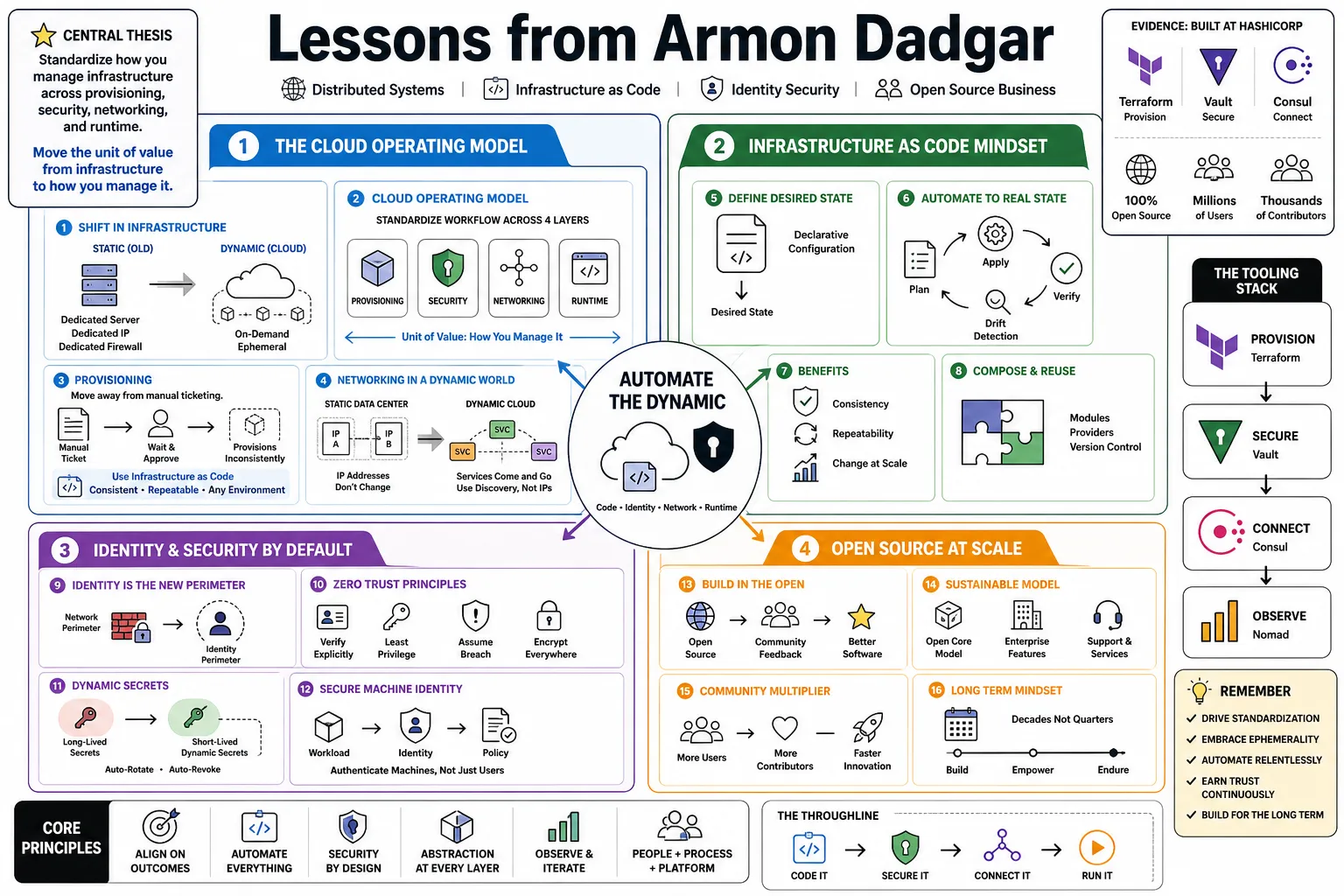
Lessons from Armon Dadgar
Armon Dadgar co-founded HashiCorp and helped develop infrastructure tools including Terraform, Vault and Consul. These lessons cover his approach to distributed systems, infrastructure as code, identity security and the business of developer tools. — Cloud Security Podcast — Infrastructure as Code.
Part 1: The Cloud Operating Model
- On the shift in infrastructure: Cloud workloads change more frequently than traditional fixed servers and addresses. Security and networking workflows must account for that dynamism rather than assume an IP permanently identifies an application. — HashiCorp — Identity-Based Security.
- On defining the cloud operating model: Dadgar organizes the cloud operating model around provisioning, security, networking and application runtime. The aim is a consistent workflow across those layers, not merely buying cloud infrastructure. — Open Source Underdogs — Armon Dadgar.
- On provisioning: Infrastructure as code gives teams a repeatable provisioning workflow across public and private environments. Standardizing that workflow reduces dependence on manually coordinating each request. — Adopting a Cloud Operating Model.
- On networking in a dynamic world: When teams deploy independently, service locations change. Service discovery lets applications find one another without coordinating every change through a fixed address map. — Adopting a Cloud Operating Model.
- On multi-cloud reality: Large enterprises often inherit multiple clouds and private infrastructure through growth and acquisitions. A common management workflow can accommodate that reality without requiring one provider everywhere. — The Logan Bartlett Show — Armon Dadgar.
- On hybrid persistence: Enterprises retain older infrastructure while adopting new technology. Tools should accommodate those systems and let organizations modernize incrementally rather than demand an immediate replacement of the whole environment. — The Logan Bartlett Show — Armon Dadgar.
- On the role of the workflow: Standardize the workflow around an operational goal rather than a particular technology. A stable workflow can remain useful as the infrastructure and tools underneath it change. — The Tao of HashiCorp.
- On cloud adoption friction: When application teams establish different infrastructure patterns, organizations inherit fragmented operations and security practices. Shared platform patterns bring those choices into a more consistent operating model. — Cloud Security Podcast — Infrastructure as Code.
- On runtime evolution: Developers should be able to describe what their application needs without managing every underlying machine. Runtime tooling can separate the application lifecycle from the operator's infrastructure lifecycle. — Microsoft — Simplifying Infrastructure Management.
- On intention versus execution: Moving to the cloud does not itself remove manual operating bottlenecks. Dadgar describes combining self-service with automated governance so every change need not return to a ticket-review queue. — Software Engineering Daily — HashiCorp Transcript.
Part 2: Distributed Systems and Complexity
- On the complexity tax: Microservices let teams develop and deploy independently, but introduce new coordination and service-discovery problems. Organizational flexibility comes with distributed-systems work that still has to be handled. — InfoQ — Research in the Real World.
- On gossip protocols: Dadgar describes adapting SWIM-style gossip for decentralized membership and failure detection. Spreading coordination across nodes requires explicit trade-offs around bandwidth, scale and fault tolerance. — InfoQ — Research in the Real World.
- On consistency vs. availability: Consul combines decentralized gossip with a strongly consistent core built around Raft. For that core, consistency means accepting limits on availability during partitions—not sacrificing partition tolerance. — InfoQ — Research in the Real World.
- On academic versus industrial design: A research algorithm must also fit real deployment constraints. Dadgar considers implementation complexity, bandwidth, failure behavior and operator needs rather than treating theoretical performance as the only criterion. — InfoQ — Research in the Real World.
- On distributed failures: Design infrastructure to detect failures and recover toward a declared desired state. Failure handling belongs in the normal operating model, rather than being only an exceptional manual procedure. — The Tao of HashiCorp.
- On simplicity: Infrastructure tools should make a complex environment easier for people to operate. Their value lies partly in a manageable interface instead of passing all underlying complexity on to the user. — Microsoft — Simplifying Infrastructure Management.
- On managing state: Decentralized coordination does not eliminate durable state. Dadgar describes a consistent core where operators need reliable shared information, alongside gossip where decentralized membership is useful. — InfoQ — Research in the Real World.
- On composability: Keeping components separate makes it easier to replace or discontinue a product that does not fit its users. Modularity avoids making every experiment inseparable from an entire platform. — The Logan Bartlett Show — Armon Dadgar.
- On automation: Codifying repeatable operations increases productivity and reduces opportunities for human error. Automation can reconcile infrastructure with its desired state, while people remain responsible for its goals and constraints. — The Tao of HashiCorp.
- On evaluating algorithms: Choose algorithms with implementation and operational understanding in mind. Dadgar contrasts complicated alternatives with designs engineers can reason about; theoretical optimality alone is not enough. — InfoQ — Research in the Real World.
Part 3: Zero Trust and Identity-Based Security
- On the perimeter: A private network should not automatically confer trust. Identity-based controls make access depend on who or what is requesting it instead of relying solely on a network perimeter. — Cloud Security Podcast — Infrastructure as Code.
- On zero trust: Authenticate identities and authorize access to specific resources rather than grant broad access because a user is inside the network. Boundary illustrates this approach for human sessions. — HashiCorp Boundary Whiteboard.
- On machine identity: Machine workloads need managed identities and credential delivery as well as human users. Application, platform and security teams must coordinate that lifecycle. — Cloud Security Podcast — Infrastructure as Code.
- On dynamic secrets: Generate credentials on demand for a particular client and limit their lifetime. Short-lived, revocable credentials reduce the exposure associated with sharing a long-lived secret across many clients. — Introduction to Vault — Armon Dadgar.
- On encryption as a service: Centralized key management can expose encryption and decryption through an API without distributing the underlying key material to applications. Developers can use that service instead of each building their own key-management system. — Introduction to Vault — Armon Dadgar.
- On access policy: Tie authorization to an application's identity and permitted actions rather than only its network address. Service identity can remain stable as instances and addresses change. — HashiCorp — Identity-Based Security.
- On high-trust vs low-trust: Security design must account for environments where network membership provides little assurance. Dadgar replaces implicit trust in the private network with explicit identity and access policy. — HashiCorp Boundary Whiteboard.
- On credential lifecycles: Manage credentials throughout their lifecycle, including rotation and revocation when no longer needed. Provisioning a secret is only one step; ongoing maintenance and eventual removal also need a workflow. — Cloud Security Podcast — Infrastructure as Code.
- On operator access: Operators should connect to the particular services they are authorized to use without being placed onto the whole internal network. Boundary separates identity-based session access from broad network access. — HashiCorp Boundary Whiteboard.
- On the identity broker: An identity broker can authenticate workloads through different platforms and provide a consistent way to obtain authorized secrets. Vault connects platform-specific identity to a common secrets-management workflow. — Introduction to Vault — Armon Dadgar.
Part 4: Open Source Strategy and Commercialization
- On open-source sustainability: Large infrastructure projects need sustained investment in engineering. Dadgar argues that a viable business model can fund the team and long-term work needed to solve substantial technical problems. — a16z — Free Software and Open Source Business.
- On the open core framework: In describing HashiCorp's historical open-core framework, Dadgar separates the practitioner's core workflow from organizational requirements. The community product addresses the individual workflow; enterprise offerings address additional organizational complexity. — Open Source Underdogs — Armon Dadgar.
- On user experience: The community tool should solve its practitioner's problem rather than feel deliberately incomplete. A usable core earns adoption; commercial features should address additional needs rather than disable the basic workflow. — Open Source Underdogs — Armon Dadgar.
- On selling through the back door: Let practitioners encounter and adopt a useful product before an enterprise sales conversation. Dadgar describes open-source distribution as an early form of product-led growth, not a tactic for making software impossible to remove. — WorkOS — Developer Products for Enterprise.
- On ecosystem as a moat: A broad ecosystem of integrations makes a tool useful in more environments and attracts contributors. That network effect can strengthen its position without guaranteeing every community user becomes a commercial customer. — WorkOS — Developer Products for Enterprise.
- On customer relationships: Maintain a direct relationship with organizations using the software. Dadgar describes customers wanting contact with the vendor itself rather than a relationship mediated entirely through a distribution channel. — Open Source Underdogs — Armon Dadgar.
- On organizational challenges: In Dadgar's historical enterprise framework, multi-datacenter operation, governance and organizational access controls create needs beyond an individual workflow. A commercial offering can serve those additional requirements. — Open Source Underdogs — Armon Dadgar.
- On transitioning upmarket: Moving upmarket requires replacing one-off startup practices with repeatable, predictable operations. Dadgar describes building toward enterprise scale, not claiming that the future revenue target had already been reached. — WorkOS — Developer Products for Enterprise.
- On the monetization flywheel: Dadgar describes winning practitioner adoption, building an ecosystem around common workflows, and serving enterprise requirements. Commercialization builds on that foundation rather than following automatically from downloads. — Open Source Underdogs — Armon Dadgar.
Part 5: Infrastructure as Code and Workflow
- On immutable infrastructure: Replacing infrastructure rather than repeatedly modifying it can make operation more predictable. Dadgar also stresses accommodating applications that cannot yet tolerate that model while customers modernize. — The Logan Bartlett Show — Armon Dadgar.
- On infrastructure versioning: Infrastructure defined in code makes changes recordable and reviewable through version control. Teams can inspect how an environment evolved instead of relying solely on undocumented operational knowledge. — Microsoft — Simplifying Infrastructure Management.
- On the plugin architecture: Keep a focused core and provide extension interfaces for integrations. Dadgar describes SDKs and plugins enabling the wider ecosystem to support services without the core team building every integration. — Open Source Underdogs — Armon Dadgar.
- On standardizing provisioning: Different providers expose different interfaces. A common infrastructure-as-code workflow lets operators provision across those environments without adopting a completely separate operating process for each. — Adopting a Cloud Operating Model.
- On automation confidence: Codified infrastructure gives teams a consistent way to manage changes and understand their intended operation. That improves confidence, but cannot guarantee every change or external dependency is perfectly predictable. — The New Stack — Dadgar on IDPs and IaC.
- On decoupling systems: Independent tools let customers solve one problem without adopting an entire suite. A team can start with provisioning while retaining its existing security solution and evaluate other components later. — The Logan Bartlett Show — Armon Dadgar.
- On the death of the runbook: Codify repeatable procedures so they can be shared, reviewed and versioned. Executable workflows reduce reliance on oral tradition; they do not make every form of written documentation unnecessary. — The Tao of HashiCorp.
- On practitioner empowerment: Give practitioners a way to express application requirements through a usable infrastructure workflow. Separating those requirements from low-level machine management reduces the burden on application teams. — Microsoft — Simplifying Infrastructure Management.
Part 6: Platform Engineering and Cloud 2.0
- On Cloud 2.0: Modern infrastructure combines cloud providers and several generations of technology. A consistent management layer should work across that mixed environment rather than assume an enterprise has replaced everything with one new stack. — The Logan Bartlett Show — Armon Dadgar.
- On the internal platform: A platform team can provide shared infrastructure and security capabilities for application teams. Clear ownership and supported patterns make those services a common foundation rather than unrelated team choices. — Cloud Security Podcast — Infrastructure as Code.
- On the golden path: Create reusable infrastructure patterns with security and compliance considered in advance. Developers can build on vetted workflows instead of rediscovering the same constraints on every deployment. — The New Stack — Dadgar on IDPs and IaC.
- On business speed: Reusable components and automated policy checks let teams move quickly within agreed guardrails. The aim is faster delivery without making every infrastructure decision a fresh central review. — Terraform 1.0 Launch Keynote.
- On self-service infrastructure: Self-service infrastructure works best with automated governance built into the workflow. Teams can operate within a permitted sandbox instead of submitting every routine change for manual review. — Software Engineering Daily — HashiCorp Transcript.
- On the graveyard of platforms: A broad platform can be difficult to sell because it brings a large adoption decision and operational burden. Dadgar favors point solutions addressing a specific pain alongside tools the customer already has. — The Logan Bartlett Show — Armon Dadgar.
- On autonomous DevOps: Generating generic infrastructure code is not the same as understanding a particular environment. Useful AI-assisted operations need organizational context—such as the chosen stack, regions and constraints—and validation of the resulting changes. — AI Native Dev — Armon Dadgar on DevOps.
- On reducing cognitive load: Application teams should not need to absorb all the complexity of operating infrastructure. A platform can present vetted, simpler workflows so developers can concentrate on the application rather than reconstruct its underlying setup. — The New Stack — Dadgar on IDPs and IaC.
- On standardizing chaos: As more teams adopt infrastructure independently, fragmented choices create an operating problem. Standardized patterns and shared ownership provide an organizational response while application teams keep building. — Cloud Security Podcast — Infrastructure as Code.
Part 7: Product Design and The Tao of HashiCorp
- On life support lines: Begin with a workflow problem and look for an existing tool that solves it adequately. Build a new component when a real gap remains, rather than inventing a tool merely to fill out a portfolio. — The Tao of HashiCorp.
- On pragmatism over dogma: Be committed to the problem without becoming rigid about one solution. An opinionated tool still needs flexibility to fit customers' existing systems and practical constraints. — The Logan Bartlett Show — Armon Dadgar.
- On asynchronous design: Use written product requirements and RFCs to make technical trade-offs available for discussion. Dadgar describes circulating proposals so research and engineering knowledge can inform design decisions. — InfoQ — Research in the Real World.
- On the Tao of HashiCorp: The Tao gives HashiCorp's tools a shared design ethos, including workflow orientation, modularity and immutability. Dadgar distinguishes that product-design framework from broader organizational principles. — Software Engineering Daily — HashiCorp Transcript.
- On solving one problem well: Give a tool a clear responsibility and make it work well with others. Dadgar relates this modular approach to Unix rather than putting every capability into one all-encompassing product. — Microsoft — Simplifying Infrastructure Management.
- On interface design: Design the user-facing workflow separately from the details it manages underneath. A useful interface makes infrastructure accessible without requiring every user to understand every implementation detail. — Microsoft — Simplifying Infrastructure Management.
- On avoiding lock-in: Keep the management workflow usable across different providers. Technology-agnostic tools help organizations retain choices instead of tying every operational practice to one vendor's interface. — Microsoft — Simplifying Infrastructure Management.
- On backward compatibility: Backward compatibility is an operational responsibility, not just a version milestone. In a 2017 interview, Dadgar described preserving application compatibility from Vault 0.1 through 0.7 and taking it seriously before 1.0. — eWEEK — Vault Enterprise Update.
Part 8: Entrepreneurship and Scaling HashiCorp
- On the origin: Dadgar and Hashimoto encountered multi-cloud problems during a University of Washington research project. Hashimoto describes his unsuccessful deployment effort; both later recognized those unresolved problems could inform HashiCorp's tools. — The HashiCorp Origin Story.
- On the practitioner focus: Start with problems practitioners actually encounter and use their feedback to improve the product. Dadgar describes building community tools before enterprise versions and letting grassroots engagement inform the roadmap. — The Logan Bartlett Show — Armon Dadgar.
- On knowing your limits: Recognize when the business needs capabilities its technical founders do not yet have. Dadgar describes bringing in enterprise go-to-market leadership while the founders continued focusing on product and engineering. — Software Engineering Daily — HashiCorp Transcript.
- On logical buyers: A multiproduct strategy is more coherent when the tools serve a common buyer's related problems. HashiCorp targeted the DevOps persona with distinct solutions rather than selling unrelated products to many different people. — The Logan Bartlett Show — Armon Dadgar.
- On the early days: HashiCorp began with a small founding team working from Dadgar's apartment. He recalls focusing on products they would enjoy using and problems they had experienced personally before a clear business plan emerged. — UW Allen School — HashiCorp Founders.
- On hyper-growth: Growth changes the founder's job as well as the organization. Dadgar describes moving from writing early products toward hiring, customers, partners and running the business as HashiCorp expanded. — UW Allen School — HashiCorp Founders.
- On building trust: Solving one problem well can earn enough trust for a customer to consider another product later. Dadgar describes that relationship developing through useful independent tools, not requiring the whole suite at the outset. — The Logan Bartlett Show — Armon Dadgar.
- On long-term vision: Build a business worth operating for the long term rather than optimize for a quick sale. Dadgar describes focusing on a durable standalone company instead of tailoring the business to a particular acquirer. — The Logan Bartlett Show — Armon Dadgar.