Lessons from Arnie Gullov-Singh
Arnie Gullov-Singh is a sales coach and former CRO and CEO who works with early-stage founders on prospecting, discovery, pricing and sales-team development. These lessons collect supported principles from his writing, interviews and practical coaching materials. — Sales Coaching for Early-Stage Founders.
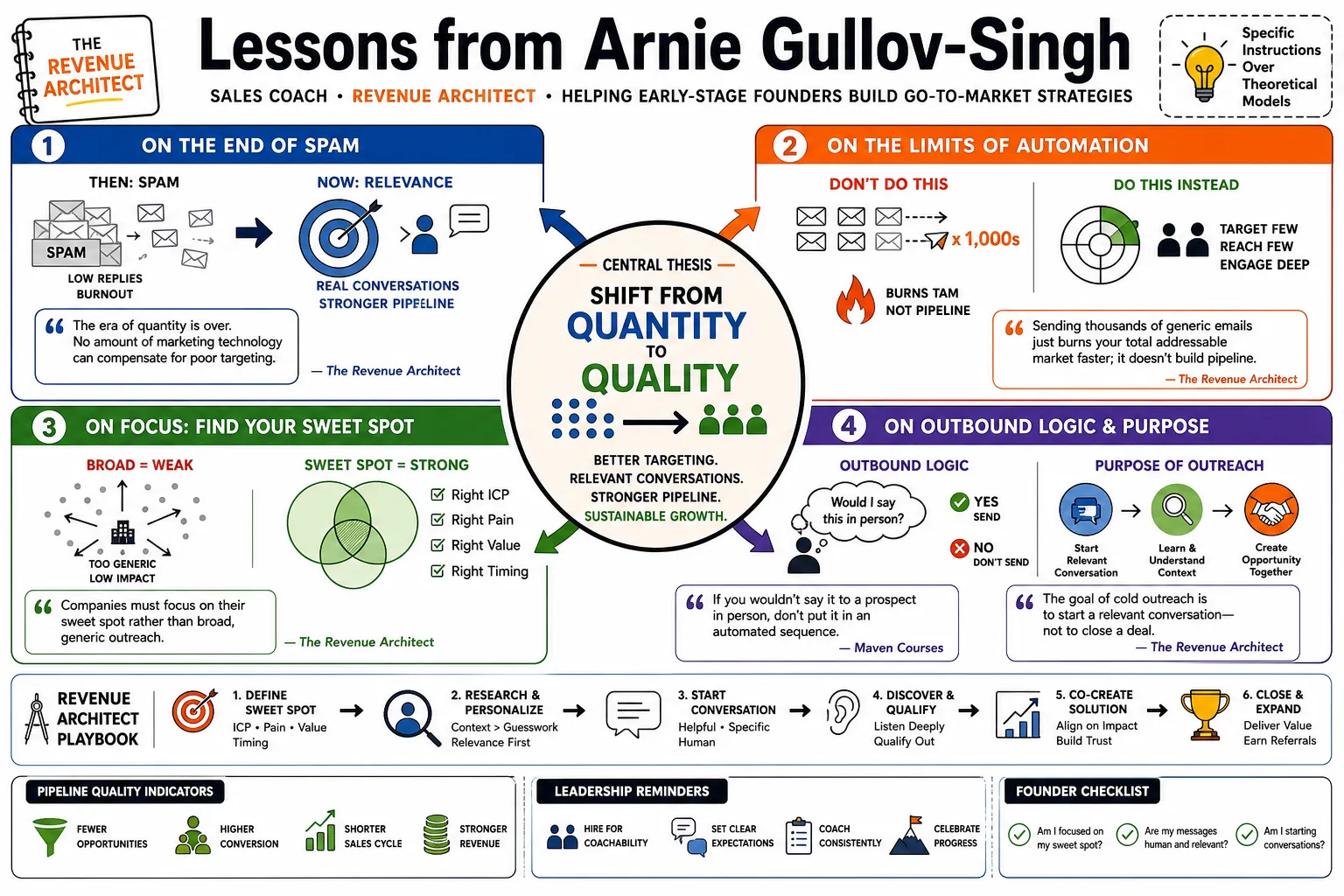
Part 1: The Shift from Quantity to Quality
- On the end of spam: Narrow the target customer before increasing outreach volume; tools cannot repair an unfocused go-to-market motion. — The top 10 GTM mistakes founders make.
- On the limits of automation: Automated email still needs researched, customer-relevant messaging. Generic pitches and empty profile-based flattery do not supply that relevance. — Cold Email Tear Down, Part 2.
- On focus: Focus outbound on the segment where you already see consistent customer success, rather than stretching into the margins. — How to scale your outbound sales.
- On the purpose of outreach: Start cold outreach with a useful, relevant insight and an engagement question before asking for a meeting. — Cold outbound email tear down.
- On tech stack bloat: Gullov-Singh favors reducing sales-tool overload and the burden of painful integrations. — Arnie Gullov-Singh on Sales-Tool Fatigue.
- On list building: Constrain prospect lists using common traits of your best customers instead of building broad lists that encourage generic outreach. — Insights from 200 Startup Prospecting Quizzes.
- On precision: Research the prospect's context so the opening message explains why the conversation is relevant to them. — Cold outbound email tear down.
Part 2: Redefining the Ideal Customer Profile (ICP)
- On generic attributes: Industry and company size alone are too broad to identify customers who share the specific problem your product solves. — Why you need a precise ideal customer profile.
- On predicting problems: Before discovery, research current tools and observable signs of the problem so your questions test an informed hypothesis. — How to prepare for and run a discovery call.
- On trigger events: Identify the critical event that makes solving the problem timely; company demographics alone do not explain urgency. — How to stop your AEs from negotiating against themselves.
- On narrow focus: An early-stage ICP may feel uncomfortably narrow. Broad targeting can produce conflicting feedback and complicate the sales motion. — Answering your questions about ICPs.
- On buyer pain: Describe customer pain, its business impact, relevant events and current tools alongside firmographic attributes. — Insights from 200 Startup Prospecting Quizzes.
- On internal champions: A useful champion needs authority or the ability to advance the decision internally, not just enthusiasm for the product. — How to keep deals moving forward.
- On market maturity: Early-stage products need buyers comfortable with product gaps and adoption risk; established-company contacts may expect a more mature solution. — Arnie Gullov-Singh on Stage-Fit Hiring.
- On qualification: Qualify out-of-ICP leads rigorously: surface missing capabilities and ask whether they are blockers for everyone involved in selecting the solution. — Answering your questions.
Part 3: Reframing the Sales Process
- On RFPs: Treat an RFP as a structured buying exercise, with a deliberate response process rather than a last-minute form-filling task. — How to respond to an RFP.
- On matching the buyer: Assign owners and sequence the response around the buyer's requirements and submission deadline. — How to respond to an RFP.
- On momentum: Agree on the next meeting or concrete next step before ending the call; interest alone does not move the process forward. — The top 10 GTM mistakes founders make.
- On mutual action plans: Use a mutual action plan to make the route toward a buying decision explicit, alongside multithreading and decision-maker involvement. — How to keep deals moving forward.
- On process discipline: Define sales stages and measure their volumes and conversion rates so the team can identify where progress breaks down. — How to survive your first year as a sales manager.
- On the illusion of progress: A friendly introductory meeting is not a buying commitment. Check whether the conversation is producing a real commercial opportunity. — How to do founder-led sales.
- On early exits: Walk away from RFPs with poor economics or little realistic chance of winning rather than consuming the team's resources on them. — How to respond to an RFP.
- On deal reviews: Use a customer-centered framework to reveal missing information and blockers in a deal, not just to collect a forecast update. — How to use a sales framework to troubleshoot your deals.
- On systemic fixes: Investigate weak conversion at a particular customer-journey stage, then review the targeting, messaging or process behind it. — How to run a GTM retro to find and fix your biggest problems.
Part 4: Pricing, Discounting, and Negotiation
- On premature discounting: Premature discounts can come from the seller's discomfort with stating price, rather than a demonstrated buyer objection. — How to stop your AEs from negotiating against themselves.
- On holding firm: State list price and give the buyer room to respond instead of offering a discount before they ask. — How to stop your AEs from negotiating against themselves.
- On upstream issues: A discount does not repair an unclear economic case. Explain the value of solving the buyer's problem before defending price. — How to turn a pricing objection into an ROI conversation.
- On trading value: Offer multiple commercial options so the buyer can find a workable agreement without automatically devaluing what you provide. — How to trade instead of negotiate.
- On price as a filter: Transparent pricing helps prospects assess affordability and fit before committing to a sales conversation. — How to maximize the bottom of your marketing funnel.
- On sticker shock: Prepare a pricing range based on comparable customers and introduce it early enough to check whether expectations align. — Answering your questions.
- On confident pricing: Compare price with the value delivered to the customer, rather than trying to justify it through the vendor's own costs. — How to turn a pricing objection into an ROI conversation.
Part 5: The Art of Discovery and Pitching
- On first calls: Use the first call for mutual discovery: establish whether the problem and potential solution justify further time from both sides. — How to prepare for and run a discovery call.
- On interrogation vs. conversation: Keep explanations concise and return to an open-ended question so discovery remains a conversation rather than a monologue. — Answering your GTM questions.
- On uncovering pain: Understand the pain's frequency, affected units and business impact before using it to support a pricing discussion. — How to stop your AEs from negotiating against themselves.
- On demoing: Organize the demo around the buyer's identified pain points; recap each problem, show the relevant solution and ask for feedback. — Answering your GTM questions.
- On listening: Listen for the buyer's situation, pain, impact, critical event and decision process; use follow-up questions and recaps to check understanding. — How to talk less and close more deals.
- On the pitch deck: Use a discovery deck as a small set of visual aids that gives the conversation structure, rather than as a substitute for it. — How to build your first sales materials.
- On establishing authority: Bring researched context about the buyer's likely challenge to discovery, then ask questions that test and refine that understanding. — How to prepare for and run a discovery call.
- On talking too much: Review recent calls for talk time. Gullov-Singh treats talking more than half the time as a prompt to improve listening, not an infallible test. — How to talk less and close more deals.
- On closing the call: Recap what you heard about the buyer's problem and its impact so they can confirm or correct your understanding. — How to talk less and close more deals.
- On technical translation: Explain technical capabilities through a specific workflow, business problem, metric and responsible owner so buyers need not connect every dot themselves. — How to avoid the horizontal platform trap.
Part 6: Go-to-Market (GTM) Strategy and Evolution
- On the stages of GTM: Gullov-Singh describes three GTM stages: founder-led sales, sales as distribution, and marketing that amplifies sales. — How to build a go-to-market team for your startup.
- On founder-led sales: Founder-led selling grounds the company's long-term vision in customers' immediate needs and builds empathy for future sales teams. — How to do founder-led sales.
- On the transition: Before hiring an AE, establish a predictable founder-led sales motion and document the repeatable steps that produce wins. — The top 10 GTM mistakes founders make.
- On hiring early reps: Hire for experience at your company's stage: early sellers must work through product gaps and limited support, not assume mature-company infrastructure. — Arnie Gullov-Singh on Stage-Fit Hiring.
- On fractional leadership: External sales coaching can give early-stage founders tailored help with calls, pricing and hiring without immediately installing a full sales leadership team. — Sales coaching for early-stage founders.
- On the mid-market gap: The publisher's Ethena case synopsis describes Gullov-Singh finding stronger growth evidence in mid-market sales than enterprise sales—a case-specific diagnostic, not a universal rule to abandon one market. — Ethena: A Go-to-Market Dilemma.
- On GTM alignment: Align sales and marketing on shared customer-journey definitions and examine lead quality through the same volume and conversion data. — How to run a GTM retro to find and fix your biggest problems.
- On scaling too fast: Do not assume inbound results will transfer to outbound. Earlier-stage prospects can require more work, longer cycles and higher acquisition costs. — How to scale your outbound sales.
- On predictability: Build a realistic revenue forecast from pipeline data and conversion patterns rather than treating individual wins as a complete operating model. — How to crush it as a new sales manager.
Part 7: Sales Leadership and Coaching
- On frontline managers: Selling and managing require different skills: analysis, delegation, coaching and hiring all need deliberate development. — How to crush it as a new sales manager.
- On coaching reps: In his introduction to the Matt Benelli conversation, Gullov-Singh emphasizes personalized coaching rather than treating every salesperson identically. — Coaching Sales Managers with Matt Benelli.
- On the manager's role: Develop reps' ability to do their own work rather than taking over their jobs or expecting them to copy the manager's style. — How to survive your first year as a sales manager.
- On one-on-ones: Gullov-Singh describes using an unnamed CEO mentor's questions about impact, learning, fair pay and balance in his own CEO one-on-ones. — Arnie Gullov-Singh on Career One-on-Ones.
- On onboarding: Onboard sellers into customer pain, the product and the sales motion through call shadowing, recorded examples and product practice. — How to onboard an AE in 10 days.
- On accountability: Use defined stages, observable calls and conversion data to understand performance rather than relying only on secondhand reports. — How to survive your first year as a sales manager.
- On morale: In his MySpace account, Gullov-Singh credits Michael Barrett with supporting early wins through a simple product, realistic quotas and incentives. — Growing Revenue from $30M to $300M.
- On metric obsession: Track activity volumes and stage conversions alongside outcomes so you can investigate problems before they appear in closed-won totals. — What to measure in an early-stage GTM.
- On leading by example: Gullov-Singh recalls joining sales calls himself to help the team sell the newly launched Hypertargeting product. — Growing Revenue from $30M to $300M.
Part 8: Marketing, Positioning, and the Workflow Argument
- On beating competitors: For AI-product comparisons, map the buyer's actual workflow—including inputs, handoffs and downstream systems—instead of giving a defensive feature comparison. — How Are You Different from Claude?.
- On category creation: Category creation differs from capturing existing demand: buyer budgets and search data may not yet exist, and sales can be expensive and unpredictable. — Category Creation with Andy Singer.
- On endorsements: In his Ad.ly interview, Gullov-Singh stresses publishers' control over paid endorsements and clear disclosure. These are historical operating principles, not current platform-rule guidance. — Ad.ly CEO Interview with AdExchanger.
- On practical advice: His founder coaching uses templates, examples, call reviews and role-playing to turn sales advice into practical work. — Sales coaching for early-stage founders.
- On clear messaging: Make the target customer, problem, impact and solution clear in customer-centered messaging rather than leaving readers to decode product jargon. — How to maximize the bottom of your marketing funnel.
- On the website's job: The website should help buyers understand the problem you solve and assess fit, with clear pricing, accessible demos and an uncomplicated next step. — How to maximize the bottom of your marketing funnel.
- On marketing metrics: Measure lead volumes and conversion through the sales journey, including channel and account differences, rather than judging marketing only by surface activity. — What to measure in an early-stage GTM.
- On customer success: Ask for referrals after delivering customer impact; connect acquisition and customer-facing teams so those opportunities are not lost in silos. — How to Ask for Referrals.
- On bridging the gap: Review whether targeting, the sales process and onboarding connect the promise made to buyers with their first meaningful customer impact. — How to run a GTM retro to find and fix your biggest problems.