Lessons from Arsalan Tavakoli
Arsalan Tavakoli is a co-founder and SVP of Field Engineering at Databricks. After a computer science PhD at UC Berkeley and a stint at McKinsey, he helped build one of the largest enterprise data platforms. This collection covers his take on managing hypergrowth, the reality of cloud migrations, and why software monopolies are losing their defensive moats.
Part 1: The Transition from Academia to Industry
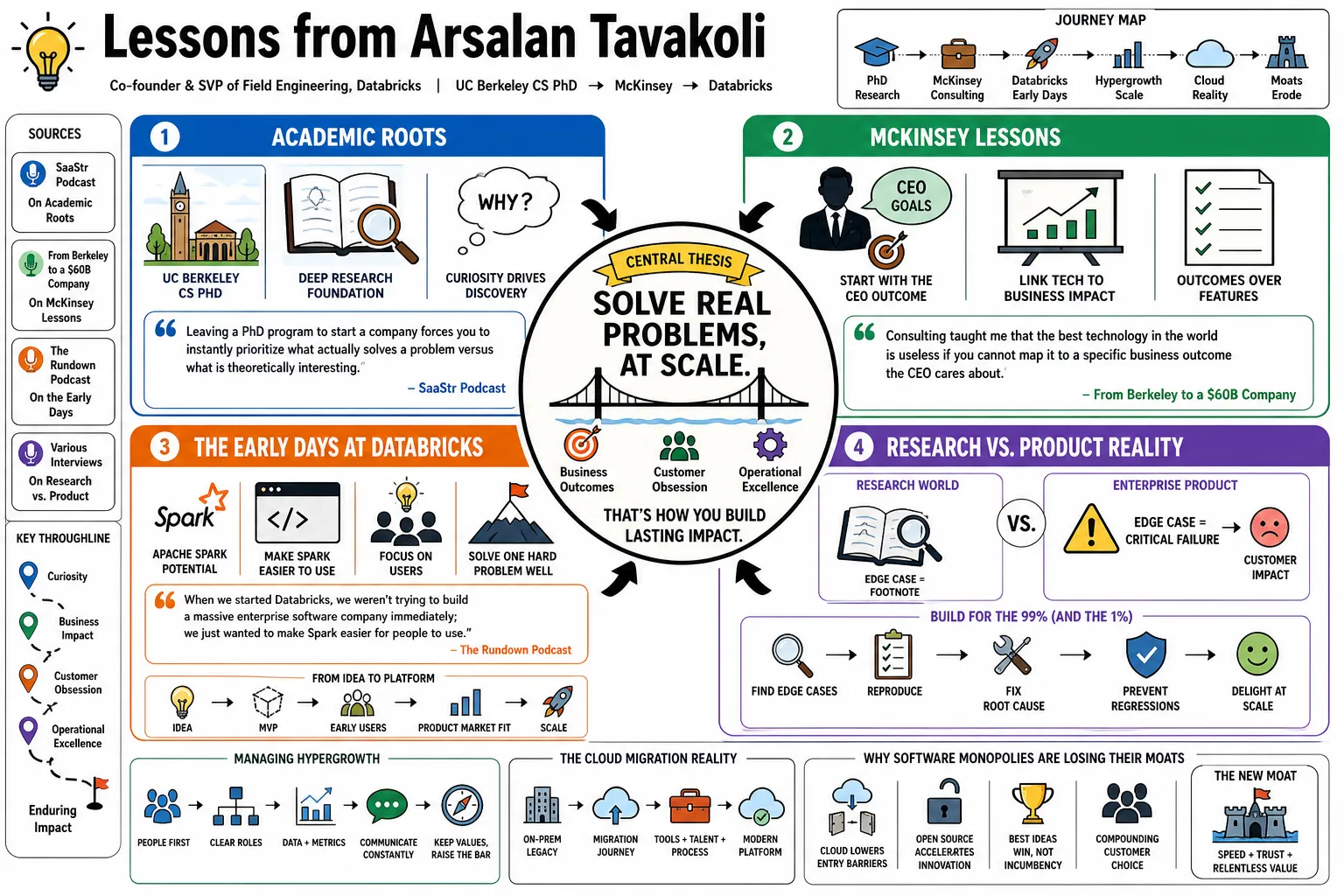
- On Academic Roots: "Leaving a PhD program to start a company forces you to instantly prioritize what actually solves a problem versus what is theoretically interesting." — Source: SaaStr Podcast
- On McKinsey Lessons: Tavakoli's McKinsey work gave him a strategy lens for enterprise technology: cloud, IT, and AI matter only when they connect to the business initiatives leaders are actually trying to move. — Reference: Databricks author bio on Tavakoli's McKinsey enterprise strategy work
- On the Early Days: "When we started Databricks, we weren't trying to build a massive enterprise software company immediately; we just wanted to make Spark easier for people to use." — Source: The Rundown Podcast
- On Research vs. Product: "In research, an edge case is a footnote. In an enterprise product, an edge case is a critical failure that ruins a customer relationship." — Source: Databricks Blog
- On Taking Risks: "The transition from advising companies at McKinsey to building one meant owning the failure, not just delivering the presentation." — Source: SaaStr Podcast
- On Academic Rigor: "The rigorous distributed systems training at Berkeley gave us the foundation to know exactly what wouldn't scale when we built the commercial platform." — Source: UC Berkeley Alumni Interview
- On Building the Core Team: Tavakoli's own path points to why Databricks valued hybrid builders: the company needed people who could understand distributed systems and still translate them into enterprise operating problems. — Reference: Databricks author bio on Tavakoli's technical and enterprise background
- On Consulting vs. Operating: "As a consultant, you optimize for clarity of the strategy. As a founder, you optimize for the speed of execution." — Source: SaaStr Podcast
- On Defining the Problem: "We spent less time trying to invent a new paradigm and more time looking at the exact friction points data scientists hated the most." — Source: The Rundown Podcast
Part 2: The Fallacy of AI Token-Maxing
- On Capital Misallocation: "We see companies token-maxing—throwing millions at API calls and generic AI models—without a single metric to prove it actually improved their bottom line." — Source: SaaStr 863
- On the AI Hype Cycle: "A lot of current enterprise AI spending is defensive. It's a fear of missing out rather than a calculated investment in a specific workflow." — Source: Disrupt 2026
- On Measuring ROI: Tavakoli pushes executives to start with the business outcome, not the AI tool; standing up agents is irrelevant if the work does not produce productivity, revenue, cost, or risk results. — Reference: Mastercard interview on focusing AI programs on outcomes, not tools
- On Proof of Concepts: "The graveyard of enterprise software is full of AI pilots that looked amazing in a sandbox but completely fell apart in production." — Source: SaaStr AI Annual
- On Budget Reality: Tavakoli's warning is that many enterprises are spending heavily on AI activity before they can explain the return, which creates budget motion without business clarity. — Reference: SaaStr analysis of Tavakoli on token spending and unclear AI ROI
- On Model Obsession: "Stop worrying about whether you are using the absolute largest model. Worry about whether the model actually understands your specific customer data." — Source: The Rundown Podcast
- On Compute Costs: "Throwing endless compute at a poorly scoped business problem is the fastest way to drain your IT budget." — Source: SaaStr 863
- On Executive Pressure: Tavakoli sees the boardroom push for AI as dangerous when it starts with technology theater; the better path is to define success first and work backward to the architecture. — Reference: Databricks interview on AI activity versus AI value
- On Sustainable AI: "The winners in this era won't be the companies that spent the most on AI, but the ones that spent the most efficiently." — Source: Disrupt 2026
Part 3: The Death of Traditional Dashboards
- On the Limits of BI: "The traditional BI dashboard is dead. Users don't want to hunt for insights across twenty tabs; they want to ask a question and get an answer." — Source: SaaStr 863
- On Static Reporting: "A static chart tells you what happened yesterday. Modern businesses need systems that tell them what to do right now." — Source: Databricks Blog
- On Democratizing Data: "True data democratization isn't giving everyone access to a complex BI tool. It's letting them query the data in plain language." — Source: SaaStr AI Annual
- On Text-to-SQL Limitations: "Just bolting a text-to-SQL interface onto a legacy database isn't enough. The system needs to understand the business logic, not just the schema." — Source: The Rundown Podcast
- On User Adoption: "If a business user has to submit an IT ticket to change a filter on a dashboard, your data platform has already failed them." — Source: SaaStr 863
- On the Shift to Agents: Tavakoli frames the shift as a move from passive reporting to systems that can act, which means data architecture has to support low-latency, governed, context-aware agents. — Reference: Databricks interview on agentic architecture beyond dashboards
- On Dashboard Fatigue: "Most dashboards are built once, looked at for a week, and then ignored. The return on that engineering time is effectively zero." — Source: Disrupt 2026
- On Natural Language: "Natural language is the new API for enterprise data, but it only works if the backend actually understands the context of the words." — Source: SaaStr AI Annual
- On Real-Time Needs: "Decision makers operate in the moment. If your data pipeline takes 24 hours to update a dashboard, you're making decisions in the past." — Source: Databricks Blog
Part 4: Data Context as the AI Bottleneck
- On the Real AI Challenge: "The bottleneck for enterprise AI is no longer the intelligence of the model; it is the context. The model needs your specific unstructured data to be useful." — Source: SaaStr 863
- On Unstructured Data: "Most of a company's actual knowledge lives in support tickets, Slack messages, and meeting transcripts, not in clean relational tables." — Source: The Rundown Podcast
- On Generic Models: Tavakoli argues that model selection is not the hard enterprise problem; accuracy, governance, production readiness, measurement, and the data estate determine whether AI works. — Reference: Mastercard interview on data, governance, and production readiness
- On Data Governance: "You cannot have an effective AI strategy without a strict data governance strategy. The model will only ever be as good as the data it is allowed to see." — Source: Databricks Blog
- On Contextual Awareness: "An AI agent that doesn't understand the history of a customer's interactions will inevitably give confident, useless advice." — Source: SaaStr AI Annual
- On the Value of Proprietary Data: "Your proprietary data is the only moat you have left. The models themselves are becoming commoditized." — Source: Disrupt 2026
- On Data Silos: Tavakoli treats silos as an AI failure mode: if agents cannot reach governed, connected, semantically meaningful data, they cannot make reliable decisions in production. — Reference: Databricks interview on data silos, governance, and semantic context
- On Continuous Updating: "Context isn't a one-time upload. It is a continuous pipeline of extracting knowledge from your business operations as they happen." — Source: SaaStr 863
- On Context Windows: "Expanding the context window of a model is great, but only if you have a reliable way to retrieve and inject the right documents into that window." — Source: The Rundown Podcast
- On Semantic Understanding: "We have to move beyond keyword search. The infrastructure needs to understand the semantic meaning of the data to serve it to the LLM." — Source: Databricks Blog
Part 5: Enterprise AI and Legacy Migrations
- On Migration Timelines: "We are using LLMs to turn what used to be a three-year legacy migration nightmare into a 30-day automated process." — Source: SaaStr 863
- On Technical Debt: Tavakoli's migration point is that AI changes the economics of old systems: when code can be understood, converted, migrated, and validated faster, legacy lock-in weakens. — Reference: Cloud/SaaStr summary on AI lowering legacy migration costs
- On Automated Code Translation: "The ability for AI to translate old SQL dialects into modern frameworks is completely changing the economics of cloud migrations." — Source: The Rundown Podcast
- On De-risking Migrations: "The biggest barrier to modernization was always the risk of breaking existing pipelines. AI helps map and test those dependencies automatically." — Source: Databricks Blog
- On the Cloud Imperative: Tavakoli's infrastructure lesson is that agentic AI needs a full operating stack, not a dashboard layer bolted onto old analytics infrastructure. — Reference: Databricks interview on the core infrastructure pieces for the agentic era
- On Cost Savings: "Companies delay migrations because of the upfront cost, ignoring the massive daily tax they pay in inefficiency and compute waste." — Source: SaaStr AI Annual
- On Legacy Lock-in: "Incumbent vendors rely on the friction of migration to maintain their margins. When AI removes that friction, their lock-in evaporates." — Source: SaaStr 863
- On Data Lakes: "The transition from rigid warehouses to flexible data lakes was the prerequisite for all the machine learning work happening today." — Source: Databricks Blog
- On Unifying Data: "You can't do AI on your unstructured data and BI on your structured data in separate silos. The migration has to be toward a unified architecture." — Source: Disrupt 2026
- On Executive Buy-in: Tavakoli makes executive approval easier by tying AI to a concrete business outcome, such as automating an expensive process or unlocking a capability the company could not deliver before. — Reference: Mastercard interview on linking AI to business outcomes
Part 6: Navigating Hypergrowth at Databricks
- On Scaling Revenue: "Hitting a multibillion-dollar run-rate isn't about one magic feature; it's about systematically removing the barriers between data engineers and data scientists." — Source: SaaStr 863
- On Maintaining Culture: Tavakoli's field-engineering vantage point puts customer reality at the center of the company; scale only works if technical teams keep learning from real enterprise constraints. — Reference: Databricks interview on field engineering and enterprise AI conversations
- On Open Source: "Open source is a great top-of-funnel motion, but you have to build a managed service that is so good that companies gladly pay to not manage it themselves." — Source: The Rundown Podcast
- On Product Focus: "In hypergrowth, the temptation is to build everything. You have to be ruthless about staying in your lane and solving the data problem better than anyone else." — Source: Databricks Blog
- On Hiring: "We look for people who have a high tolerance for ambiguity. In a fast-growing company, your job description changes every six months." — Source: SaaStr Podcast
- On Customer Feedback: Tavakoli favors focused pilots because they expose real-world constraints quickly; the point is to learn what good looks like before scaling across the organization. — Reference: Databricks interview on focused pilots and learning before scale
- On Engineering Velocity: "As the code base expands, engineering velocity naturally slows down. We invest heavily in internal tooling just to keep our teams moving fast." — Source: Disrupt 2026
- On Net Retention: "A 140 percent net retention rate means your product is actually becoming more valuable to the customer the longer they use it." — Source: SaaStr 863
- On Competing: Tavakoli sees competition shifting toward outcome-led, AI-native entrants because lower build costs and easier migrations make old lock-in defenses less reliable. — Reference: SaaStr analysis of Tavakoli on weakened software lock-in
- On the Platform Play: Tavakoli's platform argument is that agentic AI only scales when the data, governance, transactional, agent, and application layers are designed as one system. — Reference: Databricks interview on the integrated platform needed for agents
Part 7: The Future of Software Monopolies
- On Pricing Pressure: "Any business with a monopoly today will not have a monopoly 12 to 24 months from now. Collapsing software development costs will ensure that." — Source: SaaStr 863
- On Low-End Disruption: "Incumbents are going to face unprecedented pressure from low-end AI competitors who can build a majority of the functionality for a fraction of the cost." — Source: The Rundown Podcast
- On the Cost of Code: "When AI can generate boilerplate code instantly, the barrier to entry for building SaaS applications drops to near zero." — Source: Disrupt 2026
- On Defensibility: "If your entire software business is just a thin wrapper around a database, you have no defensibility against AI-native startups." — Source: SaaStr AI Annual
- On Margin Compression: Tavakoli's pricing-pressure thesis is that incumbents lose margin when customers can try credible AI-native alternatives and migrate away with far less friction. — Reference: Cloud/SaaStr summary on pricing power and migration pressure
- On Agility vs. Size: Tavakoli's competitive view favors fast, focused attackers when AI lowers build costs and buyers become more willing to test alternatives to entrenched vendors. — Reference: SaaStr analysis of Tavakoli on AI-native challengers
- On Value Creation: "The value is shifting from the application layer down to the data layer and up to the agent layer. The traditional software middle is getting squeezed." — Source: Databricks Blog
- On Custom vs. SaaS: "We will see a resurgence of highly customized internal tools because AI makes it so cheap to build them, reducing reliance on off-the-shelf SaaS." — Source: The Rundown Podcast
- On Survival: "To survive the next two years, monopolies have to willingly cannibalize their own pricing models before an AI startup does it for them." — Source: SaaStr 863
Part 8: Field Engineering and Customer Success
- On the Role of Field Engineering: "Field engineering isn't about selling software; it's about proving that the architecture can actually solve the customer's specific problem." — Source: Databricks Blog
- On Trust: Tavakoli ties enterprise trust to implementation reality: agents need governed permissions, production discipline, and technical architecture that survives contact with customer systems. — Reference: Databricks interview on governance, permissions, and production trust
- On Technical Sales: "The era of the purely relational enterprise software salesperson is over. You have to be deeply technical to sell modern data infrastructure." — Source: SaaStr Podcast
- On Customer Empathy: Tavakoli's practical AI examples start with the people stuck in painful workflows, from claims processing to onboarding; the value comes from making that work faster and less frustrating. — Reference: Mastercard interview on practical AI use cases and workflow pain
- On Time-to-Value: "The clock starts ticking the moment the contract is signed. If they haven't seen a win in 90 days, you are at risk of churn." — Source: SaaStr 863
- On Proof of Concepts: "A successful proof of concept shouldn't just prove the tech works; it should prove that the customer's team is capable of operating it long-term." — Source: The Rundown Podcast
- On Feedback Loops: "Field engineering is the most critical feedback loop for the product team. They see the paper cuts that users experience every day." — Source: Databricks Blog
- On Solving the Right Problem: Tavakoli's first question is not what agent to build, but what outcome the system must improve; without that clarity, teams cannot work backward to the right architecture. — Reference: Databricks interview on defining success before building agents
- On Long-Term Success: "We don't celebrate the deal closing. We celebrate when the customer puts their first AI model into production and it actually impacts their business." — Source: SaaStr AI Annual