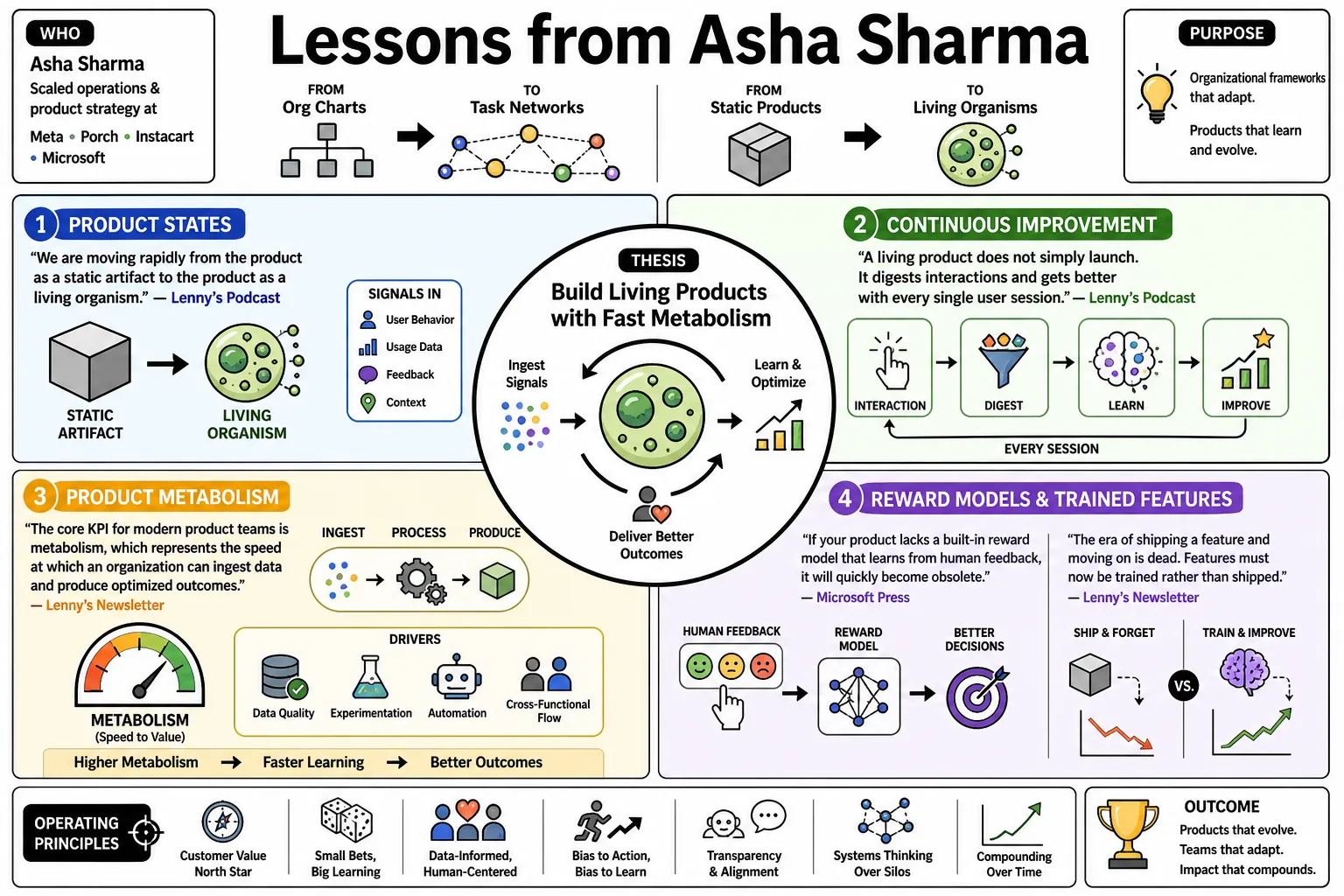
Asha Sharma has led operations and product work at Porch, Meta, Instacart and Microsoft. In her interviews, she describes how AI could make products more adaptive and change how people and agents organize work. These lessons bring together her product, leadership and operating principles. — Lenny’s Podcast — Building with AI.
Part 1: The Evolution of Products
- On Product States: Sharma expects AI products to become adaptive systems rather than fixed artifacts, changing as they learn from use. — Lenny’s Podcast — Building with AI.
- On Continuous Improvement: Build a learning loop that feeds observed interactions and outcomes back into product improvement; shipping the initial model is not the end of the work. — Lenny’s Podcast — Building with AI.
- On Product Metabolism: For AI products, pay attention to how quickly useful signals become better outcomes. Sharma describes this learning speed as a product’s metabolism. — Lenny’s Podcast — Building with AI.
- On Reward Models: Define what a good outcome looks like and use feedback to improve toward it. Reward design helps a learning system optimize for the outcomes the product is meant to deliver. — Lenny’s Podcast — Building with AI.
- On User Expectations: Sharma expects AI products to offer more adaptive, personalized experiences as they learn from use. She describes this as a direction for product development, not a capability every product already has. — Lenny’s Podcast — Building with AI.
- On AI Integration: In a model-forward product, AI influences how the product learns and behaves. Treat that as an architectural choice, not simply an extra feature attached to unchanged software. — Lenny’s Podcast — Building with AI.
- On Feedback Loops: A well-developed feedback loop can become a product advantage: the team continually learns from outcomes and improves the system, rather than competing only on individual features. — Lenny’s Podcast — Building with AI.
Part 2: Artificial Intelligence and the Future of Work
- On the Workforce of the Future: Sharma expects employees to work alongside growing collections of agents and gain access to skills they did not previously have. This is an optimistic forecast about the workforce, not an established result. — Lenny’s Podcast — Building with AI.
- On Human Value: Agents may expand what people can execute, but human creativity and judgment remain important. People still need to decide what to use AI for. — Lenny’s Podcast — Building with AI.
- On AI Platforms: Agent workflows need accountability, observability and evaluation, alongside identity and access controls. Autonomy is not a substitute for understanding what the system is doing. — Lenny’s Podcast — Building with AI.
- On Middle Management: Sharma predicts that organizations coordinating more work through agents may need fewer hierarchical layers. Reporting structures could change as tasks and throughput become more central. — Lenny’s Podcast — Building with AI.
- On Task Networks: Sharma imagines a work chart organized around tasks and throughput, with work routed among people and agents. The idea shifts attention from reporting relationships to how work gets done. — Lenny’s Podcast — Building with AI.
- On Agentic Capabilities: Agents can move beyond answering questions to carrying out tasks, such as working on a pull request. Their usefulness depends on the work they can complete, not only the answers they produce. — Lenny’s Podcast — Building with AI.
- On AI in Retail: Use AI to understand shopping intent and match it with relevant products. Instacart’s example combines semantic search with preferences and recommendations; it does not eliminate the need for search. — Emerj — AI and Retail.
- On Change Management: Start AI adoption by building fluency across the organization, then improve processes and pursue growth opportunities. Technology alone is not enough without a clear use case and a way to evaluate results. — Lenny’s Podcast — Building with AI.
Part 3: Leadership and Organizational Design
- On Building Teams: Build the right mix of generalists and specialists, and take hiring and team behavior seriously. Sharma treats building a strong team as a critical leadership responsibility. — Career Contessa — Asha Sharma Interview.
- On Executive Decision Making: Match decision speed to the stakes. For Xbox exclusivity choices with long-term consequences, Sharma prioritizes understanding the data and strategy over making the fastest decision. — Game File — Xbox Leadership Interview.
- On Accountability: Be explicit about roles, responsibilities and what success means, including your own role. Moving quickly does not remove the need for clear ownership. — Career Contessa — Asha Sharma Interview.
- On Scaling Culture: As Porch expanded, internal communication became a deliberate priority. Growing the team requires maintaining the communication that lets people work together, not assuming the early startup habits will scale unchanged. — HuffPost — Asha Sharma Q&A.
- On Navigating Crises: When a business faces difficult changes, communicate what you are seeing and what you are doing. Sharma pairs this with listening and learning, so communication reflects the work rather than substituting for it. — Windows Central — Xbox Interview.
- On Talent Density: Recruiting and retaining strong people is a central leadership responsibility as a company grows. Keep investing in the team instead of treating hiring as an administrative task. — Career Contessa — Asha Sharma Interview.
- On Cross-functional Work: Work across functional boundaries to understand the whole product loop—cost, rewards and user experience. A team focused only on its own lane can miss how these parts affect one another. — Lenny’s Podcast — Building with AI.
- On Feedback: Seek people who help the team confront hard truths as well as find creative ways forward. Sharma describes bringing in a critical analyst to challenge assumptions during Xbox’s reset. — Bloomberg Tech — Xbox’s Reboot.
- On Vision: Give the team clarity and a reason to stay committed to the mission. Sharma describes optimism as a renewable resource that helps people keep working toward difficult goals. — Lenny’s Podcast — Building with AI.
Part 4: E-commerce and the Retail Experience
- On Grocery Logistics: Grocery technology has to account for local availability, perishable goods and thin operating margins. The physical realities of the store remain part of the product problem. — Emerj — AI and Retail.
- On Consumer Habits: Changed shopping habits create new expectations for personalization and inspiration. Retail teams need to understand those expectations instead of assuming that a familiar shopping journey will remain sufficient. — Emerj — AI and Retail.
- On Fulfilling Demand: Fulfillment starts with knowing what is available in each store. Integrate inventory data and use availability models where the data has gaps, so the service can connect demand with goods that can actually be supplied. — Emerj — AI and Retail.
- On the Retail Store: Connect online and in-store service so each improves the other. Sharma argues against optimizing for one channel exclusively. — Emerj — AI and Retail.
- On Personalization: Personalization starts with understanding a customer’s intent and relevant preferences. Enrich the catalog and recommendations around those needs, including dietary preferences and brand affinity. — Emerj — AI and Retail.
- On Shopper Experience: Support platform workers with useful information, care and control over when and what work they take. Instacart’s shopper commitments make those responsibilities explicit, while acknowledging that batches and earnings can vary. — Instacart — Shopper Commitments.
Part 5: Social Connections and Scale
- On Product Simplicity: At scale, prioritize the core experience people rely on. Sharma points to WhatsApp’s reach, speed, reliability and privacy as more fundamental than adding decorative features. — Lenny’s Podcast — Building with AI.
- On Community Safety: Build privacy and safety into the core experience people depend on. Sharma treats these as platform fundamentals, alongside reliability, rather than cosmetic features. — Lenny’s Podcast — Building with AI.
- On Mobile Transitions: Porch’s mobile transition centered on a concierge that helped homeowners find professionals and book services. The example shows a mobile experience organized around completing a task. — MarTech — Asha Sharma’s CMO View.
- On User Feedback: Test what users actually respond to instead of relying only on what they say. Porch’s image experiments showed that relevance could matter more than the team’s assumptions about photo quality. — MarTech — Asha Sharma’s CMO View.
- On Global Markets: People in different markets have different needs and constraints. Sharma argues for more flexible ways to make gaming accessible, without promising a particular price or assuming one offer fits everyone. — Game File — Xbox Leadership Interview.
Part 6: Gaming Strategy and Ecosystems
- On Exclusivity vs Reach: Broad publishing benefits from reaching large audiences, while a platform needs distinctive content and services. Sharma describes evaluating the trade-off thoughtfully for each title, not a blanket decision to publish everything everywhere. — Bloomberg Tech — Xbox’s Reboot.
- On Game Subscriptions: Evaluate a subscription by whether players can afford it, value it and want to stay. Sharma connects Game Pass’s price and release-window changes to those goals. — Game File — Xbox Leadership Interview.
- On Hardware Evolution: Keep console players central while serving people across PC, mobile and cloud. Sharma’s direction is to reduce barriers between devices, not to abandon dedicated hardware. — Microsoft — Asha Sharma’s Xbox Message.
- On Community Building: Build for the community already invested in the product. Sharma cautions creators against diluting their focus simply to chase an emerging audience; expansion should be a deliberate investment. — Windows Central — Xbox Interview.
- On Franchise Management: Treat established franchises as creative work to steward, not static assets to exploit. Understand what makes them valuable, empower their studios and support new ideas. — Microsoft — Asha Sharma’s Xbox Message.
- On the Business Model: Explore new business models while protecting the creative work players value. Sharma’s stated direction favors experimentation without chasing short-term monetization at the expense of human craft. — Microsoft — Asha Sharma’s Xbox Message.
Part 7: Career Growth and Navigation
- On Career Trajectories: Develop an area of expertise, combine it with lateral thinking and understand the business analytically. Sharma’s career advice prioritizes these capabilities over pursuing a particular level or title. — HuffPost — Asha Sharma Q&A.
- On Taking Risks: A new role can feel intimidating without being the wrong move. Sharma recalls learning from work that scared her early in her career and cautions against imposing a rigid timetable on progress. — Career Contessa — Asha Sharma Interview.
- On Mentorship: Look for mentors who expand your expertise, empathy and perspective. Their experience can help you understand the world beyond the problems immediately in front of you. — HuffPost — Asha Sharma Q&A.
- On Skill Acquisition: Pair specialist knowledge with the ability to understand wider business trade-offs. Analytics and lateral thinking help you turn expertise into decisions that serve the whole company. — HuffPost — Asha Sharma Q&A.
- On Transitions: Bring your operating experience to a new field while learning from people with deep domain knowledge. Sharma describes listening to Xbox’s teams and combining her expertise with experienced gaming leaders. — Windows Central — Xbox Interview.
- On Resilience: Learn from a setback by examining what your leadership needed to do differently. Sharma’s failed youth-center project taught her about sustaining the work after a handoff. — Star Tribune — Asha Sharma Interview.
Part 8: Operational Excellence
- On Process Design: Review processes rather than preserving them by habit. Protect what works and be willing to change what does not, while keeping the product’s purpose in view. — Microsoft — Asha Sharma’s Xbox Message.
- On Data Dependency: Give business owners a working understanding of the data behind their decisions. Porch trained people to query and interpret their own inputs rather than leaving every question in an analyst’s queue. — MarTech — Asha Sharma’s CMO View.
- On Prioritization: Choose AI projects against a clear plan for investment and evaluation. Pursuing many ideas simply because AI is available is not the same as prioritizing work that improves the business. — Lenny’s Podcast — Building with AI.
- On Execution: Ideas need follow-through. Sharma’s advice is to demonstrate that you can get work done, not merely describe what someone else should do. — Career Contessa — Asha Sharma Interview.
- On Home Services: Reduce uncertainty in home services with evidence about a professional’s past work and checks on reliability. Porch’s approach used project history, reviews and verification to help homeowners make a choice. — Star Tribune — Asha Sharma Interview.
- On Unit Economics: Assess the economics of serving customers alongside their needs and lifetime value. Sharma describes using those insights to inform service levels and policies. — Emerj — AI and Retail.
- On Goal Setting: Set goals that stretch the team but remain achievable, then solve difficult problems together. Clear priorities and expectations are part of making those goals usable. — Career Contessa — Asha Sharma Interview.
- On System Failures: Look for the cause of a recurring problem rather than repeatedly treating its symptoms. Sharma’s systems example emphasizes examining underlying design before choosing a remedy. — Lenny’s Podcast — Building with AI.
Learn more:
- Lenny’s Podcast: How 80,000 Companies Build with AI — Products as Organisms, the Death of Org Charts, and Why Agents Will Outnumber Employees by 2026 | Asha Sharma (CVP of AI Platform at Microsoft)
- Microsoft: Asha Sharma Named EVP and CEO, Microsoft Gaming — Signed Leadership Messages
- Windows Central: Exclusive — Talking to New Xbox CEO Asha Sharma and CCO Matt Booty
- HuffPost: Women in Business Q&A — Asha Sharma, COO, Porch.com
- Emerj: What Artificial Intelligence Means for Retail — Asha Sharma of Instacart
- MarTech: A CMO’s View — Porch’s CMO Says Analytics & Data Are at the Core of Everything for the Home Improvement Network
- Game File: The Big Things That We’re Thinking About — Exclusive Interview with Asha Sharma and Matt Booty
- Bloomberg Live: XBOX CEO Sharma Shares Vision for Reboot — Emily Chang Interview at Bloomberg Tech 2026
- Career Contessa: An Interview with Asha Sharma, Chief Marketing Officer at Porch
- Instacart: A Renewed Commitment to the Shopper Community
- Star Tribune: Sunday Conversation with Asha Sharma of Porch, an Online Home-Services Portal