Ashby Monk studies how institutional asset owners organize investment decisions, develop capabilities and use technology. These lessons draw on his research, signed essays and direct interviews about governance, fees, climate risk and the Total Portfolio Approach. — i3 Podcast — The Future of the Pension Industry.
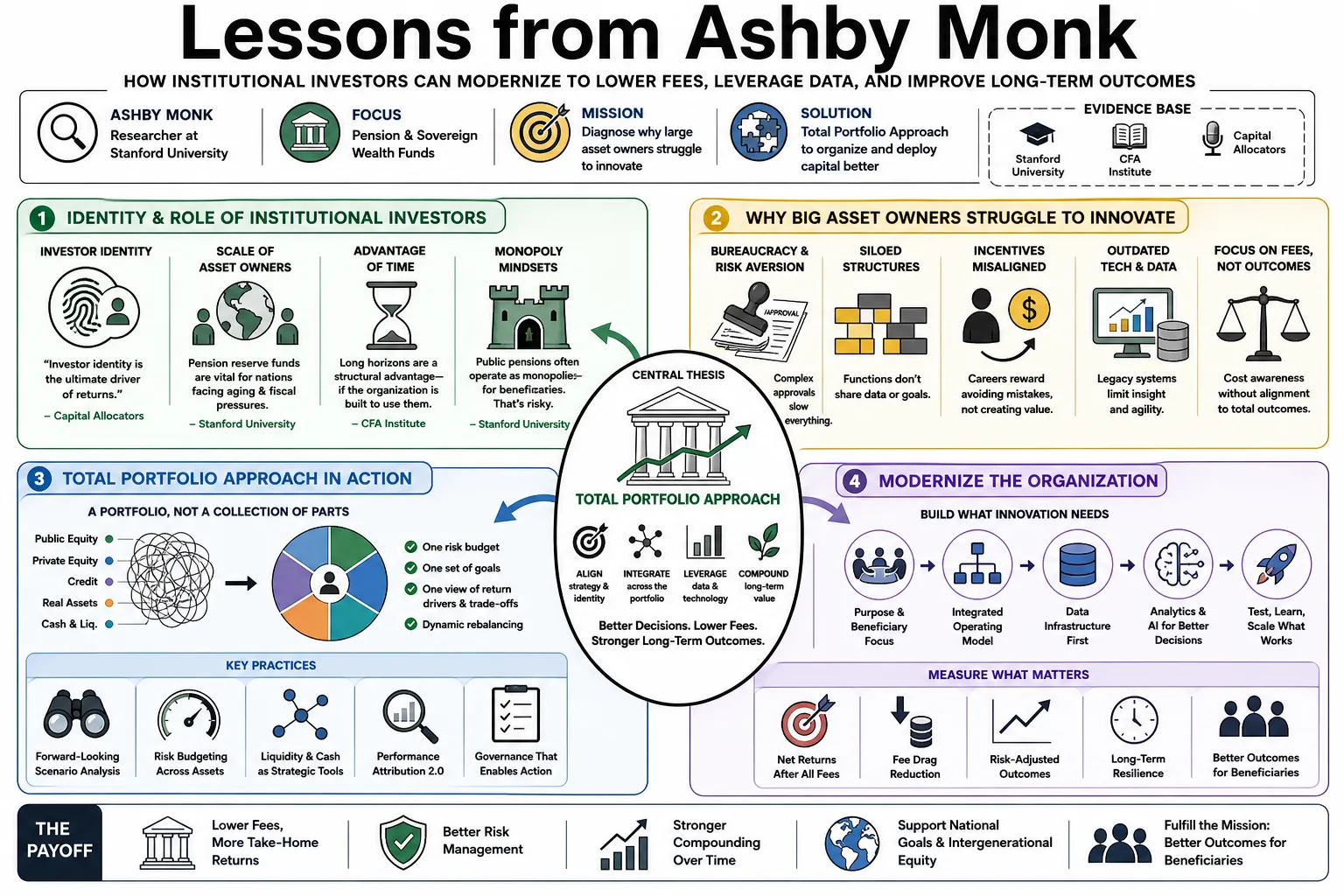
Part 1: The Identity and Role of Institutional Investors
- On Investor Identity: Monk and Rook argue that an investor’s organizational capabilities shape what it can invest in and how it implements its strategy; copying another fund’s model without that context can miss the point. — Investor Identity.
- On the Scale of Asset Owners: Pension reserve funds can pre-fund future obligations as populations age. Monk’s discussion of France and Ireland shows how short-term fiscal demands can undermine that long-term purpose. — Ireland, France Losing Long-Term Pension Assets.
- On the Advantage of Time: Long horizons can create an advantage, but investors need governance, resources and performance measures that let them use it rather than judge every decision through a short-term lens. — Assessing Long-Term Investor Performance.
- On Monopoly Mindsets: Monk argues that funds whose beneficiaries cannot leave face less pressure to modernize. He contrasts that permanence with institutions that must compete to retain members. — Meb Faber Podcast — Fees and Innovation.
- On the Purpose of Capital: Monk treats long-term asset owners as part of the machinery that finances the economy. Their investment practices need to adapt to changing risks while serving their underlying public and beneficiary goals. — Agriculture Adapts — Ashby Monk.
- On Capital Aggregation: Monk describes investing as a production process that combines capital, people, processes and information. Governance, culture and technology influence how effectively those inputs become investment decisions. — Meb Faber Podcast — Fees and Innovation.
- On Sovereign Wealth Fund Legitimacy: Monk’s sovereign wealth fund research links concerns about government-owned investors to trust and organizational legitimacy, and examines how governance can address those concerns. — Trust, Legitimacy, and Governance.
- On Institutional Mandates: Long-term liabilities do not automatically produce long-term behavior. Clark and Monk argue for performance measures and organizational practices that reflect an investor’s horizon rather than encourage short-term responses. — Assessing Long-Term Investor Performance.
- On the Weight of Responsibility: Pension investment decisions affect beneficiaries and public finances. In his Pennsylvania testimony, Monk argues that understanding costs and strengthening institutional capabilities are therefore matters of public responsibility. — Pennsylvania Pension Commission — Opening Remarks.
Part 2: Structural Challenges and Governance Deficiencies
- On Hedge Fund Wealth: Monk argues that weak pension governance and underinvestment in internal talent help external managers capture value. His criticism is that boards scrutinize internal pay while overlooking much larger external costs. — The Key to Unlocking Hedge Fund Wealth.
- On Herd Behavior: Career concerns and a desire to appear prudent can push institutional investors toward the same established practices. Monk argues that this can discourage experimentation even when a different approach deserves investigation. — Meb Faber Podcast — Fees and Innovation.
- On the Allergic Reaction to Change: Monk warns that institutions built for efficiency and expediency can resist innovation. Making room for new ideas requires a deliberate commitment rather than assuming normal operations will produce them. — What Institutional Investors Desperately Need: Two Letters.
- On Artificial Focus: Monk criticizes pension boards that focus narrowly on internal compensation while ignoring external manager fees. The relevant comparison is the total cost of obtaining the capabilities the fund needs. — Superclusters — LPs Should Get Paid More.
- On Industry Disruption: Monk cautions that a large, profitable industry is not necessarily easy to disrupt: powerful incumbents may resist change. A focused niche can offer a more workable starting point for an investment-technology business. — CFA Institute — Invest-Tech.
- On Governance and Success: Good governance gives management the authority and resources to recruit capable people and implement a strategy. Monk points to arm’s-length, expert boards as one way to support that professionalism. — Meb Faber Podcast — Fees and Innovation.
- On Internal Constraints: Political constraints on pay and resources can make it difficult for public pension funds to build internal investment capabilities. Outsourcing should be judged with those constraints—and complete internal and external costs—in view. — Meb Faber Podcast — Fees and Innovation.
- On Career Risk: Monk describes career risk as a barrier to pension innovation: people may fear losing their jobs for trying an unfamiliar approach. Institutions need room to investigate alternatives without treating every experiment as recklessness. — i3 Podcast — The Future of the Pension Industry.
Part 3: The Need for Innovation and R&D
- On the Catalyst for Change: Monk describes courage and crisis as catalysts for institutional innovation. Change can require leaders willing to challenge established practices rather than wait for routine processes to make room for it. — Superclusters — LPs Should Get Paid More.
- On the Need for R&D: Monk proposes dedicated, cross-functional R&D to investigate new tools and investment approaches and share what it learns. He distinguishes that work from ordinary research conducted inside existing asset-class mandates. — What Institutional Investors Desperately Need: Two Letters.
- On the Aikido Theory of Innovation: An impact label can let a manager exploit an investor’s aspirations without delivering the intended impact. Monk’s example of an agricultural mandate containing tobacco illustrates why internal scrutiny must go beyond the label. — The Aikido Theory of Investment Innovation.
- On No Single Blueprint: Investors cannot buy a standard blueprint for their own cultivated advantages. Monk argues that those advantages depend on the institution’s particular capabilities, governance and willingness to develop something distinctive. — When It Comes to Investing Edge: Advantage, Giants.
- On Cultivating an Edge: An investor can cultivate an advantage through delegation, responsive governance or specialized teams. Monk distinguishes these deliberately built capabilities from advantages it inherits through its sponsor, location or liabilities. — When It Comes to Investing Edge: Advantage, Giants.
- On Building Tools: Monk urges asset owners to support the development of investment technology, including backing entrepreneurs and piloting useful tools. They need not accept external managers’ proprietary systems as the only route to better information. — Forget Fintech, We Need More Invest-Tech.
- On Overcoming Inertia: Monk argues that useful innovations cannot be treated as permanent answers. Institutions need ways to learn across teams and adjust their tools and practices as circumstances change. — What Institutional Investors Desperately Need: Two Letters.
- On Courage: A peer benchmark can obscure an institution’s own advantages and obligations. Clark and Monk argue for evaluating long-term investors against their strategy and capabilities, not simply copying a peer’s allocation. — Assessing Long-Term Investor Performance.
Part 4: The Total Portfolio Approach (TPA)
- On Breaking Silos: Monk describes TPA as a challenge to asset-class silos: an investment should be assessed for what it contributes to the whole portfolio, rather than merely filling a predefined bucket. — Capital Allocators — Total Portfolio Approach.
- On the One Fund Perspective: A whole-fund view compares opportunities across public and private markets against shared goals, risk and liquidity needs. It does not remove the different constraints created by illiquid commitments. — Capital Allocators — Total Portfolio Approach.
- On Organizational Redesign: For Monk, TPA requires organizational changes as well as allocation changes. Incentives and responsibilities must encourage teams to improve the fund’s overall outcome, not only their own asset-class results. — Capital Allocators — Total Portfolio Approach.
- On Replacing the 60/40 Model: Monk does not argue that strategic asset allocation has no value: it can give boards useful discipline. TPA offers a different way to compare opportunities, and a fund may combine elements of both approaches. — Capital Allocators — Total Portfolio Approach.
- On 3D TPA Models: Monk describes a three-dimensional portfolio approach that considers impact alongside risk and return. In that model, impact is part of evaluating investment choices rather than a separate afterthought. — Capital Allocators — Total Portfolio Approach.
- On Operating Systems: A total-portfolio operating model needs an information nerve center connecting the fund’s goals to what it owns. Monk stresses that organizational decisions and portfolio information must work together, not merely sit in separate systems. — Capital Allocators — Total Portfolio Approach.
- On Agility: A whole-fund view can help an investor act on a market dislocation instead of being constrained by a silo’s allocation target. Monk presents this as a potential advantage, not a promise of perfect market timing. — Capital Allocators — Total Portfolio Approach.
Part 5: Technology, Data, and The Technologized Investor
- On the Portfolio GPS: Monk’s portfolio-GPS analogy starts with knowing the fund’s current position and destination, then assessing possible routes. Models and simulations can inform choices, but only if the underlying portfolio information is usable. — Capital Allocators — Total Portfolio Approach.
- On AI Integration: Monk sees AI as a way to turn organized portfolio information into new insights and decision support. Its role should extend beyond automating existing tasks, without assuming that more automation alone produces better investments. — Capital Allocators — Total Portfolio Approach.
- On Shifting Financial Hubs: Rook and Monk argue that the geographic and social concentration of AI research could alter financial institutions’ competitive advantages. They frame this as a possible shift in financial power, not an already completed migration. — Deep Geography.
- On Transforming Consulting: Monk expects AI to change investment consulting, but notes that consultants hold valuable historical data. Their response could be to organize that knowledge and use it to develop new advisory tools. — i3 Podcast — The Future of the Pension Industry.
- On Data Governance: Monk argues that investment technology is also a governance problem. Boards need to understand data management, cleaning and oversight, rather than treat the issue as ordinary IT maintenance. — i3 Podcast — The Future of the Pension Industry.
- On Real-Time Capabilities: A whole-portfolio view depends on information about exposures, valuations and liquidity. Monk highlights the difficulty of valuing private assets, a practical limit on treating a portfolio dashboard as an exact real-time picture. — Capital Allocators — Total Portfolio Approach.
- On the Technologized Investor: Monk’s technologized investor uses portfolio information to explore opportunities and make decisions, not just produce reports. The value lies in connecting data to the institution’s goals and capabilities, rather than assuming technology itself guarantees alpha. — Capital Allocators — Total Portfolio Approach.
- On Empowering Analysts: Monk expects AI to extract, clean and combine data from documents so investment teams can explore what they own and develop new insights. Data preparation supports analysis rather than being the final objective. — i3 Podcast — The Future of the Pension Industry.
Part 6: Alignment of Interests and the True Cost of Fees
- On Fee Transparency: Fee transparency helps investors assess alignment and the true cost of a strategy. Monk treats that scrutiny as a catalyst for improving governance and capabilities, not simply a campaign to choose the cheapest manager. — Pennsylvania Pension Commission — Opening Remarks.
- On Net vs. Gross Returns: Net returns do not explain where the difference between gross and net returns goes. Monk urges investors to recognize that fees also fund the external manager’s organization and to compare that expenditure with their own capability needs. — Superclusters — LPs Should Get Paid More.
- On Maximizing Alignment: Monk’s objective is better alignment and better value from external management. A high fee can be justified when it is earned; the problem is paying for capabilities or incentives the owner does not understand. — Pennsylvania Pension Commission — Opening Remarks.
- On Compounding Value: Fees can finance an external manager’s growing capabilities. Monk argues that asset owners should consider how that accumulated expertise strengthens the manager’s bargaining position—and what capabilities the owner could develop itself. — Superclusters — LPs Should Get Paid More.
- On Aligned Intermediaries: Monk and his coauthors propose an aligned intermediary to help long-term investors identify, assess and fund resource innovation. The design aims to connect patient capital with projects that conventional funding arrangements can miss. — The Case for an Aligned Intermediary.
- On Lowering the Base: With the same gross performance, lower costs leave more for beneficiaries. Monk argues that reducing avoidable implementation costs can lower the gross-return hurdle, rather than force a fund to seek higher returns through additional risk. — Pennsylvania Pension Commission — Opening Remarks.
- On Relational Partnerships: Monk looks for managers who act as partners beyond the narrow contract—for example, sharing useful advice or connections. Alignment is therefore also about how the relationship works, not only the negotiated fee. — Capital Allocators — Total Portfolio Approach.
- On Reclaiming Power: Asset owners supply the capital, but an under-resourced organization may struggle to evaluate its managers or negotiate from strength. Monk argues for capabilities that let owners exercise that role more effectively. — Pennsylvania Pension Commission — Opening Remarks.
Part 7: Long-Term Investing and Climate Risk
- On Non-Diversifiable Risk: Monk argues that long-horizon investors cannot treat climate exposure as a risk they can simply diversify away. Its effects can reach across holdings and locations, although the vulnerabilities of individual assets differ. — Agriculture Adapts — Ashby Monk.
- On Translating Timeframes: Long-term climate risks need to become actionable in present-day decisions. Monk points to insurance pricing and asset-specific information as ways future vulnerabilities can become current financial concerns. — Agriculture Adapts — Ashby Monk.
- On Climate Alpha: Monk sees a potential investment opportunity in understanding climate risks that other participants underestimate. He frames this as a research and investment thesis, not evidence that climate-aware investing always delivers excess returns. — Agriculture Adapts — Ashby Monk.
- On Collaborative Investing: Monk and his coauthors argue that collaborative investment structures can connect institutional capital with climate-aligned projects. Local expertise, information sharing and aligned incentives matter to making those structures work. — Mobilizing Institutional Investor Capital for Climate-Aligned Development.
- On Net-Zero Execution: A net-zero commitment needs an implementation strategy. Casady and Monk distinguish approaches such as reweighting or divestment, stewardship and retrofits, and financing climate solutions; changing a portfolio’s emissions is not the same as changing the real economy. — The Logic of Net Zero Investment Portfolios.
- On Carbon Efficiency: In, Park and Monk found a historical relationship between carbon efficiency and stock returns in their study of US companies from 2005 to 2018. That sample result is not a guarantee of future returns or proof of a universal causal relationship. — Is Being Green Rewarded in the Market?.
- On Climate Risk Matrices: Monk and his coauthors present climate-risk matrices as a practical way to map sector-specific physical vulnerabilities and possible mitigation actions. Their survey also identifies a need to connect those risks to valuations and improve investor training. — Global Risk Institute — Climate Risk Matrices.
- On the Energy Transition: In, Monk and Knox-Hayes argue that new intermediaries can help fund clean-energy innovation across different development stages. Better networks and information can connect projects with capital that fits their risks and financing needs. — Financing Energy Innovation.
- On Systemic Resilience: Monk argues that longer investment horizons can broaden an institution’s mission toward stewardship and lasting social value, rather than only the exploitation of short-lived arbitrages. — CFA Institute — Invest-Tech.
Part 8: Culture, Talent, and Organizational Design
- On the Apprenticeship Model: Monk describes institutional investing as an apprenticeship: people learn substantially through working with others and observing practice. That helps explain the importance of culture and knowledge transfer, without denying the existence of formal investment education. — i3 Podcast — The Future of the Pension Industry.
- On Social Capital: Monk and his coauthors argue that collaborative networks can help institutions develop direct-investment capabilities and share opportunities. Relationships complement internal expertise; the paper does not establish that social and human capital have equal measurable importance. — Social Capital and Collaborative Networks.
- On Compensation Structures: Mission and culture can help asset owners attract people who might earn more elsewhere. Monk presents those factors as part of recruiting and retention, not as a substitute for every necessary pay or resource decision. — i3 Podcast — The Future of the Pension Industry.
- On Retaining Talent: Internal capabilities require roles and incentives that talented specialists want to stay in. Monk discusses how hybrid organizational designs can preserve specialist expertise while encouraging a whole-portfolio perspective. — Capital Allocators — Total Portfolio Approach.
- On Knowledge Management: Rook and Monk describe knowledge management as a combination of culture and technology: people need to access existing knowledge, connect sources and create new understanding. A repository alone does not make an institution learn. — Knowledge Management for Institutional Investment.
- On Peer Collaboration: Monk encourages asset owners to learn through networks inside the organization, with their sponsor, with peers and with external managers. Those relationships can spread research and useful practices rather than leave knowledge trapped in isolated teams. — What Institutional Investors Desperately Need: Two Letters.
- On Fiduciary Duty: Clark and Monk argue that boards should resource the strategy they authorize, including people, systems and data governance. This is a governance recommendation about fulfilling long-term objectives, not a claim that one technology setup is legally mandatory. — Assessing Long-Term Investor Performance.
- On Board Governance: Monk argues that pension boards need skills in data and technology, not just conventional financial oversight. Understanding governance, management and cleaning of data helps boards make informed decisions about institutional modernization. — i3 Podcast — The Future of the Pension Industry.