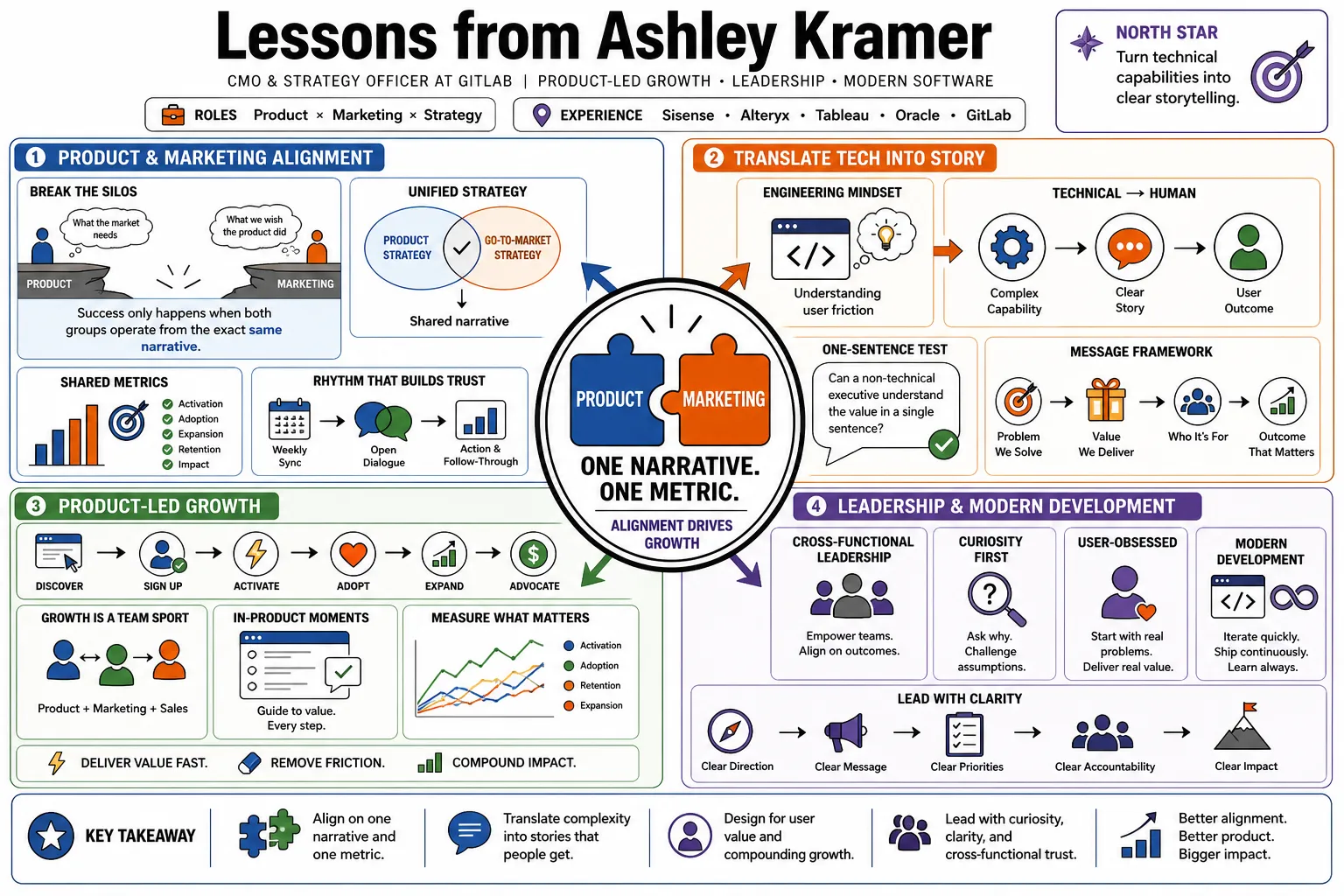
Lessons from Ashley Kramer
Ashley Kramer is the Chief Marketing and Strategy Officer at GitLab, following product and marketing roles at Sisense, Alteryx, Tableau, and Oracle. She connects product engineering with go-to-market strategy by turning technical capabilities into clear storytelling. This profile collects her insights on product-led growth, leadership, and modern software development.
Part 1: Product and Marketing Alignment
- On organizational silos: "Product builds what they think the market needs, and marketing talks about what they wish the product did. Success only happens when both groups operate from the exact same narrative." — Source: [Next Gen Builders]
- On unified strategy: "The most effective way to scale is ensuring your product and go-to-market teams aren't just communicating, but actually sharing the same metrics for success." — Source: [Grit Podcast]
- On transitioning from engineering: "My background writing code gave me a profound advantage in marketing because I could actually understand the friction our users were experiencing." — Source: [Stage 2 Capital]
- On finding the core message: "If you can't explain the value of a complex technical product in a sentence that a non-technical executive understands, your marketing has failed." — Source: [Amplitude Feature]
- On product-market fit: "It’s not just about building a good product; it’s about ensuring the market is ready for it and that your sales team knows how to position it against the status quo." — Source: [GitLab Blog]
- On feedback loops: "Marketing needs to be the fastest feedback loop for product development, bringing raw customer reactions directly to the engineering teams." — Source: [Next Gen Builders]
- On technical marketing: "You can't fake technical depth. Your marketing content has to be credible enough that a developer respects it, but clear enough that a buyer can fund it." — Source: [The New Stack]
- On bridging the gap: "It is imperative that organizations bridge the disconnects between leadership and developers with technology and collaboration." — Source: [GitLab Blog]
- On product launches: "A launch isn't a single day. It's a sustained campaign of education that proves to the market why your approach is the new standard." — Source: [Stage 2 Capital]
- On shared goals: "When product and marketing report into the same overarching strategy, you eliminate the friction of competing priorities." — Source: [Amplitude Feature]
Part 2: Leadership and Team Dynamics
- On managing ambition: "I had to learn early on that not everyone wants your job. Some people want to be incredible individual contributors, and coaching them means supporting their specific path." — Source: [Grit Podcast]
- On hiring for early stages: "When building your first marketing team, look for athletes—people who can run demand gen today and figure out product marketing tomorrow." — Source: [Stage 2 Capital]
- On perfectionism: "Perfection is often the enemy of shipping. You have to get comfortable putting things into the market to learn from real user interactions." — Source: [Grit Podcast]
- On transparent culture: "Remote work requires intentional documentation. You can't rely on hallway conversations to align a global team." — Source: [GitLab Blog]
- On giving feedback: "Direct feedback is a requirement for growth. If you are withholding feedback because it's uncomfortable, you are failing your team." — Source: [Next Gen Builders]
- On the CEO shadow program: "Shadowing leadership provides unparalleled context. It removes the mystery of executive decision-making and builds bench strength." — Source: [Grit Podcast]
- On adapting leadership styles: "The way you manage a team of engineers is fundamentally different from how you motivate a team of field marketers. You have to speak their respective languages." — Source: [Amplitude Feature]
- On psychological safety: "If your team is afraid to propose a bad idea, they will never have the space to uncover a great one." — Source: [Next Gen Builders]
- On scaling teams: "What works at 50 people breaks at 500. You have to constantly reinvent your processes and be willing to abandon what made you successful in the past." — Source: [Stage 2 Capital]
- On taking ownership: "The best leaders I've worked with don't wait for permission to solve a problem they see clearly in front of them." — Source: [Grit Podcast]
Part 3: The Power of Storytelling
- On customer narratives: “I love storytelling. My team is great at it. But customers need to be able to tell the same story, believe it, buy into it. So then we can go bring more prospects along.” — Source: [Next Gen Builders]
- On avoiding jargon: "Every industry invents acronyms to sound smart, but true clarity comes from explaining the solution so simply that the acronym becomes unnecessary." — Source: [Amplitude Feature]
- On narrative consistency: "If your website says one thing, your sales deck says another, and the product does a third, the customer will simply choose a competitor they understand." — Source: [Stage 2 Capital]
- On data in storytelling: "Data without a narrative is just a spreadsheet. You have to weave the numbers into a story that compels someone to take action." — Source: [Next Gen Builders]
- On authentic marketing: "The modern buyer is deeply cynical about marketing fluff. Your story has to be rooted in actual, demonstrable product truth." — Source: [GitLab Blog]
- On internal alignment: "Storytelling isn't just for external audiences. You have to sell the vision to your own engineering and sales teams first." — Source: [Grit Podcast]
- On the hero's journey: "In enterprise software marketing, the customer is the hero, and your product is simply the tool they use to slay their specific dragon." — Source: [Amplitude Feature]
- On concise messaging: "The hardest work in marketing is editing. Getting a complex idea down to three bullet points takes more effort than writing a ten-page whitepaper." — Source: [Next Gen Builders]
- On visual storytelling: "Never underestimate the power of a clean architecture diagram to explain what ten paragraphs of copy cannot." — Source: [The New Stack]
Part 4: Career Paths and Ambition
- On non-linear careers: "Moving from an engineering role at NASA to product leadership and then marketing wasn't a straight line, but every step built on the analytical foundation of the last." — Source: [Grit Podcast]
- On learning new domains: "When I took on marketing, I approached it like an engineering problem: define the inputs, measure the outputs, and optimize the system." — Source: [Next Gen Builders]
- On taking risks: "Career growth happens when you accept roles where you only meet 60 percent of the qualifications. The other 40 percent is where the learning occurs." — Source: [Stage 2 Capital]
- On staying close to code: "Even as an executive, understanding the fundamentals of how software is built gives you credibility that cannot be faked." — Source: [Amplitude Feature]
- On finding mentors: "The best mentors are often peers in different departments who can explain how your work impacts their daily reality." — Source: [Grit Podcast]
- On embracing change: "If you stay in your comfort zone in the technology sector, your skills will become obsolete in less than five years." — Source: [GitLab Blog]
- On dealing with failure: "A failed campaign or a missed product launch is just data. You analyze the failure, adjust the model, and run the experiment again." — Source: [Next Gen Builders]
- On balancing ambition: "You have to pace yourself. It's easy to burn out if you treat a thirty-year career like a six-month sprint." — Source: [Grit Podcast]
- On career transitions: "The hardest part of moving from a builder to a manager is learning that your output is no longer what you create, but what your team creates." — Source: [Stage 2 Capital]
Part 5: Community and Product-Led Growth
- On community as an asset: "Our community is our best marketing asset, our best product incubator, and a giant competitive advantage." — Source: [REO.dev]
- On PLG fundamentals: "Product-led growth only works if the time-to-value is virtually zero. If a user has to read a manual to get started, you've already lost them." — Source: [Amplitude Feature]
- On open source models: "Building in the open forces a level of accountability and quality that proprietary development models simply don't face." — Source: [GitLab Blog]
- On developer advocacy: "You don't market to developers; you educate them and give them the tools to solve their own problems. They will sell the product to their management for you." — Source: [Next Gen Builders]
- On user feedback: "The most valuable insights don't come from focus groups; they come from watching where real users get stuck in your free tier." — Source: [Grit Podcast]
- On scaling communities: "A healthy community requires moderation, investment, and genuine care. You can't just set up a forum and expect magic to happen." — Source: [REO.dev]
- On monetization: "The trick to PLG monetization is identifying the exact moment a user transitions from individual experimentation to team collaboration, and putting the paywall exactly there." — Source: [Amplitude Feature]
- On network effects: "When your product becomes the default standard for a specific task, the community becomes a self-sustaining engine of growth." — Source: [GitLab Blog]
- On evangelism: "Your best salespeople are not on your payroll. They are the power users who advocate for your tool in Reddit threads and Slack groups." — Source: [Next Gen Builders]
Part 6: Artificial Intelligence and Productivity
- On AI demand: "Using GenAI to develop code results in demand for more software and hence more developers." — Source: [GovInsider]
- On automating the mundane: "AI enables developers to focus on what truly matters: creativity and innovation. By automating mundane tasks, AI frees up developers' time." — Source: [GovInsider]
- On cognitive load: "DevOps teams will integrate AI/ML to automate repetitive and difficult tasks. Ideally, this would ease the burden on developers by removing their cognitive load." — Source: [GitLab Blog]
- On AI in security: "Machine learning is becoming table stakes for identifying vulnerabilities before code ever reaches a production environment." — Source: [SiliconANGLE]
- On the future of coding: "AI won't replace programmers, but programmers who use AI will rapidly replace those who refuse to adapt." — Source: [The New Stack]
- On practical AI: "We need to move past the hype of AI and focus on pragmatic, everyday use cases that save a developer fifteen minutes here and an hour there." — Source: [GovInsider]
- On AI and quality: "By simplifying debugging and testing, generative AI elevates overall code quality and reduces technical debt over the long term." — Source: [GitLab Blog]
- On AI adoption: "Enterprise adoption of AI tooling requires trust. If the AI hallucinates bad code, the developer will simply turn the feature off." — Source: [SiliconANGLE]
- On human oversight: "The human in the loop remains critical. AI is an incredibly fast co-pilot, but it still needs a seasoned captain to set the direction." — Source: [The New Stack]
Part 7: DevSecOps and Modern Software
- On integrated security: "Every company will need to have security tightly integrated into DevOps to combat the increased threats throughout the software development lifecycle." — Source: [GitLab Blog]
- On shifting left: "Security can no longer be a blocker at the end of the release cycle. It must be woven into the fabric of the developer's daily workflow." — Source: [SiliconANGLE]
- On platform consolidation: "Organizations are tired of managing a fragile toolchain of point solutions. They want a single platform where code, security, and deployment happen seamlessly." — Source: [The New Stack]
- On deployment speed: "The competitive advantage in modern business is directly tied to how fast you can push secure code to production." — Source: [GitLab Blog]
- On cloud native: "Building for the cloud isn't just about where the servers live; it's about adopting a fundamentally different architecture designed for resilience and scale." — Source: [SiliconANGLE]
- On developer experience: "If your security protocols make it impossible for developers to do their jobs, they will find a way to bypass those protocols." — Source: [The New Stack]
- On compliance: "Automating compliance checks within the CI/CD pipeline turns a painful audit process into a continuous state of readiness." — Source: [GitLab Blog]
- On continuous iteration: "Software is never finished. The DevSecOps model acknowledges that you must continuously iterate, secure, and monitor your applications." — Source: [SiliconANGLE]
- On infrastructure as code: "Treating your infrastructure with the same rigor and version control as your application code is foundational to reliable deployments." — Source: [The New Stack]
- On managing complexity: "The goal of a DevSecOps platform is to abstract away the complexity of the toolchain so the engineering team can focus on business logic." — Source: [GitLab Blog]
Part 8: Customer Obsession and Strategy
- On strategic focus: "A good strategy is defined just as much by what you explicitly choose not to build as what is on the roadmap." — Source: [Amplitude Feature]
- On understanding users: "You have to sit with the customer and watch them struggle with your software. That empathy cannot be gained from reading a quarterly report." — Source: [Next Gen Builders]
- On building must-haves: "To move a product from 'nice-to-have' to 'must-have,' it has to become deeply embedded in the daily operating rhythm of the business." — Source: [Stage 2 Capital]
- On data-driven decisions: "Customer obsession means looking at usage telemetry and letting the data, not executive opinion, dictate the next feature." — Source: [Amplitude Feature]
- On the buyer journey: "The enterprise buyer journey is rarely linear. Your strategy must account for multiple stakeholders entering the evaluation at different stages." — Source: [Next Gen Builders]
- On competitive moats: "A feature is not a moat. A highly engaged, deeply integrated community of users is a moat." — Source: [Stage 2 Capital]
- On pricing strategy: "Pricing should always reflect the value delivered. If the customer isn't extracting more value than they are paying, churn is inevitable." — Source: [Amplitude Feature]
- On customer success: "Marketing brings them to the door, product gets them to stay, but proactive customer success ensures they expand their footprint over time." — Source: [Next Gen Builders]
- On long-term vision: "True customer obsession requires looking past the immediate feature request to understand the underlying business problem they are trying to solve." — Source: [Grit Podcast]