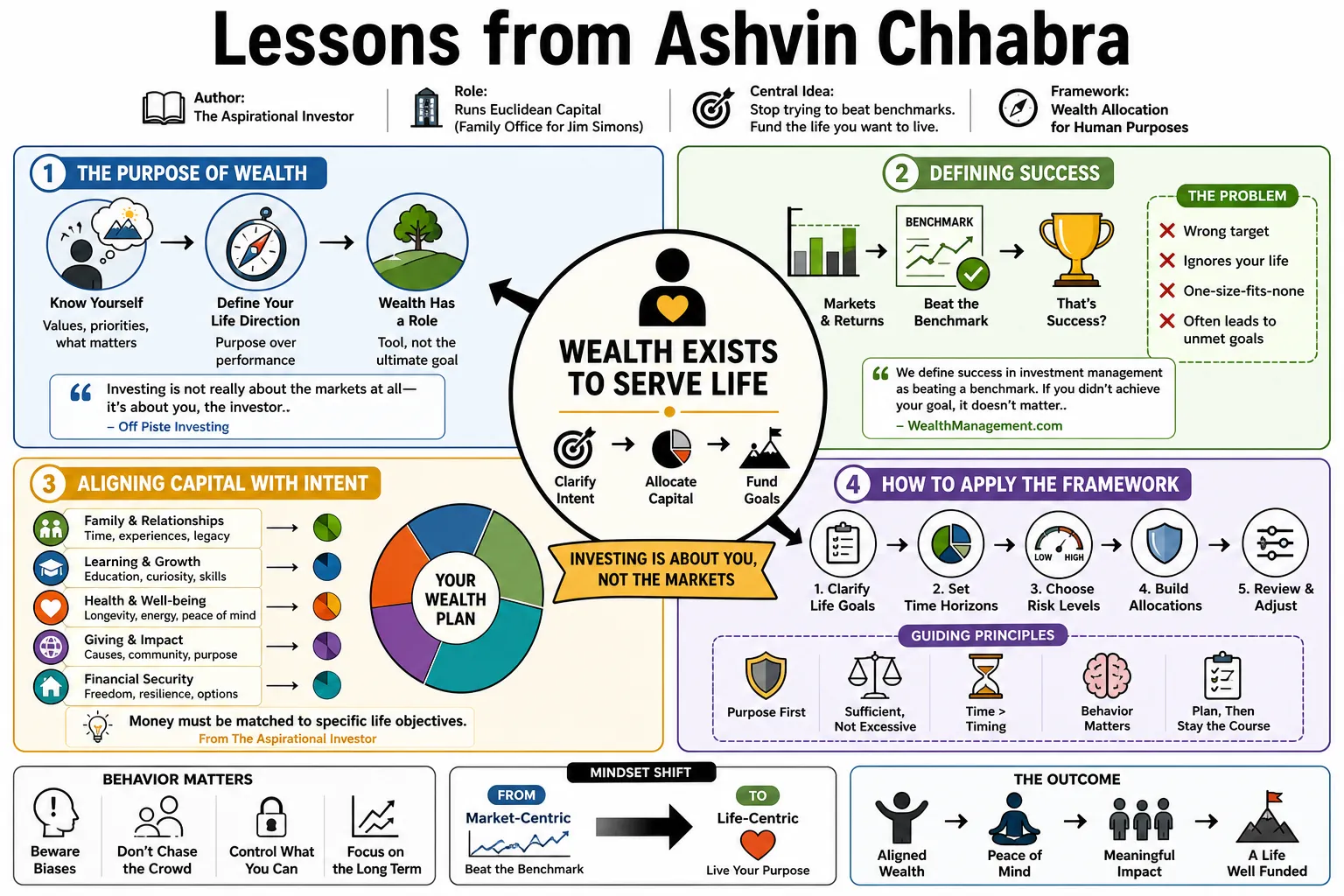
Ashvin Chhabra is President and CIO of Euclidean Capital and the author of The Aspirational Investor. His Wealth Allocation Framework combines modern portfolio theory with behavioral finance, organizing wealth around protection, market participation, and personal aspirations rather than benchmark outperformance alone. — The Aspirational Investor.
Part 1: The Purpose of Wealth
- On the Essence of Investing: Chhabra begins with the investor: what money is for, which goals matter, and how the whole balance sheet can help achieve them. — WealthManagement.com Q&A.
- On Defining Success: Judge investment success by whether personal goals are achieved. Beating a benchmark does not compensate for failing to fund an essential goal. — WealthManagement.com Q&A.
- On Wealth Creation versus Maintenance: Chhabra distinguishes wealth creation from preservation: a business or specialized earning power can create wealth, while liquidity and diversified market exposure help protect an established lifestyle. — Cafemutual Interview.
- On the Danger of Chasing Returns: During rising markets, investors can chase the next exciting company and lose wealth when a bubble breaks. Chhabra recommends securing essential goals instead of relying on speculative bets. — WealthManagement.com Q&A.
- On Life Goals as Benchmarks: The framework addresses three objectives: protecting essential needs, maintaining a standard of living, and preserving the possibility of substantially increasing wealth. Each calls for a different risk budget. — Beyond Markowitz.
- On Market Distractions: Chhabra advises ordinary investors to spend less attention on market movements and more on improving their own skills and taking care of their families. — Cafemutual Interview.
- On the True Measure of Risk: Volatility alone does not describe an investor’s risk. Cash-flow needs, life events, and the possibility of falling below a minimum acceptable wealth level also matter. — Beyond Markowitz.
- On Personalizing Portfolios: An allocation should reflect both the investor’s financial ability to take risk and their desire to avoid it, together with their goals and life stage. — Beyond Markowitz.
Part 2: The Flaws of Traditional Finance
- On the Limits of Modern Portfolio Theory: Diversification advice can be abandoned as soon as an exciting company appears. Chhabra treats that tension between safety and speculative opportunity as a problem a practical framework must address. — WealthManagement.com Q&A.
- On Standard Deviation as Risk: A portfolio’s average volatility can conceal a path that falls below the investor’s minimum wealth requirement before the expected reward arrives. The sequence of outcomes matters, not just the eventual average. — Beyond Markowitz.
- On the Flaws of the Mean-Variance Framework: A single mean–variance portfolio does not fully address the different purposes of an individual’s wealth. Chhabra adds personal and aspirational risk to the diversified market core. — Beyond Markowitz.
- On One-Size-Fits-All Advice: A stock–bond allocation is only part of the plan. Chhabra separately budgets safety, market exposure, and aspiration so that each serves the investor’s own objectives. — Beyond Markowitz.
- On the Endowments Model: Do not copy an endowment portfolio without examining the needs it serves. Chhabra places institutional spending, liquidity, and other obligations within a wider risk-allocation framework. — The Evolution of Modern Portfolio Theory.
- On "Once in a Century" Events: Chhabra questions risk models that make observed market crashes seem almost impossible. Historical discontinuities are a reason to examine protection beyond a portfolio’s average volatility. — Beyond Markowitz.
- On the Financial Industry's Priorities: Many investment products are organized around market benchmarks and risk-adjusted performance. Chhabra argues that the industry also needs solutions designed around clients’ goals. — WealthManagement.com Q&A.
- On Acknowledging Failure: A workable framework should accommodate investors’ psychological preferences and their reactions to losses, rather than assume that conventional diversification advice will always determine their behavior. — Beyond Markowitz.
Part 3: The Wealth Allocation Framework
- On the Core Strategy: Organize the balance sheet into personal or safety risk, market risk, and aspirational risk. Decide the risk allocation before selecting the assets within each bucket. — Beyond Markowitz.
- On Beyond Markowitz: Chhabra extends the Markowitz framework rather than discarding it: a diversified market portfolio sits alongside allocations for personal protection and aspirational goals. — Beyond Markowitz.
- On Compartmentalization: Separate wealth by purpose so that protection, market participation, and aspiration are not judged by one return target. The framework makes the trade-offs between these objectives explicit. — Beyond Markowitz.
- On the Independence of Buckets: Use different performance and risk measures for each bucket. Protective assets are assessed for downside protection, market assets against suitable market benchmarks, and aspirational assets for their targeted upside and loss risk. — Beyond Markowitz.
- On Aligning Risk with Purpose: After wealth has been accumulated, revisit the goals it needs to fund. Chhabra stresses a safety allocation and sufficient liquidity rather than jeopardizing that foundation to pursue another large gain. — Cafemutual Interview.
- On Managing Emotion: A safety portfolio can make it psychologically easier to retain market exposure and add during downturns. Chhabra presents this as a support for disciplined behavior, not a guarantee against panic. — WealthManagement.com Q&A.
- On Tailoring Allocations: Risk allocation changes with cash-flow needs, lifecycle stage, and the distance between current wealth and the investor’s minimum acceptable wealth level. — Beyond Markowitz.
- On Simplifying Complexity: Begin with three practical questions: what risks matter, whether the allocation across risk buckets is appropriate, and whether the assets within each bucket fit. More detailed analysis can follow. — Beyond Markowitz.
Part 4: The Safety Bucket
- On the Purpose of Safety: The protective bucket is intended to guard against a damaging decline in living standards. Its purpose is to fund the investor’s essential needs, not to maximize return. — Beyond Markowitz.
- On Defining Protective Assets: Protective assets can include cash, short-term government bonds, insurance, and a primary home net of its mortgage. Their role depends on the investor’s needs; a home is not equivalent to liquid cash. — Beyond Markowitz.
- On Peace of Mind: The value of protection includes reduced financial anxiety. Chhabra allows below-market expected returns in exchange for limiting downside risk. — Beyond Markowitz.
- On Immunity to Shocks: A market portfolio alone cannot supply protection from a market crash: it falls with the market. Chhabra therefore separates the assets intended to provide safety from ordinary market exposure. — WealthManagement.com Q&A.
- On Human Capital as Safety: Earning power is part of the balance sheet. A young professional’s future income can support risk-taking, but its stability and any associated debt must be considered. — Beyond Markowitz.
- On the Cost of Safety: Protection has a cost. In Chhabra’s illustrative portfolio, paying for downside protection reduces the expected return in ordinary conditions in exchange for a better outcome in a severe decline. — Beyond Markowitz.
- On Downside Protection: Keep enough liquidity to avoid selling a business at an unfavorable time merely to meet a cash shortfall. Chhabra treats that reserve as an important part of preserving wealth. — Cafemutual Interview.
- On Recognizing True Risk: Assess whether protective assets can meet actual obligations when needed. Chhabra’s examples include cash and short-term Treasury securities, while also accounting for inflation and other personal risks. — Beyond Markowitz.
Part 5: The Market Bucket
- On Maintaining Purchasing Power: The market bucket is intended to help maintain a standard of living over time. Exposure to diversified market assets addresses the erosion of purchasing power that cash alone may not offset. — Beyond Markowitz.
- On the Role of Diversification: Diversify the market bucket using the principles of modern portfolio theory. Chhabra retains that framework for market exposure while adding separate protection and aspiration allocations. — Beyond Markowitz.
- On Setting Expectations: The market portfolio seeks market returns, but their level and volatility are uncertain. Its role differs from both protective assets and the concentrated risks taken for aspiration. — WealthManagement.com Q&A.
- On Avoiding Idiosyncratic Risk: Avoid relying on a few concentrated positions for the diversified market core. Such holdings can rise sharply, but can also suffer losses from which they do not recover. — Beyond Markowitz.
- On the Folly of Stock Picking: Expectations of substantially beating the market can lead investors astray. Chhabra cautions that a large margin of outperformance is a low-probability outcome, not a reliable foundation for a financial plan. — Cafemutual Interview.
- On Passive vs. Active: Whether implemented through active or passive funds, the market allocation should provide diversified exposure at acceptable costs. Chhabra’s framework does not require the entire balance sheet to outperform a market index. — Beyond Markowitz.
- On Market Risk vs. Personal Risk: Market risk is one part of the plan, not a substitute for personal protection. The market bucket should be evaluated alongside the assets and obligations assigned to the safety bucket. — Beyond Markowitz.
- On Long-Term Compounding: A broadly diversified portfolio is designed to capture the underlying asset classes’ returns over the long run. The investor still needs enough financial resilience to remain invested through an adverse path. — Beyond Markowitz.
- On Benchmark Relevance: Compare the market bucket with a benchmark that reflects its asset mix, such as an appropriate combination of equity and bond indices. Different benchmarks are needed for protection and aspiration. — Beyond Markowitz.
Part 6: The Aspirational Bucket
- On Idiosyncratic Risk: Aspirational investments take targeted risks in pursuit of substantial gains, and can suffer substantial losses. Their risk profile differs from a broadly diversified market portfolio. — Beyond Markowitz.
- On the Nature of Aspirational Assets: Examples of aspirational assets include a family business, concentrated company stock, executive stock options, and leveraged investment property. Classification depends on both the asset and its purpose. — Beyond Markowitz.
- On Asymmetric Returns: Moving substantially upward in the wealth distribution generally requires more than incremental gains. Chhabra identifies aspirational risk as the willingness to pursue that possibility while recognizing the downside. — Beyond Markowitz.
- On the Lottery Ticket Mentality: The desire for both a safe cushion and a chance at a large gain is not unusual. Chhabra makes those competing preferences explicit through risk allocation rather than treating all wealth as one pool. — Beyond Markowitz.
- On Accepting Failure: Test what a severe loss in an aspirational position would do to the overall plan. Chhabra’s worked example examines company failure alongside a market decline before adjusting the allocation. — Beyond Markowitz.
- On Founder Concentration: Chhabra links substantial wealth creation to concentration, skill, and leverage that limits recourse to the rest of the balance sheet. He also warns that concentration without an edge can wipe out capital. — WealthManagement.com Q&A.
- On Skill and Alpha: An aspirational allocation can include education, specialization, or a career built around a particular skill—not just a financial investment. Chhabra emphasizes developing an edge rather than speculation alone. — WealthManagement.com Q&A.
- On Managing Windfalls: As wealth changes, reconsider the balance between protection, market exposure, and aspiration. In Chhabra’s executive example, reducing a concentrated stock holding funds protective assets and reduces debt. — Beyond Markowitz.
- On the Meaning of Wealth: Aspirational goals may involve a person’s education, specialized work, or passion. Chhabra’s framework therefore goes beyond paying ordinary expenses or selecting securities. — WealthManagement.com Q&A.
Part 7: Behavioral Biases and the Human Element
- On Integrating Kahneman and Tversky: Chhabra explicitly draws on prospect theory and investors’ preferences for certainty, probability, and possibility. The framework combines those behavioral considerations with modern portfolio theory. — Beyond Markowitz.
- On the Investor's Worst Enemy: Investors can undermine their own plans through unrealistic return expectations. Chhabra argues for education about the difficulty of beating markets, alongside clearer goals and risk boundaries. — Cafemutual Interview.
- On Loss Aversion: Chhabra incorporates the way investors evaluate gains and losses relative to a reference level. He also seeks to discourage doubling down on risk when losses appear likely. — Beyond Markowitz.
- On Mental Accounting: Segment assets according to the goals they must serve. Chhabra incorporates psychological preferences into a consistent overall allocation rather than assuming that every part of wealth has the same purpose. — Beyond Markowitz.
- On the Role of the Advisor: An advisor can add value by helping clients navigate bubbles and crashes and remain focused on goals. Chhabra sees this as a more important role than trying to identify the next benchmark-beating manager. — WealthManagement.com Q&A.
- On Regret Minimization: The framework balances protection against damaging losses with the possibility of pursuing aspirations. An investor need not choose between putting every asset at risk and abandoning all opportunities for upside. — Beyond Markowitz.
- On Narrative Bias: Excitement about the next apparently transformative company can displace diversification discipline. Chhabra warns against treating that story as a reason to put essential goals at risk. — WealthManagement.com Q&A.
- On Knowing Thyself: Examine financial capacity, desired lifestyle, minimum acceptable wealth, and personal risk preferences together. A risk questionnaire alone is not the whole assessment. — Beyond Markowitz.
Part 8: Markets, Risk, and Complexity
- On Lessons from Physics: Chhabra tests the implications of a volatility-based model against actual market crashes. A convenient mathematical description is insufficient if it misses outcomes that can threaten an investor’s plan. — Beyond Markowitz.
- On Fat Tails: Chhabra notes that market instability appears in fat-tailed return distributions and can come in clusters. Protection should be considered beyond an assumption of independent, mild fluctuations. — The Evolution of Modern Portfolio Theory.
- On Evaluating Managers: Understand how a manager achieved past performance, whether they maintain their discipline, and whether growth in assets could impair it. Chhabra also emphasizes integrity rather than choosing on a return record alone. — Cafemutual Interview.
- On the Limits of Prediction: Construct and test the plan against adverse market outcomes instead of assuming a favorable forecast. Chhabra includes scenario analysis and robustness checks, and warns that dynamic protection can fail when it is needed most. — Beyond Markowitz.
- On the Allocator's Dilemma: Institutional allocators must balance protection, diversified market participation, and higher-risk opportunities in the context of spending and other obligations. Chhabra puts that balance ahead of asset selection alone. — The Evolution of Modern Portfolio Theory.
- On Interest Rates: Interest-rate exposure matters within the whole balance sheet. In Chhabra’s example, switching a floating-rate home mortgage to a fixed rate reduces exposure to rising rates, even at a slightly higher initial rate. — Beyond Markowitz.
- On Institutional vs. Individual Risk: An institution’s long horizon does not remove its near-term spending and liquidity needs. Chhabra warns against treating a perpetual institution as though its investment portfolio can ignore those obligations. — The Evolution of Modern Portfolio Theory.
- On Navigating Uncertainty: The framework organizes resources around personal, market, and aspirational risks. It calls for testing the plan and revisiting it as conditions and goals change, rather than relying on one permanent allocation. — Beyond Markowitz.
Learn more:
- WealthManagement.com — Q&A With Ashvin Chhabra: You’re Investing All Wrong
- Ashvin B. Chhabra — Beyond Markowitz: A Comprehensive Wealth Allocation Framework for Individual Investors
- The Aspirational Investor — Official Book and Author Page
- Ashvin B. Chhabra — The Evolution of Modern Portfolio Theory for the Institutional Investor (NMS Exchange, November 2012)
- Cafemutual — To Become Wealthy, Invest in Yourself: Dr. Ashvin Chhabra