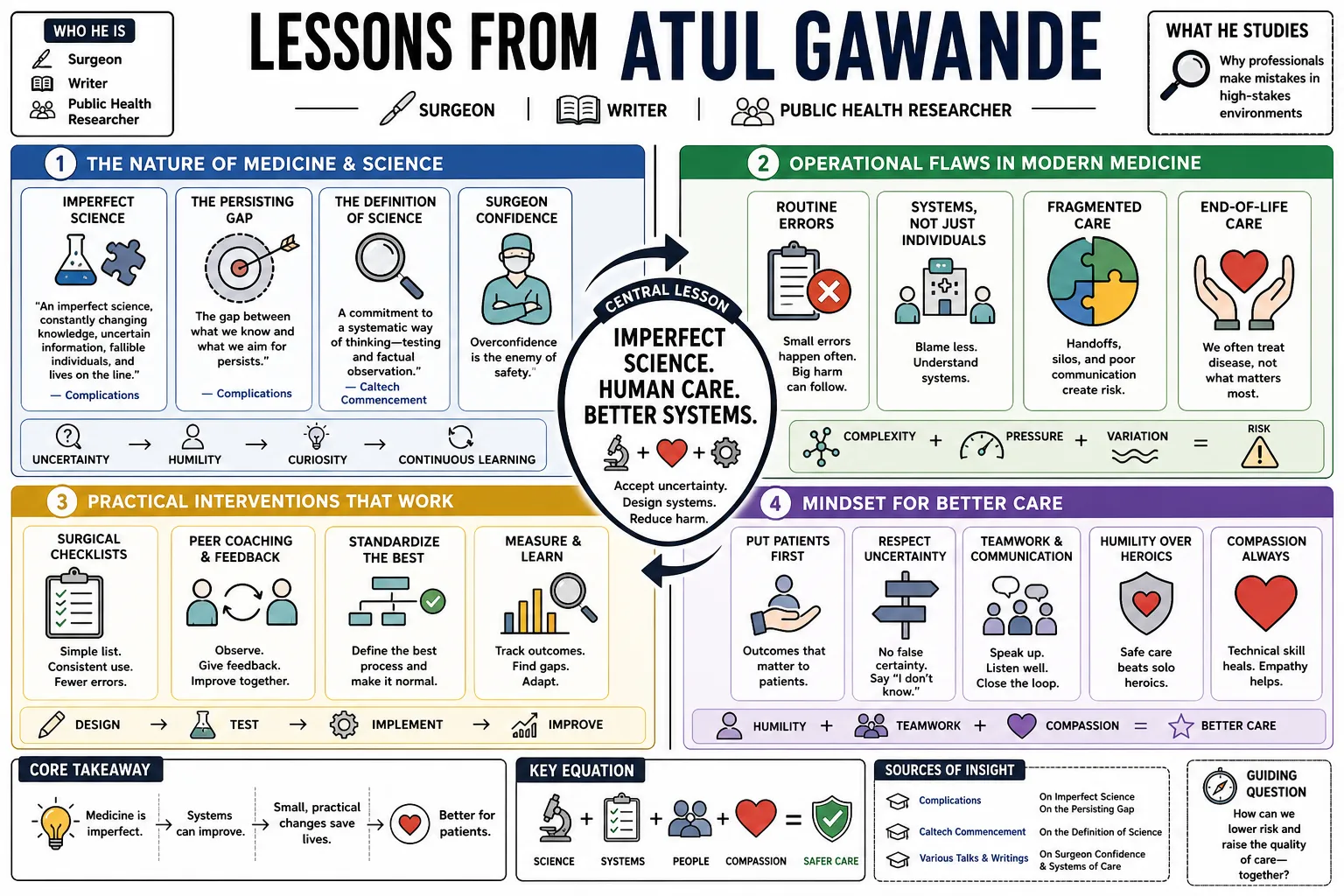
Atul Gawande is a surgeon, writer, and public-health researcher. His work examines medical fallibility, coordinated care, professional learning, and how medicine can better serve people facing mortality. — Atul Gawande — Biography.
Part 1: The Nature of Medicine and Science
- On Imperfect Science: Medicine operates with uncertainty and fallible people. Gawande argues that acknowledging these limits should sustain efforts to improve care, not excuse avoidable mistakes. — When Doctors Make Mistakes.
- On the Persisting Gap: Scientific knowledge does not automatically become reliable care. Gawande describes the difficulty of coordinating complicated capabilities held by many different people. — Publishers Weekly — In the Belly of the Medical Machine.
- On the Definition of Science: Science is a disciplined method of testing explanations against observation, not merely a qualification or profession. Its commitments matter beyond scientific careers. — The Mistrust of Science.
- On Surgeon Confidence: Act despite imperfect information, but remain alert to signs that the plan is failing. Confidence needs humility and willingness to listen. — Williams Commencement — Failure to Rescue.
- On Healthy Fear: An unnamed surgeon quoted by Gawande describes some fear as a safeguard against complacency. Gawande also examines how paralyzing self-doubt can undermine action. — When Doctors Make Mistakes.
- On Solitary Intellectualism: Reliable care depends on everyday practices and the conditions that make them possible. Knowing that hand hygiene matters is different from consistently enabling it. — BBC Reith Lecture — The Idea of Well-Being.
- On Ethics vs. Progress: Training creates a difficult tension between patients’ desire for experienced care and society’s need for future expertise. Gawande questions how unequally patients bear that burden. — The Learning Curve.
- On Etiquette vs. Technology: Expertise does not remove the need for respectful human interaction. Gawande describes how recognizing a patient’s distress changed an otherwise antagonistic encounter. — Curiosity and What Equality Really Means.
- On Clinical Complexity: Complex care can exceed one clinician’s capabilities. Gawande argues for teams deliberately coordinating their different skills around common goals for patients. — Cowboys and Pit Crews.
- On Heroic Expectations: Dramatic interventions are not the only valuable medicine. Chronic problems often require sustained attention, repeated adjustments, and a more patient kind of skill. — The Heroism of Incremental Care.
Part 2: Human Fallibility and Ineptitude
- On Types of Failure: Failure can arise from not applying available knowledge reliably, rather than lacking expertise. Gawande argues that coordinating delivery deserves attention alongside scientific discovery. — PBS NewsHour — The Checklist Manifesto.
- On Dumb Mistakes: Serious mistakes are not confined to obviously careless clinicians. Gawande examines how ordinary, capable doctors can err, making learning and prevention broader than identifying bad individuals. — When Doctors Make Mistakes.
- On Guilt vs. Shame: After an error, guilt about an action can become shame about one’s whole identity. Gawande describes that distinction without treating shame as a remedy. — When Doctors Make Mistakes.
- On Forgiving Error: Recognize that clinicians will sometimes make mistakes while continuing to demand serious improvement. Accepting fallibility is not the same as abandoning responsibility. — When Doctors Make Mistakes.
- On the Human Element: Improvement takes continuing effort within imperfect organizations. Gawande looks for workable patterns and creative responses rather than assuming that technical knowledge alone fixes delivery. — Publishers Weekly — In the Belly of the Medical Machine.
- On Character Under Failure: When medicine cannot solve a patient’s problem, honesty, comfort, and guidance remain responsibilities. Gawande criticizes his own failure to offer them alongside treatment options. — Being Mortal — Authorized Excerpt.
- On Defining Worth: A person is more than their best or worst act. Gawande argues for recognizing a shared humanity even in people whose behavior is difficult. — Curiosity and What Equality Really Means.
Part 3: The Power of Checklists and Systems
- On Discipline: Skill alone does not ensure reliable execution. Gawande presents discipline as a practiced commitment to agreed standards, alongside humility and teamwork. — Cowboys and Pit Crews.
- On Defending Against Failure: Checklists help protect against forgotten essentials and overlooked steps, including among experienced professionals. They support attention rather than establish infallibility. — The Checklist.
- On Outdated Heroism: Treating a checklist as a sign of weakness can obstruct its use. Gawande favors acknowledging the possibility of error over performing infallibility. — Democracy Now! — Atul Gawande on Checklists.
- On Bad Checklists: A checklist can become counterproductive paperwork when it switches thinking off. Gawande rejects command-and-control tick boxes in favor of aids that support teams. — Democracy Now! — Atul Gawande on Checklists.
- On Good Checklists: Keep a checklist focused enough to use in real work. Gawande’s design combines essential checks with preparation for problems that require team judgment. — PBS NewsHour — The Checklist Manifesto.
- On Adapting to Complexity: Do not use a checklist to dictate every response to complexity. Gawande describes it as a team aid, not a substitute for thinking. — Democracy Now! — Atul Gawande on Checklists.
- On Revolutionizing Industries: Medicine can learn from other high-risk fields. Gawande identifies checklists as one coordination tool used in aviation, engineering, and construction. — Cowboys and Pit Crews.
- On Judgment vs. Protocol: Systems and judgment are complements. Gawande argues for coordination and disciplined checks while retaining the need for creative, wise decisions. — Cowboys and Pit Crews.
Part 4: Mastery, Coaching, and Performance
- On Practice and Intuition: Practice can turn consciously managed fragments into more fluent performance. Gawande describes this change in his own training without equating fluency with infallibility. — The Learning Curve.
- On Perfection Without Practice: Demanding expertise while rejecting all opportunities to learn creates a contradiction. Gawande examines the need for supervised practice alongside obligations to patients. — The Learning Curve.
- On the Value of Coaching: Good coaching can help improve performance, but its quality matters. Gawande explicitly acknowledges that poor coaching can be ineffective or harmful. — Personal Best.
- On Potential: Qualification is not the end of learning. Gawande questions whether accomplished professionals can always identify and address their own performance plateaus. — Personal Best.
- On External Reality: An outside observer can reveal blind spots that the performer misses. Gawande’s coach noticed practical details he had not recognized on his own. — Personal Best.
- On Preparation: Improvement requires attentive practice rather than repetition alone. Gawande discusses working on specific weaknesses and fundamentals before expecting better performance. — Personal Best.
- On Cowboys vs. Pit Crews: Reward coordinated teams rather than individual heroics alone. Gawande’s pit-crew analogy emphasizes people directing specialized capabilities toward a shared patient goal. — Cowboys and Pit Crews.
- On the Mastery of Rescue: Prepare to recognize and respond when a plan fails. Gawande emphasizes timely adaptation and rescue, not merely willingness to take risks. — Williams Commencement — Failure to Rescue.
Part 5: Aging, Mortality, and End-of-Life Care
- On Normalizing Death: Mortality is not itself a medical failure. Gawande distinguishes accepting life’s limits from neglecting people facing them. — Being Mortal — Authorized Excerpt.
- On Unwinnable Wars: Recognize when treatment’s burdens outweigh its achievable goals. Gawande argues for guidance through medical limits, not indefinite escalation. — Letting Go.
- On Medicalizing Mortality: Medical advances changed the experience of aging and dying, but clinicians were not adequately prepared to address its human consequences, Gawande argues. — Being Mortal — Authorized Excerpt.
- On Quality Over Time: The goal is living as well as possible through the time remaining, not treating a good death as a separate technical achievement. — On Being — On Mortality and Meaning.
- On Life as a Story: People need some control over the story of their lives. Gawande uses that perspective to question care organized only around safety and survival. — On Being — On Mortality and Meaning.
- On Meaningful Endings: The final phase of life can affect those who remain. Gawande describes the importance of farewells and a piano teacher’s lasting gifts to her students. — On Being — On Mortality and Meaning.
- On Redefining Our Job: Healthcare’s purpose is broader than survival alone. Gawande argues for systems that support the reasons people wish to remain alive. — BBC Reith Lecture — The Idea of Well-Being.
- On Fighting for What Matters: Ask what treatment is meant to preserve. Gawande reframes the choice from fighting versus giving up to protecting what matters to the person. — On Being — On Mortality and Meaning.
- On Patient Priorities: Gawande reports priorities beyond longer survival, including comfort, family, awareness, and avoiding burdens. Patients’ own priorities should guide discussion. — Letting Go.
Part 6: Autonomy and What Matters in the End
- On Retaining Authorship: Needing help should not automatically remove a person’s say over their life. Gawande questions institutional routines that place safety above individual agency. — On Being — On Mortality and Meaning.
- On Maintaining Identity: Care can protect people while disconnecting them from familiar activities and relationships. Gawande argues for preserving what makes life meaningful to the individual. — Being Mortal — Authorized Excerpt.
- On Listening: Make room to learn who the patient is beyond the medical task. Gawande recommends an unscripted question that opens a genuine conversation. — Harvard Commencement — Five Rules.
- On Saying Yes: Gawande cites Bob Wachter’s advice about exploring earlier and becoming more selective later. He treats trying things as a way to discover meaningful commitments. — Stanford — 2021 Commencement Address.
- On Experiencing Life: You cannot fully predict which experiences will matter to you. Gawande encourages openness to unfamiliar opportunities rather than waiting for a predetermined passion. — Stanford — 2021 Commencement Address.
- On the Importance of How We Think: Credentials do not make someone an authority on truth. Gawande emphasizes curiosity, openness, disciplined inquiry, and collective scrutiny as habits relevant to citizenship. — The Mistrust of Science.
Part 7: Diligence, Ingenuity, and Improvement
- On Achieving Better: Improvement can come from morally clear goals and practical ingenuity. Gawande describes modest tools prompting many useful changes, rather than relying solely on spectacular discoveries. — Publishers Weekly — In the Belly of the Medical Machine.
- On the Absence of Easy Fixes: Complex work depends on many ordinary steps going right together. Gawande examines missed essentials that additional technology or expertise alone does not automatically prevent. — The Checklist.
- On Diligence: Diligence can mean returning to an unglamorous task instead of assuming someone else has handled it. Gawande’s example turns on conscientious follow-through. — Better — Authorized Introduction Excerpt.
- On the Nature of Ingenuity: Recognize shortcomings and be willing to change. Gawande favors testing and measuring an alternative over either reflexive resistance or uncritical enthusiasm. — Harvard Commencement — Five Rules.
- On the Fear of Failing: Fear should not make you unable to act or revise a plan. Gawande pairs confidence with responsiveness to evidence that something is wrong. — Williams Commencement — Failure to Rescue.
- On Being a Scientist: Count something that interests you. Gawande recommends systematic observation as a practical way to discover patterns rather than relying only on impressions. — Harvard Commencement — Five Rules.
- On Writing: Writing helps clarify what you have observed and connect with others. Gawande encourages recording even small findings rather than waiting for a grand contribution. — Harvard Commencement — Five Rules.
- On Complaining: Avoid habitual complaining that drains a team without improving anything. Gawande distinguishes engagement in the work from simply dwelling on its frustrations. — Harvard Commencement — Five Rules.
Part 8: Communication, Connection, and Change
- On Frictionless Solutions: Technology does not make behavioral change frictionless. Gawande emphasizes person-to-person interaction when changing routines and shared expectations. — Slow Ideas.
- On Speeding Change: Trust can grow through repeated, practical interaction. In Gawande’s account, a nurse became more receptive when a coach was experienced as a helpful colleague. — Slow Ideas.
- On Obsession with Data: Measure performance and investigate disappointing results. Gawande describes learning from stronger performers and adapting care, not treating effort alone as proof of quality. — The Bell Curve.
- On Scaling Solutions: A successful idea still needs workable delivery. Gawande stresses identifying local barriers rather than assuming the same roadmap will implement itself everywhere. — BBC Reith Lecture — The Idea of Well-Being.
- On Execution Over Discovery: Discovery alone is not enough. Gawande calls for studying how institutions deliver knowledge reliably, while continuing to invest in scientific research. — BBC Reith Lecture — The Idea of Well-Being.
- On Healthcare Costs: More expensive care is not necessarily better care. Gawande argues for examining how stronger-performing systems coordinate work, rather than equating spending with quality. — Cowboys and Pit Crews.