Audrey Tang is a Taiwanese programmer and former Minister of Digital Affairs. Working with civic technologists and public servants, Tang has championed open data, public deliberation and collaborative governance. These lessons examine transparency, digital democracy, shared problem-solving and self-directed learning. — Global Campus of Human Rights — Audrey Tang Interview.
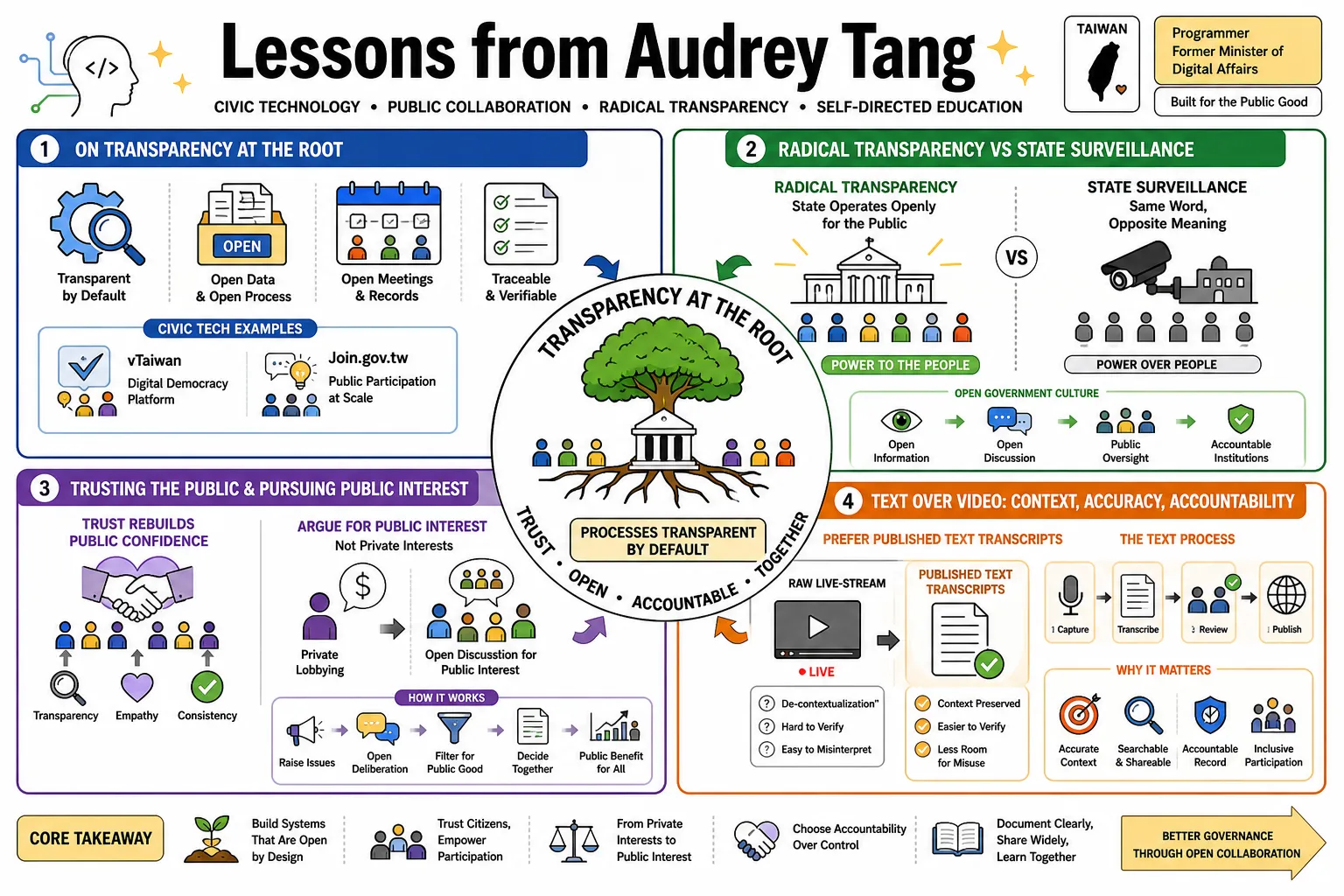
Part 1: Radical Transparency
- On transparency at the root: Make public-interest deliberation open by default, while protecting unrelated people’s privacy and confidentiality. — Politics East Asia — Digital Politics.
- On state surveillance: Transparency should expose government to citizens, not turn citizens into objects of state surveillance. Tang contrasts these directions of digital power. — RadicalxChange — Identity, Work and Democracy.
- On trusting the public: Demonstrate trust in citizens by showing how decisions are made, including failures, rather than demanding confidence in officials. — Framer Framed — Defining the Internet.
- On public interest lobbying: Publicly documented lobbying encourages advocates to explain benefits beyond themselves. Tang describes publishing office-hour conversations so others can scrutinize their arguments. — 80,000 Hours — Taiwan’s Democracy Experiments.
- On text over video: A participant-reviewed transcript can preserve context that a short video clip loses. Tang favors correcting errors and explaining references before publication. — Politics East Asia — Digital Politics.
- On healing polarization: Tang’s aim is to use collaborative technology to bridge divisions. She treats polarization as a design problem, not an inevitable feature of the internet. — Global Campus of Human Rights — Audrey Tang Interview.
- On citizen co-creation: Open data can let citizens help design and improve public services. Tang describes government and civic technologists co-creating mask maps rather than officials acting alone. — Global Campus of Human Rights — Audrey Tang Interview.
- On infrastructure for truth: Civic communication infrastructure can let people inspect events directly. Tang describes g0v’s livestreaming and documentation during the Sunflower occupation as a way to counter rumors. — Conversations with Tyler — Technology of Democracy.
Part 2: Plurality and Collaborative Technology
- On the internet of beings: Tang’s job-description poem reframes connected devices around living beings, putting people and relationships ahead of objects. — Framer Framed — Defining the Internet.
- On shared reality: Immersive technology becomes socially useful when people can enter and discuss an experience together, rather than remain in isolated virtual worlds. — Conversations with Tyler — Technology of Democracy.
- On collaborative learning: Tang’s poem redirects the focus from machine learning to collaborative learning: technology should help people learn together. — Framer Framed — Defining the Internet.
- On human experience: Tang’s poem asks designers to consider human experience rather than treating people only as users of a product. — Framer Framed — Defining the Internet.
- On the singularity: Tang contrasts a singular technological future with the plurality already present: many people, perspectives and ways of participating. — Framer Framed — Defining the Internet.
- On defining plurality: Plurality means fostering shared values while making room for differences and innovation without top-down control. Tang presents it as an approach to governance. — Global Campus of Human Rights — Audrey Tang Interview.
- On finding uncommon ground: Look for proposals that resonate across groups that otherwise disagree. Polis surfaces cross-group agreement rather than merely counting the largest faction. — 80,000 Hours — Taiwan’s Democracy Experiments.
- On conflict as energy: Conflict can become material for co-creation rather than domination. Tang’s goal is to turn contested digital spaces toward shared problem-solving. — Global Campus of Human Rights — Audrey Tang Interview.
- On digital work: Digital work concerns new possibilities for social relationships, not only communication between machines. Tang distinguishes that purpose from information technology alone. — RadicalxChange — Identity, Work and Democracy.
Part 3: Continuous Digital Democracy
- On democracy as technology: Treat democracy as a social technology that citizens can help develop. Tang compares contributing to constitutional change with contributing to software. — Conversations with Tyler — Technology of Democracy.
- On day-to-day engagement: Participation should extend beyond elections. Tang describes shorter consultation cycles as a way to hear changing concerns and revise policy more regularly. — Conversations with Tyler — Technology of Democracy.
- On low bandwidth: A signature alone communicates little. Tang contrasts petition systems that count support with consultations that invite petitioners to help develop the response. — 80,000 Hours — Taiwan’s Democracy Experiments.
- On rough consensus: Use opinion clusters to find workable shared criteria, not to erase disagreement. Tang describes crowdsourcing an agenda before stakeholders work on policy details. — 80,000 Hours — Taiwan’s Democracy Experiments.
- On fast, fair, and fun: Participation should produce useful collective insight promptly, treat contributions fairly, and feel rewarding. Tang’s fast, fair and fun criteria work together. — How to Citizen — Fast, Fair, Fun.
- On government neutrality: Let participants help choose which problems receive attention. Tang describes distributed curation rather than letting her personal preferences determine the agenda. — 80,000 Hours — Taiwan’s Democracy Experiments.
- On decentralized decision-making: Distribute agenda-setting across participants and institutions. Tang describes interagency participation officers choosing issues for collaborative attention instead of one minister selecting everything. — 80,000 Hours — Taiwan’s Democracy Experiments.
- On debugging governance: Democratic institutions can be examined and improved as social technologies. Tang uses bandwidth and response time to think about more responsive participation. — 80,000 Hours — Taiwan’s Democracy Experiments.
Part 4: The Conservative Anarchist
- On conservative anarchism: Conservative anarchism combines respect for existing traditions with resistance to coercion. Tang honors traditions without requiring others to remain within them. — 80,000 Hours — Taiwan’s Democracy Experiments.
- On voluntary cooperation: Prefer voluntary association over command. Tang describes working with institutions and communities rather than treating people as recipients of orders. — 80,000 Hours — Taiwan’s Democracy Experiments.
- On forking systems: Improve an institution by developing an alternative that can be integrated back into it. Tang’s forking analogy is constructive, not a call to destroy government. — How to Citizen — Fast, Fair, Fun.
- On preserving diversity: Preserving linguistic diversity requires more than storing languages. Tang emphasizes helping speakers feel represented and enabling others to learn their language and culture. — Internet Academy — The More You Participate.
- On avoiding coercion: Seek workable agreement and voluntary cooperation, while recognizing limits. Tang acknowledges that scarcity can require fair, self-correcting restrictions and argues for innovations that reduce their necessity. — 80,000 Hours — Taiwan’s Democracy Experiments.
- On non-monist affiliation: Social life is organized through overlapping communities, not only isolated individuals. Tang gives groups room to establish norms while allowing people to join, leave or fork. — 80,000 Hours — Taiwan’s Democracy Experiments.
- On structural obsolescence: Build alternatives that reduce the need for coercive structures. Tang explicitly connects this approach to Buckminster Fuller’s idea of making old systems obsolete through better ones. — 80,000 Hours — Taiwan’s Democracy Experiments.
Part 5: Humor Over Rumor and Fighting Disinformation
- On humor over rumor: Use humor that invites people to laugh together, not attacks that humiliate opponents. Tang argues that friendly humor can defuse outrage around misinformation. — Conversations with Tyler — Technology of Democracy.
- On the speed of fun: Respond quickly with engaging, factual communication. Tang describes trying to make humor and facts travel faster than rumors before a discussion becomes more divisive. — Conversations with Tyler — Technology of Democracy.
- On prebunking: Prepare people for manipulation before it becomes familiar. Tang describes publicly demonstrating a deepfake of herself and explaining the need to verify its provenance. — Your Undivided Attention — Future-Proof Democracy.
- On avoiding censorship: Build civil-society fact-checking and platform accountability rather than giving government sole control of truth. Tang describes voluntary co-governance; this does not mean all moderation disappears. — Politics East Asia — Digital Politics.
- On resilience: Information resilience depends on people being able to produce, check and shape information, not merely consume it. Tang calls this digital competence. — Global Campus of Human Rights — Audrey Tang Interview.
- On memetic engineering: Concrete, friendly memes can make public guidance easier to share. Tang describes the health ministry’s dog mascot explaining mask use and physical distance in everyday terms. — Conversations with Tyler — Technology of Democracy.
- On digital architecture: Design civic spaces for constructive discussion rather than advertising-driven attention. Tang argues that the same people can behave differently when a platform rewards listening. — 80,000 Hours — Taiwan’s Democracy Experiments.
- On community moderation: Collaborative fact-checking lets people flag messages and contribute context. Tang describes Cofacts pairing circulating information with crowdsourced checks and clarifications. — Your Undivided Attention — Future-Proof Democracy.
Part 6: Open Source and Civic Hacking
- On the ethos of g0v: g0v’s civic hackers made government information easier to discuss through open-source alternatives. Tang describes replacing the o in gov.tw with zero and visualizing budget items. — Politics East Asia — Digital Politics.
- On civic hacking: Civic hacking creates tools that make public information accessible and turn observers into participants. Tang presents her role as bridge-building rather than destructive disruption. — Global Campus of Human Rights — Audrey Tang Interview.
- On public code: Tang applies public-money, public-code reasoning to digital infrastructure: publicly supported systems should use open code and standards that others can inspect and share. — Audrey Tang — Trust by Design.
- On the permissionless state: Open data and APIs can let citizens improve services without waiting for a new government procurement. Tang explicitly excludes data constrained by privacy, trade secrets or national security. — 80,000 Hours — Taiwan’s Democracy Experiments.
- On the right to fork: The right to fork lets people improve a project in a different direction without controlling everyone else’s version. Open code supports alternatives that can later be reconciled. — 80,000 Hours — Taiwan’s Democracy Experiments.
- On protesters: Bring civic activists into practical collaboration with public servants. Tang describes reverse mentorship after Sunflower as a way for officials to learn public engagement from occupiers. — Politics East Asia — Digital Politics.
- On open data: Opening useful public data can demonstrate trust in citizens’ ability to contribute. Tang describes reciprocal trust emerging through the collaborative mask-map work. — Global Campus of Human Rights — Audrey Tang Interview.
- On digital plumbing: Provide spaces and infrastructure in which people can organize their own contributions. Tang describes holding that space rather than personally doing every project. — Conversations with Tyler — Technology of Democracy.
Part 7: Daoism, Emptiness, and Identity
- On emptiness: Drawing on Laozi’s Dao De Jing, Tang describes leadership as making space for others to contribute. She uses the empty-pot metaphor to explain her role in the mask-map portal. — WIRED — How Taiwan Hacked the Pandemic.
- On post-gender identity: Tang describes finding non-binary peers online and sharing experiences beyond her immediate neighborhood. This account challenges the assumption that everyone fits a single local gender norm. — RadicalxChange — Identity, Work and Democracy.
- On vulnerability: In Tang’s own account, experiencing different aspects of puberty helped her empathize across gender differences. This is personal testimony, not a general psychological or medical claim. — Conversations with Tyler — Technology of Democracy.
- On bridging divides: Tang describes Daoist breathing as a childhood survival practice and Daoism as making room for opposing views to develop into shared values. These are her experiences and beliefs. — Conversations with Tyler — Technology of Democracy.
- On language: Tang notes that Mandarin’s principal third-person pronouns sound alike, allowing flexibility in how people address her. — The Guardian — The Good Hacker.
- On adversity: Tang invokes Leonard Cohen when explaining why imperfection can invite collaboration. Sharing unfinished work gives others an opening to correct, contribute and adapt it. — MIT Solve — Steer the Machine and Save Democracy.
- On cyber peace: Digital peace requires practicing deliberation and listening across differences. Tang urges people to build collaborative civic tools rather than accepting surveillance or polarization as the default. — Global Campus of Human Rights — Audrey Tang Interview.
- On sharing credit: Make contributors’ work visible and credit them by name. Tang describes public transcripts directing recognition to the public servant who proposed an innovation rather than concentrating it on the minister. — Politics East Asia — Digital Politics.
Part 8: Redefining Education and Learning
- On contributing: Share what you learn so others can build on it. Tang describes open-source commons as places where sharing can expand what participants collectively have. — MIT Solve — Steer the Machine and Save Democracy.
- On self-teaching: The internet let Tang contact researchers beyond her local school and geography. She describes learning through shared interests without having to travel to each expert. — Internet Academy — The More You Participate.
- On collaboration over competition: Favor collaborative inquiry over ranking everyone on one track. Tang argues that learners can choose a problem and join others from different disciplines and cultures. — RadicalxChange — Identity, Work and Democracy.
- On media competence: Teach learners to create media and narratives, not merely memorize standardized answers. Tang describes competence-based education as a shift toward active production. — Conversations with Tyler — Technology of Democracy.
- On outdated curricula: Allow learning routes to respond to where knowledge is being developed. At fourteen, Tang arranged to leave school for online research because her textbooks lagged behind the work she wanted to study. — How to Citizen — Fast, Fair, Fun.
- On continuous learning: Make continued learning a normal shared activity. Tang argues that people keep learning when their community supplies reasons, examples and opportunities to do so. — Internet Academy — The More You Participate.
- On intellectual autonomy: Give learners agency to choose meaningful questions and connect with others pursuing them. Tang’s model combines autonomy with participation in a wider learning community. — RadicalxChange — Identity, Work and Democracy.