Austan Goolsbee is an economist whose research and public-service experience span taxation, digital markets and monetary policy. He served as chair of President Obama’s Council of Economic Advisers. The lessons below distinguish his research findings, historical policy arguments and personal assessments from universal rules. — Conversations with Tyler — Austan Goolsbee.
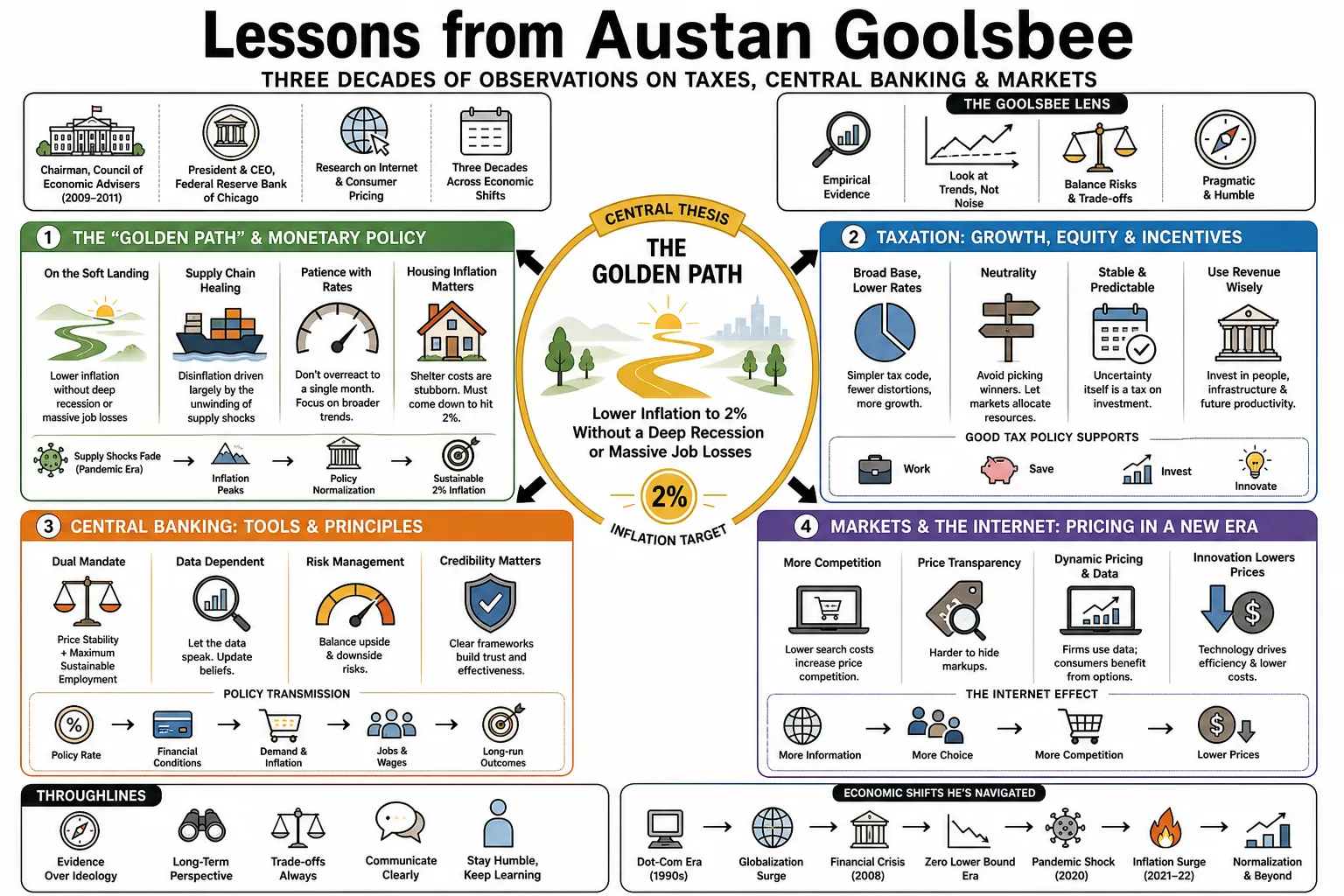
Part 1: The "Golden Path" and Monetary Policy
- On the soft landing: In his September 2023 speech, Goolsbee argued that inflation could return to the target without a recession. He called this the golden path, while stressing that it was not guaranteed. — The 2023 Economy: Not Your Grandpa’s Monetary Policy Moment.
- On supply chain healing: Goolsbee attributed part of the improvement in inflation to healing supply chains and recovering labor supply, not monetary restraint alone. — The 2023 Economy: Not Your Grandpa’s Monetary Policy Moment.
- On patience with interest rates: Judge inflation over a longer stretch rather than reacting mechanically to one monthly reading. Goolsbee emphasized this approach in his April 2024 remarks. — Chicago Fed — April 2024 Economic Outlook.
- On housing inflation: Official shelter inflation can lag changes in market rents. In August 2024, Goolsbee described that lag as a key puzzle in assessing progress against inflation. — Face the Nation — August 2024 Interview.
- On the labor market: Goolsbee argued that anchored inflation expectations could help the Fed reduce inflation with less damage to employment than in earlier episodes. Credibility mattered; this was not a guarantee that disinflation is painless. — The 2023 Economy: Not Your Grandpa’s Monetary Policy Moment.
- On data dependence: Let incoming evidence and the causes of a shock guide policy, rather than treating every cycle as the same demand-driven problem. Goolsbee describes his approach as data-dependent. — Conversations with Tyler — Austan Goolsbee.
- On the dangers of overtightening: Holding nominal rates steady while inflation falls can make policy more restrictive in real terms. Goolsbee warned in August 2024 that staying too tight for too long could harm employment. — Face the Nation — August 2024 Interview.
- On historical comparisons: Do not assume the post-pandemic inflation episode must repeat the Volcker-era trade-off. Goolsbee emphasized differences in supply shocks and the Fed’s credibility. — The 2023 Economy: Not Your Grandpa’s Monetary Policy Moment.
- On the dual mandate: The Fed’s mandate concerns maximum employment and stable prices. Goolsbee argues that financial markets matter insofar as they affect those real-economy objectives. — Monetary Policy Moments and Financial Uncertainty.
- On long-term rates: Do not assume the appropriate rate is fixed by its past level. In his November 2024 interview, Goolsbee explained that a sustained increase in productivity growth could raise the neutral rate. — The Overshoot — Austan Goolsbee Interview.
Part 2: The Digital Economy and Internet Markets
- On e-commerce competition: Goolsbee and Jeffrey Brown’s research found that internet price comparison was associated with lower term-life insurance prices in the 1990s. The result was specific to products that comparison sites made easier to compare. — Does the Internet Make Markets More Competitive?.
- On local taxes and online sales: Goolsbee’s research found that local sales taxes influenced early internet purchasing. This describes behavior under the tax arrangements studied in the 1990s, not today’s sales-tax rules. — In a World Without Borders.
- On measuring digital value: Spending alone can understate the consumer value of a time-intensive service. Goolsbee and Peter Klenow used time spent online to estimate internet benefits, with results dependent on the model’s assumptions. — Valuing Consumer Products by Time Spent Using Them.
- On broadband adoption: Barriers that delay broadband adoption can reduce its consumer benefits. Goolsbee’s broadband research examined the welfare cost of taxation that slows the spread of a new technology. — The Value of Broadband.
- On platform economics: Goolsbee’s 2018 AI-policy paper argues that scale economies, network effects and switching costs could produce winner-take-all or platform markets. He presents antitrust as a possible policy response, not an inevitable outcome for every digital market. — Public Policy in an AI Economy.
- On the friction of physical retail: Goolsbee’s computer-market research found that higher local retail prices made consumers more likely to buy remotely. The response varied by customer and computer type. — Competition in the Computer Industry.
- On tech and inflation: Goolsbee and Peter Klenow found lower measured inflation online than in comparable CPI categories during 2014–2017. Their research also identified new products as a source of measurement bias; it does not establish that all software prices fall. — Internet Rising, Prices Falling.
- On the limits of online sales: Some activities depend on being able to interact in person. Goolsbee used restaurants, massages and other services to explain why pandemic-era spending could not simply return to its old pattern while the virus remained a constraint. — NPR — When Will It Stop Being the Pandemic Economy?.
- On data as an asset: Consumer data can help sellers tailor prices and gain market power, while comparison tools can strengthen buyers. Goolsbee’s AI-policy paper treats privacy, consent and ownership of data as important policy questions, rather than declaring data a universal competitive moat. — Public Policy in an AI Economy.
Part 3: The Pandemic Economy
- On fear versus lockdowns: Goolsbee and Chad Syverson found that legal shutdown orders explained only part of the early pandemic decline in business visits. Much of the decline occurred through voluntary behavior, so lifting orders alone did not restore traffic. — Fear, Lockdown, and Diversion.
- On the recovery shape: In October 2021, Goolsbee linked the recovery in service spending to controlling the virus. He pointed to the earlier rebound as evidence of pent-up activity, while describing the absence of permanent damage as a hope, not a settled finding. — NPR — When Will It Stop Being the Pandemic Economy?.
- On remote work: In December 2023, Goolsbee said the permanence of hybrid work remained unresolved. Downtown offices faced different prospects from warehouses and multifamily buildings, and refinancing schedules affected how strains reached banks. — Chicago Fed — 2023 Economic Outlook Symposium.
- On goods vs. services: The pandemic redirected spending from in-person services toward physical goods. Goolsbee described that shift, alongside countries recovering together, as pressure on supply-chain capacity. — NPR — When Will It Stop Being the Pandemic Economy?.
- On stimulus checks: In March 2021, Goolsbee distinguished disaster relief from ordinary stimulus: helping a household avoid eviction or a business avoid closure could prevent lasting damage without the same immediate spending multiplier. This was his argument at the time, not proof that relief had no inflationary effects. — Pitchfork Economics — Relief, Inflation and Stimulus.
- On labor force participation: Goolsbee identified recovering labor participation as one of the favorable supply developments after the pandemic. His account included retirees returning, greater participation by women and immigration, rather than a single explanation for shortages. — The 2023 Economy: Not Your Grandpa’s Monetary Policy Moment.
- On behavioral economics: Goolsbee compared financial and physical contagion through their shared effect on behavior: fear can cause people to withdraw money or avoid in-person activity. Restoring confidence requires addressing the underlying threat, not merely issuing reassuring announcements. — Pitchfork Economics — Relief, Inflation and Stimulus.
- On policy agility: Match the response to the shock. Goolsbee argued that a pandemic recession centered on in-person services differs from a conventional downturn in rate-sensitive investment and durable goods. — Pitchfork Economics — Relief, Inflation and Stimulus.
Part 4: Productivity and Innovation
- On construction stagnation: Goolsbee’s construction research found a long-running productivity puzzle that ordinary measurement explanations did not resolve. In the Tyler interview, he cautioned that no single explanation had emerged as a smoking gun. — Conversations with Tyler — Austan Goolsbee.
- On R&D subsidies: Goolsbee’s research found that government R&D spending can raise scientists’ and engineers’ pay when their supply is hard to expand. Higher spending therefore need not translate proportionately into more research inputs. — Does Government R&D Policy Mainly Benefit Scientists and Engineers?.
- On artificial intelligence: If AI produces sustained productivity gains, the economy could grow faster with less inflation pressure. Goolsbee also warns that investment and spending can overheat the economy before those gains arrive. — Productivity Growth and Monetary Policy.
- On human capital: Goolsbee favors investing in education, vocational training and the skill base as a response to globalization. He presents this as a policy priority for broader growth, not proof that education alone determines it. — Chicago Policy Review — Austan Goolsbee Interview.
- On the restaurant industry: Goolsbee and his coauthors found that restaurant productivity gains were strongly associated with customers spending less time on site and increased takeout. Their study does not establish optimized scheduling as the cause. — The Curious Surge of Productivity in U.S. Restaurants.
- On technology diffusion: The gains from a general-purpose technology can spread gradually from its producers to intensive users and then to other industries that reorganize around it. Goolsbee uses electricity and computers to explain why adoption matters beyond invention. — Productivity Growth and Monetary Policy.
- On investment cycles: A loss of business confidence can reduce investment beyond the direct trade effect of an external shock. In his February 2024 interview, Goolsbee warned against measuring a foreign downturn’s impact only through exports. — Council on Foreign Relations — Austan Goolsbee.
Part 5: Taxation and Public Policy
- On corporate taxes: Evaluate corporate-tax reform as a package, including how it is financed. Goolsbee warned in 2017 that cutting rates while removing investment incentives could reward existing assets without improving growth. — CNBC — Goolsbee on Corporate-Tax Reform.
- On tax complexity: Tax compliance imposes costs beyond the tax payment itself. Goolsbee’s Simple Return proposal used information already reported to the IRS to reduce paperwork for people with straightforward finances; it did not depend on a claim about corporate lobbying. — The Simple Return.
- On inequality: Goolsbee argues that addressing inequality involves both tax policy and broader educational attainment, including community college. He does not present either approach as sufficient to erase decades of inequality. — People I (Mostly) Admire — Austan Goolsbee.
- On marginal rates: Distinguish tax-driven timing changes from lasting changes in income. Goolsbee’s executive-compensation research found that stock-option timing accounted for much of the short-run response to the 1993 tax increase. — What Happens When You Tax the Rich?.
- On carbon pricing: Goolsbee sees theoretical merit in taxing emissions but stresses implementation: monitoring and international coordination matter if the policy is to reduce emissions rather than relocate them. — People I (Mostly) Admire — Austan Goolsbee.
- On infrastructure: Ask whether infrastructure incentives produce additional investment. Goolsbee warned in his 2016 interview that tax credits could subsidize projects already planned rather than build the public infrastructure policymakers intended. — Chicago Policy Review — Austan Goolsbee Interview.
- On the safety net: Goolsbee cautions that a universal payment is not automatically a replacement for a safety net. He emphasizes the needs of people who require more support and argues that emergency protections may have to be recreated. — People I (Mostly) Admire — Austan Goolsbee.
Part 6: The Great Recession and the Obama Administration
- On the auto bailout: Assess rescue decisions through both firm viability and spillovers to suppliers and competitors. Goolsbee recalls different risks for GM and Chrysler, and acknowledges that stronger demand and restructuring helped prove his Chrysler concerns wrong. — People I (Mostly) Admire — Austan Goolsbee.
- On the speed of the crash: Crisis policy requires decisions on deadlines much shorter than academic research normally allows. Goolsbee describes drawing on other experts while recognizing that the available evidence may be incomplete. — People I (Mostly) Admire — Austan Goolsbee.
- On the stimulus size: Looking back in 2021, Goolsbee favored a larger 2009 stimulus with more long-lasting measures. He also emphasized that narrow congressional support constrained what could pass and that size was not the only problem. — Pitchfork Economics — Relief, Inflation and Stimulus.
- On housing markets: Goolsbee recalls warning the incoming administration that negative home equity and borrowers walking away could transmit large losses to banks. His account emphasizes uncertain household responses, not a universal rule about the depth of every housing downturn. — Miller Center — Austan Goolsbee Oral History.
- On political constraints: A policy’s economic merits do not remove legislative constraints. Goolsbee recalls that the marginal voters wanted a smaller 2009 package, limiting the administration’s ability to pass more spending or return for another round. — Pitchfork Economics — Relief, Inflation and Stimulus.
- On financial regulation: Stronger bank capital and liquidity after the financial crisis improved the system’s capacity to absorb stress. Goolsbee makes this comparison without claiming that regulation eliminates all banking risk. — Monetary Policy Moments and Financial Uncertainty.
- On public perception: Goolsbee recounts how the Depression shaped his grandfather’s aversion to stocks for decades. The story illustrates how a crisis can leave lasting financial fears; it is not an estimate of how long aggregate sentiment will lag. — Pitchfork Economics — Relief, Inflation and Stimulus.
Part 7: Economic Data and Measurement
- On traditional metrics: Official indicators arrive with delays and can be revised long after the period they describe. Goolsbee treats this as a reason to supplement them, not to discard official statistics. — Chicago Fed — 2023 Economic Outlook Symposium.
- On alternative data: Timely business conversations can reveal changes before official releases do, but they are not automatically more reliable. Goolsbee says policymakers must balance local reports against the statistics when they disagree. — Chicago Fed — 2023 Economic Outlook Symposium.
- On inflation indexes: The Fed’s inflation target refers to PCE, not CPI. Goolsbee explains that the measures use different coverage and weights, so their readings should not be treated as interchangeable. — At the Money — Austan Goolsbee.
- On the limitations of models: Models fitted to earlier cycles can mislead when the nature of the shock changes. Goolsbee still reads them, but combines them with evidence from interest-sensitive sectors rather than treating a model estimate as a mechanical policy instruction. — The Overshoot — Austan Goolsbee Interview.
- On survey data: Consumer sentiment can be influenced by visible prices and media coverage, and its relationship with spending can weaken. Goolsbee argues for checking what people actually do alongside what they report feeling. — Chicago Fed — 2023 Economic Outlook Symposium.
- On the Sahm Rule: Treat the Sahm Rule as a historical guide rather than an automatic recession declaration. In November 2024, Goolsbee questioned whether its past relationship carried over unchanged to a post-pandemic labor market. — The Overshoot — Austan Goolsbee Interview.
- On core vs. headline inflation: Core inflation excludes food and energy because their prices are volatile. Goolsbee uses it to examine underlying movements in goods, services and housing, not to suggest those household costs are unimportant. — Chicago Fed — 2023 Economic Outlook Symposium.
- On big data in economics: Private-sector datasets can help economists study behavior at the level of individual businesses. Goolsbee’s restaurant research used visits and spending data to investigate productivity changes that aggregate figures alone could not explain. — The Curious Surge of Productivity in U.S. Restaurants.
Part 8: Central Banking and Communication
- On forward guidance: Policy announcements can affect behavior before their full impact appears in the economy. Goolsbee’s September 2023 speech emphasized forward-looking expectations when assessing how much tightening was already in the pipeline. — The 2023 Economy: Not Your Grandpa’s Monetary Policy Moment.
- On Fed independence: Goolsbee defines monetary-policy independence as the sitting administration not choosing the interest rate. He views that separation as important, rather than claiming it is the sole source of the Fed’s credibility. — The Overshoot — Austan Goolsbee Interview.
- On speaking plainly: Make technical ideas understandable rather than leaving them inside jargon. In his productivity remarks, Goolsbee translated labor reallocation and match quality into people finding work better suited to them. — Productivity Growth and Monetary Policy.
- On groupthink: Regional Reserve Banks bring different local perspectives into national deliberation. Goolsbee values that diversity as a check against a policy conversation concentrated in Washington and New York. — Conversations with Tyler — Austan Goolsbee.
- On dot plots: Dot plots show committee members’ individual views of appropriate policy under expected conditions. Goolsbee cautions against treating them as a guaranteed collective decision about future rates. — Face the Nation — August 2024 Interview.
- On the yield curve: Goolsbee noted in November 2024 that the long yield-curve inversion had not been followed by the recession many expected. He treated this as a warning about historical rules of thumb, not proof that the Fed’s balance sheet caused their failure. — The Overshoot — Austan Goolsbee Interview.
- On humility in forecasting: Do not rule out adverse outcomes simply because recent data are encouraging. Goolsbee says central bankers must consider recession contingencies and remain ready to revise their assessment. — Face the Nation — August 2024 Interview.
- On market reactions: Goolsbee argues that the Fed should focus on prices and employment, not pursue higher equity prices as an objective. Financial markets still matter through their effects on the real economy. — At the Money — Austan Goolsbee.
- On the role of a Fed President: Gather local business and community information alongside national data. Goolsbee says these reports can reach policy discussions quickly and help interpret conditions during transitions. — Chicago Fed — 2023 Economic Outlook Symposium.