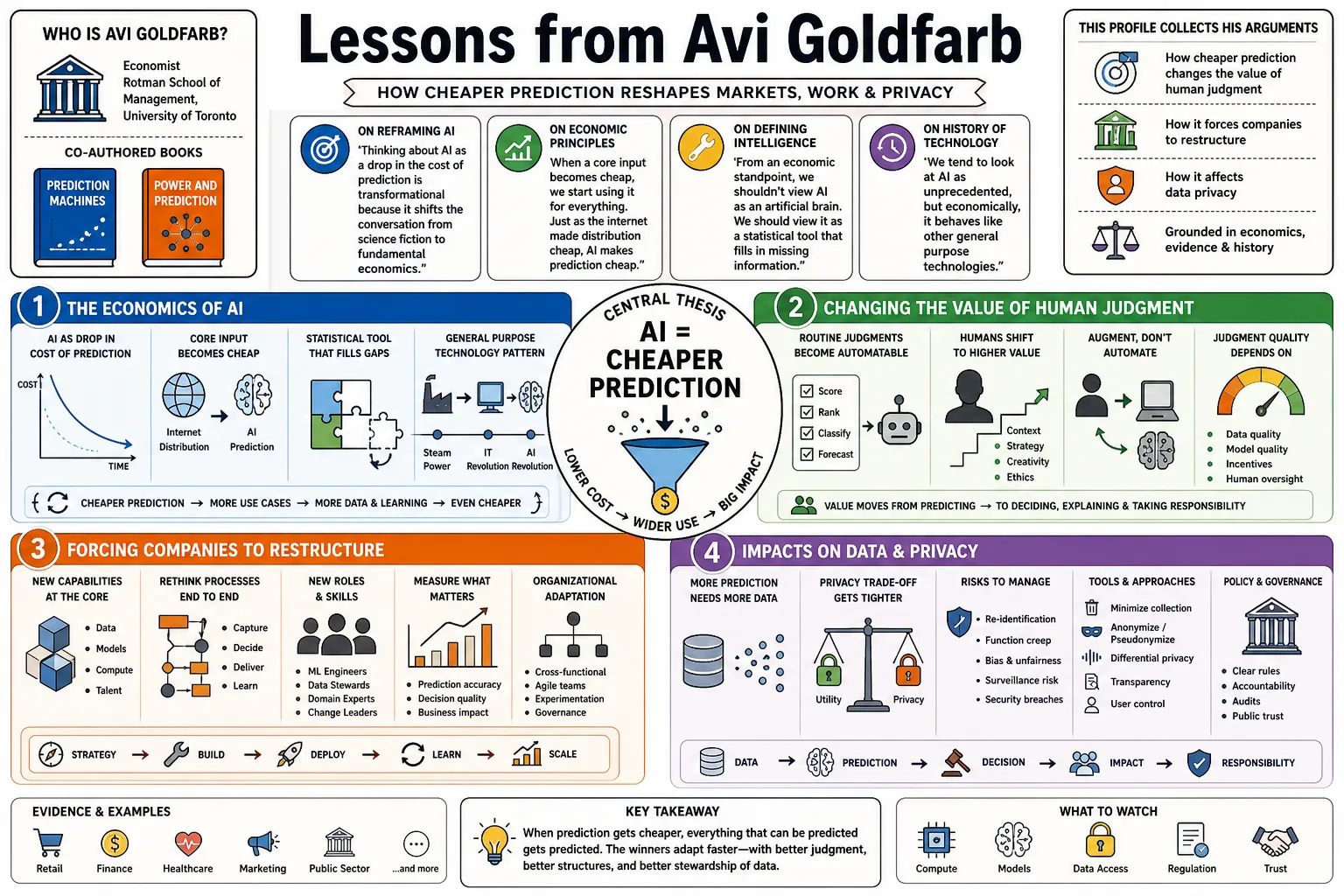
Lessons from Avi Goldfarb
Avi Goldfarb is an economist at the University of Toronto’s Rotman School of Management. His work examines how prediction technology changes business decisions, organizational design, and economic policy. — San Francisco Fed — The Disruptive Economics of AI.
Part 1: The Economics of Artificial Intelligence
- On reframing AI: Treat machine-learning advances as cheaper prediction. That economic lens clarifies business uses without assuming science-fiction intelligence. — Talks at Google — Prediction Machines.
- On economic principles: When an input becomes cheaper, businesses use more of it and find new applications. Goldfarb applies that familiar economic principle to prediction. — Talks at Google — Prediction Machines.
- On defining intelligence: For the business applications he discusses, Goldfarb treats AI as a tool for filling missing information, not as an artificial general intelligence. — WealthAbility — AI and Economic Disruption.
- On the history of technology: A useful technology can require complementary changes before its larger benefits appear. Goldfarb uses factory electrification to explain why AI adoption involves more than buying software. — Schwartz Reisman Institute — Power and Prediction.
- On the limits of automation: Cheaper prediction can increase the value of judgment and other complements. The coauthors’ model qualifies this relationship: judgment costs and automation affect the result. — Prediction, Judgment and Complexity.
- On decoupling tasks: Separate estimating an outcome from deciding what that outcome is worth. Unbundling those tasks can change who makes decisions. — Schwartz Reisman Institute — Power and Prediction.
- On productivity growth: Judge technological progress by productivity and welfare, not job counts alone. Goldfarb distinguishes potential gains from their uneven distribution and transitional employment risks. — San Francisco Fed — The Disruptive Economics of AI.
- On cost curves: Falling arithmetic costs expanded computing into unexpected uses. Goldfarb presents cheaper prediction as a similar opportunity, not a fixed forecast of its eventual reach. — Talks at Google — Prediction Machines.
- On business strategy: Business leaders can begin AI strategy by identifying prediction, judgment, action, and data requirements. In their joint talk, Agrawal describes this framework for managers without coding experience. — Talks at Google — Prediction Machines.
- On identifying opportunities: Look for customer-value bottlenecks caused by missing information. Better prediction matters most when it enables a useful change in how the business serves customers. — WealthAbility — AI and Economic Disruption.
Part 2: AI as Cheap Prediction
- On the definition of prediction: Prediction means generating missing information from information already available. It need not be a forecast about the future. — Talks at Google — Prediction Machines.
- On medical diagnosis: Medical diagnosis illustrates this definition: symptoms are observed, while their cause is inferred. The example explains prediction, not proven clinical effectiveness of any AI product. — WealthAbility — AI and Economic Disruption.
- On driving: Driving can be reframed partly as predicting what a good human driver would do. This explains a machine-learning approach, not a guarantee of safe autonomous operation. — Talks at Google — Prediction Machines.
- On translation: Translation can be approached as predicting words in one language that match the meaning of words in another. Goldfarb uses this as an example of a task newly understood as prediction. — San Francisco Fed — The Disruptive Economics of AI.
- On the expanding scope of prediction: As quality-adjusted prediction costs fall, businesses can try it in tasks previously too expensive to justify. Those new uses differ from simply replacing an existing forecast. — ORF — The Economics of Prediction.
- On data as an input: Plan separately for data that trains a model, data that runs it, and feedback that improves it. More data alone is not the same as useful data for a particular task. — ORF — The Economics of Prediction.
- On the limits of machines: A prediction does not determine an action by itself. Automated systems can take actions, but their objectives and trade-offs reflect values encoded by people. — San Francisco Fed — The Disruptive Economics of AI.
- On inventory management: Demand predictions can inform inventory and staffing decisions. Their usefulness depends on predictable patterns and the decisions made with the output; precision and waste elimination are not guaranteed. — WealthAbility — AI and Economic Disruption.
- On creative industries: Goldfarb interprets generative text and images through prediction: models use learned patterns to produce an output suited to a request. He distinguishes image generation from retrieving an existing picture. — San Francisco Fed — The Disruptive Economics of AI.
Part 3: The Rising Value of Human Judgment
- On defining judgment: Judgment determines the rewards and penalties attached to possible actions and outcomes. It is distinct from predicting which state will occur. — Prediction, Judgment and Complexity.
- On human comparative advantage: When machine prediction substitutes for a human task, other work can remain: knowing what the organization cares about and deciding how to act. This does not guarantee protection for any occupation. — ORF — The Economics of Prediction.
- On ethical trade-offs: A rain forecast does not settle whether to carry an umbrella. The choice also depends on the inconvenience of carrying it versus getting wet; those preferences can be specified in advance. — Artificial Intelligence and Uncertainty in Refugee Claims.
- On managerial roles: Managers still need to weigh consequences. The same demand forecast can lead to different staffing choices because owners value spare capacity and lost customers differently. — WealthAbility — AI and Economic Disruption.
- On automation anxiety: AI can replace prediction work or enhance a worker’s decisions. The labor-market effect depends on how those tasks fit together, not a rule that judgment-heavy jobs must earn higher wages. — Artificial Intelligence’s Ambiguous Labor-Market Impact.
- On rare events: Models can mislead when important possibilities fall outside their assumptions. Goldfarb argues for people identifying those gaps rather than treating a confident prediction as complete knowledge. — ORF — The Economics of Prediction.
- On engineering judgment: Specifying the consequences of actions is itself work. The coauthors model judgment as costly, especially when many possible states require different responses; they do not establish it as every project’s hardest step. — Prediction, Judgment and Complexity.
- On objective functions: Check whether the chosen target measures the outcome you actually want. The coauthors describe how using healthcare cost as a proxy for need can reproduce inequity even when predictions perform well. — Power and Prediction — The Anti-Discrimination Opportunity.
- On empathy: Social understanding can matter when deciding what customers or employees value. Goldfarb also notes that people may prefer a human in some caring or social roles; this is not proof machines cannot recognize emotions. — ORF — The Economics of Prediction.
Part 4: The Between Times and Adoption
- On the adoption gap: In his January 2023 discussion, Goldfarb called the interval between promising AI tools and widespread system change the Between Times. It is a historical framing, not a claim about today’s exact adoption stage. — Schwartz Reisman Institute — Power and Prediction.
- On historical parallels: Electrification did not immediately yield its full benefits when factories kept steam-era layouts. Goldfarb’s comparison emphasizes organizational redesign over decades, not a fixed thirty-year delay. — Schwartz Reisman Institute — Power and Prediction.
- On point solutions: A point solution improves one task within an existing workflow. Goldfarb distinguishes those useful incremental gains from changing the workflow or the business model itself. — WealthAbility — AI and Economic Disruption.
- On organizational friction: Adoption barriers can include regulation, uncertainty about permitted uses, and resistance from people whose roles would change. Better algorithms alone do not resolve those obstacles. — Schwartz Reisman Institute — Power and Prediction.
- On misplaced expectations: Compare an AI tool’s expected savings with the effort needed to use it. Larger benefits may require changing the business, rather than assuming any software purchase will be transformative. — WealthAbility — AI and Economic Disruption.
- On first-mover advantage: Start with the organization’s mission and find where poor prediction prevents it from delivering. A competitor may exploit that gap if the organization cannot change how it operates. — Schwartz Reisman Institute — Power and Prediction.
- On the length of the transition: Goldfarb distinguishes near-term gains from his longer-run expectations of transformation. Industries with large potential gains, such as healthcare, can also have substantial barriers to process change. — San Francisco Fed — The Disruptive Economics of AI.
Part 5: System-Level Innovation
- On redefining the business: Ask how the business model could change if a particular prediction improved substantially. The coauthors’ thought experiment varies prediction accuracy rather than assuming unlimited improvements to everything. — Talks at Google — Prediction Machines.
- On shipping: If purchase predictions became sufficiently reliable, a retailer might ship before an order and accept some returns. Goldfarb presents this as a conditional business-model possibility, not Amazon’s established practice. — ORF — The Economics of Prediction.
- On creating winners and losers: AI can shift decision power when forecasts and judgment move to different people. The coauthors’ hiring example shows why changes can reduce a local manager’s discretion. — Power and Prediction — The Anti-Discrimination Opportunity.
- On architectural changes: Separate prediction from judgment when assigning decision rights. Goldfarb describes AI as capable of either centralizing or decentralizing decisions, depending on how the system is designed. — Schwartz Reisman Institute — Power and Prediction.
- On the role of the CEO: Leadership must make the trade-offs implied by an AI-first strategy. In the joint talk, Agrawal emphasizes allocating scarce resources, not treating AI as a label or leaving priorities solely to a technical team. — Talks at Google — Prediction Machines.
- On healthcare systems: Better triage predictions could require coordinated changes to staffing, testing, and treatment workflows. Goldfarb describes a system-design possibility, not evidence that AI inevitably makes healthcare preventive. — Schwartz Reisman Institute — Power and Prediction.
- On risk tolerance: Some routines compensate for imperfect information rather than directly serving customers. Goldfarb argues for questioning those routines when prediction improves, while recognizing that a new service model requires change. — WealthAbility — AI and Economic Disruption.
- On the inevitability of change: New entrants may find it easier to build a different system because they lack existing processes and internal power structures. That potential advantage does not mean every incumbent must fail. — Schwartz Reisman Institute — Power and Prediction.
Part 6: Decision-Making Under Uncertainty
- On the anatomy of a decision: Break a decision into prediction, judgment, action, and outcome, with data supporting the process. The framework identifies where a prediction tool helps without treating it as the entire decision. — Talks at Google — Prediction Machines.
- On managing uncertainty: Uncertainty can create costly waiting time and supporting infrastructure. Goldfarb’s airport example asks how much of the customer experience exists to accommodate unreliable timing. — WealthAbility — AI and Economic Disruption.
- On reducing buffers: Better predictions of travel and processing time could reduce the waiting buffers built into a journey. This is conditional on reliable predictions, not a reason to eliminate safeguards indiscriminately. — ORF — The Economics of Prediction.
- On default actions: Rules can provide dependable coordination when case-by-case decisions are difficult. Better prediction can create opportunities to redesign those rules rather than merely execute them faster. — WealthAbility — AI and Economic Disruption.
- On the limits of past data: Predictions based on historical patterns do not automatically reveal what happens under a new strategy. Goldfarb distinguishes forecasting an existing path from identifying the causal effect of changing it. — WealthAbility — AI and Economic Disruption.
- On the illusion of certainty: Recognize uncertainty in a prediction and design the response around it. Goldfarb’s recommendation example offers alternatives because the system does not know exactly what a customer wants. — ORF — The Economics of Prediction.
- On asymmetric payoffs: Evaluate the consequences of different errors, not accuracy alone. The coauthors’ fraud example distinguishes rejecting a legitimate transaction from approving a fraudulent one. — Prediction, Judgment and Complexity.
- On the paradox of better data: Explicitly showing uncertainty can challenge a decision-maker’s confidence. Goldfarb and his coauthors discuss this in refugee decisions, where its consequences depend on how the governing system resolves doubt. — Artificial Intelligence and Uncertainty in Refugee Claims.
Part 7: The Privacy Paradox and Regulation
- On the privacy paradox: Goldfarb and Que review evidence of gaps between stated privacy concerns and sharing behavior. Context, incentives, attention, and measurement can explain that gap; it does not mean consumers never value privacy. — The Economics of Digital Privacy.
- On the cost of privacy: Privacy protections can carry economic costs as well as benefits. Goldfarb cites reduced advertising effectiveness after earlier European rules, rather than claiming every privacy law necessarily makes every market less efficient. — Avi Goldfarb’s Senate Privacy Testimony.
- On advertising effectiveness: Goldfarb and Tucker found that earlier EU privacy rules reduced display ads’ effect on stated purchase intent. The decline was more pronounced on general-content sites, not necessarily smaller publishers. — Privacy Regulation and Online Advertising.
- On entrenching incumbents: Consent requirements can advantage large generalist firms over smaller specialists in the coauthors’ model. The mechanism is unequal transaction costs, not proof that only monopolies can comply with privacy law. — Privacy Regulation and Market Structure.
- On the trade-off with innovation: Restrictions on data use can affect innovation, but privacy protection can also sustain consumers’ willingness to share. Goldfarb frames policy as balancing both risks, not maximizing unrestricted access. — Privacy and Innovation — FTC Presentation.
- On contextual sharing: The stakes of disclosure depend on context. Goldfarb contrasts potentially lasting consequences of genetic information with less consequential ordinary shopping data, rather than assuming a uniform privacy preference. — Avi Goldfarb’s Senate Privacy Testimony.
- On the future of regulation: Evaluate privacy policy through benefits, costs, externalities, and competition. Goldfarb and Que also discuss privacy-preserving technologies that can retain useful information while limiting personal-data flows. — The Economics of Digital Privacy.
Part 8: Market Competition and Digital Strategy
- On economies of scale: Customer activity can generate data that improves predictions and attracts more customers. Goldfarb and Que’s review also emphasizes diminishing returns; a feedback loop need not create limitless economies of scale. — The Economics of Digital Privacy.
- On the value of data vs. algorithms: Useful data and continuing feedback can support competitive advantage alongside prediction technology. Goldfarb does not reduce every market advantage to proprietary training data or assume all algorithms are interchangeable. — ORF — The Economics of Prediction.
- On competitive dynamics: The ability to act on a prediction and ownership of the customer relationship can determine who captures its value. Forecasting alone is not the complete competitive advantage. — ORF — The Economics of Prediction.
- On substituting capital for labor: Machine prediction can substitute for human prediction tasks. Whether that reduces employment or enhances other work depends on the associated decision tasks. — Artificial Intelligence’s Ambiguous Labor-Market Impact.
- On digital moats: Start with a problem customers value before accumulating data. Choose training, input, and feedback data around that problem; customer lock-in is not an assured consequence. — ORF — The Economics of Prediction.
- On the cold start problem: A working AI application needs suitable training data before deployment, then input and feedback data during use. Goldfarb identifies these requirements without calling initial data acquisition every business’s hardest challenge. — ORF — The Economics of Prediction.
- On liability and risk: Changing how AI records or informs decisions can create liability questions. Goldfarb’s healthcare and financial-services examples show why regulatory clarity matters; he does not assign universal legal responsibility for every AI error. — San Francisco Fed — The Disruptive Economics of AI.