As Wix's co-founder and CEO, Avishai Abrahami built a platform that opened website creation to non-technical users. He stays close to the engineering details, insists on product simplicity, and maintains a grounded view of AI's limits in software development. This profile collects his advice on building systems, managing the shift from founder to executive, and keeping the user in focus.
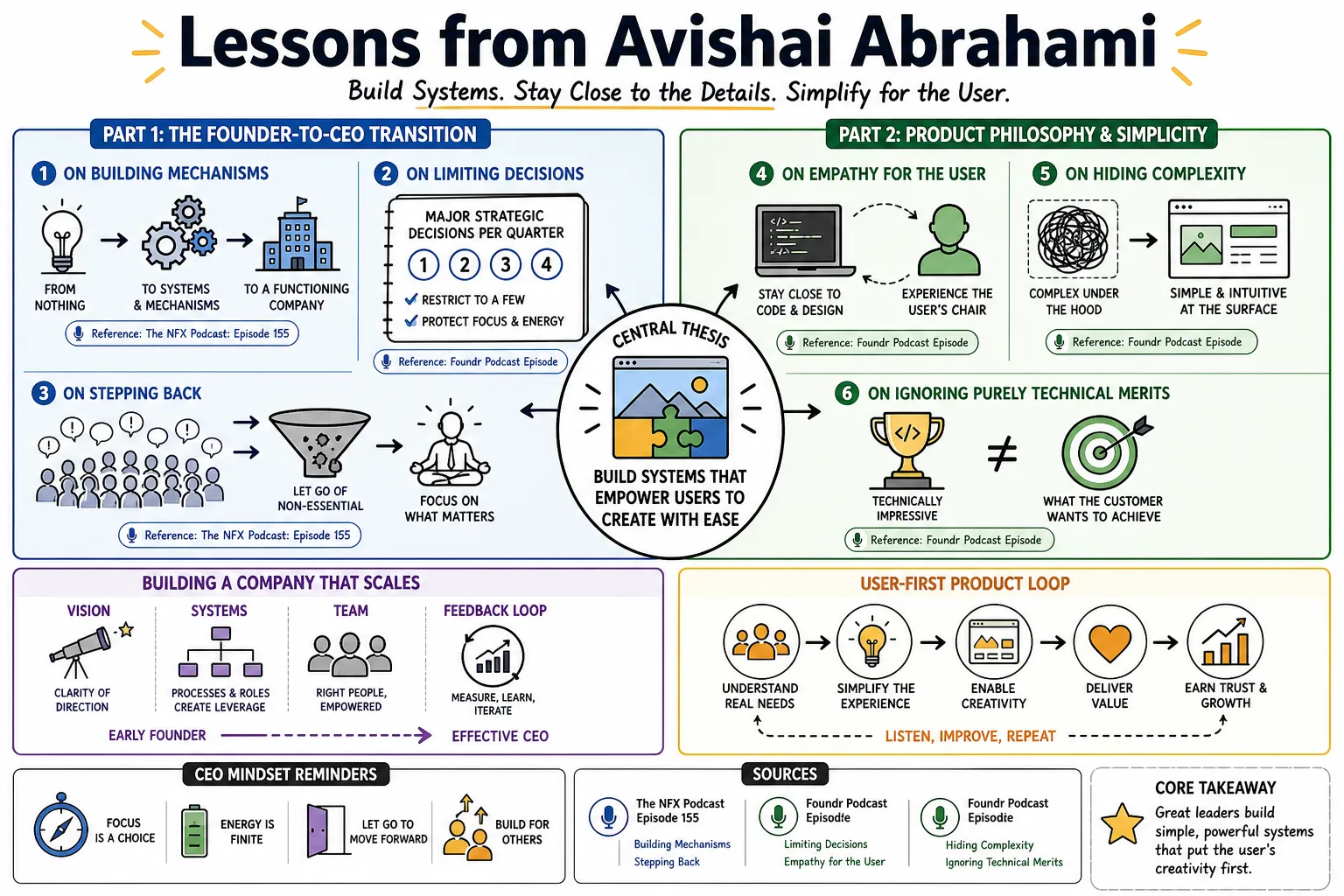
Part 1: The Founder-to-CEO Transition
- On Building Mechanisms: A founder's initial job is to create something from nothing. Transitioning to CEO requires building the systems and mechanisms that turn that initial vision into a functioning company. — Reference: The NFX Podcast: Episode 155
- On Limiting Decisions: To maintain focus and prevent burnout, restrict yourself to making a small, fixed number of major strategic choices per quarter. This sometimes means limiting yourself to just four big decisions. — Reference: Foundr Podcast Episode
- On Stepping Back: As a company scales successfully, the volume of people seeking your attention increases exponentially. Learning to completely let go of non-essential requests is a mandatory survival skill for a CEO. — Reference: The NFX Podcast: Episode 155
Part 2: Product Philosophy & Simplicity
- On Empathy for the User: Product leaders should stay closely involved with code and design so they can directly experience the same friction points and sit in the user's chair. — Reference: Foundr Podcast Episode
- On Hiding Complexity: The true purpose of design is to facilitate creativity by hiding technical complexity. This allows users to focus entirely on their output rather than the mechanics of creation. — Reference: Foundr Podcast Episode
- On Ignoring Purely Technical Merits: A successful product must prioritize what the customer actually wants to achieve and avoid the trap of optimizing for technical complexity simply for its own sake. — Reference: Foundr Podcast Episode
Part 3: Engineering & Technical Execution
- On Software Minimalism: Engineering teams should strive to drastically reduce the amount of code required for complex tasks. The goal is to turn projects that previously took months into efforts that take just days. — Reference: Foundr Podcast Episode
- On Getting Involved in the Code: When engineering inefficiencies arise, leadership should not simply mandate changes from afar. Getting directly involved in writing code can help reset timelines and establish cleaner architectural standards. — Reference: The NFX Podcast: Episode 155
- On the Superpower of AI for Developers: Generative tools act as an engineering superpower because they compress the time it takes to build functional first versions of features from weeks to mere hours. — Reference: Foundr Podcast Episode
Part 4: The Reality of AI and Vibe Coding
- On the Limits of Natural Language Coding: Using natural language to build software will not easily replace complex SaaS stacks. You cannot simply describe an intricate, enterprise-grade platform into existence. — Reference: 20VC interview
- On the Economics of Fine-Tuning: Open-source AI models are often hyped as reducing costs to near zero. However, fine-tuning models for complex business tasks often yields only modest cost savings compared to the dramatic savings seen with simple prompts. — Reference: 20VC interview
- On the Moat of Institutional Trust: Artificial intelligence cannot easily replicate the institutional trust that large enterprises require before handing over sensitive data. This leaves established platforms with a defensible advantage. — Reference: 20VC interview
- On AI Customer Support: Off-the-shelf AI customer service solutions frequently fail at scale. This often forces companies to build proprietary, fine-tuned models to achieve necessary cost efficiency and quality. — Reference: 20VC interview
Part 5: Team Dynamics & Founder Psychology
- On Founder Obsession: Successful founders must be obsessed with their mission because that intense focus drives growth. For those truly committed, a twelve-hour workday does not feel difficult. — Reference: Foundr Podcast Episode
- On Identifying Productive Failure: A healthy organization must learn to differentiate between a failure caused by poor execution and a productive failure that stems from taking a calculated, necessary risk. — Reference: The NFX Podcast: Episode 155
- On Acknowledging Ignorance: A major step in leadership is recognizing how little you actually know. This forces you to deeply appreciate and rely on the value of exceptionally talented colleagues. — Reference: The NFX Podcast: Episode 155
- On Smart Disagreement: Only hire and work with people you trust completely. Specifically seek out smart individuals who are willing to openly challenge your opinions and decisions. — Reference: The NFX Podcast: Episode 155
Part 6: AI Product Economics & Platform Strategy
- On Testing the Hardest Workflow: Judge an AI builder against the full business process, not a demo. Wix tested whether experienced engineers could reproduce the scheduling and operating logic of a hairdresser business and found that even weeks of work did not cover the complexity. — Reference: 20VC interview
- On Domain-Specific Model Advantage: A product can outperform a generic frontier model on its own narrow task when it learns from real user attempts, failures, corrections, and recurring prompt mistakes. — Reference: 20VC interview
- On Continuous Model Improvement: Treat model quality as a product feedback loop: observe where customers succeed or fail, retrain regularly, and measure whether the specialized model becomes faster, cheaper, and less error-prone. — Reference: 20VC interview
- On the Difference Between a Page and a Business System: Generating a basic website is not the same as operating payments, scheduling, fulfillment, inventory, hosting, and customer data. The infrastructure behind the interface remains a major part of the product. — Reference: Wix Blog
- On an Agent-Connected Web: A more plausible AI future is not one model owning every transaction and record. It is agents communicating with the servers where each business maintains live inventory, rules, and permissions. — Reference: Wix Blog
- On Preserving Visual Experience: Prompt-based interaction will not eliminate the need for visual interfaces. Brands still need rich ways to present products, and agents can invite website systems into the conversation to create more personalized experiences. — Reference: Wix Blog
- On Updating an AI Forecast: Be willing to revise a dramatic prediction as product evidence changes. After working more deeply with current models, Abrahami concluded that broad human replacement would likely take longer than he had expected. — Reference: 20VC interview
Part 7: The CEO's Personal Operating System
- On Protecting Thinking Time: A CEO needs uninterrupted hours for planning and real work rather than filling every available block with meetings and conversations. — Reference: 20VC interview
- On Letting the Organization Mature: Constant executive availability can make every disagreement the CEO's problem. Allowing time for teams to resolve ordinary conflicts themselves leaves the leader to handle the genuinely difficult cases. — Reference: 20VC interview
- On Expecting Discontinuity: Resilience begins by accepting that wars, pandemics, market crashes, and other shocks arrive without respecting a smooth forecast. Build the expectation of volatility before the next random Wednesday changes the plan. — Reference: 20VC interview
- On Auditing the Controllables: Under pressure, ask whether you are honestly doing the best possible work with the resources and facts you can control. A credible yes removes some of the anxiety created by everything outside your control. — Reference: 20VC interview
- On Choice as a Source of Commitment: Financial independence is valuable because it removes coercion. If you remain in a difficult job after gaining the freedom to leave, that choice creates a stronger obligation to commit fully. — Reference: 20VC interview
- On Time-Bounding Work Thoughts: Presence at home sometimes requires deliberately postponing unfinished thinking. Capture what needs attention, turn it off for the moment, and return to it during a protected work block. — Reference: 20VC interview
- On the Quality of Parental Time: Children benefit more from a parent who is attentive and happy for a shorter period than from longer stretches spent distracted, resentful, or absorbed in a phone. — Reference: 20VC interview
- On the Generosity of Mentorship: Experienced operators often give something scarcer than money when they share mistakes and advice with a new founder: focused time that they could have spent elsewhere. — Reference: 20VC interview
- On Execution as the Persistent Risk: Good plans and ambitious ideas are rarely the final constraint. The recurring challenge is building a team that can execute efficiently and pursue a larger goal without losing discipline. — Reference: 20VC interview