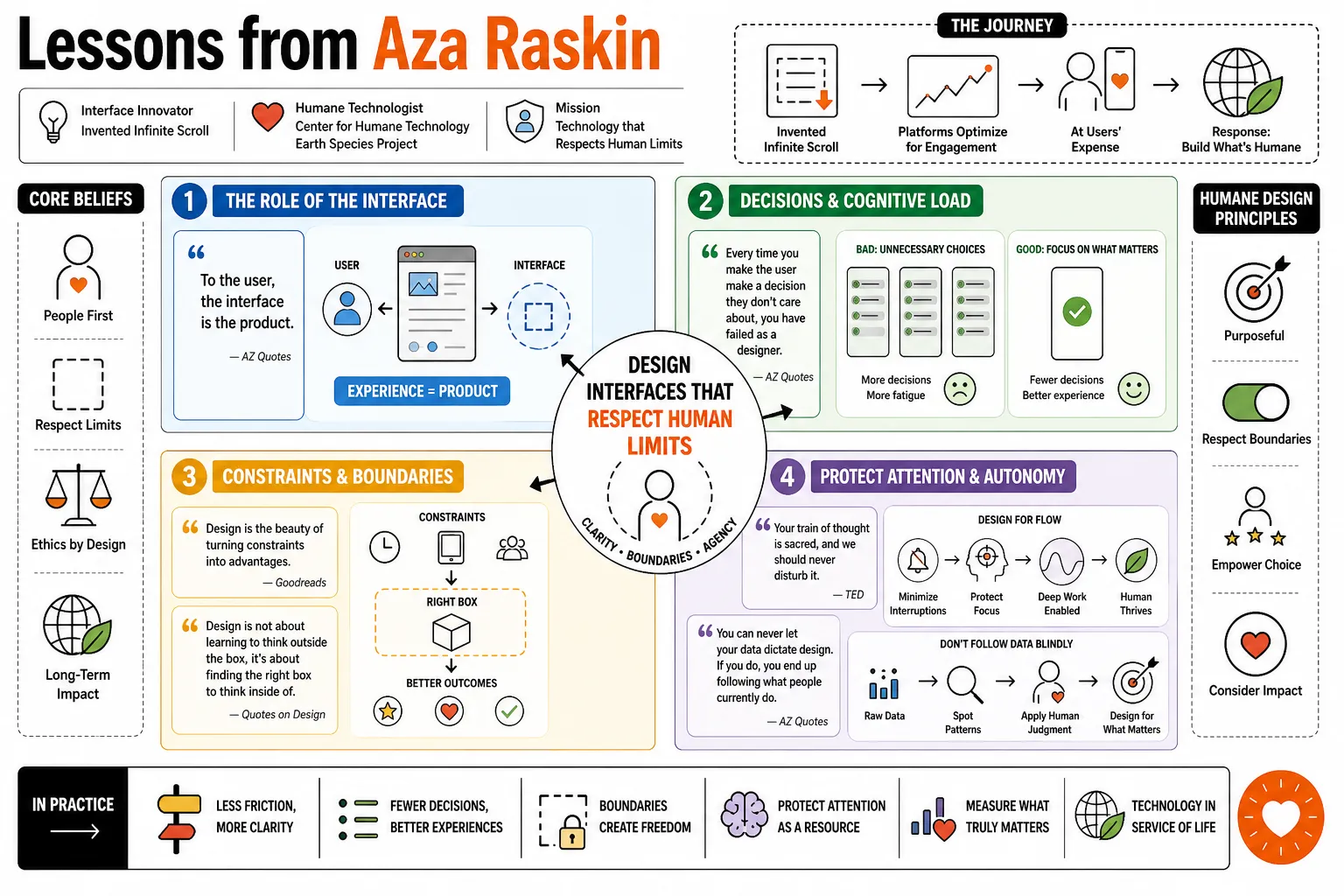
Lessons from Aza Raskin
Interface designer Aza Raskin invented the infinite scroll, a feature that eliminated the "next page" button and changed how we consume content online. After seeing platforms use the design to maximize engagement at users' expense, he co-founded the Center for Humane Technology and the Earth Species Project. This collection covers his views on digital addiction, artificial intelligence risks, and building technology that respects human limits.
Part 1: The Design of the Interface
- On the interface: "To the user, the interface is the product." — Source: AZ Quotes
- On decision fatigue: "Every time you make the user make a decision they don't care about, you have failed as a designer." — Source: AZ Quotes
- On constraints: "Design is the beauty of turning constraints into advantages." — Source: Goodreads
- On boundaries: "Design is not about learning to think outside the box, it's about finding the right box to think inside of." — Source: Quotes on Design
- On disruption: "Your train of thought is sacred, and we should never disturb it." — Source: TED
- On data reliance: "You can never let your data dictate design. If you do, you end up following what people currently do and never innovating." — Source: QuoteFancy
- On problem framing: "The big meta problem of design is figuring out how to ask the right question." — Source: Daniel Bachhuber
- On failure: "Find a faster way to fail, recover, and try again." — Source: AZ Quotes
- On rapid learning: "When you are solving a difficult problem re-ask the problem so that your solution helps you learn faster." — Source: QuoteFancy
Part 2: The Invention (and Regret) of the Infinite Scroll
- On optimization: "One of my lessons from infinite scroll: that optimizing something for ease-of-use does not mean best for the user or humanity." — Source: Product Principle
- On stopping cues: "If you don't give your brain time to catch up with your impulses, you just keep scrolling." — Source: Medium
- On unintended consequences: "I regret that I didn’t think more about how this thing would be used... I know as a designer that by taking away the stopping cue, I can make you do what I want you to do." — Source: Deceptive Design
- On stolen time: "Infinite scrolling costs the world the equivalent of hundreds of thousands of human lifetimes in wasted productivity every single day." — Source: Aampe
- On weaponized design: "It's as if social media companies are taking behavioral cocaine and just sprinkling it all over your interface and that's the thing that keeps you like coming back and back and back." — Source: Medium
- On the paradox of ease: "The paradox of technology is that it gives us the power to serve and protect at the same time as it gives us the power to exploit." — Source: Possible Podcast
- On human agency: "Features like the infinite scroll leverage asymmetric knowledge of human psychology to siphon agency and power away from people." — Source: UX Collective
- On designer responsibility: "As long as designers continue to hold this power, designers also need to also be the ones held accountable for its misuse." — Source: UX Collective
- On unit bias: "The original design of infinite scroll inadvertently exploited unit bias, removing the natural completion of a page to create a seamless, yet endless, loop." — Source: Medium
Part 3: The Center for Humane Technology
- On new responsibilities: "When you invent a new technology, you inevitably uncover a new class of responsibilities." — Source: Center for Humane Technology
- On the technology race: "If a new technology confers power, it will trigger a race to exploit that power." — Source: Center for Humane Technology
- On the need for coordination: "Without active, global coordination, that race will inevitably lead to tragedy." — Source: Center for Humane Technology
- On reach vs. speech: "Freedom of speech is not freedom of reach." — Source: Wikipedia
- On human limitations: "The problem humanity faces is that we have paleolithic emotions, medieval institutions, and god-like technology." — Source: IxDA
- On exponential power: "As technology becomes exponentially more god-like, it requires, as designers, exponentially more wisdom to be able to wield it without hurting ourselves." — Source: IxDA
- On human enhancement: "Technology isn't about making us super human, it should be about making us extra human." — Source: Azaza
- On systemic problems: "Moving away from exploitative design requires shifting from whac-a-mole problem-solving to addressing root-cause systemic incentives." — Source: Center for Humane Technology
- On attention as a commons: "Human attention is a finite resource that should be treated as a protected commons, not harvested for maximal extraction." — Source: AI for People
- On goal-oriented design: "Platforms must be designed to serve users' stated goals rather than optimizing to extend session length." — Source: AI for People
Part 4: The Incentive Structures of Tech
- On the business model: "If you're not paying for the product, you are the product." — Source: The Brown Daily Herald
- On advertising: "Because we don't pay for the products that we use, advertisers pay for the products that we use. Advertisers are the customers. We're the thing being sold." — Source: Scraps from the Loft
- On algorithmic consumption: "Software is eating the world, but because we're the product, software is eating us." — Source: Possible Podcast
- On judging AI: "The fundamental question we need to stop asking is, 'is AI good or bad?' Instead, we have to say, 'are the incentives that govern AI good or bad?'" — Source: DustyF
- On market demands: "Technology becomes dangerous not by it behaving poorly, but when it behaves exactly as the market demands." — Source: DustyF
- On the attention economy: "The underlying business model of the internet created a race to the bottom of the brain stem, incentivizing platforms to prioritize polarization and outrage." — Source: Fast Company
- On the illusion of inevitability: "Whenever we say that something is inevitable, it's like casting a spell. When you say it's inevitable, it means there's nothing to do, which means no one does anything." — Source: Fast Company
- On incentive blindness: "Even with the best intentions, developers frequently remain blind to how their creations will be weaponized by existing market incentives." — Source: DustyF
- On the shift in manipulation: "AI threatens to supercharge the race for attention by exploiting human needs for intimacy, making digital manipulation far more effective than traditional social media." — Source: Global Player
Part 5: Artificial Intelligence and Existential Risk
- On global priorities: "Mitigating the risk of extinction from AI should be a global priority alongside other societal-scale risks such as pandemics and nuclear war." — Source: Dazed
- On the new race: "The race for engagement in social media is currently being superseded by a far more profound and consequential race in the deployment of Generative AI." — Source: Center for Humane Technology
- On facing an alien intelligence: "We have summoned an alien intelligence. We don't know much about it, except that it is extremely powerful and offers us bedazzling gifts but could also hack the foundations of our civilization." — Source: Amazon AWS
- On saying no: "Progress in the age of AI will depend more on what we say no to than what we say yes to." — Source: Masters of Scale
- On the anti-human crisis: "The current trajectory of the AI race is an anti-human crisis because it creates an environment where humans inherently lose against optimization algorithms." — Source: Masters of Scale
- On collective alignment: "I don't see anything similar in scale trying to build aligned collective intelligence. And to me, that is the core problem we now need to solve." — Source: Possible Podcast
- On AI governance: "Navigating the AI era safely will require international AI treaties and robust technological infrastructure capable of verifying compliance with safety red lines." — Source: Center for Humane Technology
- On anthropomorphizing AI: "We must avoid the habit of talking about algorithms as if they think or learn, being careful not to attribute a human spark to massive statistical inference machines." — Source: Johannes Jaeger
- On foundational risks: "Embedding AI into fundamental digital infrastructure acts as a skeleton key, deploying systems with vast capabilities before their societal implications are fully understood." — Source: Center for Humane Technology
- On systemic comparisons: "The rapid development of AI shares traits with the Manhattan Project, yet it is currently being deployed globally without the necessary safety and responsibility frameworks." — Source: Glasp
Part 6: Animal Communication and the Earth Species Project
- On expanding perception: "As human beings, our ability to understand is limited by our ability to perceive. What AI does is that it throws open the aperture of what we can perceive." — Source: Google Vertex Search
- On finding a rosetta stone: "The Earth Species Project seeks to understand if you can build these shapes for animal communication as well, and if you can, is there any overlap with human communication? And if there is, you can start to build yourself a rosetta stone." — Source: IxDA
- On ground truth: "With humans you almost always know ground truth at some point. That's not the case with animals. So that also introduces new sets of scientific problems." — Source: Google Vertex Search
- On expanding empathy: "Understanding non-human languages could expand human consciousness, empathy, and awareness of the other beings we share this planet with." — Source: The Great Simplification
- On listening: "This is not about giving animals a voice. This is about being able to listen to the voice that they already have." — Source: Climate Break
- On shared benefits: "When we make life better for all the other species of earth, we'll make life better for everyone." — Source: Climate Break
- On mapping nature: "Significant breakthroughs in machine learning have opened up entirely new ways to map the latent structural patterns of non-human animal communication." — Source: Center for Humane Technology
- On the duty of care: "Decoding the complex vocalizations of other species holds the potential to fundamentally transform human relationships with nature and promote a greater duty of care for the natural world." — Source: Center for Humane Technology
- On complex communication: "Even if direct translation to human concepts is impossible, AI allows us to identify the complex, intricate structures inherent in animal vocalizations." — Source: IxDA
Part 7: Insights from "Your Undivided Attention" and "The Social Dilemma"
- On digital manipulation: "The attention economy relies on creating a race to the bottom of the brain stem, prioritizing engagement metrics over the psychological health of users." — Source: Your Undivided Attention
- On the illusion of control: "Social media platforms are deliberately engineered to bypass rational decision-making, offering intermittent variable rewards similar to a slot machine." — Source: The Social Dilemma
- On compounding damage: "The lever of technology gets longer and longer and longer so when we make small changes, we do increasing amounts of damage." — Source: IxDA
- On shifting focus: "Addressing the harms of technology requires moving beyond critiques of individual screen time and focusing on the underlying incentive structures of tech platforms." — Source: Your Undivided Attention
- On structural power: "The business model of engagement-based advertising structurally forces platforms to favor content that incites outrage, hyper-partisanship, and division." — Source: Fast Company
- On false promises: "The promise that AI will effortlessly solve grand challenges like curing cancer is often used to justify reckless and unsafe development speeds." — Source: Your Undivided Attention
- On responsible technology: "Reference: In a TED ReThinking transcript, Raskin says a responsible technologist should pre-think how a technology could start races, be abused, cause harm, create externalities, or attract bad actors before releasing it." — Reference: TED ReThinking transcript with Aza Raskin
- On existential hope: "Despite the catastrophic risks posed by exponential technology, humanity can steer these tools toward a more humane future through active coordination and systems thinking." — Source: Human Change
- On the user as the product: "The normalization of free, ad-supported digital tools obscured the reality that human attention and behavioral modification had become the primary commodities being traded." — Source: Scraps from the Loft
- On the future of intimacy: "Generative AI is uniquely positioned to exploit human desires for connection, potentially weaponizing simulated intimacy on a massive scale." — Source: Global Player
Part 8: Philosophy, Life Lessons, and Looking Forward
- On assessing talent: "When I'm hiring, I don't look for credentials, I look for knowledge." — Source: QuoteFancy
- On facing the past: "If you do not face your demons, they raise your children." — Source: Fast Company
- On multidisciplinary innovation: "Great ideas are almost always great ideas in hindsight. So if you want to have great ideas, learn lots of fields and then combine." — Source: Business Insider
- On legacy and interface: "Continuing his father Jef Raskin's legacy, interface design must be approached as a rigorous engineering discipline grounded in human psychology." — Source: Wikipedia
- On community design: "To keep tools like the web browser user-friendly, open-source communities must focus as much on design-oriented contributions as they do on writing code." — Source: CNET
- On tail-risk tradeoffs: "Reference: In the same TED transcript, Raskin says AI creates difficult tail-risk tradeoffs: possible catastrophic harms are diffuse and probabilistic, while benefits like cancer drugs are concrete and immediate, making the trade hard for human brains to judge." — Reference: TED ReThinking transcript with Aza Raskin
- On the ultimate goal of tech: "The success of future technology should be measured not by the scale of its deployment, but by its capacity to enhance and protect human well-being." — Source: Azaza
- On redesigning the internet: "The transition to an AI-driven future presents a rare, closing window of opportunity to redesign the digital landscape away from extractive attention models." — Source: Center for Humane Technology
- On human limitations and tech: "We must fundamentally acknowledge that human cognition has physical limits, and technology that ignores or actively exploits these limits is inherently destructive." — Source: IxDA