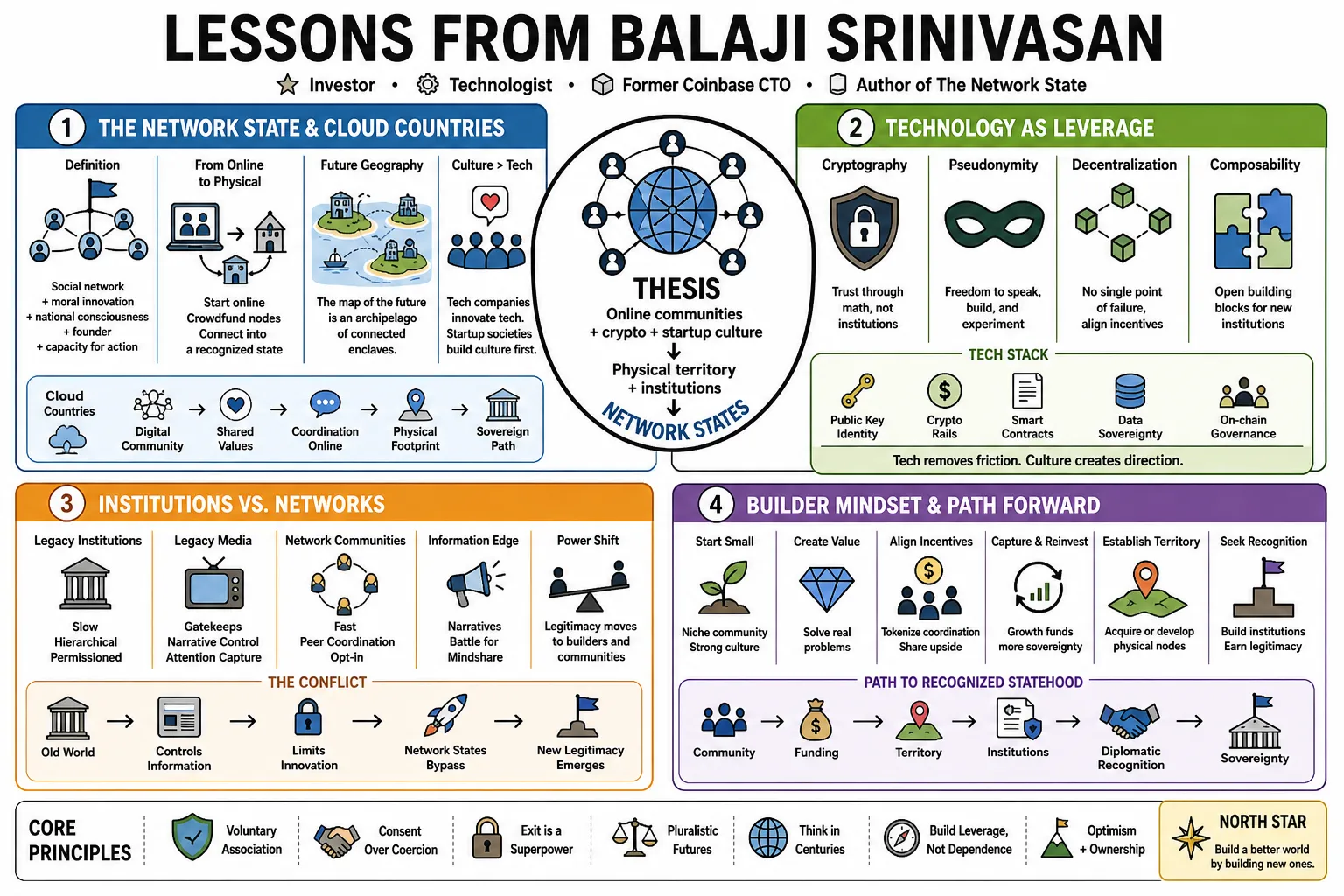
Lessons from Balaji Srinivasan
Balaji Srinivasan is an investor, technologist, and former Coinbase CTO. In The Network State, he proposes that aligned online communities crowdfund physical territory and seek diplomatic recognition. This collection examines his arguments about decentralized technology, media, institutions, and building new systems. — Tim Ferriss Show #606 Transcript.
Part 1: The Network State & Cloud Countries
- On the definition of a network state: Srinivasan defines a network state as an aligned community with collective agency, shared identity and institutions, physical territory, and eventual diplomatic recognition. — The Network State — Definition.
- On the transition from online to physical: His proposed sequence builds offline trust and an online economy before crowdfunding physical communities, connecting them digitally, and pursuing recognition. — The Network State — Seven Steps.
- On the future of geography: In his model, a community can connect geographically separated enclaves rather than acquire a single contiguous block of territory. — The Network State — How to Start a New Country.
- On culture vs. technology: A startup society begins with a shared moral premise and a proposed better way of life, rather than a pitch for a faster or cheaper product. — The Network State — The One Commandment.
- On cloud first, land second: Build the digital community before acquiring territory; the online community develops shared culture and can organize remote work and physical expansion. — The Network State — How to Start a New Country.
- On collective action: An online community becomes useful for collective action when its members coordinate around a common cause and mutual benefit. — The Network State — Seven Steps.
- On the 21st-century Leviathan: He expects conflict between networks and states to shape this century, while acknowledging that states can still prevail through regulation, coercion, and restrictions on exit. — The Network State — God, State, Network.
- On moral innovation: A moral innovation is part of Srinivasan’s definition of a network state: a shared value that helps distinguish the community. — The Network State — Definition.
- On diplomatic recognition: Diplomatic recognition distinguishes a network state in his definition from an online platform, currency network, or DAO. — The Network State — Definition.
- On peaceful exit: He proposes creating new communities and institutions peacefully rather than relying on revolution or war to replace existing states. — The Network State — How to Start a New Country.
Part 2: The Truth Machine & Cryptography
- On blockchains as truth: He points to blockchain consensus as a way for people with opposing political views to agree on recorded transactions and balances. — Tim Ferriss Show #506 Transcript.
- On cryptographic verification: He favors independently checkable cryptographic records over relying only on official confirmation, particularly for the recorded state of a digital system. — The Network State — God, State, Network.
- On soft fiction vs. hard truth: He contrasts politically useful narratives with independently verifiable technical facts, while warning against both reflexive credulity and reflexive cynicism. — The Network State — Political Power and Technological Truth.
- On the monopoly of truth: He argues that narratives about past harm can help legitimize the use or expansion of state power, making scrutiny of those narratives important. — The Network State — Political Power and Technological Truth.
- On Web3: He sees decentralized backends and web3 logins as ways to give users alternatives to a platform’s control over their identities and relationships. — The Network State — On Network States.
- On verifiable history: He proposes a cryptographically timestamped ledger of record that makes records harder to alter; this is not a guarantee that every recorded claim is true. — Tim Ferriss Show #506 Transcript.
- On decentralization: He describes the internet as removing intermediaries and enabling direct connections, with both valuable new collaboration and harmful outcomes. — The Network State — Technoeconomic Axes.
- On programmable money: He describes cryptocurrency as a financial internet, with smart contracts enabling programs that send and receive value. Ethereum extends the ideas introduced by Bitcoin; the two are not interchangeable. — Why India Should Buy Bitcoin.
Part 3: Media, Narratives & The Press
- On programming humans: He treats media as a way to shape human behavior, much as code directs machines, and uses advertising and adopted vocabulary as examples. — Tim Ferriss Show #506 Transcript.
- On political structures: He contrasts China’s state-controlled media with what he characterizes as American media influence over the state. This is his political interpretation, not a neutral description of either system. — The Network State — God, State, Network.
- On information diets: Choose information around the skills and goals you want to develop, rather than letting emotionally stimulating feeds determine what receives your attention. — David Perell — Living in the Future.
- On citizen journalism: He proposes broadening citizen reporting beyond media corporations and pairing it with more verifiable records, rather than relying on a few institutions to determine truth. — Tim Ferriss Show #506 Transcript.
- On legacy media: He criticizes media business models that reward popularity and clicks over accuracy, and favors direct contributions from people with relevant expertise. — Tim Ferriss Show #506 Transcript.
- On truth-seeking: He argues that societies need to preserve accurate technical knowledge because their practical capabilities depend on it. — The Network State — Political Power and Technological Truth.
- On the creator economy: He argues that creators with their own audiences can enter interviews with more leverage than subjects who depend entirely on a publisher’s distribution. — Tim Ferriss Show #506 Transcript.
- On the decline of institutional credibility: He criticizes institutions whose leaders inherit systems they could not build, contrasting this with founders who have to earn support through repeated demonstrations of competence. — Tim Ferriss Show #506 Transcript.
Part 4: The Pseudonymous Economy
- On identity decoupling: His pseudonymous-economy proposal separates a person’s public work identity from a globally searchable real-name identifier. — Tim Ferriss Show #506 Transcript.
- On protecting wealth: He argues that cryptography and pseudonymity can raise the cost of coercion or seizure, while acknowledging that physical attacks on identified individuals remain possible. — The Network State — God, State, Network.
- On meritocracy: His goal is a global market that evaluates demonstrated work rather than a contributor’s location, age, accent, or other identity traits. He presents this as an ideal to build toward. — Tim Ferriss Show #506 Transcript.
- On multiple identities: He envisions separate earning and speaking identities, potentially with multiple pseudonyms, rather than one identifier for every part of life. — Tim Ferriss Show #506 Transcript.
- On the history of pen names: He points to the Federalist Papers as a historical example of political ideas published under a pen name, connecting pseudonymous writing with the formation of new institutions. — David Perell — Living in the Future.
- On verifiable credentials: He proposes portable, non-transferable credentials earned by solving problems, allowing people to demonstrate skills across sites without relying solely on school affiliation. — Tim Ferriss Show #506 Transcript.
- On reducing bias: He argues that revealing less personal information could reduce discrimination based on identity; this is a proposed benefit, not proof that bias becomes impossible. — Tim Ferriss Show #506 Transcript.
- On state surveillance: He favors search-resistant pseudonyms that reduce the amount of personal information linked through a single public identifier. — Tim Ferriss Show #506 Transcript.
- On earning online: He argues that cryptocurrency could support cross-border payments for remote work and bring more people into international markets. It does not guarantee employment or income. — Why India Should Buy Bitcoin.
- On digital reputation: A persistent pseudonym can accumulate reputation, unlike a disposable anonymous identity; transferring that reputation privately is a further mechanism he proposes. — Tim Ferriss Show #506 Transcript.
Part 5: Startups, Builders & The Idea Maze
- On the Idea Maze: A founder needs a detailed view of the market’s branching paths, past failures, competitors, and technological changes—not merely a one-line idea. — Startup Engineering — Market Research, Wireframing, and Design.
- On choosing competitors: Srinivasan emphasizes understanding adjacent competitors and cites Larry Ellison’s warning that companies can come to resemble their rivals. — Startup Engineering — Market Research, Wireframing, and Design.
- On location: He argues that remote work makes founding and funding a startup less dependent on being in the Bay Area. — The Network State — God, State, Network.
- On execution vs. idea: Execution means doing the next important task and revising the task list as progress changes what needs to happen next. — Startup Engineering — Market Research, Wireframing, and Design.
- On wealth creation: He sees a startup as a way to create capabilities that do not yet exist, treating the corporate vehicle as a means to technological progress rather than an end in itself. — The Purpose of Technology.
- On iteration: Use early customer feedback on features and pricing to test a product idea and revise what to build; even imperfect feedback is better than none. — Startup Engineering — Market Research, Wireframing, and Design.
- On founders: He argues that founders can use their credibility to change an organization’s direction, accepting short-term costs to build something that may replace an existing product. — Asymetric — The Crypto Plan for World Domination.
- On the startup lifecycle: He acknowledges that mature organizations can become bureaucratic, and designs his network-state model to allow people to leave and found alternatives. — The Network State — On Network States.
Part 6: Biology, Longevity & The FDA
- On biological progress: He argues that medical regulation can delay access to innovation and advocates an alternative biomedical regime. This is his critique, not proof that regulation has no safety benefits. — The Network State — The One Commandment.
- On the right to try: He advocates a medical-sovereignty zone that would allow voluntary access to medical products without third-party interference. This is his regulatory proposal, not a statement of current rights or treatment safety. — The Network State — The One Commandment.
- On longevity: He treats extending life and ultimately overcoming mortality as central goals for technology. This is an aspiration, not evidence that human aging has been cured. — The Purpose of Technology.
- On decentralized science: He proposes open research graphs, decentralized infrastructure, and crypto incentives as possible foundations for new publishing, curation, and funding models in science. — Crypto Sci-Hub and the Decentralization of Science.
- On transhumanism: He favors using technology to extend human capabilities, including the prospect of brain-machine interfaces. This is his transhumanist vision, not evidence that today’s phones are literal external brains or that internal implants are inevitable. — Tim Ferriss Show #506 Transcript.
- On regulatory arbitrage: His medical-sovereignty proposal depends on finding a government willing to recognize a different biomedical regime; changing jurisdiction is not automatic legal permission. — The Network State — The One Commandment.
- On preventative medicine: He envisages software combining personal diagnostic histories so that health data can be interpreted and used more effectively. The essay proposes a direction for digital medicine, not a guarantee of preventing disease. — Digital Health — Balaji Srinivasan.
- On biometric data: He proposes ways to analyze genomic information across people’s computers while protecting the privacy of individual medical data. — David Perell — Living in the Future.
Part 7: Institutional Decline & Historical Cycles
- On historical cycles: He considers cyclical accounts of history alongside technological progress, suggesting that recurring political patterns can coexist with changes in capability. — The Network State — Political Power and Technological Truth.
- On the trajectory of history: He treats histories as trajectories of complex systems, using dynamical systems as an analogy for studying the behavior of populations over time. — The Network State — Political Power and Technological Truth.
- On the US vs. China: His tripolar framework contrasts the American establishment, the Chinese Communist Party, and the global crypto internet, using NYT, CCP, and BTC as shorthand. — The Network State — NYT, CCP, BTC.
- On the Counter-Decentralization: He uses counter-decentralization to describe efforts to reassert centralized control over networks, including deplatforming, banking restrictions, and surveillance. He presents the Counter-Reformation as an analogy, not an inevitable historical sequence. — Tim Ferriss Show #547 Transcript.
- On institutional rot: He argues that building a functioning parallel system can demonstrate an alternative and catalyze reform of an existing institution. — The Network State — The One Commandment.
- On the fiat system: He argues that excessive monetary issuance can devalue a currency and proposes Bitcoin reserves as a response. This is his monetary thesis, not a claim that every fiat currency must hyperinflate. — Why India Should Buy Bitcoin.
- On technological determinism: He presents technological change as one lens on history, while also warning that technological progress is not inevitable. — The Network State — Political Power and Technological Truth.
Part 8: Philosophy, Optimism & Wealth
- On positive-sum games: His win-and-help-win approach means helping people in a shared-values community develop capabilities, through training, investment, or apprenticeship, so the group and its members benefit. — The Men’s Party — Postscript.
- On the missionary mindset: He argues that a shared mission can give a community greater cohesion and commitment than financial incentives alone. — The Network State — On Network States.
- On technological progressivism: He urges people with technical expertise to explain and advocate technological progress through writing and other media, rather than leaving its public story to others. — The Purpose of Technology.
- On individual agency: He sees technology as leverage for individual agency, while recognizing that learning unfamiliar tools and taking the risks of using them can be difficult. — Eric Jorgenson — Smart Friends #48.
- On continuous learning: He favors active learning through problem-solving and deliberate practice, selecting material that builds skills rather than merely consuming a feed. — David Perell — Living in the Future.
- On the purpose of wealth: He treats money as a tool for building things that cannot yet be purchased, rather than chiefly as a way to consume more. — David Perell — Living in the Future.
- On time horizons: He takes a long-term view of technological change: his crypto thesis considers how an industry could develop over a decade, rather than only the next product release. This is a planning approach, not a guarantee of success. — Asymetric — The Crypto Plan for World Domination.
- On alignment: He proposes rewarding writers for the value they help create, so incentives favor useful work and the right audience rather than page views alone. — David Perell — Living in the Future.
- On facing adversity: When a startup faces serious difficulties, he endorses focusing effort on finding a workable way forward rather than only explaining why failure would be understandable. He explicitly credits Ben Horowitz’s advice on this point. — Eric Jorgenson — Smart Friends #48.
- On the ultimate goal: He frames technological progress as reducing scarcity, with life extension as its most ambitious goal because finite lifetimes constrain what people can do. — The Purpose of Technology.