Becca Lindquist is Head of Sales at Clay, formerly at dbt Labs and Heap, and an advisor in the Battery Catalyst Network. This profile gathers lessons from her software sales leadership work. — Battery Catalyst Network.
Part 1: The Hiring Philosophy
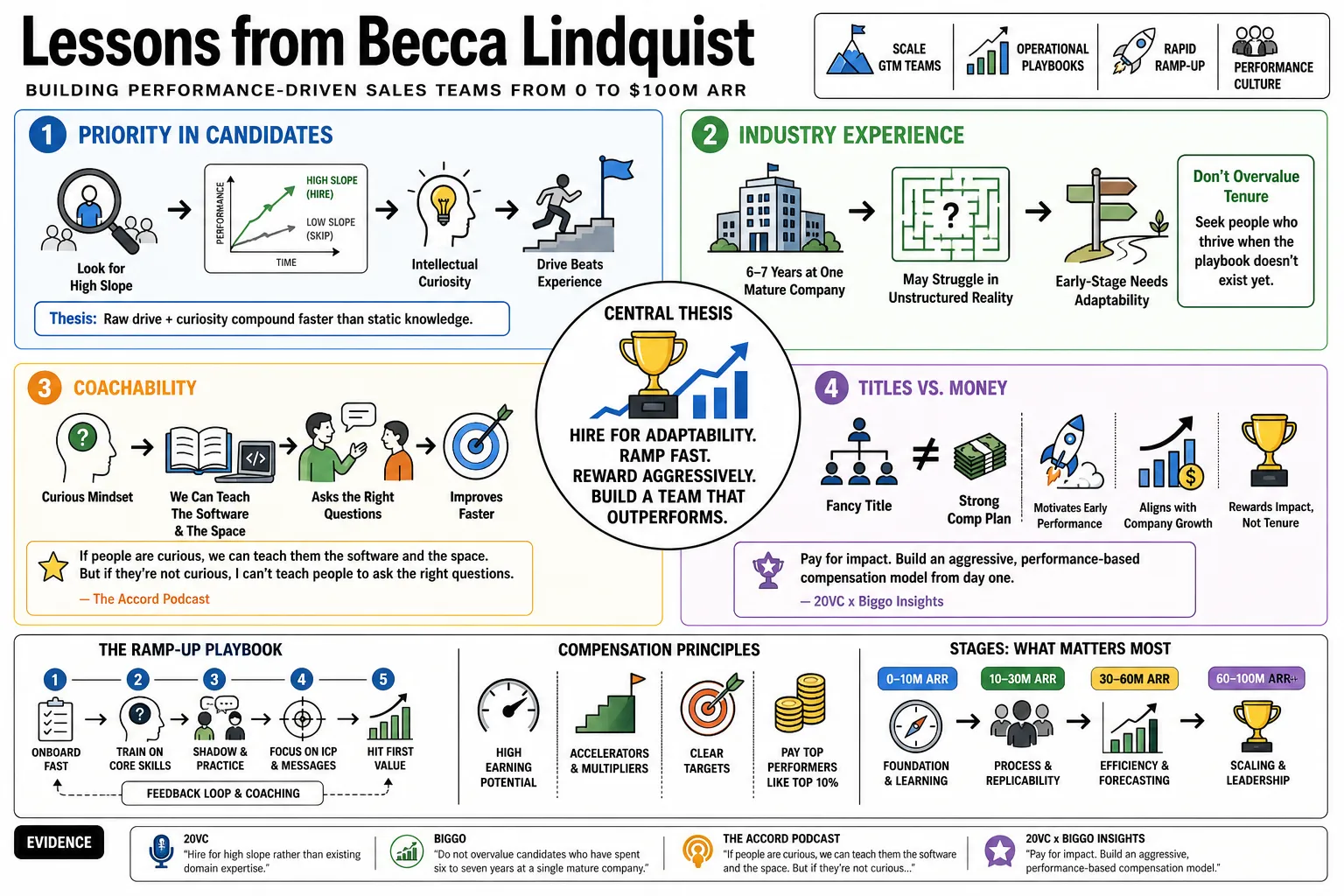
- On priority in candidates: Lindquist looks for intelligence, drive and coachability: the ability to learn and improve matters more than domain knowledge alone. She still values relevant expertise for some early hires and senior roles. — 20VC — Inside Clay’s Sales Playbook.
- On industry experience: Long tenure is a reason to ask whether a candidate can adapt outside the systems they helped build, not proof that they cannot. Lindquist also scrutinizes repeated short stays and acknowledges that someone may still be learning in a long-held role. — 20VC — Inside Clay’s Sales Playbook.
- On Coachability: Curiosity is a hiring prerequisite for Lindquist: software and industry knowledge can be taught, but she finds it harder to teach someone to ask useful questions. — Accord — Early Stage Sales Journey.
- On titles versus money: Lindquist cares more about pay, equity and scope than an impressive title. She agrees with the hiring concern about title fixation, but that is her judgment, not a validated predictor of candidate quality. — 20VC — Inside Clay’s Sales Playbook.
- On the LinkedIn test: A LinkedIn profile should tell a coherent story of growing expertise and show concrete performance outcomes. Lindquist discounts recommendations and does not treat an impressive company name as enough by itself. — 20VC — Inside Clay’s Sales Playbook.
- On Early Stage Sales Hires: A startup’s first sellers need to work without the support systems of a mature sales organization. Lindquist looks for experience with a comparable stage, buyer and motion, rather than assuming a prestigious employer makes someone ready for that environment. — The Crew Podcast — Building Clay’s GTM Team.
- On Hiring the Right Customers: Focus on customers whose use cases fit the product rather than chasing every available dollar. Poor-fit customers consume support effort and may become detractors when the product cannot make them successful. — Accord — Early Stage Sales Journey.
- On title obsession: A premature CRO title can leave a hire with little room to grow and make a later leadership hire feel like a demotion. Lindquist advises thinking about future scope instead of maximizing the title at entry. — 20VC — Inside Clay’s Sales Playbook.
Part 2: Interviewing and Assessing Talent
- On the defensiveness test: Give a leadership candidate genuine interview feedback and observe how they respond. Lindquist prefers a recruiter delivering it when possible, because the candidate’s treatment of that person can reveal defensiveness that a conversation with the hiring leader might miss. — 20VC — Inside Clay’s Sales Playbook.
- On verifying metrics: Probe a candidate’s account of a real deal instead of relying on a rehearsed claim about self-sourced pipeline. Lindquist asks where the relationship began and uses backchannels to understand the selling environment and the person’s contribution. — The Crew Podcast — Building Clay’s GTM Team.
- On Assessing Curiosity: Look for curiosity demonstrated through using the product, not just a claim of interest. For a traditional sales candidate at Clay, Lindquist asks what they built and distinguishes a meaningful working table from an unused account. — The Crew Podcast — Building Clay’s GTM Team.
- On role-playing: A memorized product demonstration can miss the skills that matter in selling. Clay instead uses a mock call followed by a deal debrief to assess business understanding, self-awareness, next steps and the ability to run a sales cycle. — The Crew Podcast — Building Clay’s GTM Team.
- On low-ego individuals: Low-ego hires should be willing to bring in people who know more or are stronger in particular areas. Lindquist pairs that openness with a willingness to experiment and adapt while an early sales process is still being built. — Accord — Early Stage Sales Journey.
- On measuring drive: Lindquist wants people who can connect a product to a real business problem and also do the work. She favors athletes as one possible signal of discipline and effort; athletics is her preference, not a requirement or proof of sales ability. — 20VC — Inside Clay’s Sales Playbook.
Part 3: Sales Compensation and Incentives
- On variable pay: Compensation should match the behavior the role now requires. Lindquist sees room to defer variable pay while buyers and use cases are still being discovered, then introduce incentives when sellers are expected to outbound into territories and repeat a known motion. — The Crew Podcast — Building Clay’s GTM Team.
- On Overperformance: When a seller exceeds a demanding quota, Lindquist wants the commission plan to reward that overperformance meaningfully. Her Clay discussion centers on accelerators rather than treating above-target revenue like ordinary attainment. — 20VC — Inside Clay’s Sales Playbook.
- On aligning behavior: A comp plan shapes behavior. In a land-and-expand business, incentives should encourage efficient initial deals rather than a seller delaying a land just to make it slightly larger; Clay credits its seller for qualifying expansion within a defined window after handoff. — The Crew Podcast — Building Clay’s GTM Team.
- On Simplicity: Keep the commission plan easy to understand and administer. Lindquist contrasts the straightforward plan she experienced at Heap with complicated allocations of variable pay. — 20VC — Inside Clay’s Sales Playbook.
- On Early Stage Equity: Equity does not provide the same immediate reward as cash tied to performance, especially when liquidity is uncertain. In discussing Clay’s move to variable pay, Lindquist questions making sellers accountable for a number without paying them more when they exceed it; this is not a rule that every experimental first-sales role must pay commission. — 20VC — Inside Clay’s Sales Playbook.
- On adjusting quotas: Quota, pay and accelerators need to fit the business economics and the attainment culture. Lindquist says Clay would change quota or pay if its ratio stopped making sense, and wants a substantial portion of the team succeeding rather than a zero-sum competition. — 20VC — Inside Clay’s Sales Playbook.
Part 4: Onboarding and Ramp-Up Strategy
- On bootcamp training: In a more developed sales organization, bootcamp gives early evidence of engagement, help-seeking and account judgment. Lindquist looks within roughly three weeks for whether a rep can prioritize accounts and begin calls and outreach; she distinguishes this from a startup that has not yet built formal training. — 20VC — Inside Clay’s Sales Playbook.
- On call recordings: Transfer founder selling knowledge through real calls: let new reps ride along, share recordings and gradually move them into leading the conversation. The recordings show how the founder explains the product and also give the new seller something concrete to critique. — 20VC — Inside Clay’s Sales Playbook.
- On continuous coaching: Coaching continues through a cycle of setting expectations, demonstrating, observing the rep and giving specific feedback. Lindquist selects calls based on complexity and the rep’s experience, and asks managers to check whether they actually taught the standard before blaming a rep for missing it. — Becca Lindquist — Sales Call Coaching.
- On Knowledge Checks: Clay uses a week-one certification that combines product understanding and discovery. Lindquist wants reps to alternate learning about the customer with teaching how the product could help, rather than delivering a feature monologue or only asking questions. — The Crew Podcast — Building Clay’s GTM Team.
- On cultural integration: Shared training helps a growing team align around how it sells. Lindquist describes bringing Clay’s GTM functions together for product learning, sales skills and a customer interview, framing the event as an investment in the team’s understanding and development. — Becca Lindquist — Camp Clay.
- On Updating Training: Training needs to stay aligned as the product and team change. Lindquist describes Camp Clay as a reset for drift in what the team sells and how it sells, combining updated product knowledge with sales skills. — Becca Lindquist — Camp Clay.
Part 5: Artificial Intelligence in Modern Sales
- On AI as a supercharger: Lindquist’s AI thesis is to equip SDRs for higher output rather than assume the role disappears. Her example of a rep booking more meetings with better tools is hypothetical, not a measured productivity result or a guaranteed target. — 20VC — Inside Clay’s Sales Playbook.
- On human talent: Automation still needs business context and judgment. Lindquist assesses whether people understand data flows, bottlenecks and where human intervention is required, not merely whether they can display a recent AI prompt. — Sound Bites — Inside the GTM Tornado.
- On the scared play: Treat AI productivity gains as an opportunity to cover more of the market, not only to maintain existing output with fewer SDRs. Lindquist contrasts these choices as her growth-oriented thesis; she is not proving that expansion is right for every business. — 20VC — Inside Clay’s Sales Playbook.
- On Personalization at Scale: Relevant automated outreach starts with a useful account signal and a reason that matters to the recipient. Lindquist warns that excessive scale can turn creative plays into generic sequences, so the aim is a workable balance between creativity and repeatability. — The Crew Podcast — Building Clay’s GTM Team.
- On automating the mundane: Automate repetitive steps such as preparation, follow-up and outreach so sellers can use their business context more effectively. At Clay, Lindquist expects sellers to experiment with these workflows and share useful improvements across the team. — Sound Bites — Inside the GTM Tornado.
- On data enrichment: A shared data marketplace can combine first-party, third-party and AI-derived signals for account research and go-to-market execution. Lindquist treats this as part of Clay’s value proposition, not proof that richer data alone guarantees better outbound results. — Sound Bites — Inside the GTM Tornado.
- On Evolving Skillsets: Lindquist’s evolving sales skill set combines business understanding with the ability to use AI and build workflows. Her GTM-engineer description emphasizes systems thinking and the context to turn an idea into useful action. — Sound Bites — Inside the GTM Tornado.
- On the future stack: Getting an AI workflow to work for one rep is different from getting a large team to adopt and iterate on it. Lindquist highlights the organizational work of changing how many people operate, rather than assuming individual access to a model solves team execution. — 20VC — Inside Clay’s Sales Playbook.
Part 6: Outbound Strategy and Pipeline Generation
- On the state of outbound: Build an outbound capability before inbound demand slows. Lindquist explains the future pipeline math to her team and trains them for the contribution the business will eventually need, rather than waiting for the inbound motion to stop working. — The Crew Podcast — Building Clay’s GTM Team.
- On pipeline ownership: Pipeline generation is shared work, not something account executives can leave entirely to marketing or SDRs. Lindquist asks leaders and other colleagues who they can reach out to so the rep has help opening the account. — 20VC — Inside Clay’s Sales Playbook.
- On Targeting: Prioritize accounts using signals of fit drawn from what effective reps already notice. Lindquist describes converting those manual signals into workflows and territory scoring, instead of asking each rep to research and rank accounts from scratch. — The Crew Podcast — Building Clay’s GTM Team.
- On Messaging Relevance: Useful messaging ties the product to a buyer’s actual workflow problem. Clay’s SDRs gather context from users so the seller can approach a leader with an informed view of how the business could improve, rather than a generic feature pitch. — The Crew Podcast — Building Clay’s GTM Team.
- On multi-threading: Map more than one route into the account. Lindquist’s team uses multithreading requests to ask executives, partners and investors to help reach the appropriate people, recognizing that the same message can receive a different response from a different sender. — 20VC — Inside Clay’s Sales Playbook.
- On Early Stage Motion: Early selling also teaches the company who its buyers are, which use cases matter and what makes customers successful. Lindquist notes that quota incentives can muddy that learning while the motion is still being discovered. — The Crew Podcast — Building Clay’s GTM Team.
- On SDR efficiency: Equip SDRs with repeatable AI and data workflows rather than leaving prospecting entirely manual. Lindquist describes tooling and training reps with Clay, while treating the expected productivity upside as a thesis to pursue rather than an established result for every team. — 20VC — Inside Clay’s Sales Playbook.
- On activity metrics: Use activity and meeting outcomes together to diagnose outbound performance. When a rep is doing the work but not generating meetings, Lindquist reviews the messaging with them instead of treating the issue as a lack of effort. — The Crew Podcast — Building Clay’s GTM Team.
- On Constant Refinement: Outbound advantages do not last indefinitely. Lindquist emphasizes executing new ideas with the right data faster than competitors and improving the team’s baseline as it learns. — The Crew Podcast — Building Clay’s GTM Team.
Part 7: Deal Mechanics and Forecasting
- On deal mathematics: Deal size must justify the selling effort and cycle length. Lindquist is skeptical of a modest annual contract that takes months to close, while acknowledging that a high-volume, light-touch motion with expansion potential can have different economics. — 20VC — Inside Clay’s Sales Playbook.
- On binary qualification: A champion must sell internally when the rep is absent, have access to and influence over the economic buyer, and have a personal win. Lindquist asks for observed evidence of all three and distinguishes a helpful coach from a genuine champion. — 20VC — Inside Clay’s Sales Playbook.
- On forecasting discipline: Forecast reviews should test the pain, the business metric, who cares about it and whether the deal is truly in the right stage. Lindquist runs weekly reviews and expects frontline managers to understand important deals, not simply read CRM updates. — 20VC — Inside Clay’s Sales Playbook.
- On managing the deal cycle: Build urgency around a business problem the buyer wants solved, not the seller’s quarter-end deadline. Lindquist recommends finding the executive who cares about the metric and asking how to get the solution into their hands sooner. — 20VC — Inside Clay’s Sales Playbook.
- On pricing confidence: Discounts can make later expansion or renewal harder when a seller has to recover the initial price concession. Lindquist’s preferred net-dollar ownership model makes sellers responsible for the quality and economics of the deals they close. — 20VC — Inside Clay’s Sales Playbook.
- On Post-Sales Handoff: Customer success begins before the handoff. Lindquist recommends enabling buyers to use the product before the sale, observing how it works for them and exchanging feedback, so the team knows it is a good solution and can support them afterward. — Accord — Early Stage Sales Journey.
Part 8: Career Growth and Leadership
- On the rotting framework: Notice when a role has stopped stretching you. Lindquist describes a flattened learning curve as a reason to explore a new role or environment, while acknowledging that a different position inside the company may also offer a route to renewed learning. — 20VC — Inside Clay’s Sales Playbook.
- On intensity: Lindquist recalls working especially hard at Heap when the commission plan made the link between closed revenue and personal reward obvious. That is her experience of one early sales model, not evidence that low base salaries or the same rates are right for every team. — 20VC — Inside Clay’s Sales Playbook.
- On staying in seat: An established sales playbook may need changes in an AI-first business. Lindquist respects the craft taught by mature sales organizations but questions carrying every step over unchanged, such as delaying product value until a full business case is complete. — 20VC — Inside Clay’s Sales Playbook.
- On Scaling Leadership: Match a sales leader to the work the company needs at its current stage. For an early team, Lindquist warns against a senior hire too far removed from closing deals, developing a pitch and handling new objections. — The Crew Podcast — Building Clay’s GTM Team.
- On Continuous Learning: Keep learning about how the business works and how useful tools can improve it. Lindquist advises newer sellers to listen, build context and practice automating workflows; she also describes spending time improving her own use of these tools. — Sound Bites — Inside the GTM Tornado.
- On transparent business signals: Evaluate a job opportunity using customer retention, expansion and defensibility as well as headline growth. Lindquist also distinguishes promised employee liquidity from an actual record of tender offers; paper equity is not automatically spendable wealth. — 20VC — Inside Clay’s Sales Playbook.
- On promoting from within: An SDR team can be a development pipeline for future closing roles as well as a source of sales pipeline. Lindquist sees promotion from an observed internal SDR as a way to reduce the uncertainty of an external hiring decision, not eliminate it. — 20VC — Inside Clay’s Sales Playbook.
- On managing up: Bring operating problems into the design of internal tools. Lindquist describes working with the product manager on Clay’s internal copilot and starting with sales basics, such as identifying accounts that are not multithreaded, before pursuing more elaborate AI ideas. — Sound Bites — Inside the GTM Tornado.
- On Developing Reps: Hands-on leadership includes developing the rep, not just reviewing results. Lindquist looks for managers who get on customer calls, help sellers build pipeline and coach deals. — The Crew Podcast — Building Clay’s GTM Team.