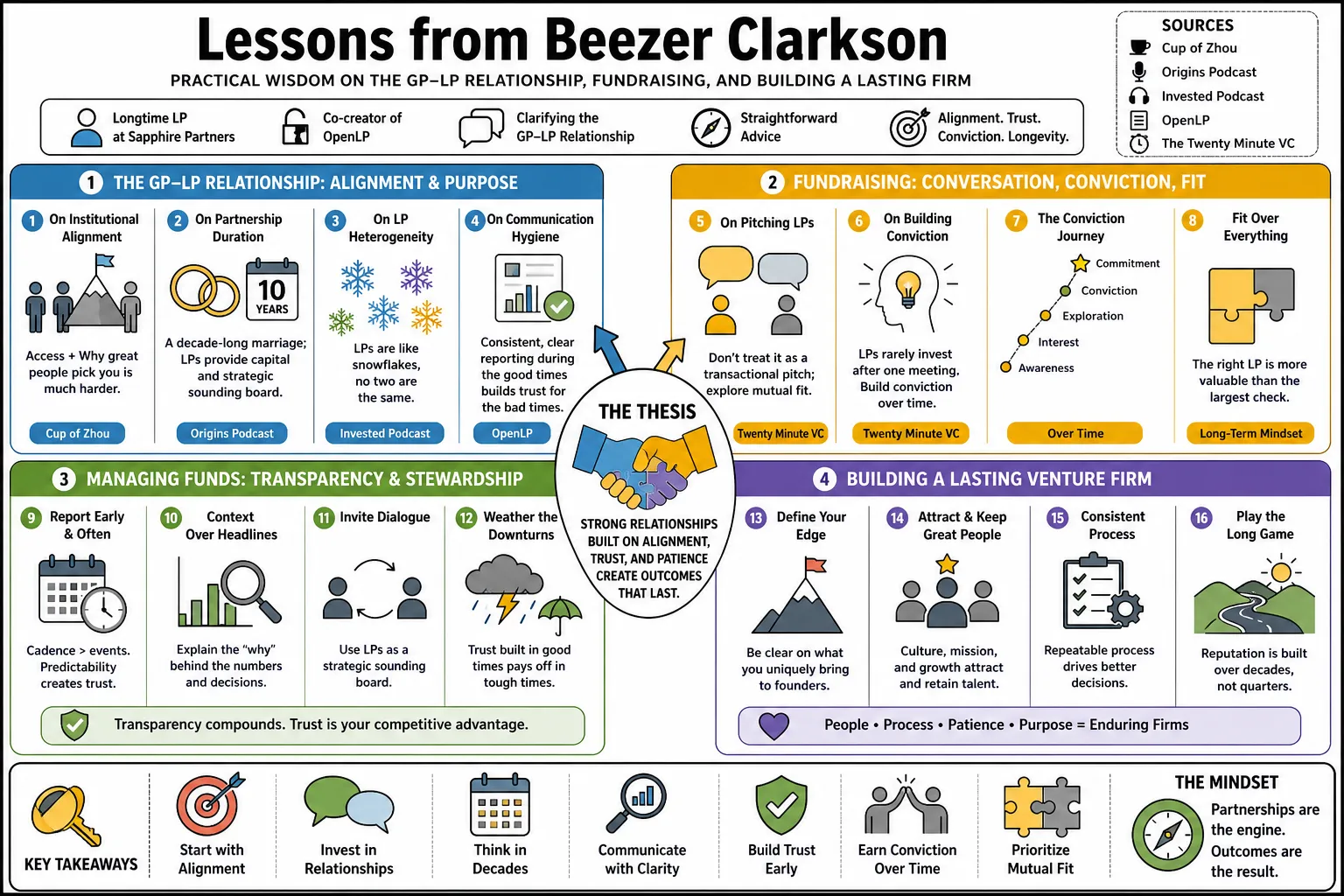
Lessons from Beezer Clarkson
Beezer Clarkson is a venture fund investor who co-led the Sapphire Partners team joining LGT Capital Partners in April 2026. This profile gathers her perspectives on LP–GP relationships, fundraising, fund management and building a lasting venture firm. — LGT Capital Partners — Sapphire Team Transition.
Part 1: The GP-LP Relationship
- On institutional alignment: Access matters more than simply seeing deals: why would a promising founder choose this investor? Clarkson applies the same question to LPs, because strong fund managers can also choose which investors they work with. — Superclusters — The Art and Science of VC Metrics.
- On partnership duration: Choose LPs for their ability to remain useful over multiple fund cycles, not just for the current check. In her description of Sapphire’s approach, Clarkson emphasizes durable capital, helpful perspective and connections alongside financial support. — Beezer Clarkson and Nino Marakovic — All In.
- On LP heterogeneity: LPs differ in their objectives, structures and reasons for investing. Learn what a particular LP needs rather than treating endowments, family offices and other investors as interchangeable. — Invested by Aleph — Beezer Clarkson.
- On communication hygiene: Agree on communication cadence and style before accepting an LP’s investment. Understanding those expectations helps a GP decide whether the relationship is workable and how to keep the investor informed afterward. — Beezer Clarkson — 9 Questions for GP/LP Fit.
- On pitching LPs: Begin an LP meeting by asking about the investor’s business and current investment focus. Establishing fit first can save an irrelevant pitch and make the conversation more useful. — Beezer Clarkson — 9 Questions for GP/LP Fit.
- On building conviction: Conviction can develop through repeated exposure to a manager and the portfolio. Clarkson’s team tries to give several colleagues opportunities to meet the GP, understand the investments and ask informed questions over time. — Superclusters — The Art and Science of VC Metrics.
- On GP transparency: Report setbacks along with what they teach you and what you are changing. Clarkson wants managers who can acknowledge problems and correct course, rather than insist everything is fine when the evidence says otherwise. — Carta — Liquidity, LPs, and the Long Game.
- On pre-filtering: Check an LP’s strategy, geography, preferred check size and acceptable fund size before pursuing an allocation. A fund can be outside those parameters even when the LP likes the manager. — Beezer Clarkson — 9 Questions for GP/LP Fit.
- On early engagement: Start relationships before the immediate fundraising deadline. Some institutional LPs want to observe how a fund operates through a cycle, so an investor who cannot commit now may still be worth knowing for a later fund. — Beezer Clarkson — 9 Questions for GP/LP Fit.
Part 2: The Realities of Fundraising
- On the primary challenge: An LP is choosing people to manage a blind pool of capital, not making a direct investment in one startup. A fundraising conversation therefore needs to establish why the manager is credible and how the proposed fund fits the LP’s business. — Beezer Clarkson — 9 Questions for GP/LP Fit.
- On market conditions: Difficult fundraising conditions can make LPs concentrate on the managers they believe in. Clarkson contrasts that higher bar for conviction with the wider range of ways newcomers can now learn about and enter venture. — Invested by Aleph — Beezer Clarkson.
- On pacing: Deployment pace affects how much a fund can learn and how many market conditions it experiences. When a manager invests faster than planned, Clarkson examines the revised model and the trade-off with time diversification instead of assuming speed is an advantage. — Superclusters — Evolving a VC Strategy.
- On the first close: An anchor LP can help a fund build fundraising momentum, but practical support is not the same as a commitment. Confirm the investor’s actual allocation and role rather than assuming an introduction or other help means they are leading the close. — Superclusters — The Art and Science of VC Metrics.
- On institutional hurdles: Institutional LPs often classify a manager by fund number, but a rapid succession of funds does not make the underlying companies mature. Clarkson distinguishes reaching Fund IV from having the operating history and realized evidence that investors may expect. — The Learning Corner — Venture Firm Survival.
- On re-ups: A stable LP base helps a manager plan for later funds. Ask how an LP has supported managers in follow-on funds and why it has declined to do so; past support does not constitute a guarantee of the next commitment. — Beezer Clarkson — 9 Questions for GP/LP Fit.
- On narrative consistency: The portfolio must make sense alongside the strategy used to raise the fund. Clarkson compares an early manager’s pitch with what they actually do, and expects managers to bring LPs along when the business evolves. — The Learning Corner — Venture Firm Survival.
- On managing rejection: An LP’s refusal can reflect available capital or portfolio capacity rather than a judgment that the GP is poor. Ask whether the investor is adding new managers, not merely whether it invests in venture. — Beezer Clarkson — 9 Questions for GP/LP Fit.
- On closing the gap: If the fund model needs more capital than originally planned, explain what has changed and discuss the options with LPs. Clarkson treats reopening or adding capital as a negotiated portfolio-construction decision, not a reason to grow simply because more money is available. — Superclusters — Evolving a VC Strategy.
Part 3: Understanding the LP Perspective
- On LP constraints: Understand how an LP approves investments as well as what it wants to buy. A family office, endowment, pension or fund-of-funds can have a different committee, adviser structure and route from a first meeting to an allocation. — Beezer Clarkson — 9 Questions for GP/LP Fit.
- On asset allocation: A large institution’s total assets do not tell you how much it can put into your venture fund. Ask about its venture allocation and annual commitment budget, because venture may compete with other strategies for the same dollars. — Beezer Clarkson — 9 Questions for GP/LP Fit.
- On risk assessment: LP underwriting needs to understand why a GP chooses particular investments and how the GP thinks about risks. Clarkson uses those discussions to build trust in a manager’s judgment before committing to decisions she cannot control deal by deal. — Invested by Aleph — Beezer Clarkson.
- On reference checks: Use founder references to understand how a GP actually behaves, but read negative feedback in context. Clarkson describes checking patterns and circumstances rather than treating a disappointed founder’s account as an automatic disqualification. — Invested by Aleph — Beezer Clarkson.
- On evaluating process: Look for a process that can be applied repeatedly, not only an attractive past result. Clarkson uses consistent underwriting to connect portfolio assumptions with the manager’s approach to founders, investment choices and firm building. — Invested by Aleph — Beezer Clarkson.
- On capital calls: Capital going out faster than it comes back limits an LP’s room for new commitments. Clarkson emphasizes that secondaries can help, but cannot by themselves resolve a sustained shortfall between capital calls and distributions. — Beezer Clarkson — Repeatability and Liquidity.
- On co-investments: Co-investment terms can matter to an LP’s portfolio as well as its economics. In discussing a small-fund survey, Clarkson highlights demand for no-economics co-investments as a tool for managing pacing and concentration risk. — Beezer Clarkson — The Great Recalibration.
- On reporting standards: Keep the financial information useful while recognizing that LPs may prefer different formats for the qualitative update. Clarkson describes managers using tools such as videos and shared documents, rather than prescribing one presentation style for every investor. — Carta — Liquidity, LPs, and the Long Game.
- On manager selection: Manager selection needs both numerical analysis and an understanding of people. Clarkson values colleagues who can read portfolio data and others who bring different context from meeting managers and learning about their markets. — Superclusters — The Art and Science of VC Metrics.
Part 4: Evaluating Emerging Managers
- On emerging manager potential: An emerging manager can make a compelling case through a distinct point of view and the work needed to attract founders. Clarkson values sustained energy for that work, but explicitly says she cannot prove that passion guarantees investment success. — Invested by Aleph — Beezer Clarkson.
- On graduation rates: Reaching later funds is far from automatic. Clarkson’s study of venture-firm formation and activity found substantial attrition between first funds and established franchises; raising the initial fund is only the start of that journey. — Beezer Clarkson — I See Dead VCs.
- On differentiation: Explain why your firm should win the founders it wants to back. Clarkson looks for a coherent connection between the manager’s perspective, the opportunity, the team and how the fund competes. — Invested by Aleph — Beezer Clarkson.
- On the first portfolio: A first portfolio gives LPs evidence of how a new manager turns an idea into investments. An early win can become a useful proof point, but Clarkson does not treat a famous early company as a prerequisite for backing a new firm. — Invested by Aleph — Beezer Clarkson.
- On building infrastructure: Building a firm requires more than choosing investments. As the manager grows, Clarkson expects its operating capacity, team and ability to work with LPs to develop alongside its portfolio. — The Learning Corner — Venture Firm Survival.
- On track record attribution: Explain each person’s role in the investments presented as a track record. Clarkson asks what happened in the room and how people contributed, while recognizing that different participants can describe the same deal differently without necessarily lying. — Invested by Aleph — Beezer Clarkson.
- On strategy drift: Evolve the strategy around the firm’s actual strengths rather than copying another investor’s model. Clarkson allows for changes in stage or approach, but expects a manager to explain the logic instead of chasing the next fashionable opportunity. — Superclusters — Evolving a VC Strategy.
- On sizing the fund: Fund size has to work with the intended checks, ownership, team capacity and plausible exits. A larger fund is not automatically a better version of a smaller one, and counting checks per partner does not establish the returns those companies can produce. — Invested by Aleph — Beezer Clarkson.
Part 5: Portfolio Construction and Concentration Risk
- On concentration: Concentrating an early fund leaves more riding on fewer opportunities. Clarkson warns that too few chances at a meaningful winner can make success harder, so concentration needs to be weighed against the rest of the fund model. — Superclusters — Evolving a VC Strategy.
- On fund math: Work backward from the fund’s return ambition to the exits and ownership that would be needed. Clarkson says strong venture results depend on substantial company outcomes, while emphasizing that there is no single formula and nothing guarantees returns. — Crunchbase News — Interview with Beezer Clarkson.
- On diversification: An early fund needs enough opportunities for a meaningful winner, while each investment still needs plausible fund-return potential. In discussing one manager’s model, Clarkson weighs the number of investments against ownership and reserves rather than treating more positions as automatically safer. — Superclusters — Evolving a VC Strategy.
- On follow-on reserves: Use reserves to support companies that warrant further investment, not simply to avoid admitting a loss. Clarkson distinguishes losing capital early from continuing to put money into a company that no longer looks capable of a meaningful result. — Superclusters — The Art and Science of VC Metrics.
- On position sizing: Check whether the initial investment and expected ownership can matter at the fund’s scale. Small positions in a large fund can require implausibly large exits to deliver the desired return, even when the companies do well. — Superclusters — The Art and Science of VC Metrics.
- On discipline: When deployment runs ahead of the plan, revisit the portfolio assumptions explicitly. Clarkson weighs options such as reserves, recycling and time diversification; changing the model needs a reasoned discussion rather than an unexamined response to a busy market. — Superclusters — Evolving a VC Strategy.
- On recycling: Recycling puts eligible early proceeds back into investments instead of distributing them immediately. It can increase capital working in the portfolio, but its value depends on the fund terms, timing and the opportunity cost of retaining cash; it does not mean reinvesting management fees. — Superclusters — The Art and Science of VC Metrics.
- On managing winners: Think about liquidity before an exit decision becomes urgent. Clarkson discusses selling part of a position while retaining upside, but stresses that the available routes depend on the company, the stakeholders and the transaction’s constraints. — Carta — Liquidity, LPs, and the Long Game.
Part 6: Team Dynamics and Firm Survival
- On partnership fracture: A change in the partners’ direction can end an otherwise successful fund relationship. Clarkson describes teams that no longer want to pursue the same stages or work together; strong past returns do not resolve every partnership issue. — Crunchbase News — Interview with Beezer Clarkson.
- On shared vision: Evaluate shared values and operating philosophy through real work together, not only a checklist. Clarkson describes years of watching decisions, discussing markets and working with common managers as the basis for confidence in a long-term team partnership. — Beezer Clarkson — Choosing a Long-Term Partner.
- On firm evolution: Successive funds bring a different firm-building task from making the first investments. Clarkson highlights the need to develop a team and organization that can meet more demanding LP expectations, rather than assuming investment skill alone scales the business. — The Learning Corner — Venture Firm Survival.
- On succession planning: A durable firm needs to consider when established investors should make room for another generation. Clarkson connects succession with keeping the team open to new people and perspectives, rather than claiming age alone determines investing ability. — Invested by Aleph — Beezer Clarkson.
- On hiring talent: Build a team with complementary abilities rather than replicas of one investor. Clarkson describes purposefully combining different skills and perspectives so the organization can understand more of the world its managers work in. — Invested by Aleph — Beezer Clarkson.
- On institutionalizing: An enduring franchise needs more than a successful first portfolio. Clarkson’s analysis points to the work of building a lasting organization, a recognizable brand and relationships with a broader LP base as managers progress into later funds. — Beezer Clarkson — I See Dead VCs.
- On decision-making: Make room for high conviction without making investment decisions unilateral. Clarkson’s team asks an advocate to explain the case, acknowledges serious objections and tries to surface disagreements early rather than at the end of the process. — Superclusters — The Art and Science of VC Metrics.
- On dead VCs: A firm can retain a name and legacy holdings while no longer being an active equity investor. Clarkson’s study identifies inactivity using a four-year window without initial or follow-on equity investments; that is not proof that a firm can never raise again. — Beezer Clarkson — I See Dead VCs.
Part 7: Market Cycles and Adaptability
- On market corrections: Industry activity reflects both new entrants and firms that stop investing. Clarkson’s study shows that continued first-fund formation can coexist with a decline in active firms when more existing managers become inactive. — Beezer Clarkson — I See Dead VCs.
- On vintage years: A fund’s deployment window determines which market conditions its portfolio encounters. Clarkson treats spreading investments across time as a real construction choice, not a guarantee that a strong manager will deliver the same results in every vintage. — Superclusters — Evolving a VC Strategy.
- On valuation discipline: Competition can raise entry valuations and make target returns harder to achieve. Clarkson ties the concern to the ownership and exit outcomes a fund needs, rather than treating a high price as proof that a particular investment will fail. — Crunchbase News — Interview with Beezer Clarkson.
- On adapting to change: Changes in technology and the market can require a different way of finding and winning founders. Clarkson argues for understanding those changes while retaining a clear reason for the firm to exist, rather than simply following someone else’s strategy. — Superclusters — Evolving a VC Strategy.
- On market resilience: Experience of downturns can help an investor avoid treating the next one as unprecedented. Clarkson values people who can remain engaged with the work while recognizing real obstacles, rather than equating optimism with ignoring risk. — Invested by Aleph — Beezer Clarkson.
- On Series A shifts: Understand what the next financing investor now requires. Clarkson expects managers to notice when funding conditions and company progress have changed, and to adjust their assessment rather than continue treating old marks or expectations as sufficient. — The Learning Corner — Venture Firm Survival.
- On secondary markets: Secondaries offer a possible liquidity route when companies remain private longer. Clarkson wants the discussion to include the interests of founders, companies, GPs and LPs, because a transaction that helps one party may need consent or cooperation from others. — Carta — Liquidity, LPs, and the Long Game.
- On capital concentration: Large platforms and smaller specialists can occupy different parts of the market. Clarkson sees room for early-stage investors with useful founder access and a differentiated role, not an automatic advantage for every small fund competing with a mega-fund. — Carta — Liquidity, LPs, and the Long Game.
Part 8: Transparency and the OpenLP Initiative
- On the motivation for OpenLP: OpenLP began as a response to the limited visibility of LP perspectives in venture. Clarkson wanted the investors behind venture funds to be easier to understand and their voices easier for GPs and founders to find. — Beezer Clarkson — OpenLP 2.0.
- On sharing the playbook: Sharing LP perspectives helps managers learn the business of running a fund before having to discover everything alone. Clarkson presents OpenLP as a place to find experienced investors’ observations, research and practical advice, not a promise that public information ensures success. — Beezer Clarkson — OpenLP 2.0.
- On community building: Sharing operational knowledge need not weaken a firm’s investment edge. Clarkson treats the LP community as a place to compare perspectives and learn from other investors, including people whose opinions differ from her own. — Carta — Liquidity, LPs, and the Long Game.
- On breaking down barriers: Make information about LP decision-making accessible to investors from non-traditional backgrounds. Clarkson describes this as an explicit aim of OpenLP, not evidence that publishing advice by itself eliminates fundraising barriers. — Sapphire Partners — The Next Generation of OpenLP.
- On educational resources: Practical fund-running questions deserve public discussion alongside market commentary. Clarkson describes OpenLP content covering fund economics, annual meetings and other LP–GP topics, giving managers access to perspectives on the business of running a fund. — Beezer Clarkson — OpenLP 2.0.
- On industry maturity: Greater dialogue does not mean every venture fund should follow one standardized model. Clarkson describes venture as a boutique craft and stresses that the right practices depend on what a firm is trying to build. — Invested by Aleph — Beezer Clarkson.
- On continuous learning: Clarkson names “What would you do if you knew you couldn’t fail?” as a favorite quotation. It reflects an interest in exploring possibilities, but the interview does not establish that she coined it or that this mindset produces better venture returns. — Forty Over 40 — 10 Questions for Beezer Clarkson.
- On the end goal: An LP can aim to make the work of fund managers and founders easier through capital, perspective and useful connections. Clarkson and Marakovic describe that service-oriented purpose as the motivation for their approach, not a proven claim that transparency allocates capital optimally. — Beezer Clarkson and Nino Marakovic — All In.