Ben Braverman led sales at Flexport and later co-founded Saga Ventures. In a 2024 interview, he described helping Flexport grow revenue from zero to $2 billion over seven years. His approach combines customer-facing selling, operational knowledge, and a sustained interest in helping founders build companies. — Tech Breakfast Club — Ben Braverman Interview.
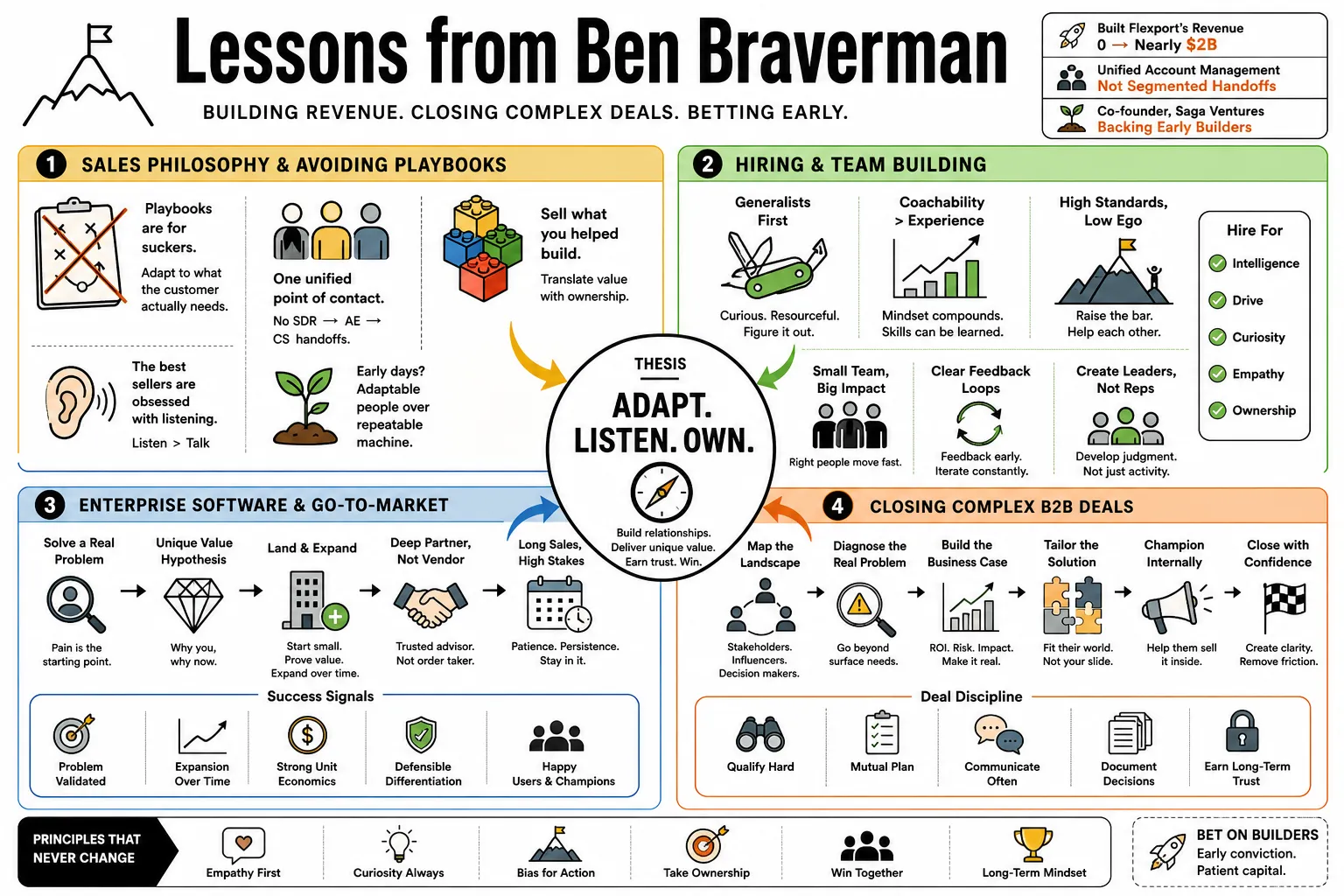
Part 1: Sales Philosophy and Avoiding Playbooks
- On rigid systems: At each stage of growth, reassess how the sales organization works. Braverman describes delaying some conventional management functions early on, then adding experienced leaders and redesigning the sales motion once Flexport had the scale and planning horizon to use them. — SaaStr — Scaling in Hypergrowth.
- On specialization: In a complex service business, specialization should serve the customer rather than force unnecessary handoffs. Flexport kept the seller involved alongside an operations partner as customers moved from their first shipment to a broader relationship. — SaaStr Podcast #222.
- On early sales: Early sales hires need to work through ambiguity. Braverman describes building Flexport’s initial team around people who could operate without the structure of an established sales organization, rather than assuming a successful big-company rep would automatically thrive. — SaaStr — Scaling in Hypergrowth.
- On founder-led sales: Early go-to-market leaders need to help shape what the company can actually sell. At Flexport, Braverman pushed beyond customs paperwork toward handling the broader freight-forwarding problem customers needed solved. — Grow & Tell — Ben Braverman.
- On listening: Understand how the customer’s business works before designing the sale. Braverman describes relationship selling as learning what an organization needs and building a solution and strategy around those goals. — SaaStr Podcast #222.
- On sales mechanics: Rigid scripts are not enough for effective outbound. Braverman describes giving the team information, references, and access to leadership so they could approach prospects creatively instead of sounding automated. — Operators — Ben Braverman.
- On authenticity: Build a relationship that makes the seller useful to the buyer’s team. Braverman describes midmarket customers looking for help executing their transportation work and sellers earning trust through repeated in-person contact. — Grow & Tell — Ben Braverman.
- On product knowledge: Curiosity helps a seller learn a complex industry. Braverman says many of Flexport’s strongest sellers arrived without logistics expertise, but were willing to learn the field and take a sustained interest in their customers. — Operators — Ben Braverman.
- On adapting: Moving upmarket changes the requirements of the sale. Flexport needed more than bigger targets: it had to develop the physical network, integrations, and capabilities required to serve large customers. — Grow & Tell — Ben Braverman.
Part 2: Hiring and Building Sales Teams
- On candidate profiles: Choose seller profiles for the segment they will serve. Braverman distinguishes high-volume SMB selling, midmarket relationship work, and key-account selling that requires navigating a large organization and its technical needs. — Grow & Tell — Ben Braverman.
- On SMB reps: High-volume SMB selling needs energy and a positive disposition. Braverman describes that role as taking many calls and helping customers through relatively straightforward logistics needs. — Grow & Tell — Ben Braverman.
- On enterprise reps: Key-account selling requires the patience to understand a large organization. Braverman describes mapping the people and systems involved and working through the technical and operational requirements of serving the account. — Grow & Tell — Ben Braverman.
- On onboarding: Give new sellers hands-on exposure to the job. Braverman describes trainees spending time alongside experienced sellers, while managers and trainers helped them learn how to conduct real customer conversations. — Grow & Tell — Ben Braverman.
- On promoting from within: Internal selling experience can give a manager tactical credibility, but performance alone is not enough. Braverman also looks for the desire to help others and the empathy to understand what their reps are trying to achieve. — SaaStr Podcast #222.
- On early startup hires: Sales should carry customer reality back into the company. Braverman sees the team as a two-way conduit: help customers understand the product, and translate their needs and frustrations into what the company should build next. — SaaStr Podcast #222.
Part 3: The Reality of B2B and Enterprise Sales
- On buyer risk: An early customer is taking a professional risk by trusting an unproven company. Braverman treats a founder’s ability to draw people into the mission as relevant not only to recruiting, but also to winning those first customers. — Venture Unlocked — Saga Ventures.
- On pricing: A customer may pay for operational value beyond the underlying freight transaction. Braverman describes Georgia-Pacific wanting Flexport’s platform across its shipments and being willing to pay a premium for that experience, even when it bought transport capacity directly. — Operators — Ben Braverman.
- On multi-threading: Large accounts involve multiple stakeholders. Braverman recommends matching that structure on the seller’s side, with experienced leaders able to join their reps when senior customer stakeholders enter the discussion. — SaaStr Podcast #222.
- On the sales cycle: A complex customer transition cannot be accelerated simply to suit the sales target. Braverman describes customers needing to experience the service and then plan the migration of their vendors and workflows onto Flexport. — SaaStr Podcast #222.
- On discovery calls: In a conventional sales cycle, qualify whether the customer has budget and is in a buying cycle. Braverman found those questions harder to interpret when raising a venture fund, because prospective LPs could choose not to allocate to venture at all. — This Week in Startups — Saga Ventures.
- On long-term value: The first transaction may be only the beginning of a substantial account. At Flexport, sellers stayed involved as customers tested the service and gradually shifted more of their business onto the platform. — SaaStr Podcast #222.
Part 4: Scaling from Zero to Billion (The Flexport Experience)
- On early traction: Flexport’s early SMB customers provided a learning ground. Many were underserved by large incumbents, and serving them helped the team practice onboarding and delivery while the stakes were still relatively small. — Grow & Tell — Ben Braverman.
- On moving upmarket: Serving large customers required Flexport to build capabilities before it could win their full business. Braverman describes years of investment in the physical network and technical requirements, with major accounts taking longer to expand than he initially expected. — Grow & Tell — Ben Braverman.
- On brand investment: Brand investment can support outbound even when attribution is imperfect. Braverman observed stronger SDR performance while Flexport was investing in its brand, and valued events and content that taught customers something useful. — Grow & Tell — Ben Braverman.
- On sales squads: Flexport paired a sales leader with an operations leader to serve an account together. The seller stayed involved in commercial questions and expansion while the operations partner and team handled the shipment work. — Grow & Tell — Ben Braverman.
- On rapid growth: Rapid growth continually opens new leadership gaps. Braverman describes new offices, new segments, and promotions creating fresh roles to fill, rather than reaching a point when the organization is permanently complete. — SaaStr Podcast #222.
- On chaos: Protect the time of strong field closers. Flexport separated customer-facing sales leadership from much of the hiring, training, and administration so experienced sellers could spend more of their time winning business. — SaaStr — Scaling in Hypergrowth.
- On product limitations: Winning large accounts sometimes meant selling a future capability before it was fully in place. Braverman describes continuing to build relationships and invest in Flexport’s service while waiting for customers to shift substantial spend. — Grow & Tell — Ben Braverman.
- On founder vision: Sales goals should reflect what the team can plausibly deliver and how customers actually buy. Braverman describes moving to annual quotas so reps could prepare customers for future bids without being pushed toward conflicting short-term targets. — SaaStr Podcast #222.
- On market timing: Market disruption helped create an opening for Flexport. Braverman recalls the early port strike putting established providers and the startup under similar supply constraints while customers urgently searched for help. — SaaStr Podcast #222.
- On loyalty: Braverman once expected to spend his entire career at Flexport. His account of leaving distinguishes that earlier intention from the later pull toward working with founders as an investor. — Hunter Walk — Ben Braverman Interview.
Part 5: Customer Experience and Account Management
- On delivery: In freight forwarding, the customer experience depends on actual delivery. Braverman contrasts Flexport with contracted SaaS revenue: customers could stop using the service when shipments did not meet their expectations. — SaaStr — Scaling in Hypergrowth.
- On accountability: Keep customers informed when circumstances change. Braverman describes using shipment data during disruptions to identify who was affected and quickly discuss the implications with those customers. — Operators — Ben Braverman.
- On retention: Keep sellers connected to the consequences of what they promise. Flexport’s seller-and-operations pairing made an unsuitable deal a problem for a close working partner, rather than something the seller could pass anonymously to another team. — Operators — Ben Braverman.
- On managing expectations: Recognize constraints outside the company’s control. Braverman describes vessel and aircraft capacity becoming limits on Flexport’s growth that the team could not solve through software or execution alone. — Operators — Ben Braverman.
- On empathy: Relationship selling requires understanding what the buyer is trying to accomplish. Braverman links empathy and patience to designing a useful partnership around the customer’s goals, rather than treating the interaction as a single transaction. — SaaStr Podcast #222.
Part 6: Venture Capital and Saga Ventures
- On transitioning to VC: Braverman’s move into venture followed years of angel investing and advising founders. In his account, he kept being drawn to spending time with builders, eventually making that work the focus of Saga. — Hunter Walk — Ben Braverman Interview.
- On fund strategy: Saga leads and co-leads pre-seed and seed investments. Braverman describes backing companies early enough that much of the assessment rests on the founder rather than a polished product or established customer base. — Venture Unlocked — Saga Ventures.
- On B2B focus: Braverman describes Saga’s focus on B2B companies in large legacy industries, particularly founders who combine technical ability with deep knowledge of the industry they want to change. — This Week in Startups — Saga Ventures.
- On evaluating founders: Conviction matters most when it is attached to a worthwhile problem. Braverman describes joining Flexport after meeting Ryan Petersen and being drawn to an unusually obsessed founder working on a mission he considered worthy. — Hunter Walk — Ben Braverman Interview.
- On capital deployment: In April 2026, Braverman described Saga’s typical checks as $2 million to $10 million, while allowing investments as small as $500,000. He said the firm remained heavily focused on pre-seed and seed and generally co-led its Series A investments. — Library of Minds — Ben Braverman.
- On adding value: Clear complementary responsibilities help a partnership work. At Saga, Braverman says he defers to Thomson Nguyen on technical diligence and Max Altman on investor-introduction timing, rather than competing to own every part of the process. — Venture Unlocked — Saga Ventures.
- On market cycles: When raising Saga’s first fund, Braverman found that prospective LPs did not credit promised anchor commitments until the documents were signed. He concluded that the team should have secured those signatures before starting broader fundraising meetings. — Venture Unlocked — Saga Ventures.
Part 7: Logistics, Operations, and High-Stakes Delivery
- On the supply chain: Logistics disruptions can become business disruptions for customers. Braverman describes factory shutdowns and constrained shipping capacity interrupting the movement of goods, making reliable transport and useful information particularly valuable. — Operators — Ben Braverman.
- On physical constraints: Software does not remove physical capacity constraints. Braverman describes periods when customer demand exceeded the space Flexport could obtain on vessels and aircraft. — Operators — Ben Braverman.
- On data visibility: A shared view of shipment data helps customers understand their exposure. Braverman describes identifying affected goods during tariff changes and shipping disruptions so customers could make decisions instead of reconstructing the information themselves. — Operators — Ben Braverman.
- On legacy systems: A legacy industry’s complexity is not solved by a better interface alone. Braverman describes freight forwarding as involving regulatory requirements, physical services, and domain knowledge that Flexport had to learn and build into its offering. — Grow & Tell — Ben Braverman.
- On exception management: Useful logistics software helps a team respond to exceptions, not just display a shipment. Braverman describes using shared data to assess disruption, communicate with customers, and support the operational work of rerouting cargo. — Operators — Ben Braverman.
- On margin compression: A more controlled freight network can come with greater utilization risk. Braverman describes dedicated freighter capacity giving Flexport a more predictable service, while requiring it to fill the aircraft or bear the cost. — Operators — Ben Braverman.
- On real-world variables: Disruptions still require operational action even when the data is available. In Braverman’s account of the Suez blockage, the platform helped customers see their exposure while the operations team worked through rerouting. — Operators — Ben Braverman.
- On operations teams: A logistics product includes the people who execute the shipment work. Flexport’s squads combined sellers with operations staff and customs expertise, keeping the service and customer relationship connected. — SaaStr Podcast #222.
- On trust in physical goods: Moving a customer’s inventory means handling something financially important to them. Braverman describes the reassurance customers gained from knowing where their goods were and having a clearer view of the transportation process. — Grow & Tell — Ben Braverman.
Part 8: Leadership, Psychology, and Narrative
- On narrative wars: Braverman argues that AI companies need to communicate their benefits more clearly and demonstrate public value. He suggests public-facing projects and utilities as ways to show that technological progress benefits more than a small group of insiders. — Library of Minds — Ben Braverman.
- On founder psychology: Braverman looks for partners and founders who can face painful market feedback without retreating into self-protective explanations. Staying willing to try, receive criticism, and iterate matters more than protecting a reassuring story about the business. — Venture Unlocked — Saga Ventures.
- On clarity of thought: A fund’s pitch should make it clear where the investment product fits in an LP’s portfolio. Braverman warns that complicated mixtures of strategies can leave allocators unsure how to classify the fund, even when they like the people behind it. — Venture Unlocked — Saga Ventures.