Ben Hunt is the creator of Epsilon Theory, a publication that examines markets through game theory and history. His work explores how narratives shape expectations and behavior, alongside the challenge of maintaining independent judgment. This profile collects his ideas about markets, institutions and community. — FEG Insight Bridge — Ben Hunt.
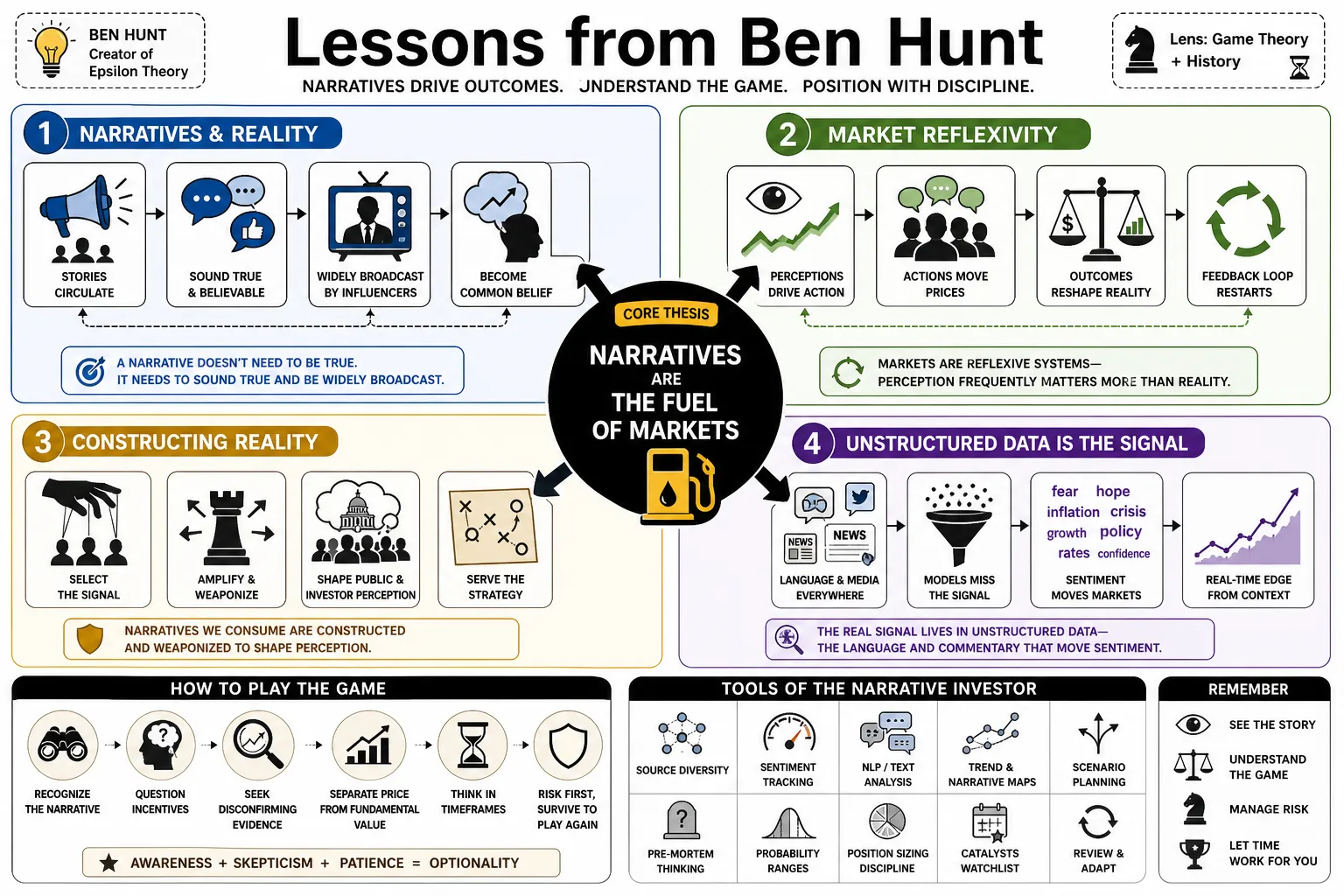
Part 1: Narratives and Reality
- On the Fuel of Markets: Hunt argues that narratives can dominate investment outcomes in policy-controlled markets. His framework extends analysis of economic fundamentals rather than claiming that fundamentals never matter. — The Narrative Machine.
- On the Purpose of Stories: A story can influence decisions because it sounds convincing, even when its truth remains uncertain. Hunt separates measuring how reality is presented from determining what is actually true. — Top Traders Unplugged — Ben Hunt.
- On Market Reflexivity: Hunt describes price and narrative as influencing one another. A changing story can reinforce a market move, while that move also changes the story. — Top Traders Unplugged — Ben Hunt.
- On Constructing Reality: Hunt warns that political, corporate and central-bank messaging can be designed to influence behavior. Analyzing that presentation is different from accepting it as a description of reality. — Top Traders Unplugged — Ben Hunt.
- On Unstructured Data: Hunt looks for meaning in articles, broadcasts and transcripts, not merely positive words or topic counts. He treats unstructured text as information worth studying alongside conventional market data. — Top Traders Unplugged — Ben Hunt.
- On Observing the Present: Hunt presents narrative analysis as a process for observing how markets are behaving now, rather than as an answer that makes the future reliably predictable. — Hunger Games.
- On Market Data: Hunt uses the metaphor of a bonfire rather than a clockwork to describe markets, emphasizing observation of changing conditions over confidence in a fixed mechanical explanation. — Hunger Games.
- On the Epsilon: Hunt uses epsilon to represent what an investment model leaves unexplained. He argues that strategic interactions among market participants deserve attention rather than being dismissed simply because the model does not capture them. — Bankless — The People’s Narrative.
- On Economic Truth: A model can work within its assumptions and still fail when the surrounding conditions change. Hunt warns against confusing mathematical elegance with survival in the larger system. — Too Clever by Half — Ben Hunt.
Part 2: Game Theory and Common Knowledge
- On Market Physics: Hunt approaches markets as a distributed game among people. Understanding other participants and their information is part of the task, not just analyzing the assets they trade. — Top Traders Unplugged — Ben Hunt.
- On Common Knowledge: Hunt distinguishes a personal belief from a belief that participants recognize as shared. His common-knowledge framework asks what people believe everyone else has also seen and understood. — Top Traders Unplugged — Ben Hunt.
- On Strategic Expectations: Hunt studies how market participants respond to one another’s expectations. A view of economic reality alone may not explain how an event affects prices when a shared narrative shapes the response. — The Narrative Machine.
- On the Information Vacuum: Hunt argues that round-the-clock financial media fills gaps in hard news with opinions and stories. Distinguish those interpretations from the information they claim to explain. — Top Traders Unplugged — Ben Hunt.
- On Market Revolutions: Writing about the January 2021 GameStop episode, Hunt argued that its lasting significance was a change in common knowledge about how markets operate, rather than the triumphant retail revolution portrayed in popular stories. — Hunger Games.
- On the 2008 Crisis: Hunt points to the belief that U.S. home prices could not decline nationwide as an important narrative underpinning mortgage securities before the 2008 crisis. His warning is to examine shared assumptions on which an investment structure depends. — When Narratives Go Bad.
- On Knowing the Game: When interpreting a crowd, do not assume you are the only participant anticipating how others will behave. Hunt uses Keynes’s beauty-contest analogy to explain why expectations about other people’s expectations matter. — Bankless — The People’s Narrative.
- On The Crowd: Hunt warns that interested participants can seed stories online in hopes that the crowd amplifies them. Ask who is positioned to benefit before treating a popular story as independent evidence. — Top Traders Unplugged — Ben Hunt.
- On The Fix: Hunt uses the Fix as a name for the status quo and the shared identity stories that support it. He recommends examining how those stories channel behavior and when they lose their force. — When Narratives Go Bad.
- On Shared Beliefs: Hunt argues that shared expectations can shape behavior even when individuals privately doubt the belief: they still anticipate that others will act on it. — The Widening Gyre.
Part 3: Wall Street and Raccoons
- On Opportunism: Hunt uses raccoons as a metaphor for financial con artists who exploit innovation. A clever new structure can create opportunities for misuse as well as legitimate applications. — Too Clever by Half — Ben Hunt.
- On Buying the Dip: In his 2015 Catch-22 essay, Hunt warned that repeatedly buying dips or selling volatility could appear dependable under a belief in central-bank support while leaving investors exposed to shocks outside that reassuring story. — Catch-22 — Ben Hunt.
- On the Lie of Participation: Hunt challenges the story that coordinated retail buying necessarily rescues a company or democratizes markets. In his GameStop essay, he warns that this heroic framing can obscure the incentives of the institutions profiting from trading activity. — Hunger Games.
- On Retail Disadvantage: Hunt urges retail investors to examine who controls trading infrastructure and benefits from their activity, rather than assume that a compelling investment story puts the odds in their favor. — Hunger Games.
- On Extractive Finance: Hunt argues that a market spectacle can reward intermediaries through trading activity and attention even when participants believe they are acting against the financial establishment. — Hunger Games.
- On Institutional Self-Preservation: In his GameStop essay, Hunt argues that preserving financial institutions and limiting contagion can take priority over the retail-investor story told to the public. — Hunger Games.
- On the Reality of Markets: Hunt recommends examining market infrastructure as well as companies: prices reflect other investors’ bets, and access to trading depends on the institutions administering the market. — Hunger Games.
Part 4: Fiat News and Fiat Money
- On Manufactured Reality: Hunt distinguishes fabricated news from fiat news: institutional framing that presents an interpretation with the authority of its issuer. The distinction matters because the two practices require different criticism. — Fiat Money, Fiat News — Ben Hunt.
- On the Origin of Value: Hunt compares fiat news with fiat currency to examine how an issuer’s authority supports acceptance. The analogy concerns public trust and institutional power, not a claim that an assertion becomes true by proclamation. — Fiat Money, Fiat News — Ben Hunt.
- On the Role of Central Banks: Hunt argues that central-bank communication can be used strategically to shape expectations. In his account, words are an instrument of policy as well as a description of conditions. — Fiat Money, Fiat News — Ben Hunt.
- On Policy as Propaganda: Hunt worries that crisis-era communication practices can become routine tools for preserving stability. He distinguishes accepting emergency measures from accepting their continued use after a crisis. — Fiat Money, Fiat News — Ben Hunt.
- On Truth in Media: Hunt argues that media institutions can frame information to serve institutional interests. Read the framing critically rather than equating an authoritative source with a neutral interpretation. — Fiat Money, Fiat News — Ben Hunt.
- On the Loss of Trust: Hunt compares debased news with debased currency: distrust can spread beyond individual bad examples and reduce confidence in genuine information too. This is his argument about trust, not a measured causal finding about all institutions. — Fiat Money, Fiat News — Ben Hunt.
- On Words as Weapons: Hunt describes strategically chosen public statements as a powerful part of central bankers’ response to the financial crisis. He warns that communication aimed at producing a response can differ from candid information. — Fiat Money, Fiat News — Ben Hunt.
Part 5: Market Complexity and The Three-Body Problem
- On Financial Complexity: Hunt uses the three-body problem as an analogy for markets whose interacting forces can undermine familiar relationships. The practical warning is not to assume an old investing signal will keep working. — The Three-Body Problem.
- On Recursive Behavior: Participants react to what they think others believe, and those reactions become further information. Hunt studies these expectations as a measurable interaction rather than assuming a simple one-way response to news. — Top Traders Unplugged — Ben Hunt.
- On the Futility of Forecasting: Hunt cautions against expecting historical patterns to supply a permanent forecasting rule. His concern is that changing interactions can weaken the relationship on which a familiar strategy depends. — The Three-Body Problem.
- On Adapting to Chaos: Hunt recommends budgeting risk across exposures and thinking honestly about the outcomes one most regrets. His response to uncertainty is a decision process, not a promise of a reliably predictable market. — The Three-Body Problem.
- On False Precision: A precise-looking estimate can depend on a relationship that no longer holds. Hunt asks investors to distinguish uncertainty about the model itself from measurable risk within the model. — The Three-Body Problem.
- On Recognizing Patterns: Hunt examines how coherent and connected a market story has become. His aim is to understand the market’s response to an event, not to claim that a narrative map predicts the event in advance. — The Narrative Machine.
- On Systemic Fragility: Hunt warns that businesses dependent on continual refinancing can be vulnerable to disruptions in funding. In his account, failures can spread when lenders withdraw credit and the resulting strain produces further defaults. — Excess Returns — Cracks in Private Credit.
- On Managing the Unknown: Hunt distinguishes decisions with reasonably understood odds from decisions where the odds themselves are unclear. Statistical risk estimates should not be mistaken for a full account of that uncertainty. — The Three-Body Problem.
- On the Illusion of Stability: Hunt distinguishes a stable market narrative from protection against external shocks. Confidence in central-bank support, he argues, can coexist with risks that the prevailing story fails to address. — Catch-22 — Ben Hunt.
- On Surviving the Game: Hunt advocates humility about forecasts and examining the regret a decision could create. Choosing a strategy starts with being honest about one’s own priorities, not maximizing a number in isolation. — The Three-Body Problem.
Part 6: The Widening Gyre
- On Societal Entropy: Hunt uses the widening gyre to describe a self-reinforcing political equilibrium in which more extreme people and ideas displace those willing to cooperate. — The Widening Gyre.
- On Political Polarization: Hunt argues that portraying the opposing party as an existential enemy encourages mutual escalation: each side can justify conduct it would otherwise reject as necessary self-defense. — The Widening Gyre.
- On the Hollow Center: In Hunt’s account, polarization weakens the electoral space for centrist candidates and pressures moderate incumbents to follow their party’s increasingly extreme direction or leave. — The Widening Gyre.
- On Institutional Failure: Hunt argues that replacing individual leaders is insufficient when political institutions continue rewarding the same competitive behavior. He recommends changing the rules that reproduce those incentives. — The Widening Gyre.
- On the Loss of Meaning: Hunt contrasts ideas proclaimed as reality by powerful institutions with judgments grounded in lived experience. He warns against treating institutional presentation as a substitute for reality. — The Widening Gyre.
- On Recognizing the Drift: Hunt recommends looking beyond blame for a particular politician to the incentives sustaining polarization, including the roles of political parties, media and technology platforms. — The Widening Gyre.
- On Resisting the Spin: Hunt urges readers to question the shared assumption that the other party is the fundamental enemy, rather than accepting narratives that make every disagreement an existential conflict. — The Widening Gyre.
- On Finding Anchor: Hunt recommends standing our ground at the scale of families and communities, where we can act as people serving one another rather than as instruments of a national political cause. — The Long Now — Make, Protect, Teach.
Part 7: Playing the Player
- On Strategic Investment: Playing the player means studying the information and stories driving other participants’ behavior. Hunt treats that understanding as complementary to knowledge of the asset being traded. — Top Traders Unplugged — Ben Hunt.
- On Market Empathy: Consider how other participants interpret the same information. Hunt’s framework asks what they expect others to believe, rather than assuming they share your view of the underlying asset. — Top Traders Unplugged — Ben Hunt.
- On Recognizing the Game: A strategy that succeeds in an immediate contest can fail in the larger game. Hunt recommends examining the surrounding incentives and constraints before mistaking a local advantage for lasting success. — Too Clever by Half — Ben Hunt.
- On the Asymmetry of Information: Hunt describes an analytical edge as information other participants lack. Studying the shared narrative can help interpret a catalyst, but he presents this as a developing research approach rather than an assured advantage. — The Narrative Machine.
- On Reading the Room: Hunt tracks whether a story is gaining attention and when relevant expertise matters to the market. Narrative analysis does not replace substantive knowledge of the investment. — Top Traders Unplugged — Ben Hunt.
- On Exploiting Predictability: Hunt’s narrative research aims to improve the response after a catalyst occurs. He explicitly distinguishes that goal from predicting the shock before it happens. — The Narrative Machine.
- On Defensive Play: Hunt recommends using an understanding of market narratives defensively, so that participation does not require surrendering judgment to stories designed to generate trading activity. — Hunger Games.
- On the Ultimate Edge: Hunt treats narrative analysis as a complement to an investor’s knowledge of an asset: it can help identify when others begin recognizing a value or catalyst the investor has already researched. — Masters in Business — Ben Hunt.
Part 8: Clear Eyes, Full Hearts
- On Taking Action: Hunt recommends making things, protecting others and teaching as concrete forms of service to the people around us. This work need not be our paid occupation to become part of our identity. — The Long Now — Make, Protect, Teach.
- On The Pack: Hunt describes a pack as a community organized around service and full-hearted conversation, rather than status competition or national party allegiance. — The Long Now — Make, Protect, Teach.
- On Clear Eyes: Hunt urges us to retain autonomy of mind rather than excuse dishonesty because it serves our preferred political side. — The Long Now — Make, Protect, Teach.
- On Full Hearts: For Hunt, a full-hearted response means acting in service to our community rather than using others for self-aggrandizement or the celebration of power. — The Long Now — Make, Protect, Teach.
- On Building Anew: Hunt recommends building decentralized, service-oriented communities from the bottom up instead of placing all our hopes in national political institutions. — The Long Now — Make, Protect, Teach.
- On Personal Agency: We can refuse to surrender our identity and judgment to institutional narratives, Hunt argues, even when we cannot personally stop the larger political process. — The Long Now — Make, Protect, Teach.
- On Authenticity: Hunt contrasts managing our personal advantage with stewarding the future of our children and communities through concrete work for other people. — The Long Now — Make, Protect, Teach.
- On the Antidote to Alienation: Hunt proposes meaningful local service and conversation as a response to alienation, connecting people through shared work rather than partisan spectacle. — The Long Now — Make, Protect, Teach.
- On Defending the Truth: Hunt recommends naming institutional framing honestly instead of accepting it as neutral information. His response is to pay attention, preserve independent judgment and make misleading narratives visible. — Fiat Money, Fiat News.
- On the Path Forward: Hunt proposes starting with family and community, then allowing a practice of making, protecting and teaching to spread through personal relationships. — The Long Now — Make, Protect, Teach.