Ben Inker is Co-Head of Asset Allocation at GMO, which he joined in 1992. This profile examines his valuation-based approach, portfolio construction, and analysis of market bubbles and private equity. — GMO — Ben Inker Biography and Quarterly Letter.
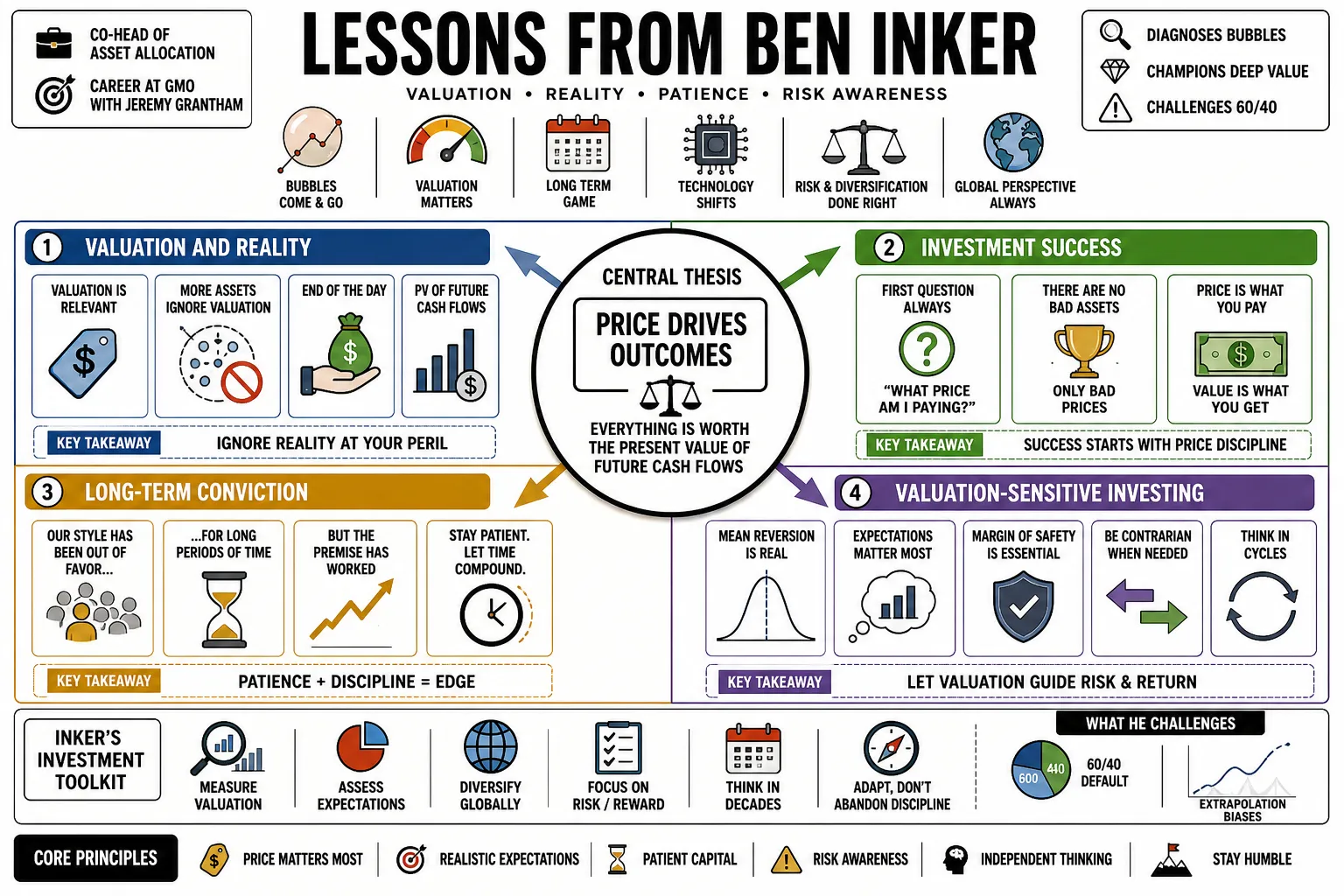
Part 1: Valuation-Sensitive Investing
- On Valuation and Reality: For cash-flow-producing assets, Inker anchors valuation in future cash flows, while acknowledging uncertainty about when market prices will reflect them. — Masters in Business — Ben Inker.
- On the Importance of Price: Even a business facing serious headwinds may offer investment value at a sufficiently low price; the risks still need to be assessed. — Masters in Business — Ben Inker.
- On Long-Term Conviction: Valuation conviction is difficult to sustain as markets move against a strategy; clients may have less patience than the manager. — Excess Returns — Ben Inker Transcript.
- On Reflexive vs. Sensitive Investing: GMO distinguishes valuation discipline from always owning stocks labeled value. The cheap half of the market can itself be unattractive, so the label is not enough to justify an allocation. — GMO — Value: That Was Then, This Is Now.
- On Forecasting Returns: GMO’s seven-year forecasts model normalization of valuations and profitability, alongside growth and income. Inker describes alternative scenarios, not a guaranteed timetable. — Masters in Business — Ben Inker.
- On Market Inefficiencies: Inker links growing corporate dominance to weaker incentives for investment and labor competition, while acknowledging that proving the concentration mechanism is difficult. — The Meb Faber Show — Ben Inker.
- On Risk Management: High multiples can compound the risk of unusually elevated profit margins reverting; Inker examines both rather than taking current earnings at face value. — The Meb Faber Show — Ben Inker.
- On Patience: Valuation positions can remain painful long enough to force investors out before their thesis pays off; a long horizon does not guarantee success. — Masters in Business — Ben Inker.
- On Historical Precedent: GMO’s 2024 webcast highlights connect past weak balanced-portfolio returns with elevated starting stock or bond valuations. — GMO — A Second Opinion.
Part 2: The Evolution of Value and Deep Value
- On the Cycles of Value: In an earlier letter, Inker warned that value could underperform when its discount to growth had become unusually narrow. GMO’s retrospective uses that warning to show why the attractiveness of value changes with its price. — GMO — Value: That Was Then, This Is Now.
- On Deep Value: Inker distinguishes broad value from deep value, the cheapest fifth of stocks, and evaluates that cohort using adjusted valuation models. — GMO — Value Does Just Fine in Recessions.
- On Value Traps: A stock that looks cheap can disappoint if its fundamentals deteriorate. Inker’s research tracks both realized revenue disappointment and weaker future expectations. — GMO — Value Does Just Fine in Recessions.
- On Intangible Assets: Inker cautions that expensed intangible investment and share buybacks can distort book value. He favors economically adjusted accounts and cash-flow analysis. — Masters in Business — Ben Inker.
- On Quality Stocks: Inker favors attention to business quality alongside valuation when considering how public holdings can offset risks in private portfolios. — Excess Returns — Ben Inker.
- On Value During Recessions: Inker’s 2023 research found value often held up relatively well across recessions, with Covid an important exception—not protection from absolute losses. — GMO — Value Does Just Fine in Recessions.
- On the Spread: A wide value-growth valuation gap can motivate a long-value, short-growth strategy designed to benefit if the gap narrows. — GMO — A Second Opinion.
- On Margin of Superiority: An asset’s expected return can fall yet its advantage over alternatives can grow. Inker used this distinction to explain increasing emerging-value exposure in 2017. — GMO — Emerging Value and Margin of Superiority.
- On Modern Value Investing: Inker favors economically meaningful accounts and cash-flow analysis over treating conventional value indices as reliable measures of cheapness. — Masters in Business — Ben Inker.
- On Growth vs. Value: Disappointing growth companies can lose both earnings expectations and valuation premiums; Inker warns that growth traps deserve scrutiny alongside value traps. — GMO — Value Does Just Fine in Recessions.
Part 3: Challenging the 60/40 Portfolio
- On Changing Regimes: Inker’s retrospective on 2021 emphasizes that stocks and bonds can both become unattractive when their expected real returns are low. — Excess Returns — Ben Inker Transcript.
- On Real Returns: In 2019, Inker warned that low prospective stock and bond returns could disappoint balanced-portfolio investors; the forecast depended on valuation assumptions. — The Meb Faber Show — Ben Inker.
- On Fixed Income Constraints: Inker’s 2017 risk analysis distinguishes long-duration bonds from cash and shorter-duration assets when considering a rise in discount rates. — GMO — Up At Night.
- On Alternative Approaches: Inker considers liquid alternatives another way to take compensated risks, not a source of effortless alpha; they still carry economic downside. — The Meb Faber Show — Ben Inker.
- On Equity Risk Premiums: Assess equity returns relative to alternatives: Inker noted that stocks could offer a reasonable premium over bonds while both offered disappointing absolute returns. — The Meb Faber Show — Ben Inker.
- On Diversification Failures: Stocks and long-term bonds can share exposure to rising discount rates; different asset labels do not remove that common vulnerability. — GMO — Up At Night.
Part 4: Dynamic Asset Allocation
- On Active Shifts: In 2019, Inker described excluding U.S. equities from GMO’s benchmark-free portfolio because their expected returns did not justify their risks. — The Meb Faber Show — Ben Inker.
- On Career Risk: Managers resisting expensive markets can face pressure to change strategy or lose their role before valuations correct. — Masters in Business — Ben Inker.
- On Opportunity Cost: In June 2026, Inker saw non-U.S. risk assets as alternatives to expensive U.S. equities, rather than requiring wholesale retreat into cash. — Excess Returns — Ben Inker.
- On Global Mandates: A global mandate lets an allocator compare opportunities across markets rather than own domestic assets regardless of price. — The Meb Faber Show — Ben Inker.
- On Tactical Patience: GMO deliberately uses slower-moving forecasts in portfolio construction because valuation signals can prompt changes too early. — Excess Returns — Ben Inker.
- On Absolute Return: Inker’s benchmark-free approach evaluates holdings on their own risk-reward merits rather than keeping them solely to limit tracking error. — Excess Returns — Ben Inker.
- On Contrarian Strategy: GMO’s valuation-sensitive approach can favor unconventional allocations when their prospective returns look better than a traditional portfolio’s. — GMO — A Second Opinion.
- On Future Unpredictability: A portfolio should remain workable if a suspected bubble persists or the valuation assessment is wrong, rather than depend on a quick collapse. — Excess Returns — Ben Inker Transcript.
- On Avoiding the Worst: Inker and Pease favor choosing well-compensated risks over relying on precise recession timing; economic forecasts can be wrong and costly. — GMO — Beyond the Landing.
Part 5: Navigating Market Bubbles
- On Defining Bubbles: Inker uses a portfolio-oriented definition of a bubble: an important asset has become too expensive to justify owning. — Excess Returns — Ben Inker.
- On Earnings vs. Valuation Bubbles: In June 2026, Inker worried that AI investment was temporarily inflating profits, making earnings-based valuations less reassuring. — Excess Returns — Ben Inker.
- On Timing the Pop: Avoid relying on a quick bubble collapse: Inker stresses that overpriced markets can persist longer than investors expect. — Excess Returns — Ben Inker.
- On Psychological Momentum: Inker’s account of 2020–2021 describes fear of missing out pushing investors toward assets whose prices could not be justified by expected cash flows. — GMO — The Joy of Missing Out.
- On Navigating the Decline: Inker credits flexibility to move beyond traditional stocks and bonds with limiting some clients’ losses in 2022; portfolios restricted to those assets had less room to maneuver. — GMO — The Joy of Missing Out.
- On Distinguishing Eras: In February 2021, Inker saw speculative behavior resembling the late dot-com period, particularly enthusiasm for companies whose advocates dismissed traditional valuation. — Masters in Business — Ben Inker.
Part 6: Assessing AI and Technological Shifts
- On Technological Disconnects: Transformative technology need not reward its builders: Inker uses earlier infrastructure buildouts to illustrate how overinvestment can erode returns. — Excess Returns — Ben Inker.
- On Capital Spending: Inker warns that rapid AI investment can lift suppliers’ revenues before the eventual depreciation costs appear, making current profits look unusually strong. — Excess Returns — Ben Inker Transcript.
- On the Internet Parallel: Inker distinguishes 2000’s broad valuation excesses from his 2026 concern that apparently reasonable multiples may rest on unusually strong earnings. — Excess Returns — Ben Inker Transcript.
- On Concentration Risk: Inker and Pease warn that a concentrated index carries more company-specific risk and may also expose investors to shared technology and geopolitical dependencies. — GMO — Magnificently Concentrated.
- On Secondary Winners: Transformative infrastructure can lower costs for its users without delivering strong returns to the companies financing the buildout. — Excess Returns — Ben Inker Transcript.
Part 7: Private Equity Skepticism
- On PE Soundness: Inker questions private-equity allocations that depend on selecting persistent outperformers without credible evidence of that selection ability. — GMO — Private Equity Quarterly Letter.
- On Performance Persistence: In his 2026 letter, Inker highlights research finding weaker buyout-manager persistence, especially when investors rely on interim fund returns. — GMO — Private Equity Quarterly Letter.
- On Justifying Fees: Long commitments and high fees make conviction in a private-equity manager especially important; Inker does not advocate abandoning the asset class. — GMO — Private Equity Quarterly Letter.
- On Quality Degradation: Inker’s buyout research found a tilt toward smaller, less profitable, more indebted companies before acquisition—not evidence that every buyout deteriorates. — Excess Returns — Ben Inker.
- On Valuation Lags: Slow appraisal updates can reduce private equity’s measured volatility without removing its underlying economic downside. — GMO — What Barbarians Like to Take Private.
- On the Institutional Trend: A fixed private-equity target can push an institution into lower-conviction funds after it exhausts the managers it genuinely trusts. — GMO — Private Equity Quarterly Letter.
- On Leverage Sensitivity: Inker and Pease warn that higher real rates or wider credit spreads can squeeze leveraged buyout companies’ cash flows. — GMO — What Barbarians Like to Take Private.
- On Public Alternatives: In 2023, Inker and Pease preferred public deep value and cheaper high-quality stocks to expensive buyouts on prospective risk-return grounds. — GMO — Beyond the Landing.
- On Asset Class Myths: Private ownership does not eliminate equity risk; Inker urges allocators to examine the underlying company exposures. — Excess Returns — Ben Inker.
Part 8: Emerging Markets and Global Opportunities
- On U.S. Premiums: In 2019, Inker saw unusually wide U.S.–international valuation gaps, even after considering sector composition; this was a dated assessment, not a permanent rule. — The Meb Faber Show — Ben Inker.
- On Cheaper Valuations: In 2019, Inker preferred international opportunities partly because valuations and profit margins were closer to normal—not because geography alone ensured safety. — The Meb Faber Show — Ben Inker.
- On Navigating Inflation: In 2017, Inker considered emerging equities’ inflation experience a speculative comfort, while emphasizing that cheaper valuations—not inflation resilience—drove GMO’s preference. — GMO — What Happened to Inflation?.
- On Strategic Hedging: In 2017, Inker described partially hedging emerging-market exposure against dollar strength while retaining other characteristics GMO found attractive. — GMO — Up At Night.
- On Emerging Value: Inker’s emerging-market approach considers country conditions alongside company quality and valuation, rather than treating the region as one uniform opportunity. — The Meb Faber Show — Ben Inker.
- On Geopolitical Risk: Geopolitical shocks can hurt already-cheap assets. Inker’s 2022 review treats such losses as a reason to reassess prices, not assume every cheap market is protected. — GMO — The Joy of Missing Out.
- On Dividend Yields: Inker cited the income yield of GMO’s emerging-value portfolio as part of its 2019 valuation case, not as insurance against political or currency losses. — The Meb Faber Show — Ben Inker.
- On Currency Fluctuations: A currency hedge has a cost: Inker’s 2017 example weighs a specific dollar-strength risk against the value of retaining emerging-market exposure. — GMO — Up At Night.
- On Long-Term Tailwinds: Economic growth is not enough to establish an investment case: Inker emphasizes starting valuation and return on capital rather than forecasting GDP. — The Meb Faber Show — Ben Inker.