Ben Lang led community work at Notion for nearly five years, helping build its ambassador program and template ecosystem. He co-founded Mapme, later joined Cursor’s community efforts, and runs the Next Play career community while investing in startups. These lessons cover bottom-up community growth, pre-launch marketing, and supporting enthusiastic software users. — People Making Things — Ben Lang Q&A. — Ben Lang — Joining Cursor. — First Round — Building Notion’s Community.
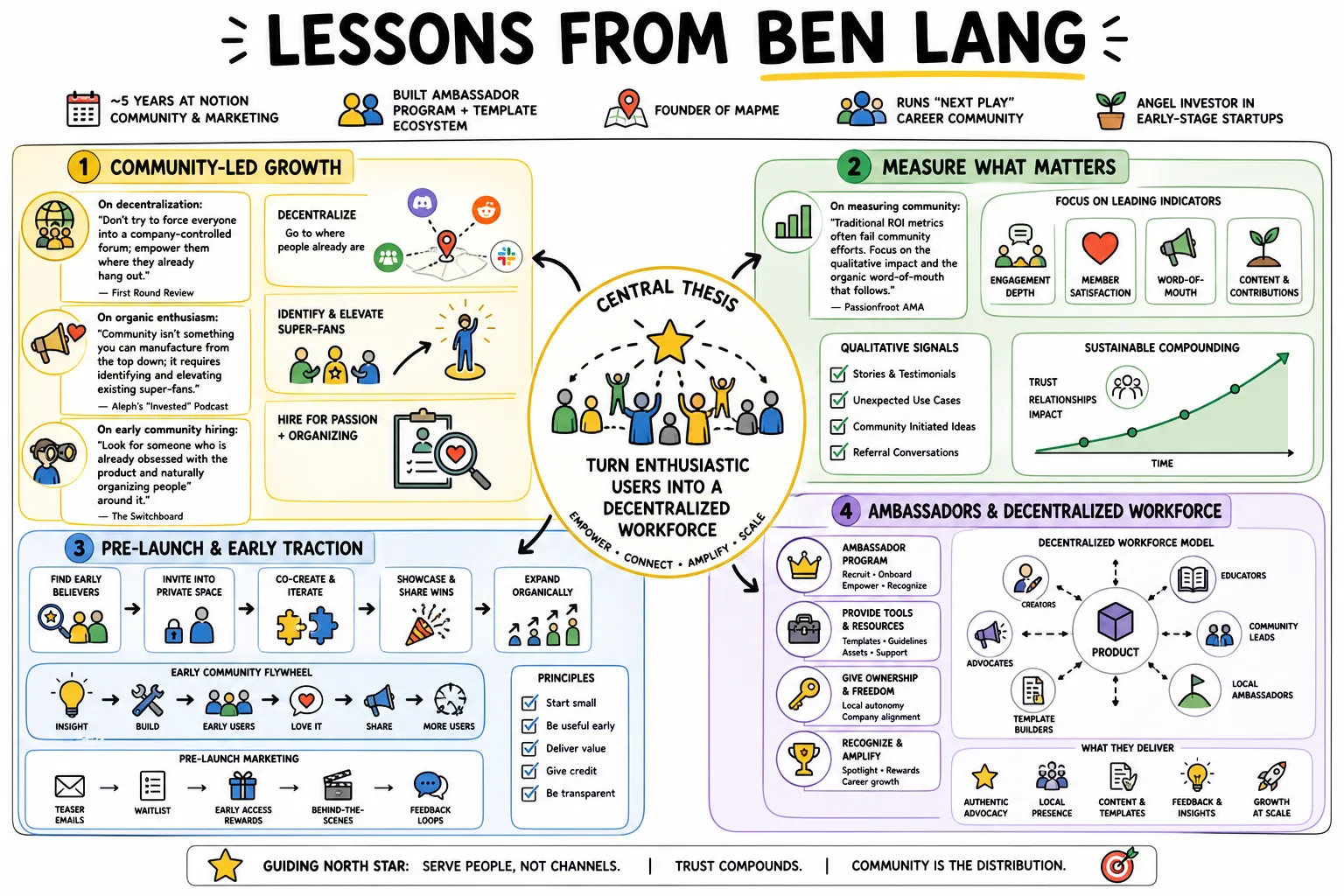
Part 1: Community-Led Growth
- On decentralization: Support user communities on the platforms they already choose, rather than requiring everyone to move into a company-controlled space. — Ben Lang — Scaling Notion’s Advocacy Program.
- On organic enthusiasm: Look for users who already want to teach, discuss, and connect around the product. Lang treats those signals as a starting point for product-based community work, not something a company can simply impose. — Aleph Invested — Ben Lang.
- On early community hiring: Look for genuine product interest, scrappiness, and a history of bringing people together. Lang sees community-building outside work as a useful hiring signal. — First Round — Building Notion’s Community.
- On measuring community: Give an advocacy program time to develop before demanding immediate ROI. Once it matures, referral links can help track the signups it generates. — Ben Lang — Scaling Notion’s Advocacy Program.
- On letting go of control: Let ambassadors run groups for their own languages and interests. At Notion, the company supported those communities rather than operating every group itself. — Pocus — Ben Lang AMA.
- On community architecture: Community can take several forms rather than one official forum. Lang describes Notion’s ambassador, consultant, creator, and event programs as distinct ways to connect with users. — First Round — Building Notion’s Community.
- On the role of events: Support local events when members want to meet one another. Notion funded community-hosted gatherings after seeing users’ enthusiasm for meeting in person. — Pocus — Ben Lang AMA.
- On identifying evangelists: Search for power users who have already started teaching or organizing others. Lang’s early outreach sought existing community builders, not just people willing to join a new group. — Pocus — Ben Lang AMA.
- On product feedback loops: Combine ambassador beta feedback, community listening, and tagged feature requests so product teams can learn from users’ experiences. — Pocus — Ben Lang AMA.
- On scaling support: Ambassadors can help other users learn the product and share practices across groups. This extends community-led education without requiring the company to run every local group. — First Round — Building Notion’s Community.
Part 2: Building Before the Product
- On pre-launch marketing: At Spoke, Lang built an IT-focused audience before the product was ready to launch. IT Kit’s newsletter reached 3,000 subscribers within three months. — Ben Lang — Building Community Before a Product.
- On finding the gap: Ask prospective users what their existing communities fail to provide. Conversations with IT leaders pointed Lang toward product discovery, recognition, and peer learning. — Ben Lang — Building Community Before a Product.
- On the IT Kit strategy: A curated resource can serve the target audience before the main product is ready. IT Kit combined selected tools, voting, and a newsletter signup. — Ben Lang — Building Community Before a Product.
- On building goodwill: IT Kit’s usefulness led some subscribers to ask about Spoke. Lang says they saw a company supporting their profession, rather than just another vendor. — Ben Lang — Building Community Before a Product.
- On early user interviews: Use early conversations to discover needs beyond the product. Lang’s coffees and Zoom calls with IT leaders helped reveal the opportunity for IT Kit. — Ben Lang — Building Community Before a Product.
- On peer-to-peer value: The IT leaders Lang interviewed wanted to discover tools, learn from peers, and receive recognition for their work. — Ben Lang — Building Community Before a Product.
- On the giver mindset: Approach prospective users with something helpful instead of immediately asking for a sale. Lang credits that approach with building goodwill around IT Kit. — Ben Lang — Building Community Before a Product.
- On audience cross-pollination: Enlist featured companies and respected community members to share an audience resource. IT Kit’s advisory board and listed products helped distribute its launch. — Ben Lang — Building Community Before a Product.
- On patience in marketing: Avoid making community participation feel like a constant sales pitch. Lang warns that being repeatedly sold to can weaken members’ willingness to participate and spread the word. — Pocus — Ben Lang AMA.
Part 3: Founder Mindset and Early Hustle
- On building Mapped in Israel: A simple map can help people explore an ecosystem. Lang’s Mapped in Israel project attracted people looking for jobs and learning about the local technology scene. — Ben Lang — Mapme’s Founding Interview.
- On the transition to Mapme: Requests to reproduce a useful side project can reveal product demand. People asked Lang for maps of other cities and categories, prompting the team to build Mapme. — Ben Lang — Mapme’s Founding Interview.
- On founder transparency: Share useful company information rather than keeping it hidden. Lang made Mapme’s dashboard, deck, investor update, and personal reflections public. — Ben Lang — First-Year Founder Reflections.
- On the first year of a startup: Keep execution central while adapting the founder’s role. Lang’s first-year reflections emphasize building a strong team, keeping money in the bank, and changing responsibilities as the company develops. — Ben Lang — First-Year Founder Reflections.
- On cold outreach: Genuine interest can open a conversation that becomes a job opportunity. Lang contacted Ivan Zhao about Notion’s API after building fan projects, and that relationship led to joining the team. — Notion — Interview with Ben Lang.
- On wearing multiple hats: Early community work may span several programs. At Notion, Lang and Camille Ricketts worked across ambassadors, influencers, conferences, education, and the original template gallery. — Notion — Interview with Ben Lang.
- On managing investors: Send monthly updates to investors and the team, and include prospective investors you have met. Build relationships and seek feedback before asking for funding. — Ben Lang — First-Year Founder Reflections.
Part 4: The Art of the "Next Play"
- On career inflection points: Talk with other people who are exploring their next move, as well as mentors and well-connected people. Lang recommends those conversations to people unsure what to do next. — People Making Things — Ben Lang Q&A.
- On evaluating startups: Investigate the team, product, and business rather than relying on funding headlines. Talk to current and former employees, customers, and investors to assess whether the opportunity fits you. — Next Play — Choosing a Startup.
- On hiring strong talent: Entrepreneurial employees can suit high-ownership teams. Lang’s AngelList spotlight highlights people who take responsibility, handle ambiguity, and work without detailed instructions. — Next Play on Campus — January 15, 2025.
- On generalist roles: Demonstrate where you can contribute instead of only offering to do anything. Lang advises generalists to identify useful work—and try some of it—before asking a startup to hire them. — Ben Lang — Advice for Generalists.
- On curated opportunities: Help people match their interests with roles and cofounder opportunities. Lang describes Next Play’s matchmaking as a way to support people exploring their next move. — People Making Things — Ben Lang Q&A.
- On continuous networking: Invest in a few trusted professional relationships and offer mutual help. Lang distinguishes those friendships from brief, infrequent conversations at events. — Ben Lang — First-Year Founder Reflections.
- On navigating transitions: Use small work samples to explore what interests you before committing to a role. Lang notes that trying useful work for a company can reveal whether you enjoy its problems, even if you are not hired. — Ben Lang — Advice for Generalists.
- On student talent: Make startup opportunities and introductions accessible to students. Next Play’s campus edition shares internships, early-team roles, and personalized matching opportunities. — Next Play on Campus — January 15, 2025.
- On the power of offline gatherings: Small, curated gatherings can connect people exploring their next venture. Lang reports that On Deck dinners led to cofounder relationships, first hires, and friendships. — Ben Lang — Introducing TLV Collective.
Part 5: Empowering Superfans
- On the template ecosystem: Let users share reusable setups that help others get started. Notion’s template gallery made it easier to copy an existing workflow instead of building from a blank page. — Notion — Interview with Ben Lang.
- On formalizing enthusiasm: Build a program around what advocates already do. Notion’s ambassador program connected existing fans with one another and the team, then supported their projects and events. — Ben Lang — Scaling Notion’s Advocacy Program.
- On user monetization: Support users who build services around the product. Notion’s certification program and directory helped consultants reach customers who needed implementation help. — Pocus — Ben Lang AMA.
- On the consultant program: Involve experienced practitioners when designing certification. Notion hired an existing consultant to help assess the skills others needed to serve customers. — First Round — Building Notion’s Community.
- On organic influencer marketing: Partner with creators who actually use the product. Lang found their Notion videos more authentic and effective than sponsorships disconnected from real use. — Ben Lang — Notion’s Influencer Marketing.
- On identifying power users: Notice users making things the team would not build itself. Lang describes community-created templates as opening many more use cases than company-made templates alone. — Aleph Invested — Ben Lang.
- On community autonomy: Give local organizers practical support for the events they want to run. Notion offered grants while ambassadors organized gatherings for their own communities. — First Round — Building Notion’s Community.
Part 6: Angel Investing and Supporting Startups
- On operator-investors: Operating experience can inform an investor’s support. Lang describes his builder background as a source of empathy for founders and insight into early company challenges. — People Making Things — Ben Lang Q&A.
- On evaluating community-led growth: Look for genuine user excitement as one investment signal. Lang recalls being drawn to Landa partly by enthusiasm in its Facebook group, alongside his confidence in the founder. — Aleph Invested — Ben Lang.
- On early-stage focus: Assess early-stage founders through more than a single pitch. Lang combines ongoing conversations with input from people he trusts, looking at responsiveness and previous work when available. — Wannabe Angels — Ben Lang Interview.
- On value add: Help a founder before expecting an investment opportunity. Lang says he introduced customers to Deel before investing, and hopes Next Play can help founders find early hires and cofounders. — Aleph Invested — Ben Lang.
- On founder market fit: At pre-seed, Lang puts more weight on the founders than on a sector thesis because a company’s direction can change. He looks for people willing to keep working over a long journey. — Wannabe Angels — Ben Lang Interview.
- On advising: Advising can mean doing hands-on work alongside a founder. Lang describes advisory roles involving shared documents, meetings, and building together, rather than merely offering an investment. — Wannabe Angels — Ben Lang Interview.
- On risk tolerance: Choose an investing route that fits your resources. Lang notes that using your own capital brings both upside and loss risk, which can be too much when liquidity is limited. — Last Money In — Ben Lang Interview.
Part 7: Tactical Marketing and Collaboration
- On collaboration: Co-host events with established companies serving the same audience. For IT Kit, partners such as Slack and Bettercloud helped attract attendees and speakers. — Ben Lang — Building Community Before a Product.
- On organic vs paid: Paid partnerships can build on existing product use. Lang began sponsoring creators already discussing Notion, then increased spending after testing signup results. — Ben Lang — Notion’s Influencer Marketing.
- On resource marketing: Useful resources can create a discovery channel. Lang reports that IT Kit began ranking in searches for its featured products, bringing attention to a pre-product company. — Ben Lang — Building Community Before a Product.
- On treating marketing like product: Test formats and outreach before scaling a marketing channel. Lang’s influencer program evolved through experiments rather than a single predetermined playbook. — Ben Lang — Notion’s Influencer Marketing.
- On the power of newsletters: A newsletter can connect readers with concrete opportunities. Lang reports hearing from Next Play readers who found a cofounder or joined a startup through its listings; these are reader anecdotes, not guaranteed outcomes. — Ben Lang — YC’s Request for Startups.
- On authentic messaging: Make partnerships feel like real product use, not just an ad read. Lang advises building relationships with creators and getting them to try the product themselves. — Ben Lang — Notion’s Influencer Marketing.
- On resource constraints: A small team can create a useful audience resource without diverting product engineering. Lang launched IT Kit with a freelance designer-developer and a modest initial investment. — Ben Lang — Building Community Before a Product.
- On narrative building: A product’s story and visual character can matter alongside its functionality. Lang connects Notion’s appeal to its playful brand, aesthetics, and emotional resonance with users. — Aleph Invested — Ben Lang.
- On measuring word of mouth: Watch for users teaching others on their own initiative. Lang’s fan projects and the workshops and guidebooks of other early users revealed advocacy that Notion could support. — Ben Lang — Scaling Notion’s Advocacy Program.
Part 8: Ecosystems and Global Tech
- On the Tel Aviv ecosystem: Lang values Tel Aviv’s talent, community, and entrepreneurial energy. He presents that preference as personal and acknowledges San Francisco’s strong talent network too. — Aleph Invested — Ben Lang.
- On global communities: Local language and context matter when expanding a community. Notion drew on proficient users to localize templates and supported creators reaching audiences in different countries. — First Round — Building Notion’s Community.
- On connecting people: Turn networking into useful introductions. Lang’s early hiring project paired job seekers with startups and tracked introductions so he could follow their outcomes. — Ben Lang — 100 Talented Friends to Hire.
- On remote work dynamics: Flexible work depends on communication. In his Mapme reflections, Lang favors flexibility over rigid working hours while emphasizing communication skills and keeping the team informed. — Ben Lang — First-Year Founder Reflections.
- On constant learning: Keep learning from users and more experienced people. Lang’s founder reflections emphasize customer conversations, team learning, and surrounding himself with experienced colleagues and advisers. — Ben Lang — First-Year Founder Reflections.
- On maintaining momentum: Continue giving advocates useful support as a program grows. Lang describes regularly adding benefits, answering requests, and hiring community leaders when he could no longer keep up. — Ben Lang — Scaling Notion’s Advocacy Program.
- On the ultimate goal: Make advocates feel appreciated and proud to join. Lang recommends clear gratitude during applications and onboarding so membership feels like an achievement. — Ben Lang — Scaling Notion’s Advocacy Program.