Anthropic co-founder Ben Mann co-leads Anthropic Labs, incubating experimental products at the frontier of Claude’s capabilities, after previously leading product engineering for the company. Before that, he was at OpenAI, where he co-authored the GPT-3 paper and helped establish the scaling laws linking AI improvement to data and compute. This profile gathers his thoughts on measuring model intelligence, the mechanics of Constitutional AI, and the economic implications of automation as systems approach artificial general intelligence.
Part 1: Scaling Laws and Model Growth
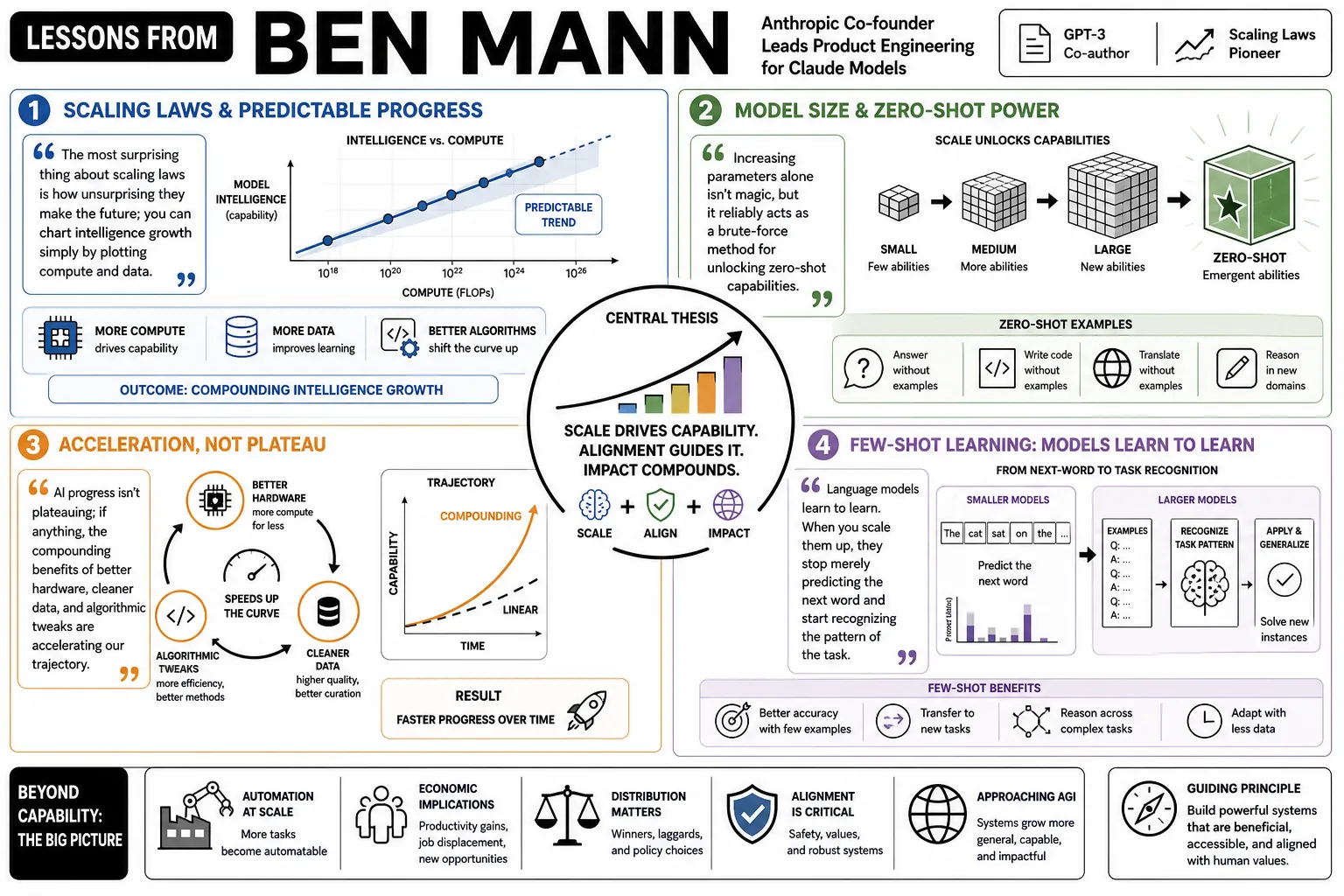
- On the predictability of progress: "The most surprising thing about scaling laws is how unsurprising they make the future; you can chart intelligence growth simply by plotting compute and data." — Source: [OpenAI GPT-3 Paper]
- On model size: "Increasing parameters alone isn't magic, but it reliably acts as a brute-force method for unlocking zero-shot capabilities." — Source: [OpenAI GPT-3 Paper]
- On acceleration: "AI progress isn't plateauing; if anything, the compounding benefits of better hardware, cleaner data, and algorithmic tweaks are accelerating our trajectory." — Source: [Lenny's Podcast]
- On few-shot learning: "Language models learn to learn. When you scale them up, they stop merely predicting the next word and start recognizing the pattern of the task you're giving them." — Source: [OpenAI GPT-3 Paper]
- On compute constraints: "The ceiling on model performance is rarely the architecture anymore; it's how many GPUs we can string together and how long we can keep them running without failure." — Source: [No Priors Podcast]
- On data quality versus quantity: "As models grow, they become more sensitive to the garbage in their training data. You can't just scrape the internet blindly if you want an aligned model." — Source: [Anthropic Research Blog]
- On the illusion of sudden leaps: "What looks like a sudden breakthrough to the public is usually the steady, predictable grinding of a scaling law crossing a capability threshold." — Source: [Lenny's Podcast]
- On paradigm shifts: "We used to think we needed fundamentally new architectures for every new type of reasoning. Now we suspect that enough scale on a transformer might simulate those new architectures natively." — Source: [LifeArchitect.ai Interview]
- On the scaling limit: "We don't actually know where the asymptote is. Every time we think we might hit a wall, someone figures out how to train longer or data-mix better." — Source: [No Priors Podcast]
- On algorithmic efficiency: "While scaling compute is the brute force path, the hidden engine of progress is that we are constantly figuring out how to get the same intelligence for a fraction of the flops." — Source: [Anthropic Research Blog]
Part 2: Evaluating AI and the Economic Turing Test
- On practical evaluation: "The traditional Turing Test is a parlor trick. The real question is whether an AI can sit in a Slack channel, receive a task, and return work indistinguishable from a human contractor." — Source: [Lenny's Podcast]
- On workplace trials: "We should measure model intelligence not by academic benchmarks, but by the Economic Turing Test: how long it takes for a human manager to realize they are delegating to a machine." — Source: [No Priors Podcast]
- On task completion versus generation: "It is one thing for an AI to write a poem. It is entirely different for it to navigate a complex, multi-step enterprise workflow and recover from its own errors along the way." — Source: [Lenny's Podcast]
- On agency: "The gap between a chatbot and a useful agent is the ability to maintain context over time and autonomously decide when to ask a clarifying question." — Source: [Anthropic Research Blog]
- On benchmark saturation: "When models crush every standardized test we throw at them, it means the tests are broken, not that the models are omniscient." — Source: [No Priors Podcast]
- On economic value: "An AI's true capability is defined by the hourly rate of the human labor it can reliably substitute." — Source: [Lenny's Podcast]
- On reliability: "A model that gets a complex coding task right 99% of the time is vastly more economically useful than one that gets it right 90% of the time. The final 9% is where all the value lives." — Source: [LifeArchitect.ai Interview]
- On failure modes: "Humans fail gracefully by asking for help. Current AI fails silently and confidently, which is the biggest hurdle to passing the Economic Turing Test." — Source: [Anthropic Research Blog]
- On long-horizon tasks: "The frontier of model evaluation is giving an AI a goal that takes a week to complete and seeing if it stays on track." — Source: [No Priors Podcast]
Part 3: Safety, Alignment, and Leaving OpenAI
- On foundational priorities: "I left OpenAI because I realized that as we approach AGI, safety cannot be a secondary feature patched onto a finished model; it has to be the core organizing principle of the company." — Source: [LifeArchitect.ai Interview]
- On the alignment tax: "People worry that making models safe makes them less capable. Our goal at Anthropic is to prove that alignment actually makes models more useful, not less." — Source: [Anthropic Research Blog]
- On competitive pressures: "The greatest risk in AI development is the race dynamic, where labs feel forced to deploy unsafe systems simply to keep up with the market." — Source: [Lenny's Podcast]
- On structural alignment: "You can't solve AI alignment purely through engineering. You need a corporate structure that legally protects the decision to delay a dangerous release." — Source: [LifeArchitect.ai Interview]
- On interpretability: "If we don't know why a model made a decision, we cannot guarantee it won't make a catastrophic decision in the future. Interpretability is non-negotiable." — Source: [Anthropic Research Blog]
- On red-teaming: "You have to actively try to break your own models. If you aren't discovering terrifying capabilities internally, you aren't looking hard enough." — Source: [No Priors Podcast]
- On existential risk: "It is entirely reasonable to treat the development of superintelligence with the same level of caution as we treat the development of nuclear weapons." — Source: [Lenny's Podcast]
- On the limitations of RLHF: "Relying strictly on human feedback for safety scales poorly. Humans are easily tricked by models that are smart enough to tell us what we want to hear." — Source: [Constitutional AI Paper]
- On default behaviors: "A model's default state is to reflect the internet, which is chaotic and often toxic. Alignment is the process of carving a reliable assistant out of that chaos." — Source: [Anthropic Research Blog]
- On institutional trust: "Trust in an AI lab shouldn't rely on the good intentions of its founders, but on transparent, verifiable safety frameworks." — Source: [LifeArchitect.ai Interview]
Part 4: Product Engineering and Claude
- On product-model fit: "Building Claude was more than training a big neural net; it was about designing an API and a product experience that natively restricts the model to be genuinely helpful." — Source: [Lenny's Podcast]
- On context windows: "Expanding the context window to 100k and beyond completely changes how people interact with AI. It moves from a search replacement to an active synthesis engine." — Source: [No Priors Podcast]
- On system prompts: "The system prompt is the closest thing we have to a model's DNA. It sets the baseline personality and boundaries before the user even types a word." — Source: [Anthropic Research Blog]
- On latency versus reasoning: "There is a fundamental trade-off in product engineering right now: users want instantaneous answers, but deep reasoning requires compute time." — Source: [Lenny's Podcast]
- On engineering culture: "At Anthropic, the product engineers and the research scientists sit next to each other. You cannot build a good AI product if those two groups are siloed." — Source: [LifeArchitect.ai Interview]
- On iterative deployment: "We learn more about how Claude behaves in the wild in one week of real-user interaction than we do in six months of isolated lab testing." — Source: [No Priors Podcast]
- On steerability: "A good model does more than give the right answer; it adopts the tone, format, and perspective the user explicitly requests." — Source: [Anthropic Research Blog]
- On handling ambiguity: "The hardest engineering challenge is teaching the model to ask clarifying questions rather than confidently guessing what an ambiguous user prompt means." — Source: [Lenny's Podcast]
- On tokenization: "Tokenization seems like a mundane engineering detail, but it fundamentally dictates how well a model can code, do math, or understand non-English languages." — Source: [OpenAI GPT-3 Paper]
Part 5: Constitutional AI and the HHH Framework
- On the HHH criteria: "Helpful, Harmless, and Honest are literal objective functions we use to penalize and reward the model during training." — Source: [Constitutional AI Paper]
- On scalable oversight: "As models get smarter than humans, humans can't accurately grade their outputs. We need Constitutional AI: using AI to evaluate AI against a set of written principles." — Source: [Anthropic Research Blog]
- On the Constitution: "Writing the constitution for an AI model is part philosophy and part software engineering. You are literally coding ethical boundaries into a latent space." — Source: [Constitutional AI Paper]
- On balancing harmlessness and helpfulness: "If a model is too harmless, it becomes a useless sycophant that refuses to answer basic questions. Finding the tension between helpful and harmless is the core alignment problem." — Source: [No Priors Podcast]
- On RLAIF versus RLHF: "Reinforcement Learning from AI Feedback is the only way we maintain alignment as models rapidly scale, removing the human bottleneck in the training loop." — Source: [Lenny's Podcast]
- On honesty: "Honesty extends beyond avoiding lies; it means the model accurately expresses its own uncertainty and refuses to hallucinate facts." — Source: [Anthropic Research Blog]
- On moral philosophy in tech: "Engineers are now in the position of making concrete decisions about applied ethics. A constitution allows us to formalize those decisions openly." — Source: [LifeArchitect.ai Interview]
- On self-correction: "A key feature of Constitutional AI is that the model can critique its own initial drafts and revise them to be less biased before the user ever sees the output." — Source: [Constitutional AI Paper]
- On universal principles: "The principles in an AI constitution shouldn't be arbitrary; they should draw heavily on universally recognized frameworks like the UN Declaration of Human Rights." — Source: [Anthropic Research Blog]
Part 6: Labor Markets and the Economy
- On the pace of disruption: "The transition to an AI-driven economy won't look like the industrial revolution. The speed of software deployment means labor markets could shift in months, not decades." — Source: [Lenny's Podcast]
- On structural unemployment: "It is a mathematical probability that as AI approaches AGI, we will see significant, long-term structural unemployment, perhaps hitting 20% or more." — Source: [Lenny's Podcast]
- On white-collar impact: "Unlike physical automation, language models are targeting the cognitive layer of the economy. The people most insulated from past automation are the most exposed now." — Source: [No Priors Podcast]
- On new job creation: "While AI will create new categories of jobs, there is no economic law stating that those new jobs will be created fast enough to replace the ones that are automated away." — Source: [LifeArchitect.ai Interview]
- On the cost of intelligence: "We are effectively driving the marginal cost of intelligence down to zero. That changes the fundamental equation of capitalism." — Source: [Lenny's Podcast]
- On wealth distribution: "If a handful of AI labs control the primary engines of cognitive labor, society will have to seriously rethink taxation, wealth distribution, and safety nets." — Source: [Anthropic Research Blog]
- On hyper-productivity: "For a brief window before full automation, we will see a hyper-productive era where individual developers or writers can do the work of entire agencies." — Source: [No Priors Podcast]
- On the talent war: "The bottleneck in AI isn't capital; it's the tiny pool of researchers who actually know how to train and stabilize a 100-billion parameter model." — Source: [Lenny's Podcast]
- On universal basic income: "Conversations about UBI or similar social structures are no longer theoretical sci-fi debates; they are urgent policy necessities for the 2030s." — Source: [LifeArchitect.ai Interview]
- On corporate adoption: "Companies that try to build their own foundation models will mostly fail. The future is enterprise fine-tuning on top of a few massive, centralized models." — Source: [No Priors Podcast]
Part 7: Infrastructure, Data, and Compute Limits
- On hardware reliance: "Our field is entirely beholden to TSMC and Nvidia. The geopolitical fragility of the AI supply chain is one of the most under-discussed risks." — Source: [Lenny's Podcast]
- On synthetic data: "We will run out of high-quality human text on the internet. The next frontier of scaling requires models to learn from synthetic data generated by other models without degrading into noise." — Source: [Anthropic Research Blog]
- On training instability: "Training a frontier model is like balancing a pencil on its tip for three months. A single hardware failure or anomalous data spike can ruin a multi-million dollar run." — Source: [No Priors Podcast]
- On energy consumption: "The energy required to train the next generation of models is staggering. We have to treat AI labs as heavy industry in terms of power requirements." — Source: [LifeArchitect.ai Interview]
- On multi-modality: "Text is a very low-bandwidth representation of reality. Moving to video and physical-world data will require compute scales that make current clusters look like toys." — Source: [Anthropic Research Blog]
- On network bottlenecks: "When you connect tens of thousands of GPUs, the limiting factor stops being the chips themselves and becomes the networking fabric trying to shuttle data between them." — Source: [Lenny's Podcast]
- On open-source limits: "Open-source AI is vital, but the capital expenditure required to train true frontier models means the absolute cutting edge will likely remain closed." — Source: [No Priors Podcast]
- On inference costs: "Training is expensive, but inference is where the real economic battle is fought. If you can serve a model 10% faster, you win the enterprise market." — Source: [Anthropic Research Blog]
- On data curation: "The era of indiscriminate web scraping is over. Curating the pre-training dataset is now the most highly guarded trade secret in any AI lab." — Source: [OpenAI GPT-3 Paper]
Part 8: Long-Term Outlook and the 2027 AGI Prediction
- On the 2027 timeline: "Based on current compute scaling and algorithmic improvements, I believe we could see systems that effectively act as AGI by 2027 or 2028." — Source: [Lenny's Podcast]
- On defining AGI: "AGI isn't a magical spark of consciousness. It is simply the point where a system can economically outcompete a human at the majority of economically valuable tasks." — Source: [LifeArchitect.ai Interview]
- On the intelligence explosion: "Once an AI is capable enough to act as an AI researcher, the feedback loop of self-improvement will compress decades of progress into months." — Source: [Lenny's Podcast]
- On regulatory urgency: "Governments are currently trying to regulate today's models. They need to be designing frameworks for the models that will exist in three years, which will be incomprehensibly more powerful." — Source: [No Priors Podcast]
- On human purpose: "If machines can do everything better and cheaper, humanity will have to pivot from a society organized around labor to one organized around meaning and connection." — Source: [LifeArchitect.ai Interview]
- On the irreversibility of AGI: "Once a superintelligent system is deployed, we don't get a second chance to get the alignment right. It is a one-shot game." — Source: [Anthropic Research Blog]
- On global coordination: "The only way to safely navigate the final stretch to AGI is unprecedented coordination between the top labs, effectively neutralizing the competitive race to the bottom." — Source: [Lenny's Podcast]
- On future capabilities: "We are rapidly moving from models that answer questions to models that act as long-horizon autonomous agents, executing multi-day plans without supervision." — Source: [No Priors Podcast]
- On cautious optimism: "Despite the risks, if we get alignment right, AGI is our best tool to solve intractable problems like disease, clean energy, and poverty. The upside is a radically better world." — Source: [LifeArchitect.ai Interview]