Benjamin S. Bloom was an educational psychologist whose work addressed mastery learning, classroom achievement, the development of talent, and the classification of educational objectives. This profile examines those themes in his original publications and direct interview. — Learning for Mastery (1968).
His relevant publications include the 1956 cognitive-domain taxonomy, the 1968 mastery-learning paper, the 1981 collected essays, the 1984 two-sigma paper, and the multi-author 1985 talent study that he edited. — Taxonomy of Educational Objectives (1956).
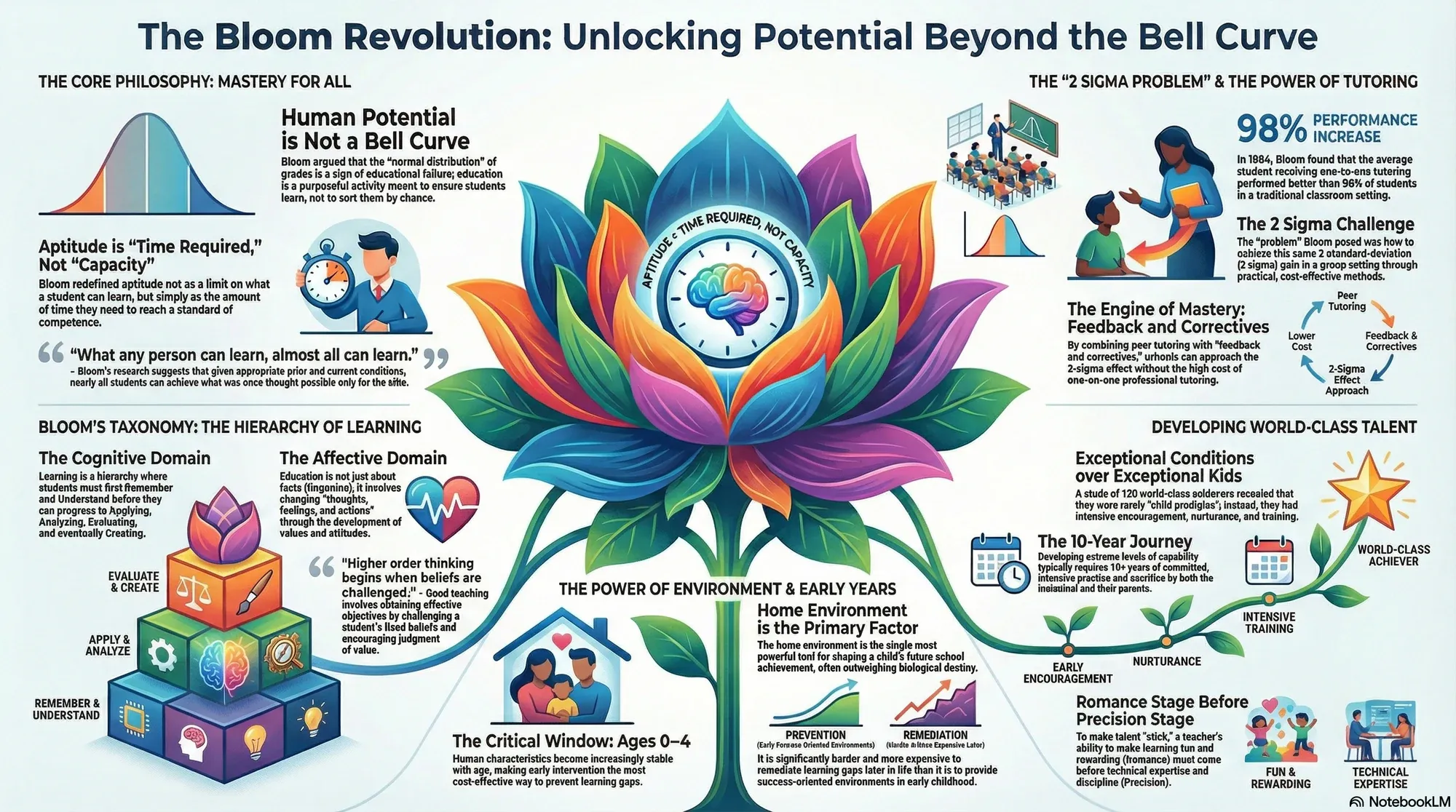
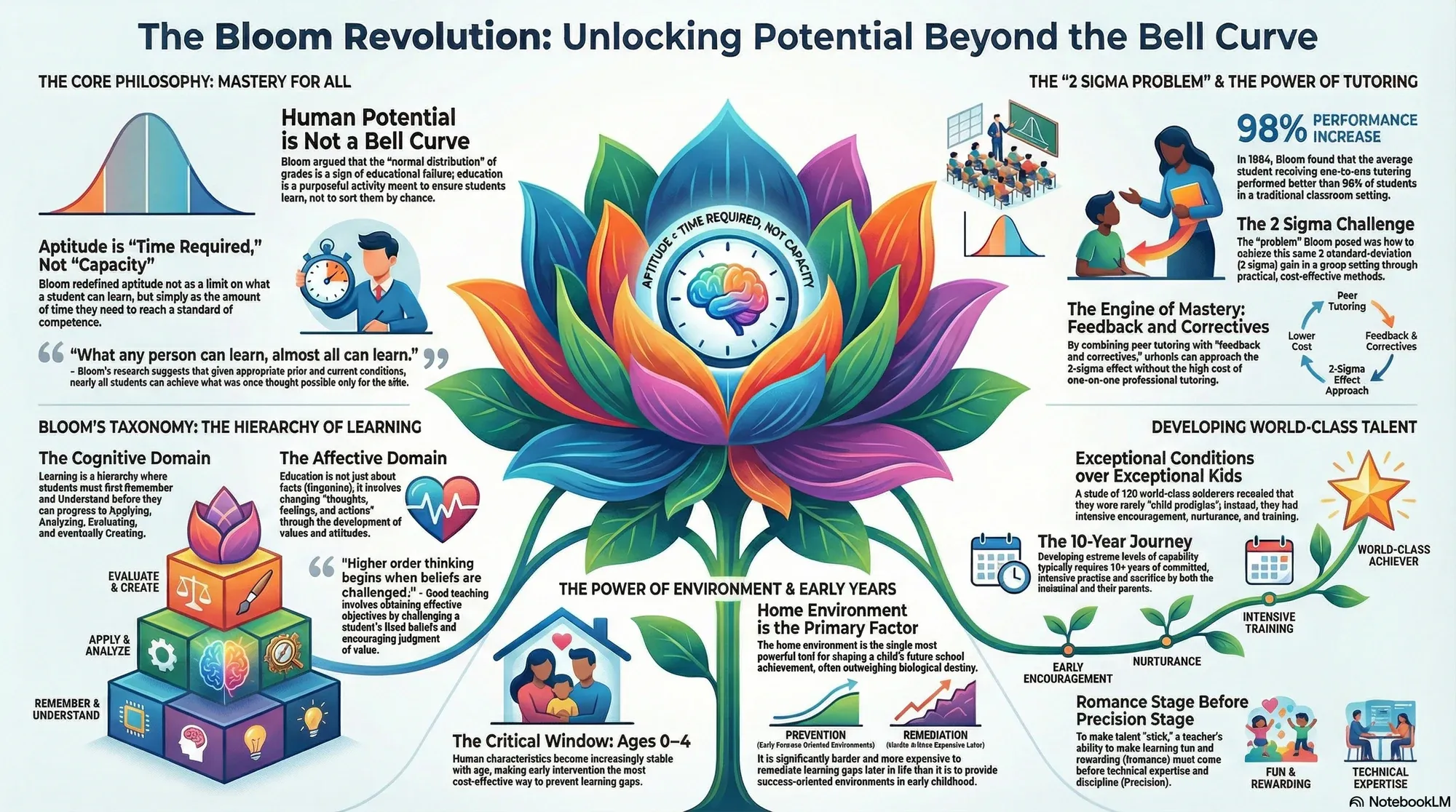
On Mastery Learning & Human Potential
Bloom argued that under appropriate teaching and time conditions, many more students can reach mastery than conventional grading patterns imply. His 1968 article states this as a research and instructional goal, not an unconditional guarantee for every student. — Learning for Mastery (1968).
- Favorable learning conditions: Bloom said most people can learn much of what others can if prior and current learning conditions are suitable; in the same passage he explicitly noted a small group with severe impairments as possible exceptions. — All Our Children Learning (1981).
- Develop talent rather than only select it: Bloom argued that education should seek ways for a larger share of students to learn effectively, rather than design schooling primarily to identify a small successful minority. — Learning for Mastery (1968).
- Build foundations for complex work: The committee’s cognitive taxonomy moves from knowledge and comprehension through application and analysis toward synthesis and evaluation. It offers a framework for planning increasingly complex objectives, not a verified Bloom quotation that creativity always follows mastery. — Taxonomy of Educational Objectives (1956).
- Education changes learners: In a curriculum-development essay, Bloom describes education as changing students’ thinking, feelings, and actions. The wording belongs to that essay, not to the 1956 cognitive taxonomy cited in the old post. — All Our Children Learning (1981).
- Learning conditions can narrow differences: Bloom wrote that, when learning conditions are favorable, students can become more alike in achievement, learning rate, and motivation than conventional schooling suggests. This is a bounded research claim, not a promise of identical outcomes. — All Our Children Learning (1981).
- Seek each learner’s fullest development: Bloom urged schools to design learning conditions that let far more children reach a high level of learning, instead of treating current achievement distributions as fixed limits. — Learning for Mastery (1968).
- Distinguish knowledge from educational fads: Bloom urged educators to separate what they know from myths and unsupported remedies, and to test promising new ideas instead of mistaking fashion for evidence. — All Our Children Learning (1981).
- Expectations can become self-fulfilling: Bloom warned that expectations embedded in grading and selection can become self-fulfilling, reinforcing the sorting of students rather than expanding their opportunities to learn. — All Our Children Learning (1981).
- Do not assume achievement must form a bell curve: Bloom argued that a normal distribution of grades is not a sacred educational target: effective instruction aimed at mastery could yield a different achievement distribution. — All Our Children Learning (1981).
- Treat nonmastery as an instructional signal: Bloom’s mastery-learning approach asks teachers to diagnose what a student has not yet learned and provide corrective help before the next unit, rather than merely classify the learner as unable. — Learning for Mastery (1968).
- Measure against mastery, not a race: Bloom’s approach defines a standard of mastery for a learning unit and adjusts help and time to reach it. The old “learning is not a race” sentence was not verified as his verbatim wording. — Learning for Mastery (1968).
On The "2 Sigma Problem" & Tutoring
Bloom’s 1984 paper summarized short comparative studies in which the average tutored student scored about two standard deviations above the conventional-class average, exceeding 98% of conventional-class students. He asked how to approach this result with practical group instruction. — The 2 Sigma Problem (1984).
- The cost problem behind two sigma: Bloom stressed that individual tutoring was too costly for most societies at scale, so the research problem was to find more practical group methods that could approach its learning results. — The 2 Sigma Problem (1984).
- Make a powerful method teachable: Bloom argued that a group-instruction method yielding tutoring-like gains would matter most if ordinary teachers could learn it quickly and use it without substantially more cost or time. — The 2 Sigma Problem (1984).
- Tutoring revealed unrealized potential: Bloom interpreted the large tutoring gain as evidence that many students had much more learning potential than their conventional-class results showed. The finding was from the particular studies he summarized. — The 2 Sigma Problem (1984).
- Learning conditions changed the outcome: In the studies Bloom summarized, students began with similar measured aptitude and prior achievement, yet tutoring and mastery-learning groups achieved different results from the conventional group. This comparison does not prove intelligence is irrelevant. — The 2 Sigma Problem (1984).
- Combine alterable variables cautiously: Bloom investigated whether mastery learning’s feedback-corrective process could be combined with changes in teaching and other alterable conditions to approach tutoring effects; he called some proposed combination rules suggestive, not settled. — The 2 Sigma Problem (1984).
- Focus research on alterable learning conditions: Bloom contrasted adjustable conditions—such as teaching quality, time use and formative feedback—with more static student measures when seeking stronger school learning. He did not establish a general numerical ranking of instruction over intelligence. — The 2 Sigma Problem (1984).
On Talent Development (The "Bloom Study")
Bloom’s retrospective research team interviewed 120 high achievers across six fields, including music, athletics, sculpture, mathematics, and neurology. This success-selected sample describes developmental patterns; it does not establish that the same conditions would make every child world-class. — Educational Leadership: Benjamin Bloom Interview.
- Conditions around the learner matter: Bloom’s direct interview emphasizes recurring patterns of home support, instruction, and sustained effort among the high achievers studied. The “exceptional kids / exceptional conditions” line remains unverified as his verbatim wording. — Educational Leadership: Benjamin Bloom Interview.
- Talent develops through sustained support: Bloom described the studied high achievers’ development as involving prolonged encouragement, education, training and effort. His account does not make innate differences irrelevant. — Educational Leadership: Benjamin Bloom Interview.
- Talent is a developmental process: Bloom described a long sequence of learning and support conditions in which interests are cultivated and effort sustained. “Talent is a long process of becoming” is not a verified quotation from him. — Educational Leadership: Benjamin Bloom Interview.
- Make early exploration rewarding: Bloom said learners should encounter a field playfully and with engaging teachers before moving toward precision and advanced skill. He attributed the romance-and-precision rhythm to Alfred North Whitehead. — Educational Leadership: Benjamin Bloom Interview.
- Families supply time and encouragement: Bloom reported that many parents in the talent study communicated a strong work ethic and actively supported sustained learning. This retrospective evidence should not be turned into a universal requirement or an exact unverified “sacrifice” quotation. — Educational Leadership: Benjamin Bloom Interview.
- High-level expertise took many years: Bloom reported that concert pianists in the study practiced for an average of about seventeen years before international distinction. The broader lesson is sustained training; his study did not establish a universal ten-year or 10,000-hour rule. — Educational Leadership: Benjamin Bloom Interview.
- Begin with interest, then precision: Bloom told an interviewer that exploration and playful engagement should precede a precision stage. He explicitly identified this rhythm as Whitehead’s idea, recognized in the talent study. — Educational Leadership: Benjamin Bloom Interview.
- Early promise is a weak selection filter: Bloom opposed using early aptitude screening to exclude children from special learning experiences; he favored broad exploration followed by growing commitment and performance-based evidence. — Educational Leadership: Benjamin Bloom Interview.
On The Taxonomy of Educational Objectives
Bloom edited a committee’s 1956 cognitive-domain taxonomy. Its original sequence is Knowledge, Comprehension, Application, Analysis, Synthesis, and Evaluation; “Creation” as the highest named category belongs to a later revision, not the 1956 handbook. — Taxonomy of Educational Objectives (1956).
- Classify objectives more precisely: The 1956 handbook attempts to make vague terms such as “understanding” more precise by classifying observable educational objectives; the old “simple classification of higher mental processes” quotation was not verified. — Taxonomy of Educational Objectives (1956).
- Separate what is known from what is fashionable: In a 1981 essay, Bloom wished for a systematic ordering of educational knowledge so that reliable findings could guide action and fads could be recognized and tested. The old post cites the wrong book. — All Our Children Learning (1981).
- Use the original six cognitive categories: The 1956 cognitive handbook orders objectives from Knowledge and Comprehension through Application, Analysis and Synthesis to Evaluation. It does not say the revised “Remember/Understand/Create” labels appeared in 1956. — Taxonomy of Educational Objectives (1956).
- Distinguish cognitive and affective goals: The 1956 handbook says the project envisaged cognitive, affective, and psychomotor domains but develops the cognitive one in this volume. Values and attitudes were planned for separate treatment, not part of the six cognitive categories. — Taxonomy of Educational Objectives (1956).
- Evaluation ended the original cognitive sequence: In the 1956 handbook, Evaluation follows Synthesis and concerns judgment against internal or external criteria. This identifies the original sequence without attributing the later revision to Bloom alone. — Taxonomy of Educational Objectives (1956).
On Environment & Early Childhood
- Early learning environments matter: Bloom’s collected essay argues that home and school environments influence learning, especially during periods of rapid development. The old “single most powerful tool” quotation was not verified as his exact words. — All Our Children Learning (1981).
- Repeated early success can shape self-concept: Bloom connected repeated school success over years with a more positive self-view, while noting that additional research was needed on causal pathways. This is narrower than the unverified claim that one success sets a lifelong trajectory. — All Our Children Learning (1981).
- Home processes affect achievement: Bloom highlighted parent-child interaction, language stimulation and encouragement as important correlates of school achievement; in the studies he cited, the home-environment index was especially predictive of language learning. — All Our Children Learning (1981).
- Use early opportunities without a hard cutoff: Bloom saw especially rapid change in some characteristics during the first five years and argued for strong early learning conditions. He did not establish ages zero to four as a universal intervention deadline. — All Our Children Learning (1981).
- Stability is not immutability: Bloom argued that development reflects interacting environmental conditions; later change can be harder but remains possible under sufficiently strong conditions. A stable score is not automatically biological destiny. — All Our Children Learning (1981).
- Earlier help can prevent widening gaps: Bloom emphasized early verbal learning and the risk that initial language gaps widen in primary school, while explicitly saying there is no age at which improving conditions is too late. The old cost comparison was not verified. — All Our Children Learning (1981).
On Teachers and Instruction
- Work with conditions educators can change: Bloom’s two-sigma research searched for adjustable features of learners, materials, home/peers and teaching, rather than treating test-measured differences as the whole explanation for achievement. — The 2 Sigma Problem (1984).
- Adapt explanations to the learner: Bloom argued that teachers and materials can be modified when a student does not understand a task or procedure; alternate explanations and support may help more than repeating one presentation. — All Our Children Learning (1981).
- Use feedback and corrective help: Bloom’s mastery-learning approach supplements group instruction with frequent checks, feedback and individualized corrective assistance when students need it. — Learning for Mastery (1968).
- Learning conditions affect more than test scores: Bloom reported that tutoring studies showed differences not only in cognitive achievement but also in attitudes, interests and academic self-concept, while acknowledging the studies’ limited settings. — The 2 Sigma Problem (1984).
- A bell curve is not the instructional goal: Bloom argued that effective teaching for mastery could produce an achievement pattern unlike the normal curve. A bell-shaped grade distribution alone does not prove every school has failed. — All Our Children Learning (1981).
- Instruction has several adjustable components: Bloom discusses clear cues, student participation and reinforcement, alongside feedback and corrective help, as features educators can adjust. The list is not a strict exhaustive definition of teaching quality. — All Our Children Learning (1981).
- Use formative checks to improve learning: Bloom distinguished diagnostic/formative checks used for feedback and correction during a learning sequence from grading at the end. Their value lies in guiding next steps, not a universal claim that summative assessment is worthless. — Learning for Mastery (1968).
- Early correction may reduce later learning time: Bloom argued that helping students master prerequisite units early can make later learning more efficient, while treating the size of that effect as an instructional question rather than a guarantee. — Learning for Mastery (1968).
- Interpret aptitude as time required: Bloom adopted John Carroll’s model in which aptitude for a learning task is related to the time a learner needs for mastery, rather than a fixed ceiling on what that learner can learn. — Learning for Mastery (1968).
References & Further Reading
- Bloom, Benjamin S. (1984). “The 2 Sigma Problem: The Search for Methods of Group Instruction as Effective as One-to-One Tutoring.” Educational Researcher.
- Brandt, Ronald S. (1985). “On Talent Development: A Conversation with Benjamin Bloom.” Educational Leadership.
- Bloom, Benjamin S. (1981). All Our Children Learning: A Primer for Parents, Teachers, and Other Educators.
- Bloom, Benjamin S., ed. (1956). Taxonomy of Educational Objectives, Handbook I: Cognitive Domain.
Additional original source: