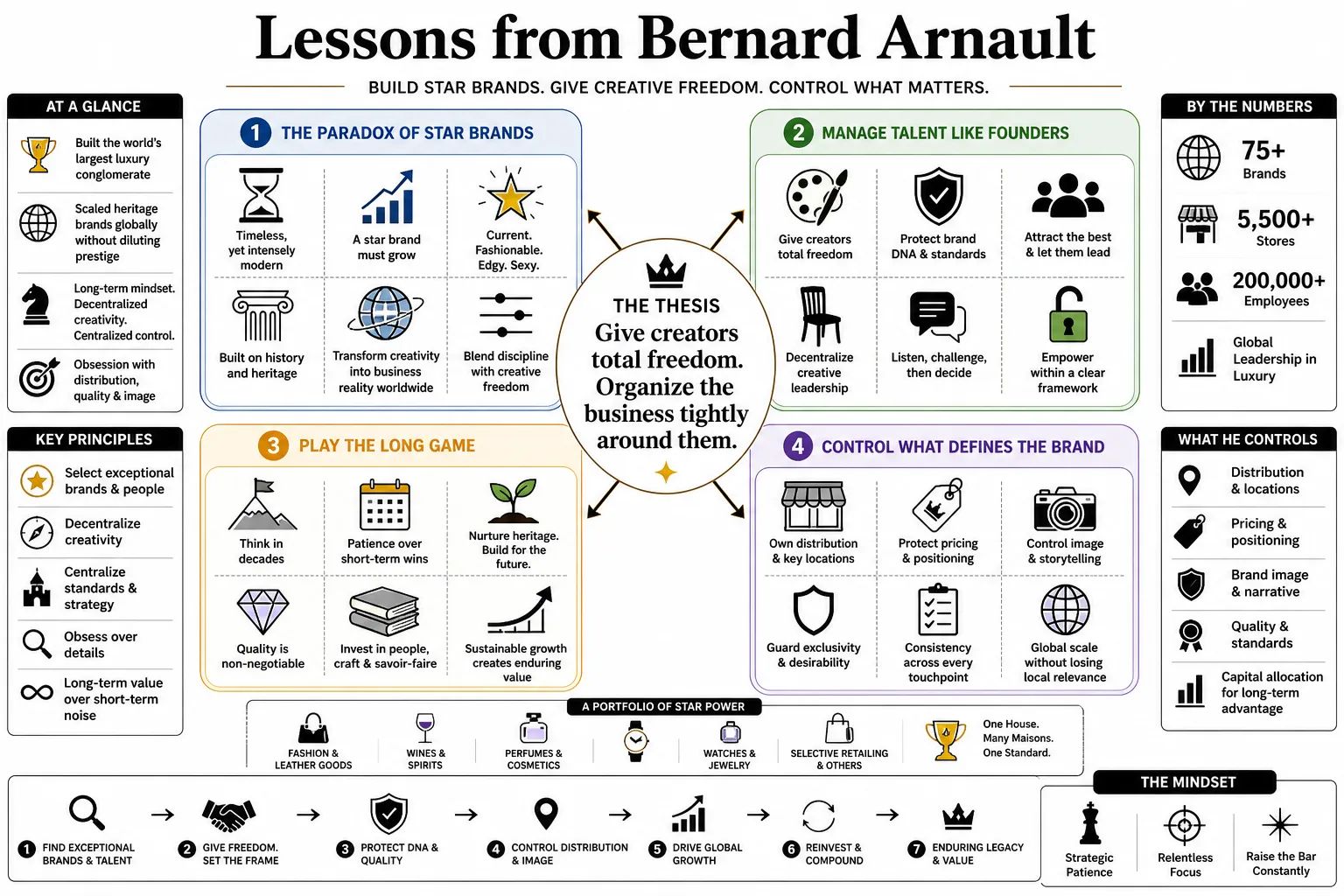
Lessons from Bernard Arnault
Bernard Arnault developed LVMH around distinct luxury houses, combining creative ambition with careful product execution and global distribution. In his own interviews, he emphasizes long-term brand relevance, quality, talented people and staying close to customers. — Forbes Q&A.
Part 1: The Paradox of Star Brands
- Balance timelessness with modernity: Arnault describes a star brand as one that preserves its history while producing work that feels current. Both qualities matter to its lasting appeal. — Forbes Q&A.
- Make growth part of a star brand: In Arnault’s 2001 framework, a star brand feels timeless yet modern and sells strongly while remaining profitable. It was his description of rare houses, not a rule for every business. — HBR Interview Abstract.
- Keep a brand current: He argues that a historic house has to keep inventing, so its products remain contemporary rather than merely relying on inherited prestige. — Forbes Q&A.
- Give heritage time to develop: Arnault says luxury houses build on history and heritage over time; their growth should not outrun their ability to maintain product quality. — CNN TalkAsia Interview.
- Turn creativity into usable products: Arnault says his role is to help designers turn creative ideas into products people can enjoy and use, without extinguishing the original creative ambition. — Forbes Q&A.
- Protect the creative process: Arnault distinguishes open creative exploration from the disciplined manufacturing needed to bring a product to market. — HBR Interview Abstract.
- Choose creators who want their work used: Arnault contrasts designs made for museums with clothes people will actually wear; he wants creative work to become useful products. — Forbes Q&A.
- Execute ideas with persistence: Arnault says an idea is only a small part of a startup’s success; persistence and strong execution account for far more. — Forbes Q&A.
Part 2: Creative Autonomy and Control
- Give artists room to invent: In Arnault’s account, creators need substantial freedom from financial and commercial constraints during initial design work. — HBR Interview Abstract.
- Avoid intrusive creative oversight: He argues that managerial limits imposed too early can inhibit artists’ best work. — HBR Interview Abstract.
- Pair designers with inspired management: Arnault says a house needs a designer aligned with its history and a management team able to work smoothly with that designer. — CNN TalkAsia Interview.
- Pair studio freedom with production discipline: LVMH’s historical operating model gave designers wide creative freedom while planning manufacturing tasks with rigor. — HBR Interview Abstract.
- Keep Maisons distinct: LVMH says its Maisons retain identity and autonomy while gaining access to Group resources; the structure is intended to preserve each house’s creative character. — LVMH 2025 Annual Report.
- Preserve an acquired house’s heritage: When announcing RIMOWA’s entry into LVMH, Arnault emphasized its unique history, craftsmanship and continuity alongside innovation. — LVMH–RIMOWA Announcement.
- Separate creative risk from operating discipline: Arnault’s model gives early ideas space to be unconventional, then applies disciplined production to bring selected work to market. — HBR Interview Abstract.
Part 3: Time, Patience, and Long-Term Value
- Control impatience in business: Arnault says a long-term position matters, and recalls selling an underperforming cosmetics business too early because he lost patience. — Forbes Q&A.
- Look beyond the next six months: He says his concern for a brand is how admired it will be in five or ten years, rather than its profitability in the next six months. — Forbes Q&A.
- Plan beyond the current downturn: Asked amid a possible near-term slowdown in 2024, Arnault said LVMH’s plans were aimed at 2030. This is a concrete planning horizon, not a guarantee about results. — Bloomberg Businessweek Interview.
- Build desirability over time: Arnault’s example of a historic brand emphasizes preserving its roots while adding modern products so it remains desirable years later. — Forbes Q&A.
- Design for enduring appeal: Arnault contrasts enduring house products with short-lived technology cycles; his Dom Pérignon example expresses a conviction about future demand, not a guaranteed outcome. — CNBC Interview.
- Keep a startup spirit as the group grows: Arnault urges a large organization to act entrepreneurially and stay close to customers and designers rather than retreat into offices. — Forbes Q&A.
- Prepare for leadership succession: Arnault says he is considering whether one of five family members working in the Group has the capacity to take over. Succession is an open decision, not a settled appointment. — Bloomberg Businessweek Interview.
Part 4: Financial Discipline and Profitability
- Treat profit as a consequence of the work: Arnault tells his team to focus on doing the job well rather than obsessing over near-term profitability; he presents profit as an outcome, not an automatic guarantee. — Forbes Q&A.
- Make rigorous production support creative economics: The HBR publisher summary describes Arnault’s model as combining radical product innovation with exacting manufacturing productivity to make star brands profitable. — HBR Interview Abstract.
- Be patient with a struggling house: After selling a cosmetics business too soon, Arnault concluded that a disappointing brand may need deeper understanding and years of patient work before a turnaround. — Forbes Q&A.
- Let strong houses support emerging ones: Arnault describes grouping Maisons so established brands can give smaller houses time to grow while the portfolio shares scale advantages. — Bloomberg Businessweek Interview.
- Earn a premium through product value: Arnault argues that creativity, innovation and quality support the high-end product relationship; he does not treat simply lowering price as the same strategy. — CNBC Interview.
- Engineer the manufacturing process: Arnault’s historical account pairs artistic freedom with planning individual manufacturing steps to achieve quality and productivity. — HBR Interview Abstract.
- Fund global launches deliberately: Arnault says launching new products globally requires higher investment, an advantage for a group able to support its houses at scale. — Forbes Q&A.
- Do not confuse lower prices with the same product model: Arnault argues that his pursuit of artisan-made, high-quality products is not compatible with simply pushing prices downward. He acknowledges more affordable goods serve a different market. — CNBC Interview.
- Use portfolio scale behind the scenes: Arnault says a collection of strong brands improves the Group’s position when buying advertising and negotiating real estate. — Forbes Q&A.
Part 5: Quality, Craftsmanship, and Product
- Build around creativity, innovation and quality: Arnault describes those three elements as central to LVMH’s high-end product model. — CNBC Interview.
- Treat quality as non-negotiable: LVMH defines excellence as meticulous attention to detail across products and services, with no compromise on quality. — LVMH Mission and Values.
- Let the product and its presentation work together: Arnault links desire to the product itself, the store environment and how it is presented; marketing follows creative product development rather than replacing it. — Oxford Union Q&A.
- Value inherited craftsmanship: Arnault connects a house’s history and trained artisans to the quality people experience in its products. — CNBC Interview.
- Do not let marketing dictate invention: Arnault separates product creation from later marketing: creators first make something distinctive, then the company presents it well through stores and advertising. — Oxford Union Q&A.
Part 6: Acquisitions, Growth, and Crises
- Keep options open during a crisis: Arnault says LVMH’s historically low debt gave it room to adapt and sometimes grow faster than competitors in difficult periods. He does not claim it won share in every crisis. — Oxford Union Q&A.
- Use a diversified group for resilience: LVMH’s different Maisons, business groups and geographies give it several sources of activity during disruption; this is a group design and reported experience, not proof it always outperforms standalone rivals. — LVMH Chairman’s Message.
- Look for openings when markets cool: Arnault says a downturn can create investment opportunities, but advises patience and caution when assets are overheated rather than indiscriminate spending. — Oxford Union Q&A.
- Stay vigilant in uncertainty: In LVMH’s 2023 letter, Arnault describes confidence in the Group alongside vigilance amid economic and geopolitical uncertainty. — LVMH Shareholder Letter.
- Give smaller houses time to reach their potential: Arnault says smaller Maisons can take years to build the right creative and management combination before reaching star-brand growth. — CNN TalkAsia Interview.
- Enter promising markets early: Arnault recalls opening a Louis Vuitton store in China in 1991, before the market’s later expansion. This is a dated first-mover example, not a mandate to conquer every rival. — Forbes Q&A.
- Let scale attract talent: Arnault says the Group’s strongest portfolio advantage is its ability to attract talented people, alongside property and advertising leverage. — Forbes Q&A.
Part 7: Brand Positioning and Customer Image
- Control distribution to protect image: LVMH identifies distribution control as a way to shape brand image, customer reception and the selling environment. — LVMH 2025 Annual Report.
- Invest in direct retail: LVMH’s strategy relies heavily on its own store network to present products and sustain a consistent customer experience; it does not make every form of wholesale universally impossible. — LVMH 2025 Annual Report.
- Present the product in the right setting: Arnault connects customer desire to the store environment and the way a product is displayed, alongside the product’s own merits. — Oxford Union Q&A.
- Make the store part of the brand experience: LVMH says control of retail allows its Maisons to shape customer reception and the environment around their products. — LVMH 2025 Annual Report.
- Limit a radical product’s initial risk: Arnault describes releasing bold designs in small quantities while established classics carry much of the line, allowing creativity without putting the whole business at risk. — HBR Interview Reproduction.
- Create products before asking marketing to sell them: Arnault says LVMH first creates distinctive products and then works on how to present them and build desire; marketing is downstream of invention in his account. — Oxford Union Q&A.
- Draw authority from real history: Arnault links the appeal of a historic house to its accumulated roots and craftsmanship, which customers can learn about through products and brand presentation. — CNBC Interview.
- Keep the core product coherent globally: Arnault says LVMH generally offers the same core products across countries, while recognizing that particular products have different local levels of demand. — Oxford Union Q&A.
Part 8: Management Habits and Leadership Focus
- Stay near customers and designers: Arnault tells leaders to spend less time in offices and more time with customers and designers, and says he visits stores weekly. — Forbes Q&A.
- Attract outstanding people: Arnault calls the ability to attract strong people the Group’s largest advantage and treats creative talent as central to its business. — Forbes Q&A.
- Inspect store execution in detail: Arnault’s store visits include attention to small presentation and staff details; the 2024 interview records his own example about what sales attendants wear. — Bloomberg Businessweek Interview.
- Stay constructively uneasy after success: Arnault urges a successful business to keep questioning its choices and innovation pipeline rather than assuming recent results guarantee future strength. — Oxford Union Q&A.