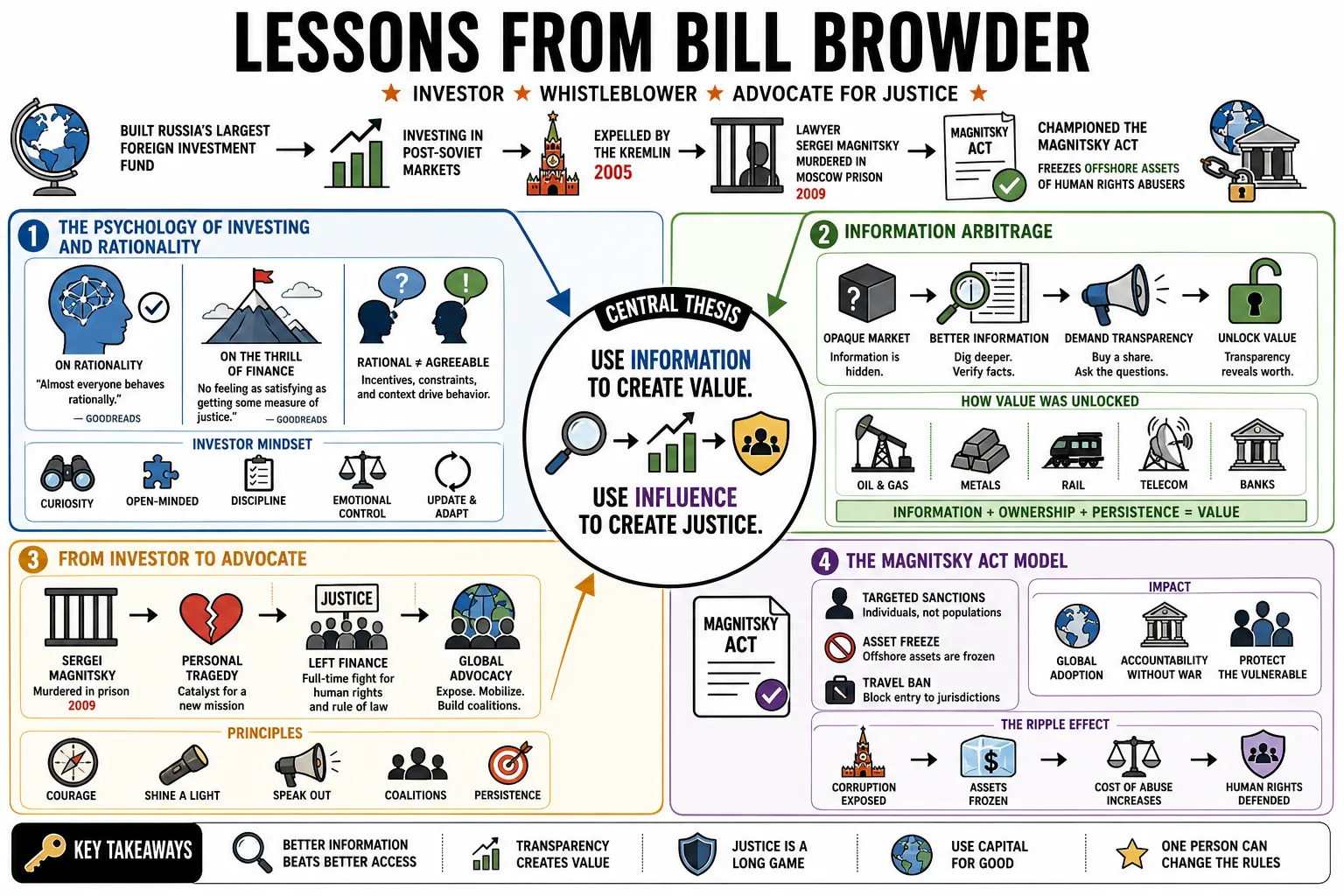
Lessons from Bill Browder
Bill Browder ran Hermitage Capital, a major foreign investment fund in Russia, until his expulsion in 2005. After Sergei Magnitsky died in Russian custody, Browder shifted from finance to a campaign for targeted visa bans and asset freezes against alleged human-rights abusers. These lessons follow his investing experience and his later account of that campaign. — Browder Senate Testimony.
Part 1: The Psychology of Investing and Rationality
- On Rational Incentives: Browder argued that banks had little incentive to scrutinize profitable but suspicious clients when enforcement consequences were weak. He used this risk-and-reward explanation to make sense of behavior he otherwise found inexplicable. — Browder UK Foreign Affairs Testimony.
- On the Thrill of Finance: Browder has contrasted the satisfaction of a successful investment with the greater satisfaction he felt when European lawmakers recognized the injustice suffered by Sergei Magnitsky and his family. — David Perell Interview.
- On Information Arbitrage: At Hermitage, Browder’s team researched alleged corporate theft, assembled company-specific evidence and publicized it to defend its minority investments. — Browder Senate Testimony.
- On Contrarian Investing: Browder invested in deeply discounted Russian assets when many investors avoided the market; the opportunity depended on a catalyst that could unlock value, not low prices alone. — CFA Institute Interview.
- On Understanding Motives: Browder later reconsidered Putin’s earlier tolerance of his shareholder activism: he came to believe that it had temporarily served Putin’s interests before those interests changed. — RFE/RL Interview.
- On Shareholder Activism: Browder says Hermitage did not begin as an activist fund; after the 1998 crash, public challenges to alleged asset stripping became a way to protect its minority-shareholder positions. — CFA Institute Interview.
- On the Value of Transparency: Browder says Hermitage’s publication of findings about alleged theft at portfolio companies coincided with less theft and higher share prices in those holdings. — Browder Senate Testimony.
- On Assessing Risk: Browder later acknowledged that he had treated risk mainly as a financial question and underestimated the personal danger of confronting corruption in Russia. — CFA Institute Interview.
- On Recognizing Defeat: When Russian authorities barred Browder from the country and later raided Hermitage’s Moscow offices, the dispute had moved beyond an ordinary investment loss; he says he had underestimated the personal stakes. — Red Notice Official Excerpt.
Part 2: The Soviet Legacy and Russian Mentality
- On the Soviet Work Ethic: Browder has described the Soviet system of state-set prices and wages as economically broken, with weak incentives to work. This was his interpretation of the system he encountered as Russia moved toward privatization, not a measured claim about every Russian worker. — Real Vision Interview.
- On the Magic-Fish Proverb: Browder used a Russian magic-fish proverb to explain how he interpreted Vladimir Potanin’s attempted dilution of Hermitage’s Sidanco investment. The anecdote describes his view of that particular shareholder conflict, not the mentality of all Russians. — Real Vision Interview.
- On Post-Soviet Hardship: Browder recalls the 1990s transition as both an extraordinary investing opportunity and a period of insecurity for many ordinary Russians, with weak institutions and deep economic hardship. — Real Vision Interview.
- On the Cost of Speaking Up: In Browder’s account, Sergei Magnitsky testified about the alleged tax-refund fraud despite the risks; Browder says that testimony was followed by his arrest and pressure to retract it. — Browder OSCE Speech.
Part 3: The Mechanics of Corruption and Oligarchy
- On Privatization: Browder recalls Russia’s privatization as an opportunity to buy formerly state-owned assets cheaply, but says control of much of the resulting economy became concentrated among a small number of oligarchs. His figures are estimates from his account, not independently established here. — Real Vision Interview.
- On State Bureaucracy: Browder says Hermitage investigators obtained commercially available records and combined them with other information to trace suspected corporate theft, then shared their findings with journalists. — Barry Ritholtz Interview.
- On the Interior Ministry: According to Browder’s Senate testimony, Interior Ministry officers seized Hermitage corporate records in 2007; he says those records were then used to re-register investment holding companies fraudulently. — Browder Senate Testimony.
- On Money as a Shield: Browder argues that moving suspected illicit wealth into rule-of-law countries can initially make it feel protected, but it also creates a point of leverage: those jurisdictions can freeze identified assets. — Browder Senate Testimony.
- On Institutional Theft: Browder alleges that the corporate records seized from Hermitage were used to take control of its Russian holding companies and claim a $230 million tax refund, illustrating the specific mechanism his team investigated. — Browder Senate Testimony.
- On Offshore Accounts: Browder’s sanctions strategy rests on his claim that some Russian officials and their proxies hold valuable assets abroad, where visa bans and asset freezes can reach them. — Browder Senate Testimony.
- On Tax Fraud Schemes: Browder’s team traced proceeds they say came from the $230 million Russian tax-refund fraud through foreign accounts; he presents that tracing as a way to pursue accountability outside Russia. — Browder UK Parliament Evidence.
- On the Judicial System: After Magnitsky reported the alleged fraud, Browder says his complaints and requests for medical care were ignored or rejected by Russian authorities, changing his view of whether domestic institutions would deliver justice. — Browder Senate Testimony.
Part 4: The Tragic Trajectory of Sergei Magnitsky
- On Sergei’s Character: Browder describes Sergei Magnitsky as the lawyer who investigated the alleged theft of Hermitage’s tax payments and testified about the officials he believed were involved, despite the risk of confronting them. — Browder OSCE Speech.
- On State Retaliation: According to Browder, officers Magnitsky had named in testimony arrested him in November 2008 and pressured him during pretrial detention to withdraw his account. — Browder Senate Testimony.
- On the Value of Human Life: Browder recounts that Magnitsky’s repeated requests for medical attention were ignored or rejected while he was held in pretrial detention. The case shaped Browder’s view of the cost of institutional impunity. — Browder Senate Testimony.
- On Ultimate Sacrifice: Browder testified that Magnitsky, suffering from untreated medical conditions, was placed in an isolation cell, beaten by guards and found dead later that night in November 2009. — Browder Senate Testimony.
- On the Kremlin’s Denials: Browder told a UK parliamentary committee that Russian officials denied violence in Magnitsky’s death and later prosecuted Magnitsky posthumously, part of what Browder describes as a campaign to change the narrative. — Browder UK Parliament Testimony.
- On Transforming Grief into Action: Browder says news of Magnitsky’s death changed the direction of his life: he pledged to pursue consequences for those he held responsible and redirected his work toward that campaign. — Browder Senate Testimony.
- On Bearing Witness: Magnitsky’s written complaints from detention gave Browder and his colleagues a record they could take to foreign lawmakers after Russian authorities declined to prosecute, making documentation central to their campaign. — Browder Senate Testimony.
- On Sergei’s Idealism: Browder says he and Magnitsky initially expected Russian authorities to pursue the alleged tax fraud once they submitted complaints and testimony; Magnitsky’s subsequent arrest overturned that expectation. — Browder Senate Testimony.
- On Lasting Legacy: Browder’s campaign helped turn Magnitsky’s name into a targeted sanctions law: the 2012 US measure authorized visa bans and asset freezes for designated people implicated in his case and other serious abuses in Russia. — Browder Senate Testimony.
Part 5: The Anatomy of the Putin Regime
- On Putin’s Wealth: Browder has estimated that Putin controls substantial wealth through associates and proxies, but that is Browder’s allegation rather than a verified personal balance sheet. — Browder Senate Testimony.
- On the Kremlin’s Achilles Heel: Browder says targeted asset freezes and travel bans were designed to reach officials who could act with impunity at home but valued money and mobility abroad; he called this the Putin regime’s Achilles heel. — IBA Interview with Bill Browder.
- On Putin’s Outrage: Browder links Russia’s adoption ban and repeated attempts to pursue him through threats and legal requests to its anger over Magnitsky sanctions. This is his interpretation of the backlash. — IBA Interview with Bill Browder.
- On State Retaliation against the US: After the US Magnitsky Act passed, Russia barred American families from adopting Russian children; Browder argued that this punished vulnerable children in retaliation for sanctions on officials. — Browder Senate Testimony.
- On Proxy Holdings: Browder pointed to the Panama Papers and traced links to cellist Sergei Roldugin to argue that some assets might be held for Putin through proxies. The proxy relationship and ultimate ownership remain allegations in his testimony. — Browder Senate Testimony.
- On Geopolitical Ambitions: Browder argues that Putin’s framing of Ukraine as an enemy makes compromise politically difficult for him and helps explain why Browder expects the war to continue. This is his assessment, not a certain forecast. — TVO Browder Interview.
- On the Kremlin’s Mafia Tactics: Browder has characterized Putin’s government as operating like a criminal organization, arguing from the fraud and money-laundering cases he has investigated. That is his political assessment, not a neutral judicial finding. — TVO Browder Interview.
- On Appeasing Dictators: Browder has argued that engagement without consequences failed to change Putin’s behavior and that targeted financial sanctions were a more concrete response to abuses. This is his policy judgment rather than a universal law of diplomacy. — Browder TIME Essay.
Part 6: The Strategy Behind the Magnitsky Act
- On Creating a New Tool: After concluding that the Magnitsky case would not be prosecuted in Russia, Browder and US senators pursued individual visa bans and asset freezes as a way to impose consequences beyond Russia’s borders. — Browder Senate Testimony.
- On Overcoming Initial Resistance: Browder recalls that many officials expressed sympathy for Magnitsky but offered no action; Senator Ben Cardin instead sponsored legislation that imposed personal visa and asset restrictions. — Browder Senate Foreign Relations Testimony.
- On Broadening the Scope: After other Russian abuse victims sought the same remedy, Cardin and co-sponsors added 65 words to the draft so it could target serious human-rights abusers in Russia beyond Magnitsky’s case. — Browder Senate Foreign Relations Testimony.
- On Bipartisan Support: The Magnitsky measure drew support across US parties: Browder recounts sponsorship by Cardin and McCain, and the 2012 Senate vote was 92–4. — Browder Senate Foreign Relations Testimony.
- On Globalizing the Law: A 2016 US Global Magnitsky law extended the approach beyond Russia; Browder then advocated similar targeted-sanctions regimes in other jurisdictions, including Canada, the UK and the EU. — Browder Senate Foreign Relations Testimony.
- On Financial and Information Conflict: Browder argued that confrontations with kleptocratic regimes also occur through banks, media and information. In his account, exposing money flows and those who enable them can matter alongside traditional state responses. — Browder UK Foreign Affairs Testimony.
- On John McCain’s Support: Browder recalls that John McCain made time to hear Magnitsky’s story and joined Ben Cardin in sponsoring legislation; Browder regarded McCain’s support as pivotal to the campaign. — Browder’s TIME Essay on John McCain.
Part 7: The Cost of Complicity in the West
- On Western Enablers: Browder argues that lawyers, accountants, trustees, company-formation agents and PR firms can help sanctioned people conceal or manage assets; he has proposed a disclosure duty for advisers who know where those assets are held. — Browder UK Treasury Testimony.
- On the London Laundromat: Browder told UK lawmakers that his team traced funds it alleged came from the Magnitsky-related tax fraud into the UK, and he criticized the lack of a UK money-laundering investigation at that time. — Browder UK Foreign Affairs Testimony.
- On Legal Intimidation: Browder says a libel suit brought against him by former Russian police officer Pavel Karpov was an attempt to silence his Magnitsky campaign; he reports that the UK court struck it out in 2013. — Browder UK Parliamentary Evidence.
- On Enforcement Gaps: Browder says information his team supplied prompted money-laundering inquiries in several countries, while UK authorities did not open a comparable investigation at the time. He presented that contrast as an enforcement failure. — Browder UK Foreign Affairs Testimony.
- On Professional Ethics: Browder draws a distinction between legitimate legal advice or defence and helping a client break sanctions law; he argues that advisers who cross that boundary should face consequences. — Browder UK Foreign Affairs Testimony.
- On Real Estate as a Safe Haven: Browder says his investigators traced alleged proceeds of the Magnitsky-related fraud to luxury property on Spain’s coast, prompting him to submit a complaint to a Spanish anti-corruption prosecutor. — Carnegie Council Interview.
- On the PR Industry: Browder has urged disclosure of lobbyists and public-relations advisers acting for foreign governments, arguing that opaque advocacy can make it harder to scrutinize attempts to weaken sanctions. — Browder UK Foreign Affairs Testimony.
- On Interpol Abuse: Browder reports that Russian authorities made repeated requests through INTERPOL systems to pursue him; he says several were rejected as politically motivated and that the attempts constrained his travel. — Browder UK Parliamentary Evidence.
- On Complacent Politicians: Browder argues that Western leaders’ actions matter more than condemnatory words: he pointed to weapons deliveries and sanctions on Russian oil as measures he wanted considered for Ukraine. — TVO Browder Interview.
- On Corporate Accountability: From his experience in Russia, Browder argued that firms faced pressure either to accommodate corrupt officials or risk retaliation. That was his judgment about doing business there, not an inevitable outcome for every company. — Browder UK Foreign Affairs Testimony.
Part 8: The Path Forward and the Value of Justice
- On Using Seized Assets: Browder advocates confiscating frozen Russian central-bank reserves and putting them toward Ukraine’s defence before reconstruction. This is a policy proposal, not an accomplished transfer. — RFE/RL Browder Interview.
- On Resilience: Browder says he will not change his campaign out of fear despite threats and the effort required to manage his security. His stated reason is his commitment to Magnitsky’s case. — RFE/RL Browder Interview.
- On Global Unity: Browder argues that any confiscation of frozen Russian central-bank reserves should be coordinated among major allied countries, partly to avoid shifting reserves from one currency to another. — RFE/RL Browder Interview.
- On Shifting Internal Sentiment: Browder interprets the mixed public reaction during Prigozhin’s 2023 march as a sign that visible loyalty to Putin may depend on fear and uncertainty about who holds power. — TVO Browder Interview.
- On the Fragility of Regimes: Browder cautions that a government can appear secure until an unexpected challenge, but he also says Putin could remain in power for life; the timing of any change is unknowable. — TVO Browder Interview.
- On Truth as a Weapon: Browder says his team publicized company-specific allegations and later used Magnitsky’s written complaints to challenge official denials and disinformation about the case. — Browder UK Parliament Testimony.
- On Sergei’s Sacrifice: Browder says his sense of guilt and grief over Magnitsky’s death continues to motivate his campaign for justice years later. This is his personal account, not the unverified claim that he literally owed Magnitsky his life. — EUvsDisinfo Interview.