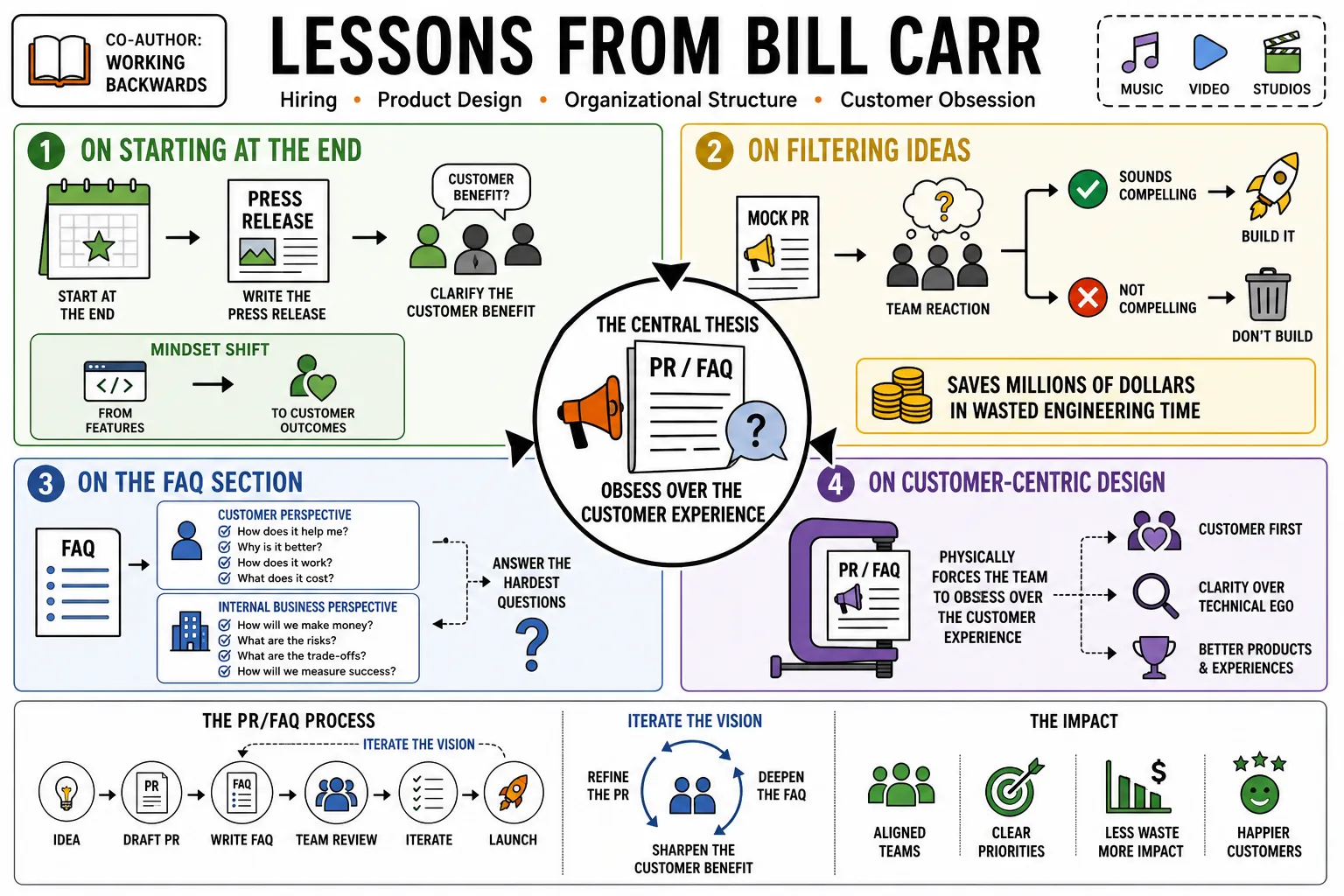
Lessons from Bill Carr
Bill Carr was Amazon’s vice president of digital media and helped build Amazon Music, Prime Video and Amazon Studios. With former Amazon colleague Colin Bryar, he wrote Working Backwards to explain the company’s management practices and their origins. — a16z Podcast — Bill Carr and Colin Bryar.
Part 1: The PR/FAQ Process
- Write the customer announcement first: Carr and Bryar describe writing a proposed product announcement before development so the team must define the customer and the benefit it intends to deliver. — Working Backwards PR/FAQ Guide.
- Use a funnel to filter ideas: The authors recommend drafting many PR/FAQs and advancing only the ideas that survive customer-value and feasibility review, rather than building every idea that enters the pipeline. — Working Backwards PR/FAQ Guide.
- Answer difficult questions in the FAQ: The external FAQ addresses customer concerns; the internal FAQ surfaces financial, technical, legal and operational hurdles before a product decision. — Working Backwards PR/FAQ Guide.
- Design from the customer problem: The PR/FAQ starts with a precisely defined customer and problem, then tests whether the proposed solution would be meaningfully better than the alternatives. — Working Backwards PR/FAQ Guide.
- Iterate the document with stakeholders: An initial author expands a rough PR/FAQ through cross-functional review and successive executive discussions before a go/no-go decision. — Working Backwards PR/FAQ Guide.
- Write plainly for customers: The press release and external FAQ use language a prospective customer can understand, avoiding corporate jargon and vague product descriptions. — Working Backwards PR/FAQ Guide.
- Specify resources before approval: When a PR/FAQ receives a go decision, its internal questions should already spell out staffing, investment, rough timing and operational requirements. — Working Backwards PR/FAQ Guide.
- Test willingness to pay and buildability: The PR/FAQ asks whether enough customers value the proposed solution and whether its economics and implementation risks can work; pricing is a design constraint, not a universal fixed field in the announcement. — Working Backwards PR/FAQ Guide.
- Use writing to expose weak thinking: The authors use the PR/FAQ to make a team’s assumptions, unknowns and proposed customer value explicit enough for scrutiny and debate. — Working Backwards PR/FAQ Guide.
- Describe a valuable future experience: The proposed announcement describes a customer experience worth creating, then the FAQ works backward through the obstacles to make it possible. — Working Backwards PR/FAQ Guide.
Part 2: Single-Threaded Leadership
- Assign full-time ownership: The authors define a single-threaded leader as the senior person working full time on one critical initiative with the skill and resources to make it happen. — Working Backwards — Single-Threaded Teams.
- Make accountability explicit: A single-threaded team shares an objective, while its leader owns the resources and is accountable for progress and setbacks. — Working Backwards — Single-Threaded Teams.
- Give the team control of dependencies: The model aims to put the necessary people and resources under a focused leader so work is not stalled by repeated resource bargaining across functions. — Working Backwards — Single-Threaded Teams.
- Reduce coordination drag: The authors say a shared objective and clearer ownership can reduce alignment meetings and resource disputes, though they also note risks of duplication and siloed expertise. — Working Backwards — Single-Threaded Teams.
- Prioritize focus over team size: Carr and Bryar distinguish the single-threaded model from a simple small-team rule: dedicated ownership and necessary resources matter more than an arbitrary headcount. — Working Backwards — Single-Threaded Teams.
- Diagnose a stalled initiative’s ownership: When work is repeatedly delayed by functional contention, the authors’ diagnostic is whether a capable leader has full-time ownership and control of resources. — Working Backwards — Single-Threaded Teams.
- Align first, then grant autonomy: The executive team and single-threaded leader agree on objectives, metrics and boundaries before the team operates autonomously with regular course corrections. — Working Backwards — Single-Threaded Teams.
- Pair ownership with regular review: Clear team ownership does not mean fire-and-forget: the authors recommend agreed metrics and recurring executive review to catch drift early. — Working Backwards — Single-Threaded Teams.
- Scale decisions through clear owners: Carr says that as a company grows beyond a small team, a founder cannot attend every decision; processes and dedicated team ownership help distribute decisions coherently. — a16z Podcast — Bill Carr and Colin Bryar.
Part 3: The Bar Raiser Hiring Model
- Hire against a defined bar: Carr and Bryar describe a repeatable process that compares candidates with role requirements and leadership principles rather than lowering standards to fill a vacancy. — Working Backwards — Bar Raiser Hiring.
- Keep the Bar Raiser independent: The Bar Raiser participates in the interview loop but cannot be the hiring manager or report to that manager, allowing a company-wide standard to be represented. — Working Backwards — Bar Raiser Hiring.
- Counter urgency bias: A trained Bar Raiser helps the team resist pressure to fill an open seat with someone who falls below the agreed hiring bar. — Working Backwards — Bar Raiser Hiring.
- Reserve a hiring veto: The Bar Raiser can veto a hire that fails the bar, but the authors emphasize persuasion and evidence-based discussion before any veto. — Working Backwards — Bar Raiser Hiring.
- Probe for behavioral evidence: Interviewers examine specific past actions against assigned leadership principles and document the examples behind their assessment. — Working Backwards — Bar Raiser Hiring.
- Write assessments independently: Interviewers complete written assessments before the group debrief to reduce confirmation bias and give the team a full evidence set. — Working Backwards — Bar Raiser Hiring.
- Debrief with evidence: The Bar Raiser facilitates a discussion of disputed assessments, asking panelists which observed examples justify each judgment. — Working Backwards — Bar Raiser Hiring.
- Ask for concrete past actions: Behavioral interviews are used to test a candidate’s actions and judgment against specific principles, instead of relying on an impression or hypothetical alone. — Working Backwards — Bar Raiser Hiring.
- Train Bar Raisers through practice: Prospective Bar Raisers are mentored, shadow and reverse-shadow interview loops, and practice leading debriefs before taking full responsibility. — Working Backwards — Bar Raiser Hiring.
Part 4: Six-Page Narratives and Meetings
- Use prose for complex decisions: Carr and Bryar say Amazon replaced slides in senior decision meetings because narrative documents made assumptions and relationships between facts easier to examine. — Working Backwards — Narratives and Decision-Making.
- Make the memo a coherent argument: A short narrative uses complete sentences, evidence and relevant charts to show the reasoning behind a proposal, not just fragments on slides. — Working Backwards — Narratives and Decision-Making.
- Read together before debating: The authors describe distributing the memo at the meeting and giving participants roughly 15–20 minutes to read and annotate before discussion. — Working Backwards — Narratives and Decision-Making.
- Let the written argument carry the idea: A narrative meeting shifts attention from presentation polish to the quality of the documented reasoning and evidence. — Working Backwards — Narratives and Decision-Making.
- Include context, options and evidence: The authors’ narrative standard calls for precise facts, analysis of the problem and an actionable decision, with charts or an appendix where useful. — Working Backwards — Narratives and Decision-Making.
- Revise the narrative before the meeting: The authors say a strong narrative cannot be drafted the night before: a lead writer and collaborators refine it through multiple drafts and reviews. — Working Backwards — Narratives and Decision-Making.
- Spend meeting time on decisions, not slides: The authors report that narrative meetings reserve more time for debate after a short read period, allowing more substance than a slide-led presentation. — Working Backwards — Narratives and Decision-Making.
- Keep supporting data in an appendix: For a one-hour meeting, the authors recommend no more than six pages of required narrative reading, with optional supporting material in an appendix. — Working Backwards — Narratives and Decision-Making.
Part 5: Managing Inputs and the WBR
- Use the WBR to spot variance: Carr and Bryar describe the Weekly Business Review as a rapid scan of many metrics, with owners explaining noteworthy movements and customer-impacting defects. — Working Backwards — Input Metrics and WBR.
- Manage controllable inputs: The authors distinguish results such as revenue from customer-facing inputs—selection, price or delivery speed—that teams can influence through action. — Working Backwards — Input Metrics and WBR.
- Find customer-facing leading indicators: The authors map the customer journey to controllable measures, then refine the list as they learn which activities influence desired outcomes. — Working Backwards — Input Metrics and WBR.
- Choose measures that reveal the experience: Carr and Bryar favor metrics that expose customer-facing improvement or defects, not a dashboard that merely repeats output growth. — Working Backwards — Input Metrics and WBR.
- Standardize the report’s visual language: The authors say consistent chart formats make hundreds of WBR measures easier to scan for changes and exceptions within a short meeting. — Working Backwards — Input Metrics and WBR.
- Audit metrics against customer reality: The authors urge leaders to inspect a metric when observations or customer complaints do not match the dashboard and to add better measures for undetected defects. — Working Backwards — Input Metrics and WBR.
- Turn defects into better instrumentation: After a significant error, the authors ask which upstream measure could have predicted it and what data collection must be built before the next WBR. — Working Backwards — Input Metrics and WBR.
- Investigate when metrics and anecdotes conflict: The authors describe Amazon’s “Dive Deep” principle as being skeptical when data and anecdotes diverge, treating the mismatch as a reason to inspect the measure and the customer experience. — Working Backwards — Input Metrics and WBR.
Part 6: Digital Media and Amazon Studios
- Confront the shift from physical to digital: Carr recalls that physical books, CDs and DVDs accounted for most Amazon revenue in 2003, so his team was asked to explore a digital-media future instead of defending the old format. — a16z Podcast — Bill Carr and Colin Bryar.
- Learn from the Unbox launch failure: Carr’s own retrospective says the 2006 Unbox Video launch disappointed customers because of rights restrictions, product choices and engineering defects; he later documented the mistakes. — Working Backwards — Carr on the Unbox Launch.
- Make Prime video a distinctive experience: Carr said the video service needed its own customer value proposition, with content chosen from usage evidence and exclusive programs that gave customers a reason to try it. — AllThingsD — Bill Carr Media Interview.
- Use originals to differentiate and learn: Carr described original programming as a way to invite new creators, differentiate the service and gather customer feedback earlier in development. — AllThingsD — Bill Carr Media Interview.
- Test pilots with real viewers: Carr described releasing all 14 early pilots for free and asking customers for feedback, while cautioning that the predictive accuracy of that feedback had to be learned over time. — AllThingsD — Bill Carr Media Interview.
- Put end customers first in partner talks: Carr recalls refusing requests from some movie and record-company partners when he believed the requested concessions would work against the end customer. — First Round Review — Carr and Bryar Interview.
- Build the whole digital experience: Carr’s Kindle account shows that a compelling digital-media offering required a connected device, seamless downloading and supporting capabilities Amazon did not initially have. — First Round Review — Carr and Bryar Interview.
- Treat licensing as a product constraint: Carr’s Unbox self-assessment identifies DRM and licensing restrictions on selection and use as major reasons the digital-video customer experience failed. — Working Backwards — Carr on the Unbox Launch.
- Commit to multiyear reinvention: Carr describes digital-media development as a long experiment, with successive customer-feedback cycles rather than an immediate hit. — AllThingsD — Bill Carr Media Interview.
Part 7: Customer Obsession and Invention
- Invent for needs customers may not articulate: Carr recounts that the team avoided an iTunes imitation and explored how a connected reader could make ebooks genuinely useful, starting from customer needs rather than existing capabilities. — First Round Review — Carr and Bryar Interview.
- Build an invention mechanism: Carr and Bryar describe customer-backward PR/FAQ reviews, focused teams and input metrics as repeatable mechanisms rather than relying on one inspired product idea. — Working Backwards — Leadership Principles.
- Learn visibly from failed bets: Carr’s Unbox retrospective describes documenting a failed launch and sharing lessons so future teams could avoid repeating the same mistakes. — Working Backwards — Carr on the Unbox Launch.
- Differentiate through customer value: Carr said Amazon’s media service was built around a distinct value proposition for customers, not simply a response to Netflix or another competitor. — AllThingsD — Bill Carr Media Interview.
- Look for delight beyond the current baseline: Carr’s Kindle account emphasizes details such as a device already tied to a customer’s account and an easy path from discovery to reading—features beyond merely offering digital files. — First Round Review — Carr and Bryar Interview.
- Solve a meaningful unmet customer problem: The PR/FAQ asks whether the proposed product solves a specific customer problem materially better, faster or cheaper than existing substitutes. — Working Backwards PR/FAQ Guide.
- Remove friction across the experience: Carr describes customer access to digital media across devices as an important part of the service, beyond simply offering a file for sale. — AllThingsD — Bill Carr Media Interview.
Part 8: Culture and Scaling Organizations
- Turn intent into mechanisms: Carr and Bryar argue that leadership principles have to be embedded in repeatable practices—hiring, team ownership, written decisions and operating reviews—to affect behavior. — Working Backwards — Leadership Principles.
- Use principles as decision tools: The authors describe Amazon’s principles as criteria used in hiring, reviews and everyday choices, not simply values printed on a wall. — Working Backwards — Leadership Principles.
- Change your mind when evidence warrants it: Carr argues that leaders should actively seek persuasive evidence and be willing to revise a strongly held position when new information changes the best answer. — a16z Podcast — Bill Carr and Colin Bryar.
- Use documents to seek the truth: The authors say narrative and PR/FAQ reviews should expose assumptions, alternatives and difficult facts for debate, rather than merely sell a preferred idea. — Working Backwards PR/FAQ Guide.
- Experiment with reversible process changes: The authors describe Amazon’s switch from slides to written narratives as a reversible trial: teams could test it, learn, and keep it only if meetings improved. — Working Backwards — Narratives and Decision-Making.
- Use cheap tests before expensive builds: Carr argues that writing and comparing one-page product announcements costs far less than building mockups, giving teams a frugal way to discover which ideas deserve investment. — a16z Podcast — Bill Carr and Colin Bryar.
- Stay close to operational detail: Carr and Bryar link Amazon’s “Dive Deep” principle to leaders knowing their customer experience, auditing metrics and questioning conflicts between data and anecdotes. — Working Backwards — Leadership Principles.