Bill Walsh led the San Francisco 49ers from a 2–14 predecessor season to three Super Bowl titles and became known for an innovative passing offense and a deliberate approach to coaching. — Pro Football Hall of Fame — Bill Walsh.
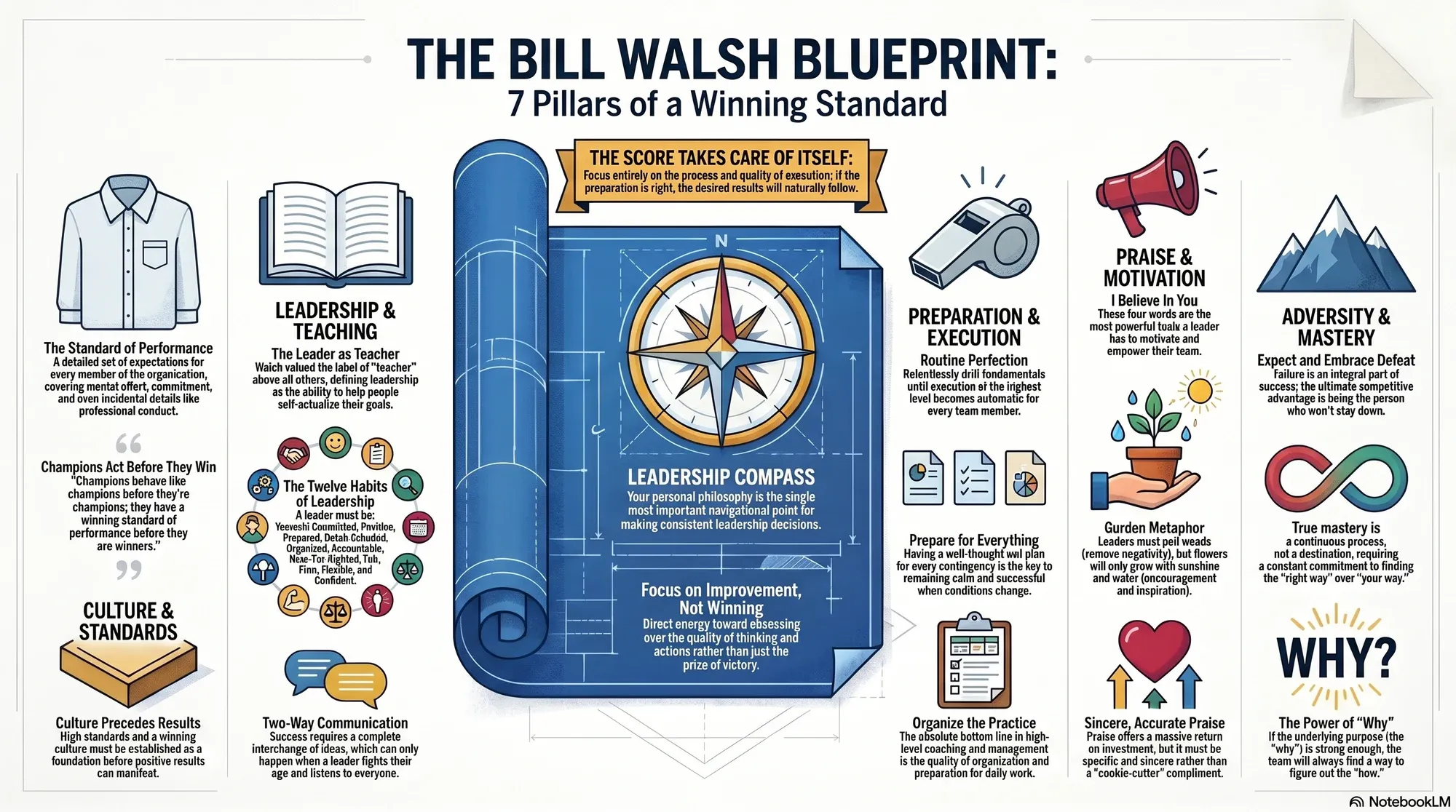
On Philosophy and Focus
- On Standards Before the Score: Walsh said his early 49ers teams worked toward a standard of performance before they could reasonably talk about winning; he saw results as following the quality of that work. — Sports Illustrated — To Baffle and Amaze (archive).
- On an Operating Philosophy: Walsh treated a coherent approach to coaching as something to examine and refine, not a slogan to announce. — Sports Illustrated — To Baffle and Amaze (archive).
- On Measurable Improvement: When the 49ers were losing, Walsh talked with the team about raising its standards and improving its play rather than fixating on the next final score. — Sports Illustrated — To Baffle and Amaze (archive).
On Culture and Standards
- On Explicit Practice Expectations: Walsh wanted each practice activity to have a clear purpose, the relevant skill explained, and players focused on what the drill was meant to improve. — Journal of Excellence — Quality Practice Interview.
- On Peer-Enforced Standards: Walsh said demanding teammates can reinforce a team standard; he recalled Ken Norton asking scout-team players to reset and execute properly. — Journal of Excellence — Quality Practice Interview.
- On Addressing Lapses in Focus: When a player lost concentration, Walsh favored noticing the lapse and pushing him back toward the required effort, often with support rather than ridicule. — Journal of Excellence — Quality Practice Interview.
On Leadership and Teaching
- On Coaching as Teaching: Walsh described a coach’s job as designing an environment where players understand the skills they are practicing and can learn to execute them. — Journal of Excellence — Quality Practice Interview.
- On Self-Examination: Walsh described repeatedly questioning his own coaching judgments, even after success, rather than assuming that a winning method could not be improved. — Sports Illustrated — To Baffle and Amaze (archive).
- On Flexing the System to the Player: Walsh said a coach should adapt the offense to the players available; he would not ask every quarterback to play like Montana or Young. — ESPN — Walsh on Adapting an Offense.
- On Competence Before Declaration: Walsh argued that players gain confidence in a leader through sound decisions and demonstrated command of the work, not assertions of authority. — Sports Illustrated — To Baffle and Amaze (archive).
- On Creating Confidence: Walsh said a coach can help athletes focus by making the activity meaningful and giving them a setting in which they can improve rather than practice in fear. — Journal of Excellence — Quality Practice Interview.
- On Two-Way Communication: Walsh wanted ideas and information to move through the team, including from players to coaches, rather than only from the top down. — Sports Illustrated — To Baffle and Amaze (archive).
- On Listening Past Ego: Walsh connected effective team communication with a leader’s willingness to resist ego and listen to others. — Sports Illustrated — To Baffle and Amaze (archive).
- On Human Dignity: Walsh explicitly placed human dignity at the center of his leadership approach and linked it to genuine communication across the team. — Sports Illustrated — To Baffle and Amaze (archive).
- On Designing the Learning System: Walsh put responsibility on coaches to identify needed skills, choose appropriate drills, and explain how those drills connect to game demands. — Journal of Excellence — Quality Practice Interview.
- On Opening Coaching Opportunities: The 49ers’ institutional history records Walsh hiring Black assistants outside the NFL’s customary network and helping expand their paths into coaching. — 49ers Museum — Walsh and Harry Edwards.
On Preparation and Execution
- On Rehearsing Contingencies: Walsh included recurring game situations and foreseeable contingencies in the practice plan so players could respond from rehearsal. — Journal of Excellence — Quality Practice Interview.
- On Organizing Practice: Walsh expected a knowledgeable coach to know the specific purpose of every minute of practice, rather than fill time with conditioning alone. — Journal of Excellence — Quality Practice Interview.
- On Preparation and Spontaneity: Walsh said solid preparation gave a team more room to adapt spontaneously; improvisation worked best on top of a rehearsed foundation. — Christian Science Monitor — What It Takes to Win.
- On Studying the Opponent: Walsh asked teams to study opponents’ tendencies and rehearsed responses, not merely perfect their own routines in isolation. — Journal of Excellence — Quality Practice Interview.
- On Game-Like Repetition: Walsh wanted repeated practice at game-like speed so techniques and responses became more reliable under competition. — Journal of Excellence — Quality Practice Interview.
- On Developing Less-Ready Players: Walsh counted developing players who were not yet game-ready among the explicit purposes of practice, rather than spending all attention on stars. — Journal of Excellence — Quality Practice Interview.
On Praise and Motivation
- On Supportive Correction: Walsh said athletes who eased off often needed reminders and support, not criticism or ridicule alone. — Journal of Excellence — Quality Practice Interview.
- On Building Belief Through Preparation: Walsh observed that athletes who know they have prepared well can compete more confidently against comparable opponents. — Journal of Excellence — Quality Practice Interview.
- On Specific Feedback: Walsh emphasized correcting specific techniques and recognizing actual improvement rather than relying on undirected exhortation. — Journal of Excellence — Quality Practice Interview.
- On Raising the Floor: Walsh paid attention to athletes who were falling short in practice and tried to lift their effort to the team standard through active coaching. — Journal of Excellence — Quality Practice Interview.
- On Practice Energy: Walsh wanted focus, communication and enthusiasm to circulate among players, with the coach creating a setting where that energy supported learning. — Journal of Excellence — Quality Practice Interview.
On Adversity and Resilience
- On Holding Standards During Losses: Walsh recalled that the 49ers kept working to raise their standards through an eight-game losing streak even when the immediate results were discouraging. — Sports Illustrated — To Baffle and Amaze (archive).
- On Progress That Is Hard to See: Looking back on the 1980 skid, Walsh said the team was maturing and raising its standards even when the losses made progress difficult to recognize. — Sports Illustrated — To Baffle and Amaze (archive).
- On Composure Under Pressure: Walsh argued that pressure games reward preparation and sound decisions more than emotional speeches or attempts to summon extra intensity. — Christian Science Monitor — What It Takes to Win.
On Mastery and Success
- On Continuing Skill Development: Walsh wanted practice to keep improving specific techniques, rather than become a rote exercise after a player learned the basics. — Journal of Excellence — Quality Practice Interview.
- On Matching Method to Talent: Walsh said coaches should adapt tactics to a player’s abilities; the same skill may be taught differently to players with different strengths. — Sports Illustrated — To Baffle and Amaze (archive).
- On Mentorship That Lasts: In an NFL remembrance, Joe Montana said Walsh was among the most influential people in his life, a narrower supported account than the old unverified quotation. — NFL — Joe Montana Remembers Walsh.
- On Revising a Favored Approach: Walsh’s willingness to question his methods and listen to others made improvement more important than defending a preferred way of doing things. — Sports Illustrated — To Baffle and Amaze (archive).
- On Explaining the Why of Practice: Walsh said athletes focused better when they could see how a drill related to an upcoming game; activity for its own sake risked losing their attention. — Journal of Excellence — Quality Practice Interview.
- On Introspective Innovation: Walsh linked coaching innovation to introspection: develop ideas, examine the variables and keep looking for better answers. — Pro Football Hall of Fame — Bill Walsh.
On Personal Growth and Character
- On the Value of a Mentor: Walsh credited his former coach Bob Bronzan with shaping his approach and remembered seeking guidance when he doubted his own path. — Sports Illustrated — To Baffle and Amaze (archive).
- On Enjoying the Work of Improvement: Walsh believed some athletes find intrinsic satisfaction in practicing a skill better, beyond the external reward of a win. — Journal of Excellence — Quality Practice Interview.
- On Confidence Without Self-Absorption: Walsh distinguished confidence that helps athletes perform from self-orientation that makes a player harder to coach or less respectful of opponents. — Journal of Excellence — Quality Practice Interview.
Learn more:
- Sports Illustrated — To Baffle and Amaze (archive)
- Christian Science Monitor — What It Takes to Win
- Journal of Excellence — Quality Practice Interview
- Pro Football Hall of Fame — Bill Walsh
- 49ers Museum — Walsh and Harry Edwards
- ESPN — Conversation with Bill Walsh
- ESPN — Walsh on Adapting an Offense
- NFL — Joe Montana Remembers Walsh