Sachin and Binny Bansal started Flipkart as an online bookstore in Bengaluru in 2007 and developed it into a major Indian e-commerce company. Their direct interviews describe how they tackled early customer distrust, delivery constraints and later scaling challenges. — India Today Founders Interview.
Their accounts differ by speaker and by stage of the company: both did the initial work, then developed different responsibilities as Flipkart grew. — India Today Founders Interview.
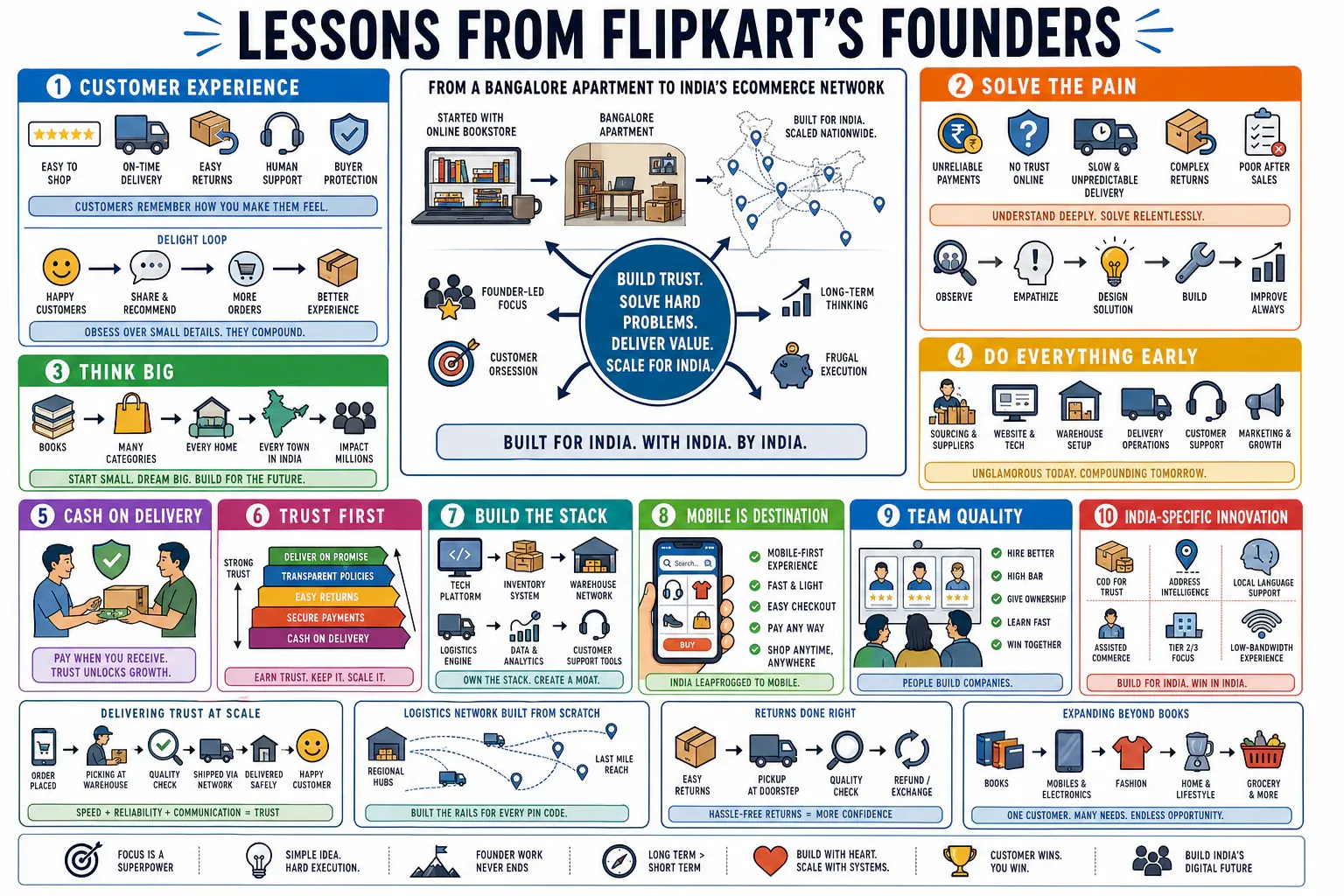
On Ambition, Vision, and Getting Started
- On Starting With a Customer Problem: Sachin said the founders abandoned a comparison-shopping idea after finding too few Indian sites to compare, then asked whether they could offer customers better service themselves. — VCCircle Founders Conversation.
- On Making Customer Experience the Core: Binny said customer experience became a top-level metric at Flipkart; the company initially focused on doing book orders well before expanding categories. — India Today Founders Interview.
- On Letting Ambition Grow With Evidence: Sachin and Binny said they did not start with a fixed grand revenue forecast: their view of the opportunity expanded as the business and market became clearer. — India Today Founders Interview.
- On Doing the Early Work Yourself: The founders recalled collecting ordered books from distributors and packing them personally while the company was small. — India Today Founders Interview.
- On Raising the Hiring Bar: Sachin said building strong teams and keeping a high talent bar were among the most important lessons he carried from Flipkart to Navi. — Moneycontrol Sachin Bansal Interview.
- On Sharing Every Job at the Start: Sachin said both founders initially packed orders and wrote software; distinct CEO and COO roles came later as the business grew. — India Today Founders Interview.
On Building for the Indian Market
- On Cash on Delivery as Access: Sachin said cash on delivery brought in people without cards or comfort using them for online purchases; Binny described it as removing a major barrier. — India Today Founders Interview.
- On Building Missing Logistics: Binny said Flipkart launched cash on delivery with its own logistics after finding that existing service and payment habits did not support higher-priced electronics. — CNBC Binny Bansal Interview.
- On Earning Trust Through Service: Sachin linked cash on delivery, in-house logistics and a replacement policy to making online shopping more reliable for wary customers. — Frontline Sachin Bansal Interview.
- On Mobile-First, Not App-Only: Sachin argued that smartphone growth required a mobile mindset. The company’s app-only push was a period strategy rather than a universal rule; Flipkart also maintained a mobile website. — ET Brand Equity Mobile Remarks.
On Strategy, Competition, and Scaling
- On Bringing New Customers Online: Sachin said the challenge was to bring more Indians from offline shopping to a reliable online experience, rather than assume they would adopt it automatically. — Frontline Sachin Bansal Interview.
- On Technology as a Scaling Tool: Binny credited a technology-first approach across marketing, supply chain and pricing for helping Flipkart scale beyond manual processes. — CNBC Binny Bansal Interview.
- On Using Data to Plan Inventory: Binny described combining customer purchase history with external signals to forecast inventory and make better buying decisions. — India Today Founders Interview.
- On Choosing Patient Capital: Binny explained that Walmart offered long-term strategic capital so Flipkart could invest in supply chain, innovation and talent without repeated fundraising cycles. — Code Commerce Binny Bansal Interview.
Post-Flipkart Learnings
- On Simplifying Financial Services: Sachin said Navi aimed to use in-house technology to make financial products more accessible, affordable and easier for customers to understand. — CNBC-TV18 Sachin Bansal Interview.
- On Helping Startups Through Scaling: Binny said xto10x grew from seeing different startups encounter similar team and operating problems after the initial product-building phase. — CNBC Binny Bansal Interview.
- On Building for the Long Term: Sachin said he had never intended to sell Flipkart and approached Navi as a project to build over decades, not as a quick exit. — Moneycontrol Sachin Bansal Interview.
- On Investing in Founders and Impact: Binny said he looked at entrepreneurs’ motivations and whether their ideas could create transformative impact, including in fields with long development cycles. — Times of India Founders Interview.
- On Innovating Within Financial Rules: Sachin said financial regulation protects customers’ money; Navi would have to innovate inside those boundaries while engaging regulators. — CNBC-TV18 Sachin Bansal Interview.
- On Giving Back to New Founders: Binny called investing in and helping startups a way to give back to the Indian ecosystem; Sachin also emphasized sharing experience with entrepreneurs. — Times of India Founders Interview.
On Partnership, Culture, and Mindset
- On Complementary Founder Styles: The founders said they initially shared work, then developed different strengths: Binny described Sachin as more intuitive and himself as more analytical, with common values. — India Today Founders Interview.
- On Ownership for Early Leaders: Binny advised young startups to hire a few complementary leaders with real founder-like responsibility, motivation and meaningful equity. — Times of India Founders Interview.
Additional Key Learnings
- On Capital as One Input: Binny said capital mattered but was not the only competitive factor; Flipkart also needed to execute in talent and innovation. — Code Commerce Binny Bansal Interview.
- On Building Trust in Each Interaction: Sachin described dependable delivery, replacement policies and customer support as the practical work behind a trustworthy online retail brand. — Business Standard Sachin Bansal Interview.
- On Logistics as Differentiation: Binny said eKart began because external delivery capacity broke down, and later its reach and customer-satisfaction advantage differentiated Flipkart. — Code Commerce Binny Bansal Interview.
- On Building Before Fundraising: Sachin recalled that early attempts to raise money went nowhere, so the founders stopped attending startup events and focused on building the business. — VCCircle Founders Conversation.
- On Simplifying Financial Decisions: Sachin framed Navi’s challenge as making financial products understandable enough for an ordinary customer, including his mother, to make informed choices. — CNBC-TV18 Sachin Bansal Interview.
- On Learning From Mistakes: Sachin said the useful response to an advertising or operating error is to understand it, change the work, and avoid repeating it. — Business Standard Sachin Bansal Interview.
- On Choosing What Matters to Customers: Binny described asking which activities actually created customer value, including whether to run servers or redeploy engineers to customer-facing work. — FactorDaily Binny Bansal Interview.
- On Customers Before Competitors: Binny said Flipkart tried to make decisions from the customer’s point of view rather than simply follow competitors’ moves. — India Today Founders Interview.
- On Opportunity Beyond Commerce: Sachin identified healthcare and education as promising fields where internet tools had made relatively little impact and where new products could matter. — Times of India Founders Interview.
- On Evolving the Founder’s Role: The founders said their focus had to move from daily execution toward strategy as Flipkart grew; Binny later stressed self-awareness to keep growing as a leader. — Economic Times Founders Account.
- On Living the Culture Daily: Sachin said core values lose force when leaders make exceptions; Flipkart tried to live customer obsession, excellence and meritocracy in daily decisions. — Business Standard Sachin Bansal Interview.