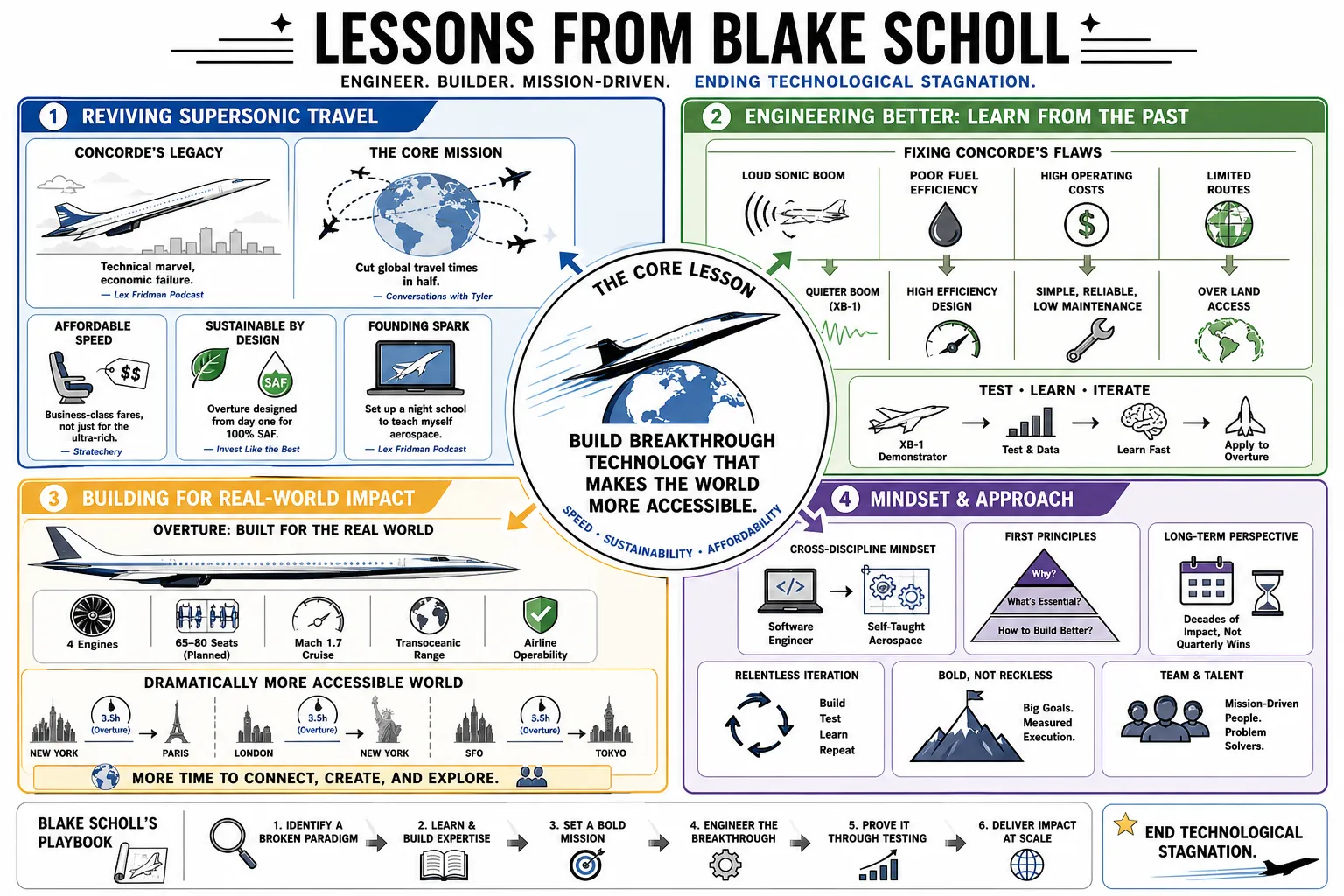
Lessons from Blake Scholl
Blake Scholl is the founder of Boom Supersonic, an aerospace company building a commercial airliner designed to fly twice as fast as today's passenger jets. A former software engineer, he taught himself aerospace engineering to fix the economic and technical flaws that grounded the Concorde. This profile covers his approach to hardware development and his push to end technological stagnation.
Part 1: Reviving Supersonic Travel
- On the Concorde's legacy: "Concorde was a technical marvel, but an economic failure that airlines couldn't afford to operate." — Source: Lex Fridman Podcast
- On the core mission: "The goal of Boom is to make the world dramatically more accessible by cutting global travel times in half." — Source: Conversations with Tyler
- On ticket prices: "If supersonic flight is only for the ultra-rich, it is a niche novelty. We have to design an aircraft that airlines can fly profitably at business-class fares." — Source: Stratechery
- On fuel efficiency: "To bring back supersonic travel responsibly, we had to design Overture from day one to operate on 100% sustainable aviation fuel." — Source: Invest Like the Best
- On the founding spark: "I set up a news alert for supersonic flight startups, waiting for someone to solve the problem. When no one did, I realized I had to start it myself." — Source: Y Combinator Startup Podcast
- On route economics: "Airlines buy planes for unit economics. The aircraft must generate better returns than subsonic alternatives." — Source: Stratechery
- On transoceanic routes: "The sweet spot for supersonic commercial travel is over water, where we can fly Mach 1.7 without sonic booms disturbing populated areas." — Source: The Shawn Ryan Show
- On the Symphony engine: "When the legacy engine manufacturers failed to meet our requirements on our timeline, the only logical step was to design and build our own propulsion system." — Source: Conversations with Tyler
- On Overture's design: "We optimized the fuselage for aerodynamics and passenger comfort, recognizing that a narrower cabin reduces drag and enables faster speeds." — Source: Lex Fridman Podcast
- On long-term passenger volume: "Ultimately, we want to scale production and efficiency until supersonic flight is available for the price of today's economy tickets." — Source: Invest Like the Best
Part 2: The Stagnation of Transportation
- On technological retreat: "Unlike every other form of technology, we simply gave up on going faster. It was as if someone decided that air travel should not exceed the speed of sound." — Source: The Shawn Ryan Show
- On aviation's lost decades: "We traded speed for marginal improvements in fuel efficiency and cabin amenities, ignoring the most valuable resource a traveler has: time." — Source: Medium/Flux Podcast
- On the 1970s mindset: "The aviation industry accepted the Concorde's retirement as proof that supersonic commercial flight was inherently flawed, rather than a first draft that needed iteration." — Source: Mike Rowe Podcast
- On institutional inertia: "Large aerospace primes are incentivized to build derivative aircraft because clean-sheet designs introduce financial risk to their existing monopolies." — Source: Stratechery
- On the failure of imagination: "When you accept the current speed of a Boeing or Airbus as a law of physics, you stop looking for the aerodynamic and material breakthroughs that allow you to go faster." — Source: Conversations with Tyler
- On breaking the speed limit: "There is no fundamental physical reason we cannot travel across the Pacific in four hours; it is purely an engineering and economic challenge." — Source: Lex Fridman Podcast
- On societal ambition: "We used to build things that pushed the boundaries of human capability. Returning to supersonic flight is a way to reclaim that ambition." — Source: Invest Like the Best
- On incrementalism: "You cannot get to Mach 1.7 by making a standard jet five percent better every year. It requires a fundamental reset of the airframe." — Source: Y Combinator Startup Podcast
- On the cost of slowness: "The hidden tax on the global economy is the days lost to transpacific and transatlantic travel, separating families and slowing down business." — Source: The Shawn Ryan Show
Part 3: First-Principles Engineering
- On self-education: "I did not have an aerospace degree, so I downloaded textbooks, studied aerodynamics, and built mathematical models until the physics made sense." — Source: Y Combinator Founder Stories
- On questioning assumptions: "Whenever someone says that is how it has always been done in aerospace, you have to dig down to the foundational physics to see if the constraint is real." — Source: Lex Fridman Podcast
- On aerodynamics: "The shape of a supersonic aircraft is dictated strictly by the air; you do not get to design it to look cool, it looks cool because the physics require it." — Source: Mike Rowe Podcast
- On carbon composites: "We can build Overture today because carbon fiber composites allow us to create lighter, stronger airframes that handle thermal stress far better than the Concorde's aluminum." — Source: Conversations with Tyler
- On engine development: "Designing a bespoke engine requires stripping away legacy supply chain assumptions and asking what a purely optimized supersonic propulsion unit looks like today." — Source: Stratechery
- On computational fluid dynamics: "Modern computing power allows us to run millions of wind tunnel simulations digitally, finding aerodynamic efficiencies that were mathematically impossible to discover in the 1960s." — Source: Invest Like the Best
- On problem decomposition: "You take the massive problem of building a faster plane and break it down into thrust, drag, weight, and fuel consumption, solving each independently." — Source: Y Combinator Startup Podcast
- On thermal management: "Flying faster than sound generates immense friction. The engineering challenge shifts from standard lift to managing the heat load across the leading edges." — Source: Reddit Aviation AMA
- On safety by design: "First principles in aviation always lead back to redundancy. You design systems where multiple independent failures still result in a safe landing." — Source: Lex Fridman Podcast
- On the designer-engineer synthesis: "I think you get the best results when you've got designers that think like engineers and engineers that think like designers, and then just hold a very high bar." — Source: Conversations with Tyler
Part 4: Building Hardware Like Software
- On iteration costs: "If you want to move fast in hardware, you must aggressively reduce the financial and temporal cost of trying a new idea." — Source: Invest Like the Best
- On software-defined hardware: "We integrate software engineers directly into our hardware teams because modern aerospace design is fundamentally a computational problem." — Source: Medium/Flux Podcast
- On moving past spreadsheets: "Traditional aerospace relies on laborious manual processes and massive spreadsheets. We build software tools to automate the rote engineering work." — Source: Conversations with Tyler
- On rapid prototyping: "You learn more from flying a sub-scale demonstrator like the XB-1 than you do from another year of purely theoretical whiteboard planning." — Source: Lex Fridman Podcast
- On feedback loops: "Software development taught me the value of the tight feedback loop. We apply that to hardware by simulating rigorously before we bend metal." — Source: Y Combinator Startup Podcast
- On cross-disciplinary teams: "A great software engineer can look at a fluid dynamics problem and find an algorithmic optimization that a traditional aerospace engineer might miss." — Source: Stratechery
- On continuous integration: "We treat the aircraft's design files like a codebase, using version control and continuous integration to ensure different components match up perfectly." — Source: Invest Like the Best
- On supply chain delays: "This is going to be a million dollars for one engine's worth of blades, and it's going to take six months to get them. I was like, 'Six months? What's going on for six months?'" — Source: Conversations with Tyler
- On digital twins: "Before a physical plane ever takes off, its digital twin has flown thousands of hours in simulated adverse conditions." — Source: The Shawn Ryan Show
Part 5: Startup Execution and Speed
- On founder pacing: "Life is short so if you want to do a lot, it helps to move fast." — Source: Substack Profile
- On early traction: "In the beginning, no one believed a software guy could build a jet. I had to secure letters of intent from airlines to prove the market existed." — Source: Y Combinator Founder Stories
- On capital intensity: "Building an airplane requires massive capital. You have to learn how to do financial engineering alongside aerospace engineering to keep the company funded." — Source: Stratechery
- On hiring outside aerospace: "We actively hire outside of Boeing and Airbus. We bring in engineers from SpaceX, Tesla, and software startups because they know how to work with urgency." — Source: Lex Fridman Podcast
- On surviving skepticism: "When the legacy manufacturers dismissed us, it was a massive advantage. It meant they were not going to try to outbuild us until it was too late." — Source: Invest Like the Best
- On making decisions: "In a startup, a good decision made today is infinitely better than a perfect decision made six months from now." — Source: Y Combinator Startup Podcast
- On leveraging the YC model: Boom describes its path from YC Demo Day to XB-1 as a founder lesson in de-risking hard-tech ventures and focusing on pragmatic milestones that build an audacious product step by step. — Reference: Boom FlyBy article on YC Demo Day, de-risking hard tech, and pragmatic milestones
- On resource constraints: "Having less money than a prime aerospace contractor forces you to be creative. You cannot spend your way out of a problem; you have to think your way out." — Source: Conversations with Tyler
- On momentum: "Momentum is the lifeblood of a hardware startup. If the team sees physical progress on the factory floor, they will run through walls to solve the next issue." — Source: Medium/Flux Podcast
Part 6: Overcoming Institutional Risk
- On regulatory hurdles: "You do not fight the FAA; you partner with them. You bring them data early and often so they understand the safety profile of the vehicle." — Source: Mike Rowe Podcast
- On the supplier ecosystem: "The aerospace supply chain is optimized for the duopoly. When you are a new entrant, you have to build deep relationships to convince suppliers to take a bet on you." — Source: Stratechery
- On vertical integration: "We did not want to build our own engine, but when the existing supply chain refused to meet the specs for Overture, vertical integration became the only path forward." — Source: Invest Like the Best
- On infrastructure compatibility: "We designed Overture to use existing airport infrastructure. If you require airlines to rebuild their gates to accommodate your plane, you will never sell one." — Source: Conversations with Tyler
- On environmental standards: "Meeting Chapter 14 noise requirements is non-negotiable. Supersonic aircraft must blend seamlessly into the traffic patterns of existing global hubs." — Source: Reddit Aviation AMA
- On industry skepticism: "Incumbents will always tell you that what you are trying to do is impossible, mostly because it justifies why they haven't done it themselves." — Source: Lex Fridman Podcast
- On safety culture: "In a safety-critical industry, moving fast cannot mean cutting corners on testing. It means building better systems to conduct those tests faster." — Source: The Shawn Ryan Show
- On financial engineering: "Raising capital for a deep tech aerospace company requires finding investors who understand the difference between technical risk and execution risk." — Source: Y Combinator Founder Stories
- On certification timelines: "Certification is a math equation. If you understand the exact parameters the regulators require, you can engineer the aircraft to solve that equation." — Source: Invest Like the Best
Part 7: Designing for the Passenger
- On the magic of flight: "I find the moment of takeoff deeply moving every time, even though air travel is quite routine now. No other experience gives as direct a perception of what it means to be human." — Source: Medium/Flux Podcast
- On cabin ergonomics: "At Mach 1.7, the flight is short enough that you do not need a lie-flat bed. The priority becomes a highly comfortable, productive seat with a massive window." — Source: Lex Fridman Podcast
- On the value of time: "Passengers are buying their time back. Saving three hours on a transatlantic flight is life-changing for frequent travelers." — Source: Stratechery
- On the window seat: "Every passenger on Overture gets a large window and direct aisle access. We eliminated the middle seat entirely because it degrades the travel experience." — Source: Mike Rowe Podcast
- On reducing jet lag: "When you cut flight times in half, you fundamentally change how the human body experiences time zone shifts. You arrive refreshed instead of exhausted." — Source: The Shawn Ryan Show
- On in-flight productivity: "The cabin is designed as a quiet, turbulence-reduced environment where professionals can get actual work done during the shortened flight." — Source: Conversations with Tyler
- On Steve Jobs' influence: "I frequently ask our design team, 'What would this be like if somebody who cared as much as Steve Jobs or Jony Ive had designed it?'" — Source: Conversations with Tyler
- On accessibility: "We are starting with business-class fares, but the engineering roadmap is entirely focused on driving down operational costs until anyone can afford to fly supersonic." — Source: Invest Like the Best
- On atmospheric cruising: "Flying at 60,000 feet means you are above the weather and above the standard traffic. The sky is a darker blue, and the ride is incredibly smooth." — Source: Reddit Aviation AMA
Part 8: The Long-Term Vision for Humanity
- On human progress: "Let's convert some jet fuel into human progress." — Source: Conversations with Tyler
- On global connection: "When the travel time between Tokyo and San Francisco drops to five hours, those two cities become culturally and economically linked in a way they never were before." — Source: Lex Fridman Podcast
- On adaptable skills: "Your background does not dictate your future. Knowledge and skills are adaptable and changeable, and there to support our passions." — Source: World Economic Forum
- On sustainability: "True progress means going faster without destroying the planet. Supersonic travel must scale alongside the mass production of sustainable aviation fuels." — Source: Invest Like the Best
- On the next generation: "I want my kids to grow up in a world where crossing an ocean is as routine and fast as crossing a state line." — Source: Medium/Flux Podcast
- On the end of distance: "The ultimate goal of transportation technology is to eliminate distance as a barrier to human relationships and economic trade." — Source: Y Combinator Startup Podcast
- On inspiring engineers: "We want to prove that hard hardware problems are solvable. If we can build a supersonic jet, what other impossible physical challenges can the next generation solve?" — Source: The Shawn Ryan Show
- On leaving software: YC frames Scholl as a software engineer who pivoted mid-career into aviation; in the transcript, Scholl says chasing what he already knew gave competence but not purpose, while supersonic flight gave him a mission he would not want to give up on. — Reference: YC Startup Library transcript on Scholl moving from software into aviation and choosing mission over familiar skills
- On defining the future: "The future does not happen on its own; it is built by people who refuse to accept the limitations of the present." — Source: Mike Rowe Podcast
- On the ultimate legacy: "If Boom succeeds, the geography of the earth effectively shrinks, and we expand the radius of where people can live, work, and love." — Source: Stratechery