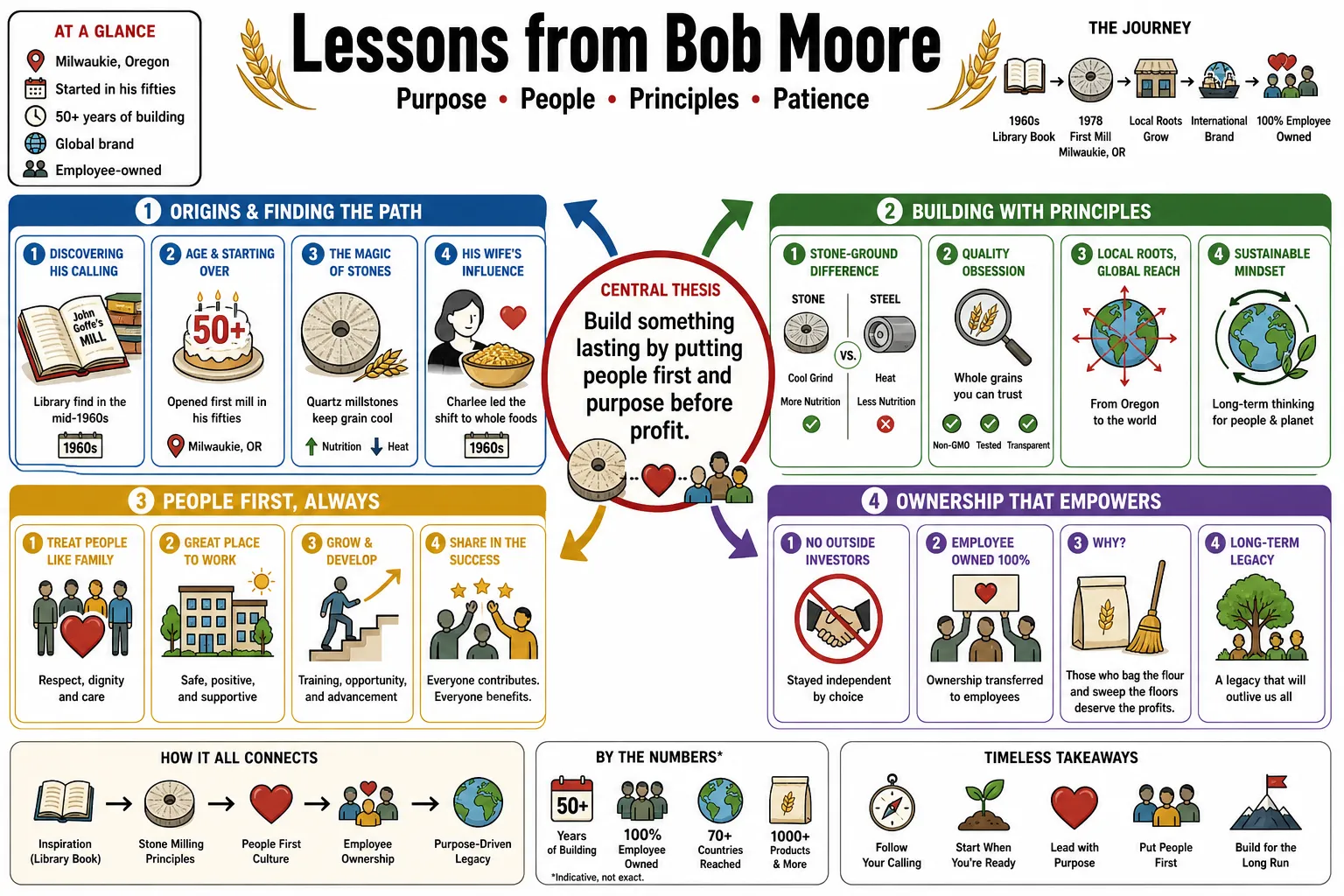
Lessons from Bob Moore
Bob Moore and Charlee built an earlier flour mill with their sons in Redding, California, before founding Bob’s Red Mill in Oregon in 1978. After decades of growth, Moore chose an employee stock ownership plan rather than an outside sale. The transition began in 2010 and reached 100% employee ownership in 2020. — Fortune Interview.
Part 1: Origins and Finding the Path
- On Discovering His Calling: Reading John Goffe’s Mill at a library drew Moore toward stone milling; he pursued used equipment and eventually opened his first mill in Redding with Charlee and their sons. — Culinate Interview.
- On Starting Later: Moore established Bob’s Red Mill in Oregon in 1978 after an earlier automotive career, a first family mill in Redding, and a move north for seminary study. — Culinate Interview.
- On Stone Milling: Moore used traditional quartz millstones to grind whole grains while retaining their bran, germ and endosperm; he said the slow-turning stones helped avoid overheating. — Culinate Interview.
- On Charlee’s Influence: Charlee Moore’s interest in feeding their family whole grains helped shape the milling business Bob later built with her. — Whole Grains Council Interview.
- On Finding the Millstones: Moore searched for old milling equipment and bought three sets of millstones in North Carolina for the family's California mill. — Whole Grains Council Interview.
- On Returning From Retirement: After leaving the Redding mill to their sons, Bob and Charlee moved to Oregon so he could pursue seminary studies. An old mill there drew them back into grain milling. — Acres U.S.A. Interview.
- On Naming the Red Mill: Moore said the “Red Mill” name came from red mills he had seen during his travels. After leasing the Oregon building, he repaired and painted it red. — Culinate Interview.
- On Being the Face of the Brand: Moore put his portrait on the package because he wanted customers to know who made the food. He later laughed that people were surprised to learn there really was a Bob. — Whole Grains Council Interview.
- On Building the First Mills: The Redding mill began with Bob, Charlee and two sons; later, their Oregon operation started small, used newspaper ads, and expanded through local customers and retail partnerships. — Whole Grains Council Interview.
Part 2: The Philosophy of Employee Ownership
- On Employee Ownership: Moore said long-serving employees deserved a stake in the company they helped build, so he pursued an employee stock ownership plan instead of selling to an outside buyer. — Fortune Interview.
- On Choosing the ESOP: Moore and his partners signed the ESOP agreement on his 81st birthday in 2010, beginning with an employee stake of about one-third of the company. — Fortune Interview.
- On Money and Ownership: Moore argued that more companies could share ownership with employees, but many owners put their own financial return first. — Fortune Interview.
- On Shared Stakes: Moore said that stock ownership gave employees a financial interest in the company's performance, on top of an earlier profit-sharing program. — Rho MarketFit Interview.
- On Money and Purpose: Moore valued having enough money to travel and live comfortably, but said a successful life also needed a purpose beyond accumulating more. — Fortune Interview.
- On Valuing Workers: Moore linked employee ownership to his responsibility toward the people who kept the mill running, saying he wanted them to have secure jobs after he was gone. — Eating Rules Interview.
- On Completing the Transfer: The ESOP reached 100% employee ownership on April 30, 2020, ten years after the initial 2010 agreement. — Fortune Interview.
Part 3: People and Respect
- On the Golden Rule: Moore said the golden rule—treating others as he wished to be treated—guided his approach to employees and to business. — Rho MarketFit Interview.
- On People Before Money: Moore said people should come before money, while acknowledging that profit was needed to keep the business and its jobs going. — Rho MarketFit Interview.
- On Farmers and Suppliers: The company's stated early mission included building close relationships with farmers and suppliers alongside providing whole-grain food to customers. — Bob’s Red Mill Founders’ Story.
- On Employee Attitude: Moore believed that hiring honest people, treating them fairly and sharing profits helped employees feel part of the company and shaped how customers experienced it. — Whole Grains Council Interview.
- On Discussing Failures: Moore described a weekly staff meeting where leaders reviewed both a success and a failure from the previous week, making setbacks part of shared operational discussion. — The Kitchn Interview.
- On Staying Accessible: A firsthand 2014 profile observed Moore strolling the aisles of his store and talking with customers and employees rather than remaining only at his desk. — George Fox Journal Profile.
- On Useful Work: Moore hoped his work would be fruitful and beneficial to other people, a purpose he tied to making whole-grain food. — Whole Grains Council Interview.
- On Profit Sharing Before Ownership: Before introducing the ESOP, Moore developed a formula for paying employees a share of profits in separate checks when the business could afford it. — Rho MarketFit Interview.
- On Doing Business Ethically: Moore said a company could succeed by making a good product, hiring honest people, sharing profits, and treating others fairly. — Whole Grains Council Interview.
- On Knowing Employees: Moore tried to remain acquainted with employees, celebrating birthdays and building personal relationships even as growth made that harder. — Rho MarketFit Interview.
Part 4: Real Food and Nutrition
- On Whole Foods: Moore preferred minimally processed whole grains and said he wanted customers to be able to buy foods that retained the grain's natural components. — Eating Rules Interview.
- On Food Trends: Although the business developed a substantial gluten-free product line, Moore continued to express his personal commitment to whole grains rather than treating every food trend as a reason to change his core mission. — Portland Monthly Interview.
- On Oatmeal: Moore said he ate oatmeal regularly for breakfast, often adding flaxseed meal. — Eating Rules Interview.
- On Enjoying Simple Food: When asked whether he had tired of eating oatmeal for decades, Moore said he still enjoyed good food; simple grain dishes remained pleasurable to him. — CBS News Interview.
- On Gluten-Free Oats: When customers with gluten intolerance asked for suitable products, Moore began keeping grains without wheat, rye or barley separate, later developing a substantial gluten-free line. — Food Republic Interview.
- On Gluten-Free Grain Variety: Moore said the company used grains such as amaranth, buckwheat, quinoa and sorghum in its gluten-free products, adapting its product range to customer demand. — Acres U.S.A. Interview.
Part 5: Navigating Adversity
- On the 1988 Fire: An arson fire destroyed the old wooden mill in 1988. Moore was nearing 60 and briefly considered retirement, but he and Charlee chose to rebuild. — Bob Moore’s Oregon Business Essay.
- On Restarting Quickly: After the fire, Moore kept some production going at the family's earlier Redding mill, found temporary space within days, and then secured a larger site. — Acres U.S.A. Interview.
- On Community Support: Employees, suppliers and customers urged the Moores to keep supplying grain after the fire; Fred Meyer offered to hold its retail opening for about three months while they rebuilt or relocated. — Bob Moore’s Oregon Business Essay.
- On Financial Risk After the Fire: Moore said the 1988 blaze left the business financially depleted—his second experience of going broke—and taught him that he could recover from a severe setback. — The Kitchn Interview.
- On Saving the Millstones: The 1988 fire destroyed the building but the old millstones survived, allowing Moore to reuse a core part of the original operation as he re-established production. — Culinate Interview.
- On Turning Disaster Into Growth: Moore later saw the rebuilding as a chance to move into a larger facility, which expanded production beyond the cramped old mill. — Whole Grains Council Interview.
- On Pandemic Demand: In a 2020 interview, Moore said the mill was operating around the clock to meet unusually strong demand for flour and baking ingredients during the early pandemic. — Rho MarketFit Interview.
- On Choosing to Continue: Moore acknowledged considering retirement for a couple of days after the fire. A young miller whose family had just bought a house helped convince him that employees were depending on the business to survive. — Acres U.S.A. Interview.
Part 6: Wealth and Greed
- On More Than a Face on the Package: Moore wanted employees—including those working far from Oregon—to see the milling and packaging operation and feel connected to the work behind the brand. — Rho MarketFit Interview.
- On Enjoying Success: Moore said business success let him enjoy a comfortable home and travel; his concern was not having money, but letting money replace purpose. — Fortune Interview.
- On a Wider Responsibility: Moore said business success gave him the means and responsibility to help his community rather than keep every dollar for himself. — Rho MarketFit Interview.
- On the Risk of Selling: Moore worried that an outside acquirer with no existing relationship to the staff could make decisions without regard to the employees he knew. — Acres U.S.A. Interview.
- On Making Employee Ownership Work: Moore viewed an ESOP as a workable succession path for a solvent company, while recognizing that it required valuation, advisers and substantial expense. — Acres U.S.A. Interview.
- On the Community That Fit: Moore said Portland's size and receptive local media helped the young Oregon mill find its first customers and expand into nearby stores. — Portland Monthly Interview.
- On Durable Success: Moore treated profit sharing and employee ownership as part of a succession plan that could reward workers while keeping the company operating. — Fortune Interview.
Part 7: Daily Work and Longevity
- On Daily Routine: In his later years, Moore described arriving at the mill early, eating breakfast there, and taking part in regular cross-department and executive breakfast meetings. — Fast Company Essay.
- On Retirement: Moore said retirement held little appeal because the mill still offered him interesting work and challenges. — Acres U.S.A. Interview.
- On Keeping His Mind Engaged: Moore described reading widely and playing music as enjoyable habits; he personally believed sight-reading music helped keep his mind sharp. — Bon Appétit Interview.
- On Hard Times and Perspective: Moore said earlier business failures gave him perspective that made later good periods feel more precious. — Rho MarketFit Interview.
- On Remaining Involved: After giving up day-to-day CEO duties, Moore remained the company’s president and was still going to work regularly into his nineties. — Fortune Interview.
- On the Sound of the Mill: Moore recalled loving the rhythm of the original wooden mill when its millstones were running together. — Culinate Interview.
Part 8: Legacy and Giving Back
- On Nutrition Philanthropy: Bob and Charlee Moore gave $5 million to Oregon State University to establish a center for whole-grain nutrition research and outreach. — Oregon State Gift Announcement.
- On the Purpose of Their Giving: The Moores used proceeds from the employee-ownership transition to support nutrition programs and research aimed at improving family and child health. — Eating Rules Interview.
- On Charlee’s Shared Legacy: Charlee was a cofounder of the company and a partner in its major Oregon nutrition gifts; the OHSU institute bears both Bob’s and Charlee’s names. — OHSU Natural Partnership.
- On Community Nutrition Education: Bob and Charlee gave $1.35 million to the then-National College of Natural Medicine for community nutrition workshops and a teaching/research kitchen. — NUNM Gift Announcement.
- On Building It Together: Moore repeatedly credited Charlee, their sons and the employees whose work helped the milling business grow, rather than describing the company as his achievement alone. — Whole Grains Council Interview.
- On Planning for Continuity: Moore said employee ownership was a way to keep the company from passing to a large buyer after his death while preserving jobs for the people who had built it. — Eating Rules Interview.
- On Tangible Employee Benefits: In a CBS interview, employee Dave Geiter said his ownership stake helped him put his children through college—one concrete example of the benefit Moore hoped employee ownership would provide. — CBS News Interview.
- On Food and Fairness: Moore said the business aimed to make whole grains accessible to more people at reasonable prices. — OHSU Natural Partnership.