Boris Wertz is the founding partner of Version One Ventures in Vancouver. Before becoming an investor he was COO of AbeBooks.com, which Amazon acquired in 2008, and Andreessen Horowitz named him a board partner in 2014. — Business Insider author profile: Boris Wertz.
The Founder’s Operating System
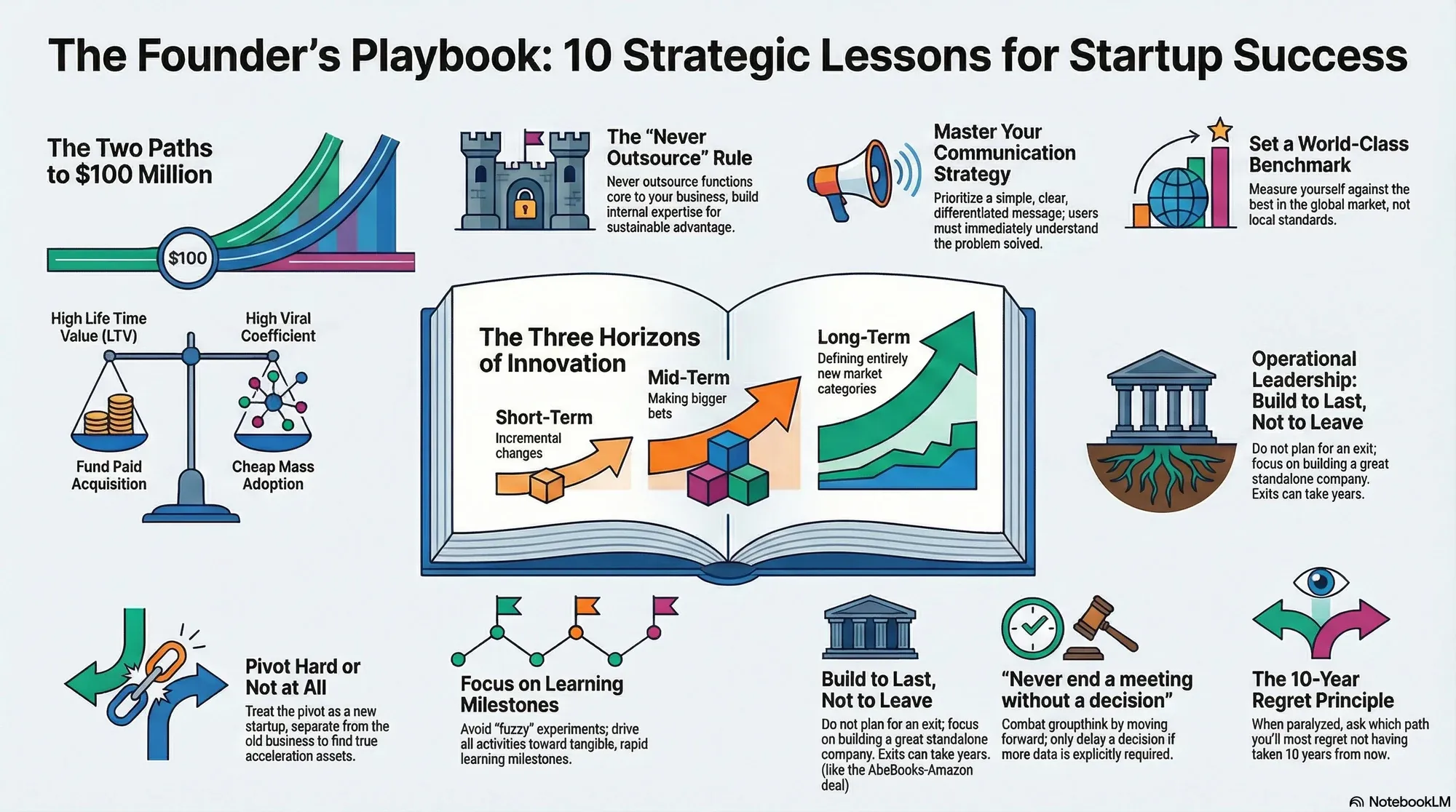
- On Scaling to $100 Million: "Generally speaking, there are two ways (and only two ways) to scale a business to hit that $100 million threshold: Your business has a high Life Time Value (LTV) per user, giving you the freedom to spend a significant amount of money in customer acquisition. High LTV can usually be found in transactional or subscription businesses. Your business has a high viral co-efficient (or perhaps even a network effect) that lets you amass users cheaply without worrying too much about the monetization per user or spending money on paid acquisition." — Boris Wertz, "The only 2 ways to build a $100 million business" (Medium).
- On Protecting the Core: Version One's advice for seed-stage companies: "we never recommend outsourcing unless it's for an ancillary area or a one-time task. You never, ever want to outsource your core… by doing so, you fail to build the expertise in your own company. And you can't build a great company on an outside agency's stuff." — Version One Ventures: "So you just raised your seed round, now what?".
- On Learning Through Experiments: "Too many start-ups fall into the pitfall of running experiments for the sake of running them, and then never actually learn anything since the parameters were too fuzzy. Drive your activities toward reaching tangible learning milestones…as many as possible, as fast as possible." — Version One Ventures: "How to really learn from your experiments".
- On Long-Term Vision: Wertz writes: "To be wildly successful, you cannot sacrifice your long-term vision for short-term success just as you can't sacrifice your current product and customer base for your long-term vision." He frames innovation across three horizons: incremental improvements, bigger mid-term bets, and long-term breakthroughs that define a new market category. — Version One Ventures: "Why you need to innovate on three horizons".
- On Pivoting Decisively: "Course changes happen all the time and can lead to brilliant things. But when pivoting, you need to completely separate your old and new businesses. Approach your pivot as if it were a completely new startup. Then see which pieces of your current setup (people, product, etc.) can potentially help you accelerate the new opportunity." — Version One Ventures: "If you need to pivot, pivot hard".
- On World-Class Standards: "The entrepreneurs who succeed always have a unique perspective as to what is world-class — they don’t limit their perspective to what is best in Canada. It’s a super-important benchmark to always have in mind. Today you have a worldwide market. There are no national barriers any more." — Canadian Business: "Why Version One founder Boris Wertz tells Canadian entrepreneurs to look abroad" (2014, archived 2018).
- On Decisive Meetings: Wertz writes: "One key message that can apply to any start-up is to never end a meeting without a decision (unless everyone determines that more data is needed to make that decision). If a meeting begins to succumb to groupthink and indecision, you need to ask why we can't make a decision today instead of another day." — Inc.: "3 Rules to Scale Your Business".
- On Regret-Minimizing Decisions: Wertz writes: "Here's the principle that I've really started to embrace. Ask yourself: If you look back at this decision 10 years from now, which path will you most regret not taking?" — Inc.: Boris Wertz, "How to overcome decision paralysis".
- On Stubborn Vision: "You need a clear vision of where you want to go and the values that will guide you towards that place. You need to be opportunistic (aka flexible) when it comes to all the details of how to get there." — Version One Ventures
- On Pre-PMF Restraint: Experienced founders can undermine their own flexibility by raising too much and building a large team before product-market fit, making necessary pivots much harder. — The Neon Show: Lessons From 25 Years of Investing
Venture Craft and Outlier Investing
- On Founder Conviction: "We never had much success when we had more conviction about the business than the founders." — Techcouver
- On Expanding Technology Markets: "Everyone (investors and founders alike) has underestimated the size of the addressable market for tech over the past decade." — Version One Ventures
- On Venture’s Capital Flywheel: "Increased returns will attract more capital to venture as an asset class... The world has its fair share of problems that we need to tackle and technology can play an important role in it. More dollars available for those venture opportunities means more and quicker progress!" — Version One Ventures
- On Venture Time Horizons: Wertz says early-stage venture is slow to pay: Version One's 2012 fund one is 12 years in, paid back the fund more than once mostly in the last couple of years, and still has "another at least two or three years left," which he sums up as "15 years until the portfolio is fully developed." — The Neon Show: Lessons From 25 Years of Investing.
- On Investor Taste: Portfolio construction can be improved over time, but an investor’s taste for exceptional founders and unusual outlier opportunities is much harder to teach. — The Neon Show: Lessons From 25 Years of Investing
- On Continuous Reinvention: Success as a generalist investor requires a constant willingness to rebuild one's networks and knowledge base from scratch to find the next major shift. — Version One Ventures Blog
- On Staying Open to Outliers: Despite having defined focus areas, a firm must leave space for extraordinary founders who are building completely outside of the firm's current theses. — Version One Ventures Blog
Building Canada’s Innovation Economy
- On Strategic National Focus: A smaller country should change its playbook and concentrate on sectors where it has real structural advantages instead of trying to lead in every field. — RBC Disruptors: Canada’s Tech Growth Challenge
- On Commercializing Research: Producing world-class research is not enough; an ecosystem must also turn that research into companies and scale them. — RBC Disruptors: Canada’s Tech Growth Challenge
- On Activating Private Capital: Canada should move more pension and other private capital into the innovation economy rather than depending primarily on government-sponsored programs. — RBC Disruptors: Canada’s Tech Growth Challenge
- On Procurement as Startup Fuel: Government and corporate procurement can give technology companies the real revenue traction they need to raise additional private capital. — RBC Disruptors: Canada’s Tech Growth Challenge
- On Investment-Backed Immigration: A founder visa should use real investor capital as its central quality filter instead of allowing qualification through an incubator letter without financial backing. — Maclean’s: Canada’s Entrepreneur Opportunity
- On Modern Investment Thresholds: Immigration investment requirements should be periodically updated to reflect the actual capital needed to build a credible startup in current market conditions. — Maclean’s: Canada’s Entrepreneur Opportunity
AI and Business Model Reinvention
- On Double Disruption: "The most powerful disruptions occur when a technology disruption and a business model disruption go hand in hand. This ‘double disruption’ forces incumbents to get up to speed with a new technology and a new business model at the same time." — Version One Ventures
- On Outcome-Based AI Pricing: "Currently, most enterprise SaaS companies sell software based on seats, but true AI-native companies will replace human labor and they should sell outcomes, not software." — Version One Ventures
- On the Pace of AI: "AI isn’t sprinting to AGI — it’s pacing into the mainstream. That means more room for founders to build, compete, and ultimately define what AI becomes." — Three Years of ChatGPT: Where We Are With AI Today
- On AI’s Real Bottlenecks: Today's true bottlenecks are better prompting, smarter verification, and novel business models; startups that solve these specific pain points will stand out. — Version One Ventures Blog
- On Where AI Value Accrues: The AI ecosystem will likely see its value cluster at the extremes: close to the metal (infrastructure and compute) and close to the customer (deeply embedded workflow applications). — Three Years of ChatGPT: Where We Are With AI Today
Robotics and Engineered Biology
- On Purpose-Built Robotics: Version One's current robotics thesis: "the earliest adoption of robots will not be humanoids but 'point solutions' that do a specific task better than a human." — Version One Ventures: "Our Considerations on Robotics, Updated".
- On Robotics Value Creation: Simply being cheaper than human labor is rarely enough to win over a market; a robotics solution must create new value by being faster, more accurate, or significantly better. — Version One Ventures Blog
- On Software as the Hardware Moat: As physical robot hardware becomes increasingly standardized and commoditized, a robotics startup's true defensibility shifts from its physical components to the software layer that makes the machines intelligent and useful. — Version One Ventures Blog
- On Biology’s Engineering Era: The fundamental shift in biology is not that the underlying science has become easier, but rather that new tools and AI are enabling unprecedented ways to construct and scale solutions. — Version One Ventures Blog
- On Modern Biotech Founders: The ideal founders in modern biotech are often deeply technical outsiders who use AI to bring new perspectives to legacy problems, rather than traditionally trained biologists. — Version One Ventures Blog
Sources for the original lessons
- How to overcome decision paralysis
- How to really learn from your experiments
- Inc.: 3 Rules to Scale Your Business
- If you need to pivot, pivot hard
- So you just raised your seed round, now what? - Version One Ventures
- The only 2 ways to build a $100 million business
- Version One founder Boris Wertz tells Canadian entrepreneurs to look abroad
- Why you need to innovate on three horizons