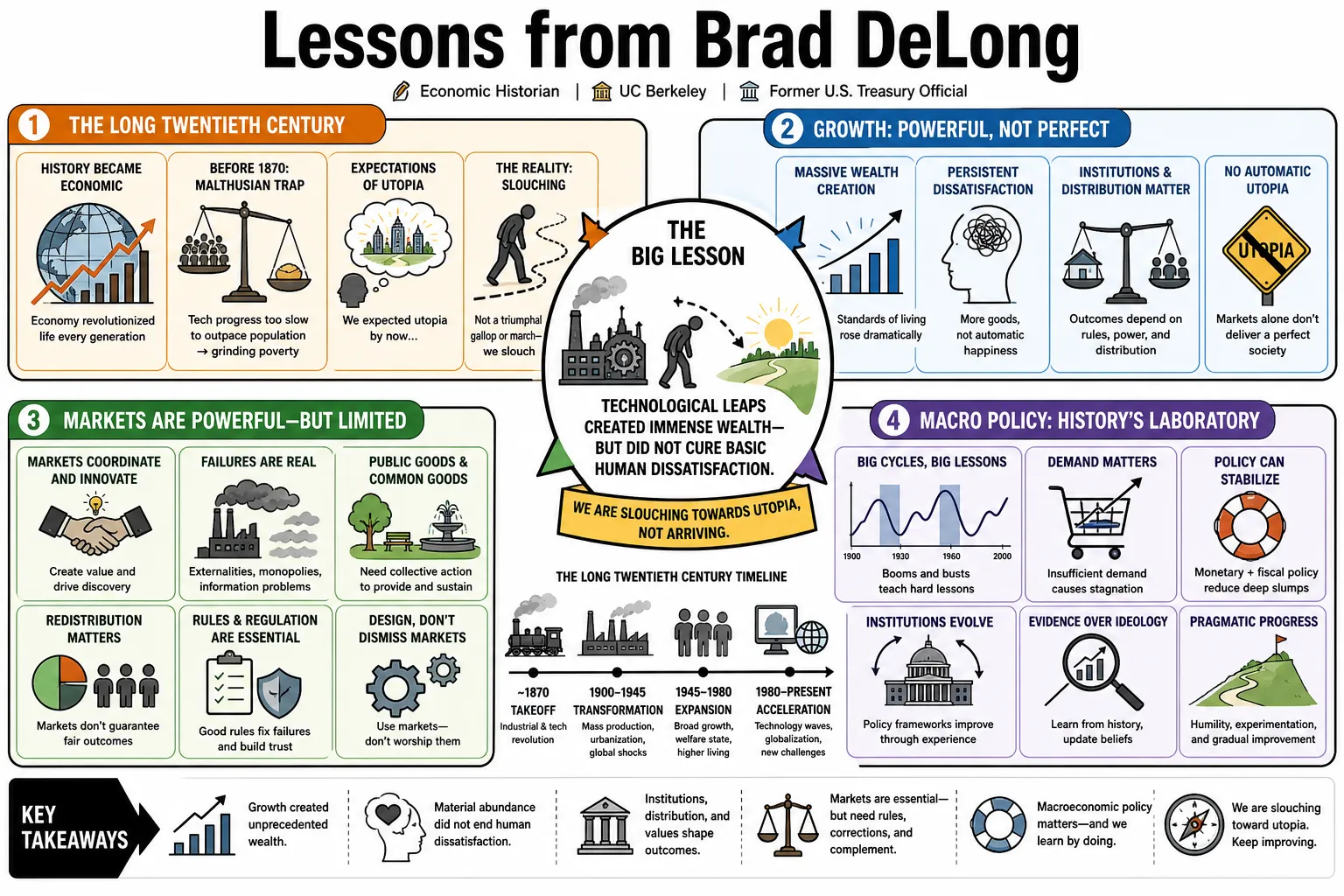
Lessons from Brad DeLong
Brad DeLong is a professor of economics at UC Berkeley, a former deputy assistant secretary of the Treasury in the Clinton administration, one of the first economics bloggers (Grasping Reality) and the author of Slouching Towards Utopia: An Economic History of the Twentieth Century (2022). — Milken Institute Review: J. Bradford DeLong, "Slouching Towards Utopia" (introductory chapter excerpt, 2023).
Part 1: The Long Twentieth Century
- On the Long Twentieth Century: DeLong dates the "long 20th century" from around 1870, with "the triple emergence of globalization, the industrial research lab and the modern corporation," to 2010, when the North Atlantic economies were still reeling from the Great Recession. — Milken Institute Review: J. Bradford DeLong, "Slouching Towards Utopia" (introductory chapter excerpt, 2023).
- On the Pace of Ideas: DeLong's "very crude personal guess" is that the growth rate of the world's stock of useful ideas "shot up from about 0.45 percent per year before 1870 to 2.1 percent per year afterward." — Milken Institute Review: J. Bradford DeLong, "Slouching Towards Utopia" (introductory chapter excerpt, 2023).
- On Revolution Every Generation: A 2.1 percent growth rate "is a doubling every 33 years," so the underpinnings of society in 1903, 1936, 1969 and 2002 were each profoundly different, and a government coping with repeated revolutions "cannot help but be greatly stressed." — Milken Institute Review: J. Bradford DeLong, "Slouching Towards Utopia" (introductory chapter excerpt, 2023).
- On Not Reaching Utopia: DeLong: "We did not run to the trail's end and reach utopia. We are still on the trail — maybe, for we can no longer see clearly to the end of the trail or even to where the trail is going to lead." — Milken Institute Review: J. Bradford DeLong, "Slouching Towards Utopia" (introductory chapter excerpt, 2023).
- On Hobsbawm's Short Century: DeLong contrasts his long 20th century with Eric Hobsbawm's "short 20th century" of 1914 to 1991, arguing that the short century misses "the bigger, more important story" running from about 1870 to 2010. — Milken Institute Review: J. Bradford DeLong, "Slouching Towards Utopia" (introductory chapter excerpt, 2023).
- On Grand Narratives: Histories of centuries "are by definition grand narrative histories, built to tell the author's desired story," and DeLong argues we need them to think at all, using them as a ladder to climb beyond, in Wittgenstein's image. — Milken Institute Review: J. Bradford DeLong, "Slouching Towards Utopia" (introductory chapter excerpt, 2023).
- On Unequal Riches: Average world income per capita in 2010 was about 8.8 times its 1870 level, but DeLong warns to "never forget that the riches were vastly more unequally distributed around the globe in 2010 than they were in 1870." — Milken Institute Review: J. Bradford DeLong, "Slouching Towards Utopia" (introductory chapter excerpt, 2023).
- On More Marvelous Than Terrible: DeLong: "In between, things were marvelous and terrible, but by the standards of all of the rest of human history, much more marvelous than terrible." — Milken Institute Review: J. Bradford DeLong, "Slouching Towards Utopia" (introductory chapter excerpt, 2023).
- On Tyrannies of the Century: DeLong: "people can and do use technologies — both the harder ones for manipulating nature, and the softer ones for organizing humans — to exploit, to dominate and to tyrannize," and the long 20th century saw "the worst and most bloodthirsty tyrannies that we know of." — Milken Institute Review: J. Bradford DeLong, "Slouching Towards Utopia" (introductory chapter excerpt, 2023).
- On Life Before 1870: DeLong: before 1870 "there's no possibility at all that humanity is going to be able to bake the economic pie sufficiently large that everyone can have enough," so politics was largely elites elbowing each other aside and running "a force-and-fraud domination and exploitation scheme." — Conversations with Tyler: Brad DeLong on Slouching Towards Utopia (2022).
Part 2: The Year 1870 and Engines of Growth
- On the Gate That Opened: Full globalization, the industrial research laboratory and the modern corporation "were the keys, unlocking the gate that had previously kept humanity in dreadful poverty," so the problem of making humanity rich could now be posed to the market economy. — Milken Institute Review: J. Bradford DeLong, "Slouching Towards Utopia" (introductory chapter excerpt, 2023).
- On Doing It Only Once: DeLong on the 1870 to 1920s change: "You only go from having no indoor plumbing and no public health — and so having half your babies die before the age of five — to one in which infant mortality is extremely low… once." — Conversations with Tyler: Brad DeLong on Slouching Towards Utopia (2022).
- On Technology Growth: DeLong counts technology growth as real income growth plus half of population growth, which gives roughly 1.7 percent per year from 1870 to 1913, "four times what the worldwide average was back in the century before 1870." — Conversations with Tyler: Brad DeLong on Slouching Towards Utopia (2022).
- On Training Molecules or Verses: On why Britain fell behind Germany, DeLong says "Germans were being trained to manipulate molecules in organic chemistry while Britons were being trained to write verses in the style of Macaulay." — Conversations with Tyler: Brad DeLong on Slouching Towards Utopia (2022).
- On Siemens in Britain: DeLong: "The fact that in 1913, the largest British electrical manufacturing firm is the English subsidiary of the German Siemens — that speaks a lot." — Conversations with Tyler: Brad DeLong on Slouching Towards Utopia (2022).
- On Intermediating Information: DeLong guesses that Germany and America surged partly because investment banks like Deutsche Bank and J.P. Morgan saw themselves as intermediating information between people with money and people with ideas, and he says he "was never really able to nail that down." — Conversations with Tyler: Brad DeLong on Slouching Towards Utopia (2022).
- On Experiment Over Utility: DeLong on the Royal Society: it "decides nothing except through experiment," which he calls "a miraculous and completely unexpected transformation, and one to which I think we owe a huge amount." — Conversations with Tyler: Brad DeLong on Slouching Towards Utopia (2022).
- On Coal, Globalization and Invention: DeLong estimates about half a percent a year of technological progress from 1770 to 1870, one-third from cheap surface coal, one-third from globalization, leaving roughly one-sixth of a percent a year of underlying invention: "a steampunk economy" that "looks pretty damn Malthusian." — Conversations with Tyler: Brad DeLong on Slouching Towards Utopia (2022).
- On the One Big Wave: What happened instead, DeLong says, was "the one big wave, as Gordon calls it": 2 percent a year of productivity growth together with Schumpeterian creative destruction "to double human technological competence every generation." — Conversations with Tyler: Brad DeLong on Slouching Towards Utopia (2022).
- On Mill and the Lightened Day: John Stuart Mill claimed in the early 1870s "it is questionable if all the mechanical inventions yet made have lightened the day's toil of any human being," and DeLong notes you must go forward a generation before progress becomes unquestionable. — Milken Institute Review: J. Bradford DeLong, "Slouching Towards Utopia" (introductory chapter excerpt, 2023).
Part 3: The Hayek-Polanyi Tension
- On Hayek's Crowdsourcing: DeLong: Friedrich Hayek observed that "the market economy 'crowdsources' — incentivizes and coordinates at the grassroots — solutions to the problems it sets." — Milken Institute Review: J. Bradford DeLong, "Slouching Towards Utopia" (introductory chapter excerpt, 2023).
- On Property and Rights: DeLong on Polanyi's point: the market economy recognizes property rights, so "If you have no property, you have no rights. And if the property you have is not valuable, the rights you have are very thin." — Milken Institute Review: J. Bradford DeLong, "Slouching Towards Utopia" (introductory chapter excerpt, 2023).
- On Man and the Market: DeLong: "The only stable principle had to be some version of 'The market was made for man, not man for the market.'" The hard questions were which men counted and what version of making the market would be best. — Milken Institute Review: J. Bradford DeLong, "Slouching Towards Utopia" (introductory chapter excerpt, 2023).
- On Hayek's Mr. Hyde: DeLong calls the Hayek who dismissed "social justice" his "idiot Mr. Hyde side," and notes the market economy can deliver only what property owners think is just. — Milken Institute Review: J. Bradford DeLong, "Slouching Towards Utopia" (introductory chapter excerpt, 2023).
- On the Shotgun Marriage: DeLong: "Perhaps the closest humanity got was the shotgun marriage of Hayek and Polanyi blessed by Keynes in the form of post–World War II North Atlantic developmental social democracy." — Milken Institute Review: J. Bradford DeLong, "Slouching Towards Utopia" (introductory chapter excerpt, 2023).
- On Harnessing Eight Billion Brains: DeLong: "There is no better way for harnessing the eight-billion-brain anthology intelligence of humanity to achieving the social goals we all want, other than to organize a well-functioning market system." — Conversations with Tyler: Brad DeLong on Slouching Towards Utopia (2022).
- On Property Rights and the Market: DeLong: the trouble is aligning prices with social values, "the fact that in a real market, the only rights that matter are property rights," and that externalities of every kind must also be handled. — Conversations with Tyler: Brad DeLong on Slouching Towards Utopia (2022).
- On Which Hayek: DeLong: "There's Hayek, and there's Hayek, and there's Hayek." He uses Hayek as "a hook on which I can hang a set of ideas," and Polanyi as another. — Conversations with Tyler: Brad DeLong on Slouching Towards Utopia (2022).
- On Failing Its Own Test: DeLong: postwar social democracy "failed its own sustainability test. And so we are still on the path, not at its end. And we are still, at best, slouching toward utopia." — Milken Institute Review: J. Bradford DeLong, "Slouching Towards Utopia" (introductory chapter excerpt, 2023).
Part 4: The Failure of Utopia and the Hedonic Treadmill
- On Wants Mastering Wealth: DeLong on the hedonic treadmill: "We do not use our wealth to overmaster our wants. Rather, our wants use our wealth to continue to overmaster us." — Milken Institute Review: J. Bradford DeLong, "Slouching Towards Utopia" (introductory chapter excerpt, 2023).
- On Material Want: DeLong is tempted to follow Richard Easterlin: "modern economic growth is not a triumph of humanity and technology over material want, but of material want over humanity and technology." — Conversations with Tyler: Brad DeLong on Slouching Towards Utopia (2022).
- On Being Sated: DeLong on his laptop: "Most of the time, I should be aware that materially, I'm very quite sated," yet he finds himself annoyed that it is not as fast as another he could buy. — Conversations with Tyler: Brad DeLong on Slouching Towards Utopia (2022).
- On the Realm of Necessity: Asked what Keynes got wrong about a coming leisure society, DeLong says "I really do not know," and wonders whether status-seeking rather than need now drives his own work. — Conversations with Tyler: Brad DeLong on Slouching Towards Utopia (2022).
- On Schumpeter and Bureaucracy: DeLong on Schumpeter's bureaucratization of the large firm: "I would say in the very long run, no. In the medium run, definitely yes." — Conversations with Tyler: Brad DeLong on Slouching Towards Utopia (2022).
- On Simon Against Ehrlich: DeLong would take Julian Simon's side of the bet: "We are extremely inventive. There are eight billion of us," and environmental problems are problems of externalities and the management of commons, not of resources becoming scarce. — Conversations with Tyler: Brad DeLong on Slouching Towards Utopia (2022).
- On the Middle-Income Trap: DeLong describes a trap where returns to positive-sum cooperation are lower than returns from joining "some force-and-fraud, exploitation and domination machine," and says the governmental technology of appropriation improves along with other technologies. — Conversations with Tyler: Brad DeLong on Slouching Towards Utopia (2022).
- On Colonialism and Lenin: DeLong once argued worldwide divergence "was largely the result of internal and external colonialism plus Lenin," but he says he has now "run out of excuses" for why middle-income and other traps persist. — Conversations with Tyler: Brad DeLong on Slouching Towards Utopia (2022).
- On Countercyclical Spending: Advising Britain, DeLong says "When private spending sits down, public spending should stand up," and that a long-run plan is needed to finance it. — Conversations with Tyler: Brad DeLong on Slouching Towards Utopia (2022).
Part 5: Macroeconomics and the Great Recession
- On Austerity's Cost: DeLong says austerity left Britain "10 percent poorer as a result of a failure to make public and private investments over the past decade and a half, and another 10 percent poorer because of the disaster of Brexit." — Conversations with Tyler: Brad DeLong on Slouching Towards Utopia (2022).
- On Investor Confidence: DeLong cites Keynes that "the animal spirits of investors depend very much on investors' attitude toward and confidence in the soundness of the government." — Conversations with Tyler: Brad DeLong on Slouching Towards Utopia (2022).
- On Rational Noise: DeLong credits Larry Summers's insight that "rational people don't maximize expected wealth. They maximize utility," so noise trading will be persistent. — Conversations with Tyler: Brad DeLong on Slouching Towards Utopia (2022).
- On Lucky Financiers: DeLong: the most influential financial players will often be people "who have massively failed to diversify and who have been very lucky three times in a row and who, as a result, think that they're absolute geniuses." — Conversations with Tyler: Brad DeLong on Slouching Towards Utopia (2022).
- On the Fiscal Theory of the Price Level: DeLong says he was surprised when "the fiscal theory of the price level suddenly showed up outside of Whitehall and camped out and set up its tent," and asks whether it is true or whether the wrong people run financial markets. — Conversations with Tyler: Brad DeLong on Slouching Towards Utopia (2022).
- On Growth Without Utopia: DeLong: at 30 percent per century population growth, the world after 1500 was "still a Malthusian economy": "Still, half your babies die. Still, life expectancy is 30." — Conversations with Tyler: Brad DeLong on Slouching Towards Utopia (2022).
- On Substack and Blogging: DeLong: "Substacking is blogging, except that Substacking is blogging where you have explicit permission to send things to people's email inboxes, and also to have a rather large tip jar." — Conversations with Tyler: Brad DeLong on Slouching Towards Utopia (2022).
- On Blogging as Play: Asked whether Substack or blogging is better, DeLong says "I thought blogging was more fun. I like being a squirrel." — Conversations with Tyler: Brad DeLong on Slouching Towards Utopia (2022).
- On Unwritten Volumes: DeLong says the book's cutting-room floor has "600 pages" plus about "400 pages that exist in disorganized form," and asks readers to vote on which sequel he should write. — Conversations with Tyler: Brad DeLong on Slouching Towards Utopia (2022).
Part 6: Public Policy and the Clinton Years
- On NAFTA and China-WTO: Brad DeLong: "NAFTA and China-WTO look, to me, like things that have been broadly good for the American economy. And they have been even better for America as the world's dominant superpower." — Brad DeLong's Grasping Reality: HOISTED FROM ÞE ARCHIVES: NAFTA & Other Trade Deals Have Not Gutted American Manufacturing—Period.
- On Job Shedding: Brad DeLong: "I am probably an outlier among neoliberal and neoclassical economists in thinking that most of that shedding — US job shedding that exceeded German job shedding — was bad." — Brad DeLong's Grasping Reality: HOISTED FROM ÞE ARCHIVES: NAFTA & Other Trade Deals Have Not Gutted American Manufacturing—Period.
- On Cushioning the Losers: Brad DeLong: "We have not done our proper job in cushioning the incomes of and providing opportunities to those people and communities that have found themselves behind the eight-ball, in sectors flooded by imports as other countries industrialize (especially China)." — Brad DeLong's Grasping Reality: HOISTED FROM ÞE ARCHIVES: NAFTA & Other Trade Deals Have Not Gutted American Manufacturing—Period.
- On Governments and Great Transformations: Brad DeLong: "I suppose that, in retrospect, it would be extraordinary if governments had not missed managed the repeated great transformations that hit the world generation after generation after 1870." — Brad DeLong's Grasping Reality: Slouching Tweetstorm:.
- On Delicate Trade Rules: Brad DeLong: "We do want a trading system in which companies exporting and investing have confidence that they will not be specifically discriminated against by governments, but the form such rules should take are very delicate." — Brad DeLong's Grasping Reality: HOISTED FROM ÞE ARCHIVES: NAFTA & Other Trade Deals Have Not Gutted American Manufacturing—Period.
- On a Broken Political Economy: Brad DeLong: "In my view, it may well all end in tears—but, if so, not because of the deficits we have run in the past, but because of the deficits our broken political economy will produce in the future" — Brad DeLong's Grasping Reality: America's Past Deficits & Current Debt Are Very Unlikely to Be a Problem; But Future Deficits Might....
- On Slicing the Pie Equitably: Brad DeLong: "We made little if any progress on figuring out political-social institutions for slicing the pie equitably, or for tasting the pie: using our wealth to make ourselves healthy, safe, secure, and happy." — Brad DeLong's Grasping Reality: Slouching Tweetstorm:.
- On the Clinton Deficit Plan: Brad DeLong: "The Clinton administration of 1993-2001 sold its 1993 deficit-reduction reconciliation bill as a phased-in five-year plan to boost American economic growth and American incomes." — Brad DeLong's Grasping Reality: HOISTED FROM 2018: Why Trumpists & Ex-Trumpists Should Just Sit Down & Shut Up.
- On Tariffs and Industrial Strategy: Brad DeLong: "They can only work when they are paired with a sensible industrial strategy." — Brad DeLong's Grasping Reality: CGTN Panel: Trying to Assess the Impact of the Trump Tariff No Method Policy Disaster.
Part 7: The Economics Blogosphere and Public Discourse
- On Value Above Replacement: Brad DeLong: "Where I think I have Value Above Replacement, I will provide it. Where I think I do not, I will point you to somebody who does." — Brad DeLong's Grasping Reality: HOISTED FROM THE ARCHIVES: My Review of Charles Maier: The Project-State and Its Rivals: A New History of the Twentieth .
- On a Royal Road Into Economic History: Brad DeLong: "My hope is that this will give both humanists and quants a shared Royal Road into global economic history: accessible enough for students who have never coded before, but with enough analytical bite that numerate students will not be bored." — Brad DeLong's Grasping Reality: A Brief Note on the Near-Absence of Pre-1500 "Economic Growth".
- On a Malthusian Past: Brad DeLong: "We see a past of everywhere before 1500—and note, in many parts of the world long after that—characterized by three salient features: Malthusian dire poverty." — Brad DeLong's Grasping Reality: DRAFT: Social Theory for the Mid-21st Century.
- On Big-Think History: Brad DeLong: "I really don’t think either really-existing socialism or fascism is, in the long run of human destiny, worthy of being a protagonist (or an antagonist) in big-think broad-sweep history." — Brad DeLong's Grasping Reality: Slouching Tweetstorm:.
- On the Fall of the Blogosphere: Brad DeLong: "In this case, that means that we need to have an accurate theory of what caused the Fall of the Blogosphere in the first place." — Brad DeLong's Grasping Reality: Old-Style Blogging Should Be New Again!, & BRIEFLY NOTED.
- On Analogies From Past Elites: Brad DeLong: "I think we can learn a lot in terms of useful analogies from the history of what went on within past élites." — Brad DeLong's Grasping Reality: DRAFT: Social Theory for the Mid-21st Century.
- On Technology and the Relations of Production: Brad DeLong: "I need to think about how changing technology induces changes in the forces of production that then require changes in the relations of production which have consequences for the political-social-cultural superstructure built on top of that." — Brad DeLong's Grasping Reality: John Quiggin on þe End of Neoliberalism, & BRIEFLY NOTED:.
Part 8: Historical Parallels and the Future
- On the Breakout Around 1870: Brad DeLong: "I see the breakout—the moment after which we were highly likely to be on track to something like our modern world—as taking place around 1870, with the coming of the Industrial Research Lab, the Modern Corporation, and full globalization." — Brad DeLong's Grasping Reality: Þe Slouching Towards Utopia Book Launch Effort Continues, &.
- On Using Rather Than Being Used by Technology: Brad DeLong: "And I am enough of a cyber-optimist to believe that even in the medium run we can use rather than be used by our technologies for our benefit, no matter what the counterexamples of FaceBook and Twitter and Mark Zuckerberg and Elon Musk might suggest." — Brad DeLong's Grasping Reality: MAMLM as a General Purpose Technology: The Ghost in the GDP Machine.
- On the Hayek-Polanyi Axis: Brad DeLong: "I see the Hayek-Polanyi axis of contestation as a genuine quest for the best way of organizing human society as we move from imperial-commercial through steampower, applied-science, mass-production, global value-chain, and not into information-attention modes of production." — Brad DeLong's Grasping Reality: DRAFT: "Slouching Towards Utopia": Reply to Social Science-History Association Commenters.
- On Capital Export: Brad DeLong: "I could rant with the best of them about our failure to be a capital-exporting nation financing the industrialization of the world, a role from which we would ultimately benefit both economically and politically." — Brad DeLong's Grasping Reality: HOISTED FROM ÞE ARCHIVES: NAFTA & Other Trade Deals Have Not Gutted American Manufacturing—Period.
- On China as a Co-Equal: Brad DeLong: "China is likely to be co-equal with the US as a superpower by the end of this century; enmeshing it in our economy starting now is the best move in a long-term plan to make that equality one of partnership and alliance rather than competition and cold war." — Brad DeLong's Grasping Reality: HOISTED FROM ÞE ARCHIVES: NAFTA & Other Trade Deals Have Not Gutted American Manufacturing—Period.
- On Institutions as Information Processors: Brad DeLong: "I have, I think, a decent grip on markets, hierarchies, and a certain class of institutions-as-information-processing-devices." — Brad DeLong's Grasping Reality: From Waterholes to Weber: Why Human Coordination Breeds Charisma & Crap.
- On Benefiting From Globalization: Brad DeLong: "We have all benefited enormously from globalization and will continue to benefit, provided it is not disastrously managed." — Brad DeLong's Grasping Reality: CGTN Panel: Trying to Assess the Impact of the Trump Tariff No Method Policy Disaster.
- On Building Utopia: Brad DeLong: "We should, thereafter, have straightforwardly turned our technological power and wealth to building something very close to a utopia: a truly human world." — Brad DeLong's Grasping Reality: & "Slouching Towards Utopia" Is a Go....