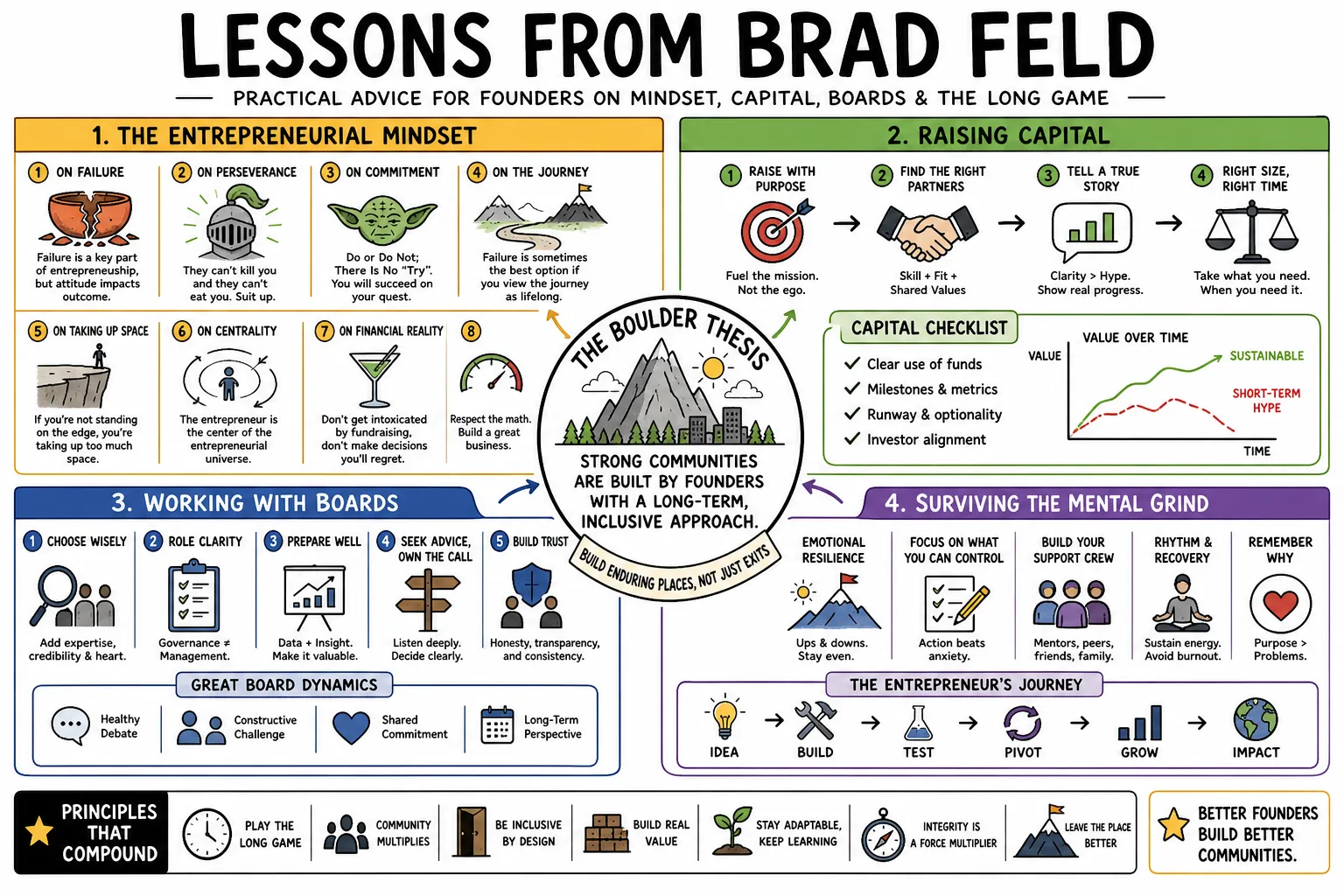
Lessons from Brad Feld
Brad Feld is a venture capitalist, co-founder of Techstars and of the venture firm Foundry Group, and the author of Startup Communities, Venture Deals, Startup Boards and Give First. He is best known for the Boulder Thesis, which holds that startup communities must be led by entrepreneurs. — TechCrunch: "Brad Feld on 'Give First' and the art of mentorship (at any age)" (2025).
Part 1: The Entrepreneurial Mindset
- On Improving Instead of Defending: Feld: "It's not your job to defend your team. It's your job to improve your team." He says the great CEOs he has worked with believe this and behave this way. — Feld Thoughts: "It's Your Job To Improve Your Team" (2013).
- On Saying "We Need to Get Better": Feld says an amazing CEO responds to criticism of the team with "yup – we need to get better – here's what we are doing," then asks "what else do you think we should do?" and "how can you help us improve?" — Feld Thoughts: "It's Your Job To Improve Your Team" (2013).
- On Competence Not Being Static: Feld: "Someone who was incredible at a job when the company is 50 people might be horrible at the job when the company is 500 people. Nothing is static – including competence." — Feld Thoughts: "It's Your Job To Improve Your Team" (2013).
- On Switching From Defend to Improve: Feld: "if you switch immediately from 'defend' to 'improve', you can often get extraordinary feedback and help in real time." — Feld Thoughts: "It's Your Job To Improve Your Team" (2013).
- On the Price of Admission for a CEO: Feld says a CEO must set the vision and strategy, recruit and retain the best talent, and make sure the company has enough cash; he calls these three "price of admission" because "you can't be a great CEO if you don't do these three things." — Feld Thoughts: "Being A Great CEO" (2013).
- On Having a Framework: Feld: "having a clear framework for what you, and how you do it, is powerful," because what a CEO spends time on changes with the stage of the company. — Feld Thoughts: "Being A Great CEO" (2013).
- On Honesty With Yourself: Feld says the job "requires a great CEO to continually grow and learn from mistakes" and to "work diligently at being honest with himself, his team, and his board about what is going on." — Feld Thoughts: "Being A Great CEO" (2013).
Part 2: Venture Capital and Fundraising
- On Getting Several Term Sheets: Feld and Jason Mendelson: "Your goal when you are raising a round of financing should be to get several term sheets." — Venture Deals blog: "Chapter 2: How To Raise Money" (2011).
- On VCs Not Being Alike: Feld and Mendelson: "VCs are not a homogeneous group; what might impress one VC might turn off another." — Venture Deals blog: "Chapter 2: How To Raise Money" (2011).
- On Knowing Who You Are Dealing With: Feld and Mendelson advise founders to "make sure you know who you are dealing with, what their approach is, and what kind of material they need during the fund-raising process." — Venture Deals blog: "Chapter 2: How To Raise Money" (2011).
- On Not Fixating on Valuation: Feld and Mendelson: "it's a mistake to focus only on the valuation when considering the economics of a deal," because price, liquidation preference, vesting, the employee pool and antidilution also matter. — Venture Deals blog: "Chapter 4: Economic Terms of the Term Sheet" (2011).
- On Doing or Not Doing: Chapter 2 of Venture Deals includes a section titled "Do or Do Not; There Is No Try" alongside determining how much to raise, fundraising and due diligence materials, finding a lead VC and closing the deal. — Venture Deals blog: "Chapter 2: How To Raise Money" (2011).
Part 3: Startup Communities
- On the Boulder Thesis: Feld's Boulder Thesis has four parts: "Entrepreneurs must lead the startup community," "The leaders must have a long-term commitment," "The startup community must be inclusive of anyone who wants to participate in it," and "The startup community must have continual activities that engage the entire entrepreneurial stack." — Feld Thoughts: "Empirical Support for the Boulder Thesis" (2014).
- On Leaders and Feeders: Feld says communities have leaders and feeders: "you don't need a lot to make a huge difference – a half a dozen is a great starting point – but they have to commit for 20 years from today." — Feld Thoughts: "Entrepreneurial Communities Must Be Led By Entrepreneurs" (2011).
- On Government Co-opting Leadership: Feld: "if the leadership of an entrepreneurial community is co-opted by local government – there might be short term activity – but it will fail over the long term to become sustainable." — Feld Thoughts: "Entrepreneurial Communities Must Be Led By Entrepreneurs" (2011).
- On Feeders Who Try to Lead: Feld says feeders who try to lead never succeed: "rhythm is wrong: 20 years vs. 4 of government – personality is wrong: lead vs. support – incentives are wrong: job vs. creative act." — Feld Thoughts: "Entrepreneurial Communities Must Be Led By Entrepreneurs" (2011).
- On Including Anyone: Feld calls the third Boulder Thesis principle, "The startup community must be inclusive of anyone who wants to participate in it," one he saw "on display in many different ways" and found "powerful." — Feld Thoughts: "The Power Of Including Anyone Who Wants To Participate In The Community" (2012).
- On Leadership Culture: Feld lists the keys of a startup community's leadership culture as "Inclusive," "Mentor Driven," "Non Zero Sum Game," and "Porous Boundaries." — Feld Thoughts: "Startup Communities: Creating A Great Entrepreneurial Ecosystem In Your City" (2011).
- On Sustainable Communities: Feld's principles for a sustainable entrepreneurial community: "Led By Entrepreneurs," "Have A 20 Year Commitment," "Welcome Everyone Into The Entrepreneurial Community," and "Engage The Entire Entrepreneurial Stack." — Feld Thoughts: "Startup Communities: Creating A Great Entrepreneurial Ecosystem In Your City" (2011).
- On Giving Before Getting: Feld says "Give Before You Get" came from his 2012 Startup Communities book: if you want a startup community to move, "you need people willing to put energy in without defining upfront what they'll get back." — TechCrunch: "Brad Feld on 'Give First' and the art of mentorship (at any age)" (2025).
Part 4: Negotiation and Legal Dynamics
- On Weak Negotiators: Feld and Mendelson: "We've found that most people, including many lawyers, are weak negotiators." — Venture Deals blog: "Chapter 9: Negotiation Tactics" (2011).
- On Knowing More Than Terms: Feld and Mendelson: "Regardless of how much you know about term sheets, you still need to be able to negotiate a good deal." — Venture Deals blog: "Chapter 9: Negotiation Tactics" (2011).
- On Negotiating Everywhere: Although Venture Deals is mostly about financings, its negotiation chapter covers tactics "that you can use in your life," and illustrates "the different types of characters you'll probably meet along the way." — Venture Deals blog: "Chapter 9: Negotiation Tactics" (2011).
- On Publishing All Your Moves: Feld and Mendelson note that portfolio-company executives "can read about everything we know online and in this book," so they can now negotiate more effectively against the authors. — Venture Deals blog: "Chapter 9: Negotiation Tactics" (2011).
Part 5: Leadership and Management
- On Competence and Loyalty: Feld: "I view competence as the most important attribute while assuming loyalty." But, he adds, "a 'loyal incompetent' is also worthless to an organization." — Feld Thoughts: "Valuing Competence vs. Loyalty" (2008).
- On Bidirectional Loyalty: Feld says he is "always willing to take one more shot" when someone falls down on competence, but if the other person is not willing to reciprocate loyalty while addressing the issue, "we are finished." — Feld Thoughts: "Valuing Competence vs. Loyalty" (2008).
- On Supporting the CEO: Feld: "I support the CEO's of my portfolio companies 100%, until the moment I don't, at which point I act on it." That lets him spend his time "working for" the CEO rather than having the CEO feel like he works for him. — Feld Thoughts: "Talking To Fellow Directors About Replacing A CEO" (2005).
- On Limping Along: On replacing a CEO, Feld says "My experience indicates that it is never a good idea to limp along." — Feld Thoughts: "Talking To Fellow Directors About Replacing A CEO" (2005).
- On Supporting or Replacing: Feld relays a wise VC's advice: "Every morning when you get up, think about your company's CEO and decide whether you are going to support him or not. If you are going to support him, do everything in your power to help him make your company successful. If you are not going to support him, then replace him." — Feld Thoughts: "Talking To Fellow Directors About Replacing A CEO" (2005).
- On Culture Over Competence: Feld: "it's always better to chose cultural fit over competence when you have to make a choice." — Feld Thoughts: "Hire For Cultural Fit Over Competence" (2012).
- On the Deadly Hiring Mistake: Feld: "Many people default into choosing people who have high competence but a low cultural fit. This is a deadly mistake in a startup." — Feld Thoughts: "Hire For Cultural Fit Over Competence" (2012).
- On Acknowledging Good Work: Feld: "when people do a great job, it's worth spending a moment acknowledging them." — Feld Thoughts: "Take the Time to Acknowledge Management's Performance" (2010).
- On a Pat on the Back: Feld: "A little pat on the back will go a long way, especially after three hours of questions." — Feld Thoughts: "Take the Time to Acknowledge Management's Performance" (2010).
Part 6: Board Dynamics
- On Forward-Looking Boards: Feld: "the vast majority of the board meeting should be 'forward looking.'" He says many VC boards are backward looking. — Feld Thoughts: "The Best Board Meetings" (2009).
- On the 80/10/10 Problem: Feld says most board meetings are "80% status updates, 10% strategy / issues, and 10% administration," and that "the 80% / 10% split on status vs. strategy should be reversed." — Feld Thoughts: "The Best Board Meetings" (2009).
- On Face-to-Face Boards: Feld agrees with Fred Wilson that board meetings need to be "in person" and that "there is immense value in a board dinner the night before a board meeting." — Feld Thoughts: "The Best Board Meetings" (2009).
- On the Board Package: Feld: "the entire board package should be sent out several days in advance to all board members." He prefers prose to a PowerPoint deck and wants the meat to be "what's going on now and going forward, not looking back." — Feld Thoughts: "My Ideal Board Meeting" (2014).
- On the Executive Session: Feld's ideal board meeting ends with a 30-minute executive session of the CEO and board only, where the lead director checks in on any feedback for the CEO, and he says "the day of the 'board update' is over." — Feld Thoughts: "My Ideal Board Meeting" (2014).
- On a One-Page Agenda: Feld and Jim Lejeal: "A good agenda is one page long, has each topic clearly articulated, and lists the length of time expected for the topic and the person responsible for leading the discussion." — Feld Thoughts: "Board of Directors; The Agenda" (2006).
- On No Surprises: Feld and Lejeal: "There should be no surprises in the board meeting – the agenda should be clear about what is being covered." — Feld Thoughts: "Board of Directors; The Agenda" (2006).
- On Ordering the Agenda: Feld and Lejeal: "Order the agenda so that the topics that are the most important to address in the meeting are covered first," because board members often have to leave before the end. — Feld Thoughts: "Board of Directors; The Agenda" (2006).
- On Small Boards With Outsiders: Feld: "I like to keep boards small and weighted toward outside directors as the companies grow, rather than just a cadre of VCs sitting around the board torturing the CEO with conflicting advice and opinions." — Feld Thoughts: "Expectations for Outside Board Members" (2014).
Part 7: Mental Health and Vulnerability
- On Acknowledging Depression: Feld: "For some reason we've embraced failure as an entrepreneurial trait that is ok, but we still struggle with acknowledging and talking about depression." — Feld Thoughts: "Depression and Entrepreneurs" (2012).
- On Denying Reality: Feld: "entrepreneurs get depressed. To deny this, is to deny reality, and that's against my value system." — Feld Thoughts: "Depression and Entrepreneurs" (2012).
- On the Responsibility Glitch: Feld calls the feeling of too much responsibility "the responsibility glitch" and advises: "be responsible for yourself first," since only then can you be constructively responsible for others. — Feld Thoughts: "The Responsibility Glitch" (2016).
- On Over-Responsibility Backfiring: Feld learned that "by being too responsible, I caused a number of unintended negative side effects," including undermining the people working for him because he overcompensated for them. — Feld Thoughts: "The Responsibility Glitch" (2016).
- On Talking to Someone: Feld: "talking about it, even privately, has helped me address my depression," so he encourages anyone struggling to have a few people they can talk to openly. — Feld Thoughts: "Do People Treat Me Differently Since I Talk Openly About Depression?" (2014).
- On Being Open: Feld: "being open about and writing about my struggles with depression has been a huge plus for me." — Feld Thoughts: "Do People Treat Me Differently Since I Talk Openly About Depression?" (2014).
- On the Weakness Myth: Feld says leaders and entrepreneurs are programmed to "never show weakness," and advises: "Talk to your mentors, your peers, and your partners. Take the risk of being vulnerable." — Feld Thoughts: "Bringing Depression Out of The Shadows In Startups" (2015).
- On Being a Resource: When someone opens up about depression, Feld says "I mostly try to listen, be empathetic, and introduce the person to other peers who have struggled with the same thing," and he claims his experience as his own rather than suggesting generic solutions. — Feld Thoughts: "Bringing Depression Out of The Shadows In Startups" (2015).
- On Body and Mind: Feld: "I personally no longer separate between physical health and mental health – they are both part of our existence as humans." — Feld Thoughts: "Techstars Entrepreneurship & Mental Health Series" (2020).
Part 8: Mentorship and Give First
- On It Being Their Company: Feld says Techstars tells founders "it's your company," so they make the decisions and everything from mentors is "just data." — Feld Thoughts: "Mentors 13/18: Guide, Don't Control" (2016).
- On One Decision: Feld says Foundry Group wants "to make one decision about a company – whether or not we support the CEO," and a mentor likewise gets to decide only whether to keep being a mentor. — Feld Thoughts: "Mentors 13/18: Guide, Don't Control" (2016).
- On Guiding to Understanding: Feld: "your job is to guide them to an understanding of the situation." — Feld Thoughts: "Mentors 13/18: Guide, Don't Control" (2016).
- On Helping, Not Solving: Feld: "As a mentor, your job is not to solve a founder's problem. It's to help. It's to listen. It's to provide feedback and data from your experience." — Feld Thoughts: "Mentors 15/18: Be Optimistic" (2017).
- On Optimism: Feld: "given the stress on a founder, it's best to do this from an optimistic frame of reference." — Feld Thoughts: "Mentors 15/18: Be Optimistic" (2017).
- On Peer Mentoring: Feld says the best mentor relationships become peer relationships: "I call this 'peer mentoring' and – while it can start as an equal relationship, it's magical when it evolves from a mentor – mentee relationship." — Feld Thoughts: "Mentors 6/18: The Best Mentor Relationships Eventually Become Two-Way" (2014).
- On Data Over Assertions: Feld: "The best mentors provide data and hypotheses, not assertions about what you should do." — TechCrunch: "Brad Feld on 'Give First' and the art of mentorship (at any age)" (2025).
- On Being an Effective Mentor: Feld: "Your ability to be effective as a mentor isn't related to your success or experience — it's a way of being." — TechCrunch: "Brad Feld on 'Give First' and the art of mentorship (at any age)" (2025).
- On Two-Way Mentoring: Feld: "Here's the magic trick of mentorship: The best mentor-mentee relationships become peer relationships where the mentor learns as much from the mentee as the mentee learns from the mentor." — TechCrunch: "Brad Feld on 'Give First' and the art of mentorship (at any age)" (2025).
- On the Long Game of Giving: Feld: "over the long term, people at the giver end are much more successful when success isn't simply measured as power and money." — TechCrunch: "Brad Feld on 'Give First' and the art of mentorship (at any age)" (2025).