Brad Jacobs is a serial entrepreneur who has built billion-dollar companies in waste, equipment rental and logistics, largely through acquisitions: United Waste Systems, United Rentals and XPO. He later founded QXO and wrote How to Make a Few Billion Dollars. — McKinsey, "XPO's Brad Jacobs on building businesses through M&A" (Inside the Strategy Room, 2022).
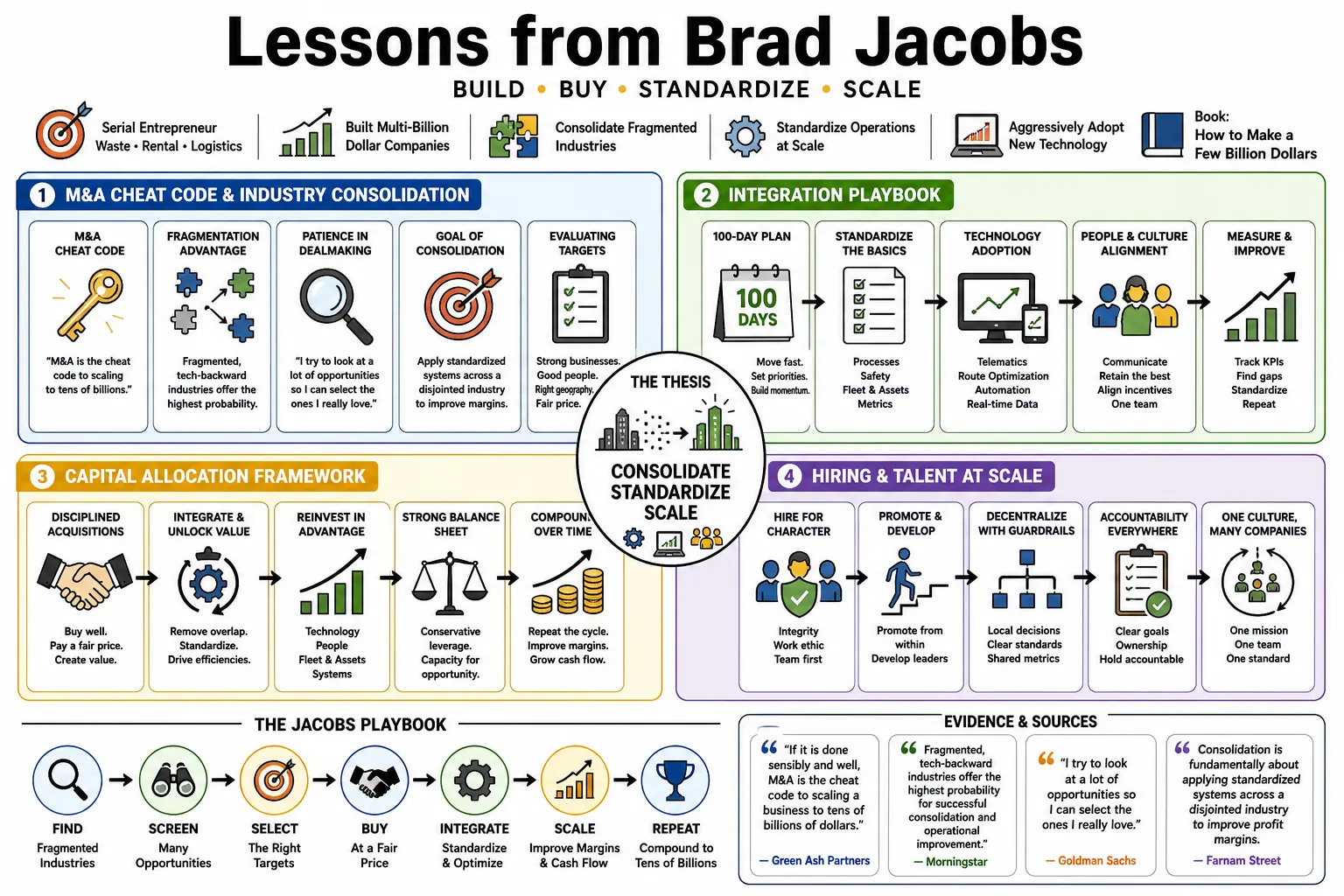
Part 1: M&A and Industry Consolidation
- On M&A as One Tool: Jacobs: "M&A is a tool in the tool kit and it's not the only tool when you define the job as building an integrated company that creates lots of value for the shareholders." — McKinsey, "XPO's Brad Jacobs on building businesses through M&A" (Inside the Strategy Room, 2022).
- On Buying Versus Integrating: Jacobs: "Buying a company is signing a document and wiring money—it's not the hardest thing in the world. The real work starts after you own the business." — McKinsey, "XPO's Brad Jacobs on building businesses through M&A" (Inside the Strategy Room, 2022).
- On Strategy Before Deals: Jacobs: "You can't do M&A in a vacuum. You need a strategy centered around how, as a result of the business plan, you can provide a superior service to customers, so they choose you rather than a competitor." — McKinsey, "XPO's Brad Jacobs on building businesses through M&A" (Inside the Strategy Room, 2022).
- On the Waste Rollup: At United Waste the strategy was to go into tertiary markets and buy the landfill capacity, then the collection companies hauling to it: "Density and scale are very helpful in the waste business." — McKinsey, "XPO's Brad Jacobs on building businesses through M&A" (Inside the Strategy Room, 2022).
- On Rollup Versus Rollout: Jacobs says United Rentals was both a rollup and a rollout, and "where we really made money was on the rollout," opening hundreds of greenfield locations, because the invested capital was much lower. — McKinsey, "XPO's Brad Jacobs on building businesses through M&A" (Inside the Strategy Room, 2022).
- On Small Family-Owned Targets: Jacobs says smaller deals were more labor-intensive because they involved family-owned businesses with no GAAP financials: "You have to spend time getting to know the owners." — McKinsey, "XPO's Brad Jacobs on building businesses through M&A" (Inside the Strategy Room, 2022).
- On Fear in M&A: Jacobs: "M&A is risky and management teams are right to be afraid. I've been afraid with every single acquisition I did." — McKinsey, "XPO's Brad Jacobs on building businesses through M&A" (Inside the Strategy Room, 2022).
- On M&A Versus Organic Growth: Jacobs: "M&A is much more risky than good, old-fashioned organic revenue growth and good, old sales and marketing. Now, those have less upside. M&A, if done correctly, can create tons of shareholder value." — McKinsey, "XPO's Brad Jacobs on building businesses through M&A" (Inside the Strategy Room, 2022).
- On Patience With Deals: Jacobs: "M&A is a lot like having kids. It's very hard to plan exactly. You have to be patient and disciplined. I'm in a hurry to do the right deal… But I'm not in a hurry to do the wrong deal." — TIME, "XPO's Billionaire Chairman Brad Jacobs Is Hunting for His Next Big Deal" (2022).
Part 2: The Integration Playbook
- On Fast and Standardized: On integrating technology, Jacobs says "Two words: fast and standardized," with one ERP system as soon as possible so you can close the books right after the purchase. — McKinsey, "XPO's Brad Jacobs on building businesses through M&A" (Inside the Strategy Room, 2022).
- On Ripping Off the Band-Aid: Jacobs: "On some aspects of integration, you want to be gentle, but on integrating technology platforms, you want to rip off the Band-Aid because you're not functioning at full level until then." — McKinsey, "XPO's Brad Jacobs on building businesses through M&A" (Inside the Strategy Room, 2022).
- On Respect for Acquired People: Jacobs: "We were extremely respectful to the people. We never went into an acquisition with the arrogant attitude that we had all the answers." — McKinsey, "XPO's Brad Jacobs on building businesses through M&A" (Inside the Strategy Room, 2022).
- On Asking Before Changing: Jacobs' three integration questions were "What are you doing that we would be crazy to change? What are you doing that's not so great that we should change? What's your best idea to improve the company?" Then, he says, "we shut up, listened carefully, and documented what they were saying." — McKinsey, "XPO's Brad Jacobs on building businesses through M&A" (Inside the Strategy Room, 2022).
- On One Promise: Jacobs told acquired employees: "I will only make you one promise: I will try my best, but I will mess up some things, so give me a break and give me some time. And feel free to tell me when I'm messing up." — McKinsey, "XPO's Brad Jacobs on building businesses through M&A" (Inside the Strategy Room, 2022).
- On Single-Point Accountability: Jacobs: "if you have one person accountable for each task, you are more likely to achieve it on time than if a group is responsible for it," with a regular cadence of check-ins. — McKinsey, "XPO's Brad Jacobs on building businesses through M&A" (Inside the Strategy Room, 2022).
- On the Day-One Mistake: Jacobs: "The single biggest mistake that acquirers make after buying a company is that on day one, they think they have all the answers. Guess what? They don't." — TIME, "XPO's Billionaire Chairman Brad Jacobs Is Hunting for His Next Big Deal" (2022).
- On Ears and Eyes: Jacobs: "In the early days of an acquisition, we use our ears and eyes a lot more than our mouths." — TIME, "XPO's Billionaire Chairman Brad Jacobs Is Hunting for His Next Big Deal" (2022).
- On Over-Communicating: Jacobs says a leader must be crystal clear on the strategy and then "communicate, communicate, communicate, then over-communicate on top of that." — McKinsey, "XPO's Brad Jacobs on building businesses through M&A" (Inside the Strategy Room, 2022).
Part 3: Identifying and Acquiring Talent
- On a Deep Bench: Jacobs on succession: "Create a deep bench of executives whom you expose to all the key things going on in the company, even if it's not their direct responsibilities." — TIME, "XPO's Billionaire Chairman Brad Jacobs Is Hunting for His Next Big Deal" (2022).
- On Not Siloing Executives: Jacobs: "I never siloed executives, like you see in most companies," and XPO created a big bench of CEO candidates. — TIME, "XPO's Billionaire Chairman Brad Jacobs Is Hunting for His Next Big Deal" (2022).
- On Paying for Raw Capitalists: Jacobs says he wants people "who are raw capitalists, people who want to make money for themselves and their families," and ties compensation to making money for shareholders. — The Knowledge Project with Shane Parrish: Brad Jacobs (auto-generated transcript on PodScripts).
- On Where Credit Goes: Jacobs: "The CEO always gets more credit than the CEO deserves," because the credit is dispersed among the people doing due diligence, negotiation, integration and technology. — McKinsey, "XPO's Brad Jacobs on building businesses through M&A" (Inside the Strategy Room, 2022).
- On Lifelong Learning: Jacobs, who never finished college: "they have to cultivate an attitude of wanting to be a lifelong learner. You also need to learn to write." — TIME, "XPO's Billionaire Chairman Brad Jacobs Is Hunting for His Next Big Deal" (2022).
- On Working Your Tail Off: Jacobs: "generally speaking, you have to work your tail off to be very successful in business." — TIME, "XPO's Billionaire Chairman Brad Jacobs Is Hunting for His Next Big Deal" (2022).
- On Capital and Time: Jacobs: "There are only two things you have to manage as a CEO and that's allocation of capital and time." — McKinsey, "XPO's Brad Jacobs on building businesses through M&A" (Inside the Strategy Room, 2022).
- On A Players: Brad Jacobs: "I want all A players around me. I want people whose relationship with me, I value so much that if it was terminated, I would be lost." — David Senra: My Conversation with Brad Jacobs (auto-generated transcript on PodScripts).
- On a Team Smarter Than Him: Brad Jacobs: "I put together a team of people who are generally smarter than me and who are more talented than me in what they do." — David Senra: My Conversation with Brad Jacobs (auto-generated transcript on PodScripts).
Part 4: Building a High-Performance Culture
- On the Happiest Moment: Jacobs likes to ask "what's the happiest moment of your day, as opposed to how did your day go?", a question he learned from Martin Seligman. — The Knowledge Project with Shane Parrish: Brad Jacobs (auto-generated transcript on PodScripts).
- On Big Goals and Accountability: Jacobs: "People should dream big, set big goals, be very specific [about] the milestones, and then be visible in holding yourself and your team members accountable for progress." — TIME, "XPO's Billionaire Chairman Brad Jacobs Is Hunting for His Next Big Deal" (2022).
- On Ego: Jacobs: "For me, business has never been about ego. It's about making money for shareholders." — TIME, "XPO's Billionaire Chairman Brad Jacobs Is Hunting for His Next Big Deal" (2022).
- On No Wrong Notes: Jacobs on his jazz training: "there is no wrong note. If someone plays a note, that's just a new note. It's not the wrong note." Business needs the same ability to improvise, because "life changes. Markets change." — The Knowledge Project with Shane Parrish: Brad Jacobs (auto-generated transcript on PodScripts).
- On the Math Side: Jacobs says the math side of business is "making order out of disorder" and seeing patterns, because "the great mathematicians reduce very complicated things to a formula." — The Knowledge Project with Shane Parrish: Brad Jacobs (auto-generated transcript on PodScripts).
- On Fast and Slow: Jacobs says music taught him "when to go fast and when to go slow." — TIME, "XPO's Billionaire Chairman Brad Jacobs Is Hunting for His Next Big Deal" (2022).
- On Staying Close to the Customer: Brad Jacobs: "And I find if you get closest to the person in the organization who's closest to the customer, that's how you get the real story." — www.morganstanley.com/insights/videos/hard-lessons/qxo-chairman-ceo-brad-jacobs-.
- On Being Heard: Brad Jacobs: "It's empowering that people feel they matter because they do matter, and their voice is really being heard and taken into consideration in forming the plan" — www.morganstanley.com/insights/videos/hard-lessons/qxo-chairman-ceo-brad-jacobs-.
- On Enjoying Life: Brad Jacobs: "if you wanna enjoy life, you need to find positive stuff in it." — www.morganstanley.com/insights/videos/hard-lessons/qxo-chairman-ceo-brad-jacobs-.
Part 5: Capital Allocation and Value Creation
- On Shareholder Value: Jacobs: "The primary purpose of the senior leadership team is to create shareholder value." Sometimes that meant buying companies and sometimes selling or spinning off parts. — McKinsey, "XPO's Brad Jacobs on building businesses through M&A" (Inside the Strategy Room, 2022).
- On Dilution: Jacobs: "Raising equity is dilutive; selling parts of the businesses you bought is less dilutive and may be accretive and more strategically sensible." — McKinsey, "XPO's Brad Jacobs on building businesses through M&A" (Inside the Strategy Room, 2022).
- On Scale Overnight: Jacobs: M&A "gives you the opportunity to get market share and scale overnight, and in most businesses, scale helps a lot because you can leverage your SG&A off a larger revenue base." — McKinsey, "XPO's Brad Jacobs on building businesses through M&A" (Inside the Strategy Room, 2022).
- On Scalability: Jacobs: "Scalability is the most important thing I look for when I get into an industry." — TIME, "XPO's Billionaire Chairman Brad Jacobs Is Hunting for His Next Big Deal" (2022).
- On Buying in a Downturn: Jacobs, in late 2022: "A downturn creates buying opportunities for acquirers with capital like me." — TIME, "XPO's Billionaire Chairman Brad Jacobs Is Hunting for His Next Big Deal" (2022).
- On Fixer-Uppers: Jacobs: "I will also look at fixer-uppers. I have done plenty in the past, and I'll look at opportunities that have wind to their back in terms of growth trends." — McKinsey, "XPO's Brad Jacobs on building businesses through M&A" (Inside the Strategy Room, 2022).
- On Doing One Thing at a Time: Jacobs: "I only do one thing at a time. I'm a serial CEO." — McKinsey, "XPO's Brad Jacobs on building businesses through M&A" (Inside the Strategy Room, 2022).
- On Buying in a Disciplined Way: Brad Jacobs: "buying companies in a disciplined way. Prices too high, we don't do it. Price is reasonable." — David Senra: My Conversation with Brad Jacobs (auto-generated transcript on PodScripts).
- On M&A Synergies: Brad Jacobs: "And the ones that really worked the best were ones that we put the companies together, and there were both cost and revenue synergies." — www.morganstanley.com/insights/videos/hard-lessons/qxo-chairman-ceo-brad-jacobs-.
Part 6: Failure, Risk, and Problem-Solving
- On Oversight by Track Record: Jacobs on overseeing management: "If my management team had not done much M&A, I would be skeptical and provide a lot of oversight. On the other hand, if the management team has experience creating a lot of value from M&A, I would give them a long leash." — McKinsey, "XPO's Brad Jacobs on building businesses through M&A" (Inside the Strategy Room, 2022).
- On the Conway Pivot: Jacobs calls buying the less-than-truckload company Conway in 2015 "one of the best business deals I did in my life," a pivot from XPO's asset-light brokerage into an asset-heavy business bought at a small fraction of what he knew it could be worth. — The Knowledge Project with Shane Parrish: Brad Jacobs (auto-generated transcript on PodScripts).
- On Reframing Problems: Brad Jacobs: "You make money finding problems and solving them." — www.morganstanley.com/insights/videos/hard-lessons/qxo-chairman-ceo-brad-jacobs-.
- On Imperfection: Brad Jacobs: "Here's the things I'm working on that aren't perfect, aren't efficient yet, but here's my plan to make them efficient and make them really good." — www.morganstanley.com/insights/videos/hard-lessons/qxo-chairman-ceo-brad-jacobs-.
- On Every Mistake in the Book: Brad Jacobs: "I've made every mistake in the book over the decades. And I've learned from those mistakes, and I've refined it and refined it, but I have a winning formula." — David Senra: My Conversation with Brad Jacobs (auto-generated transcript on PodScripts).
- On Sharing Information: Brad Jacobs: "They're afraid to share the good information. They think a competitor is going to hear about it. Okay, well, they will. But let them try to copy us." — David Senra: My Conversation with Brad Jacobs (auto-generated transcript on PodScripts).
- On What Naysayers Can Teach: Brad Jacobs: "naysayers sometimes can help you correct your own path, can tell you, gee, you know, maybe I'm cutting costs too much." — David Senra: My Conversation with Brad Jacobs (auto-generated transcript on PodScripts).
- On Looking for Problems: Brad Jacobs: "I think as a CEO, it's actually kind of good to be a little, not negative, but to be looking for the problems 'cause that's how you make money." — www.morganstanley.com/insights/videos/hard-lessons/qxo-chairman-ceo-brad-jacobs-.
Part 7: Mindset and Psychological Resilience
- On Being Born to Be a CEO: Jacobs: "I was born to be a CEO. The job matches my skill set just perfectly and gives me a lot of satisfaction apart from the money." — TIME, "XPO's Billionaire Chairman Brad Jacobs Is Hunting for His Next Big Deal" (2022).
- On Cognitive Therapy: Brad Jacobs: "I found an amazing cognitive therapist, and I went to the guy twice a week, hour and a half a shot for two years. It was fantastic. One of the best things I've ever done in my life" — David Senra: My Conversation with Brad Jacobs (auto-generated transcript on PodScripts).
- On Reframing Negativity: Brad Jacobs: "I don't think I'm born positive." — www.morganstanley.com/insights/videos/hard-lessons/qxo-chairman-ceo-brad-jacobs-.
- On Suffering From Perfectionism: Brad Jacobs: "I suffered a lot from perfectionism when I was younger. I wanted to be perfect." — David Senra: My Conversation with Brad Jacobs (auto-generated transcript on PodScripts).
- On a Universe That Is Not Perfect: Brad Jacobs: "I wanted the universe to be perfect. Everything just goes swimmingly well at my beck and call and command. Well, it turns out, that's not reality." — David Senra: My Conversation with Brad Jacobs (auto-generated transcript on PodScripts).
- On Not Being Miserable at the Top: Brad Jacobs: "I would not want to be one of these senior guys who's, like, frowning all the time. and upset and angry and depressed." — David Senra: My Conversation with Brad Jacobs (auto-generated transcript on PodScripts).
- On Context: Brad Jacobs: "I think context is really important. It gives you meaning. It gives you purpose. It gives you understanding. It gives you wisdom." — David Senra: My Conversation with Brad Jacobs (auto-generated transcript on PodScripts).
- On Not Embracing Negativity: Brad Jacobs: "I don't embrace negativity. I'm okay with it, but I don't make a big deal about negativity. I'd much rather enjoy the positivity. I'm a sunny side up guy." — David Senra: My Conversation with Brad Jacobs (auto-generated transcript on PodScripts).
Part 8: Technology, Automation, and Efficiency
- On Proprietary Technology: Jacobs: "Our biggest secret is proprietary technology, which has been a big part of our growth." — TIME, "XPO's Billionaire Chairman Brad Jacobs Is Hunting for His Next Big Deal" (2022).
- On Adding Capacity: Jacobs says XPO nearly tripled its trailer production and expected its driver training schools to graduate twice as many drivers, which "primarily create more capacity" to unsnarl customers' supply chains. — TIME, "XPO's Billionaire Chairman Brad Jacobs Is Hunting for His Next Big Deal" (2022).
- On Industries AI Will Not Disrupt: Brad Jacobs: "I find stuff that AI and automation are not going to disrupt at any time in the near future." — David Senra: My Conversation with Brad Jacobs (auto-generated transcript on PodScripts).
- On AI and Managers: Brad Jacobs: "So, I think short term, there's no question that AI is better for you as a manager." — www.morganstanley.com/insights/videos/hard-lessons/qxo-chairman-ceo-brad-jacobs-.
- On Passing on Chegg: Brad Jacobs: "I think the AI is going to come in basically do that for free." — David Senra: My Conversation with Brad Jacobs (auto-generated transcript on PodScripts).
- On Standardization: Brad Jacobs: "I have a very strong appetite for standardization." — The Knowledge Project with Shane Parrish: Brad Jacobs (auto-generated transcript on PodScripts).