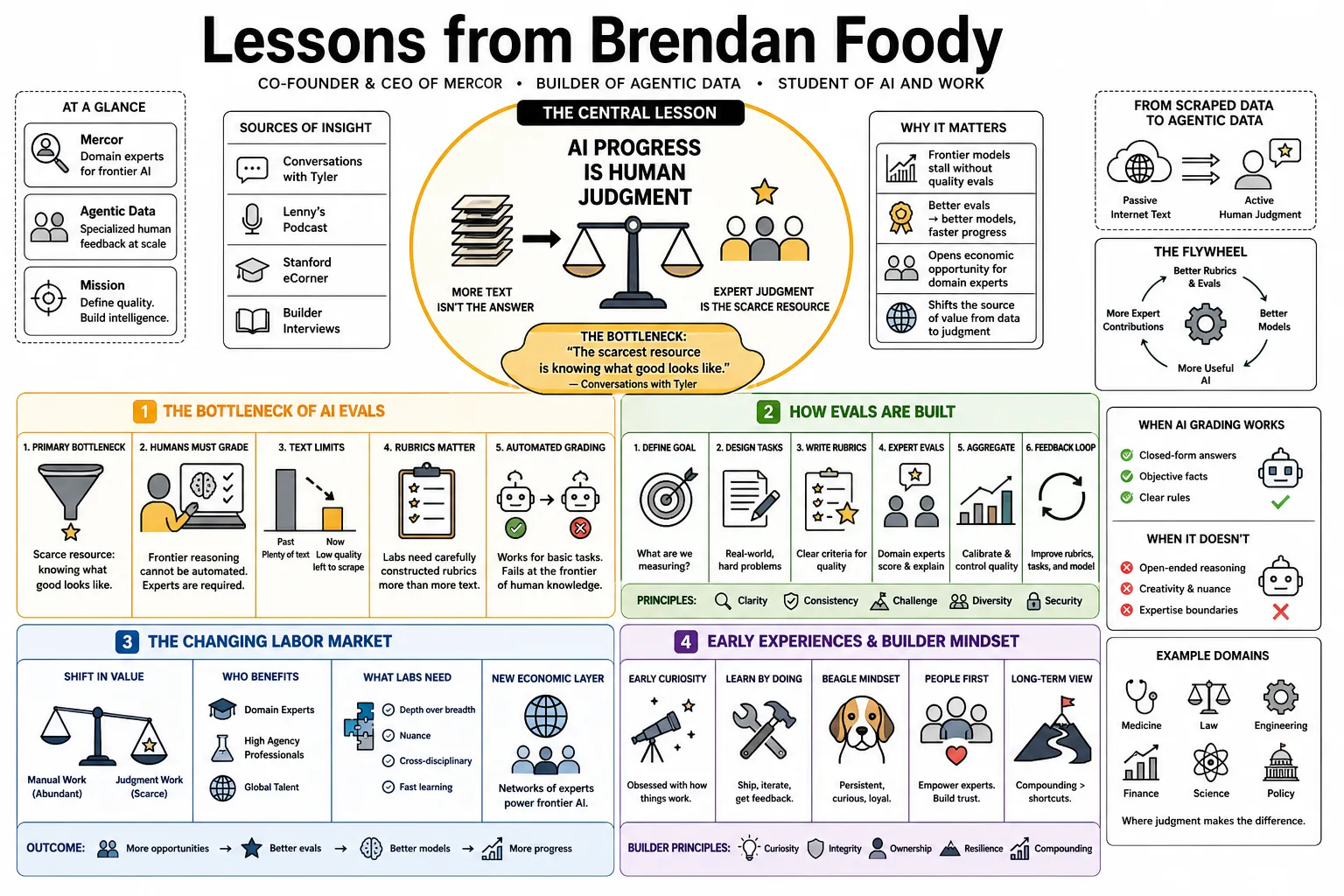
Lessons from Brendan Foody
Brendan Foody is the co-founder and CEO of Mercor, an AI company that hires the domain experts who teach leading AI models. At 22, Cowen introduced him as the youngest unicorn founder ever and the youngest Conversations with Tyler guest. — Conversations with Tyler: Brendan Foody on AI evals, hiring and Mercor (recorded Oct 16, 2025).
Part 1: The Bottleneck of AI Evals
- On Knowing What Good Looks Like: Foody: "The scarcest resource is knowing what good looks like." — Conversations with Tyler: Brendan Foody on AI evals, hiring and Mercor (recorded Oct 16, 2025).
- On Academic Evals: Foody: "The largest disconnect that we were seeing in AI research is that everyone was focused on academic evals, like GPQA for PhD-level reasoning or IMO for Olympiad math, which were wholly disconnected from the outcomes that customers actually care about." — Conversations with Tyler: Brendan Foody on AI evals, hiring and Mercor (recorded Oct 16, 2025).
- On the Most Valuable Data: Foody says one kind of data is a curriculum the model reads, while the second is a way of measuring success: "That second kind of data is the most valuable," where models attempt a problem many times, score the responses and learn. — Conversations with Tyler: Brendan Foody on AI evals, hiring and Mercor (recorded Oct 16, 2025).
- On Hill Climbing Tests: Foody: "When we have these phenomenal tests for model capabilities — whether in economics, law, or other domains — it's amazing how fast the researchers can hill climb them and optimize around them." — Conversations with Tyler: Brendan Foody on AI evals, hiring and Mercor (recorded Oct 16, 2025).
- On Defining the Evals: Foody: "the largest way that these deep domain experts can help to contribute to the advancement of AI is defining the evals." — Conversations with Tyler: Brendan Foody on AI evals, hiring and Mercor (recorded Oct 16, 2025).
- On Time as a Proxy for Value: To build APEX, experts describe how they spend their time and write prompts and rubrics for each bucket: "Using their time is the best proxy we have for the economic value associated with their salary, or what customers are willing to pay for." — Conversations with Tyler: Brendan Foody on AI evals, hiring and Mercor (recorded Oct 16, 2025).
- On the Pace of Improvement: Foody: "the rate of model improvement at economically valuable tasks is incredible." — Conversations with Tyler: Brendan Foody on AI evals, hiring and Mercor (recorded Oct 16, 2025).
- On 25 to 30 Percent a Year: Foody puts the improvement from GPT-4o to GPT-5 on APEX at "a 25 percent–, 30 percent–improvement" per year, with GPT-5 at 64 percent, so maintaining that "would definitely be challenging." — Conversations with Tyler: Brendan Foody on AI evals, hiring and Mercor (recorded Oct 16, 2025).
- On What Models Still Struggle With: Foody names two things humans do well that models struggle with: "longer horizon tasks" of 50 or 100 hours, and "integrating multiple tools with our response." — Conversations with Tyler: Brendan Foody on AI evals, hiring and Mercor (recorded Oct 16, 2025).
- On Six to Twelve Months: Foody: "I would be shocked if we don't have enormously capable models across those dimensions of lots of tool use with very long horizon tasks in the next six to twelve months." — Conversations with Tyler: Brendan Foody on AI evals, hiring and Mercor (recorded Oct 16, 2025).
Part 2: The Value of Human Expertise
- On What Mercor Does: Foody: "we hire all of the experts that teach the leading AI models. When one of the AI labs wants to teach their models how to be better at poetry, we'll find some of the best poets in the world that can help to measure success via creating evals and examples of how the model should behave." — Conversations with Tyler: Brendan Foody on AI evals, hiring and Mercor (recorded Oct 16, 2025).
- On Paying Poets $150 an Hour: Foody: when phenomenal poets teach the models something once, "they're then able to apply those skills and that knowledge across billions of users, hence allowing us to pay $150 an hour for some of the best poets in the world." — Conversations with Tyler: Brendan Foody on AI evals, hiring and Mercor (recorded Oct 16, 2025).
- On Rubrics Like a Professor's: Foody: "An example might be similar to how a professor in English class would create a rubric to grade an essay or a poem." — Conversations with Tyler: Brendan Foody on AI evals, hiring and Mercor (recorded Oct 16, 2025).
- On a Little Disagreement: Foody wants "some degree of consensus of different exceptional people believing that they're each doing a good job, but you probably don't want too much consensus because you also want to get all of these edge case scenarios." — Conversations with Tyler: Brendan Foody on AI evals, hiring and Mercor (recorded Oct 16, 2025).
- On Models Checking the Graders: Foody says models can catch expert graders who are "tired or not putting a lot of effort into their work," across "tens of thousands of people" working on the platform. — Conversations with Tyler: Brendan Foody on AI evals, hiring and Mercor (recorded Oct 16, 2025).
- On Taste in Law: Foody: "in law, I think it's going to be a long time. The reason is that there's so much taste involved in legal responses that effectively getting all of the taste that Cass has into the model is going to be difficult." — Conversations with Tyler: Brendan Foody on AI evals, hiring and Mercor (recorded Oct 16, 2025).
- On Knowledge That Isn't Written Down: Foody: "There're interestingly a lot of areas in law where the right way of approaching something is not written down or codified. It exists more in the heads of experts." — Conversations with Tyler: Brendan Foody on AI evals, hiring and Mercor (recorded Oct 16, 2025).
- On Where Models Will Struggle: Foody: "it's those domains where there's a lot of taste that isn't well-documented that the models will struggle immensely with." — Conversations with Tyler: Brendan Foody on AI evals, hiring and Mercor (recorded Oct 16, 2025).
Part 3: Agentic Data and Model Training
- On Turning Mistakes Into Environments: Foody: "Instead of the customer support rep monotonously responding to tickets every day, they'll find the mistake that the agent makes. They'll turn that into an RL environment, and then, all of a sudden, the agent will be able to solve that problem many times." — Conversations with Tyler: Brendan Foody on AI evals, hiring and Mercor (recorded Oct 16, 2025).
- On an RL Environment Machine: Foody: "a huge portion of the economy will become an RL environment machine." — Conversations with Tyler: Brendan Foody on AI evals, hiring and Mercor (recorded Oct 16, 2025).
- On Fixed-Cost Investments in Agents: Foody expects "these fixed-cost investments of teaching an agent how to do something, building an RL environment for something, and then being able to use agents as many times as we want to perform that activity." — Conversations with Tyler: Brendan Foody on AI evals, hiring and Mercor (recorded Oct 16, 2025).
- On Finding Mistakes: Brendan Foody: "The only element of technical AI that they’ll need is to find where the model makes a mistake." — conversationswithtyler.com/episodes/brendan-foody/.
- On the Eval as Requirements Document: Brendan Foody: "If the model is the product, then the eval is the product requirement document." — www.youtube.com/watch?v=ja6fWTDPQl4.
- On the Road to Automation: Brendan Foody: "that entire road to automating the entire economy and building agents for everything is paved with humans creating eval workflows." — rosetta.to/u/20vc/mercor-ceo-co-founder-brendan-foody-how-they-grew-from-1m-to-5.
- On Self-Teaching Superintelligence: Brendan Foody: "every single time that there's been questions around are we going to have super intelligence that's just able to teach itself and do everything that that's turned out to not be true." — rosetta.to/u/20vc/mercor-ceo-co-founder-brendan-foody-how-they-grew-from-1m-to-5.
- On Proprietary Advantages: Brendan Foody: "it creates so much value for customers that it's extremely difficult to compete against." — rosetta.to/u/20vc/mercor-ceo-co-founder-brendan-foody-how-they-grew-from-1m-to-5.
- On a Human Anchor: Brendan Foody: "if you want to push the frontier to get the model to do something that the human knows how to do that the model doesn't know how to do, then you need some human stasis point to measure that" — rosetta.to/u/20vc/mercor-ceo-co-founder-brendan-foody-how-they-grew-from-1m-to-5.
Part 4: The Future of Knowledge Work
- On Gold Medals and Email: Brendan Foody: "they can't draft an email for me. They can't schedule a meeting." — rosetta.to/u/20vc/mercor-ceo-co-founder-brendan-foody-how-they-grew-from-1m-to-5.
- On Fixed-Cost Agents: Brendan Foody: "we’ll move towards these fixed-cost investments of teaching an agent how to do something, building an RL environment for something, and then being able to use agents as many times as we want to perform that activity." — conversationswithtyler.com/episodes/brendan-foody/.
- On Probing the Model for a Week: Foody: "I do think we’ll very quickly get to the point where Cass has a really hard time finding a mistake the model makes, where he has to spend maybe a week just trying to probe it." — Conversations with Tyler: Brendan Foody on AI evals, hiring and Mercor (recorded Oct 16, 2025).
- On Elastic Roles: Brendan Foody: "engineering is such an elastic role right? Where if we could build 100 times more software or say we make engineers 10 times more efficient, we would probably build 100 times more software" — rosetta.to/u/20vc/mercor-ceo-co-founder-brendan-foody-how-they-grew-from-1m-to-5.
- On Elastic Demand: Brendan Foody: "a category of things that have very elastic demand are going to be super exciting because when we make people 10 times more productive, we'll build 10 times if not a hundred times as much software as an example" — www.youtube.com/watch?v=ja6fWTDPQl4.
- On the Long Road: Brendan Foody: "that long road is paved with all of the evals that help to make those capabilities possible." — www.youtube.com/watch?v=ja6fWTDPQl4.
Part 5: Rethinking Hiring and Talent
- On Nepotism and Data-Driven Hiring: On whether nepotism returns, Foody says "in some companies and industries, that will happen," but hopes models with an eval set of performance reviews will judge whether a reference "should actually be considered, or maybe as a countersignal." — Conversations with Tyler: Brendan Foody on AI evals, hiring and Mercor (recorded Oct 16, 2025).
- On AI Interviews for Thiel Fellows: Foody says Mercor has worked with the Thiel Fellowship "on building out AI interviews that are able to better assess Thiel Fellows, and using models to analyze the transcripts of those recordings to see what are the signals." — Conversations with Tyler: Brendan Foody on AI evals, hiring and Mercor (recorded Oct 16, 2025).
- On Superhuman but Noisy: On AI-scored interviews, Foody: "it will be certainly superhuman because humans aren't very good at it, but it's still such a difficult problem that there's going to be variance." — Conversations with Tyler: Brendan Foody on AI evals, hiring and Mercor (recorded Oct 16, 2025).
- On Noise in Hiring Data: Foody: "There're all these things that just add noise to that problem," such as a family issue or being sick during the interview, but with full context he thinks it could become "phenomenal" over roughly a decade. — Conversations with Tyler: Brendan Foody on AI evals, hiring and Mercor (recorded Oct 16, 2025).
- On Disaggregated Labor Markets: Foody: "one of the largest inefficiencies in labor markets is that everything is disaggregated, and that when one of our friends is applying to a job, they would apply to a couple dozen jobs. When a company is considering who to hire, they’ll consider a fraction of a percent of people in the economy." — Conversations with Tyler: Brendan Foody on AI evals, hiring and Mercor (recorded Oct 16, 2025).
- On an Aggregator Everyone Applies To: Foody: "It feels like there needs to be a structural change there, where there’s an aggregator that everyone applies to, and every company hires from facilitating this perfect flow of information." — Conversations with Tyler: Brendan Foody on AI evals, hiring and Mercor (recorded Oct 16, 2025).
- On LinkedIn as a Matching Problem: Foody: "LinkedIn has all the distribution to pretty much every company and every candidate, but at the very same time, it’s incredibly difficult to understand, based on someone’s LinkedIn profile, whether they’ll actually perform well at a given job." — Conversations with Tyler: Brendan Foody on AI evals, hiring and Mercor (recorded Oct 16, 2025).
- On College and Information Online: Brendan Foody: "I think that so much of the reason that college is no longer valuable from an educational standpoint is that that information is all available online." — rosetta.to/u/20vc/mercor-ceo-co-founder-brendan-foody-how-they-grew-from-1m-to-5.
Part 6: Entrepreneurship and Early Lessons
- On the Donut Arbitrage: Foody: "I initially realized that Safeway donuts were selling for $5 a dozen. My 8th-grade mind was thinking that is such a deal. I would pay $2 a donut, and I bet my friends would as well." — Conversations with Tyler: Brendan Foody on AI evals, hiring and Mercor (recorded Oct 16, 2025).
- On Moving Off Campus: Foody: when his middle school tried to shut him down, "I moved my donut stand about 50 feet off of school campus so they couldn't police me." — Conversations with Tyler: Brendan Foody on AI evals, hiring and Mercor (recorded Oct 16, 2025).
- On Paying His Mom: Foody: "I paid my mom $20 a week to drive me in her minivan to be able to bring more donuts from Safeway," pricing her at about the cost of an Uber. — Conversations with Tyler: Brendan Foody on AI evals, hiring and Mercor (recorded Oct 16, 2025).
- On Salaries in Donuts: Foody: "I'd pay my friends in donuts because I perceived the cost of the donuts as my cost basis versus they perceived it as $2 each. I had a little bit of arbitrage in the salaries." — Conversations with Tyler: Brendan Foody on AI evals, hiring and Mercor (recorded Oct 16, 2025).
- On Undercutting Competition: When a competitor selling Chuck's Donuts appeared, Foody says "I dropped my prices to $1 for two weeks to drive them out of business." — Conversations with Tyler: Brendan Foody on AI evals, hiring and Mercor (recorded Oct 16, 2025).
- On the Sneaker Side Hustle: Brendan Foody: "I realized that all of these sneaker resellers were eligible for AWS credits, but they weren't claiming the AWS startup promotions." — rosetta.to/u/20vc/mercor-ceo-co-founder-brendan-foody-how-they-grew-from-1m-to-5.
- On Hearing It From the Market: Brendan Foody: "sometimes you just need to like sort of hear it from the market" — www.youtube.com/watch?v=ja6fWTDPQl4.
- On Ridiculously Ambitious Goals: Brendan Foody: "we've always set these ridiculously ambitious goals" — www.youtube.com/watch?v=ja6fWTDPQl4.
- On High Standards: Brendan Foody: "the second thing is really high standards which is who we hire and what we expect of them." — www.youtube.com/watch?v=ja6fWTDPQl4.
- On Hours and Ownership: Brendan Foody: "we've never mandated hours. It's more been a byproduct of people that care a lot" — www.youtube.com/watch?v=ja6fWTDPQl4.
Part 7: Dyslexia and Thinking Differently
- On Dyslexia and Debate: Foody, who did speech and debate with his co-founders from age 14: "I did okay, but I'm dyslexic, and so I… would always stumble over words, or mix things up." — Conversations with Tyler: Brendan Foody on AI evals, hiring and Mercor (recorded Oct 16, 2025).
- On Clarity of Thought: Foody: "high clarity of thought often correlates very strongly with people that speak very well." — Conversations with Tyler: Brendan Foody on AI evals, hiring and Mercor (recorded Oct 16, 2025).
- On Doing More Reps: Foody says confidence helps: "Someone that's willing to speak and improve and iterate on it, because oftentimes, it's just doing more of that activity that allows you to improve on it." — Conversations with Tyler: Brendan Foody on AI evals, hiring and Mercor (recorded Oct 16, 2025).
- On Slower, Deeper Thinking: Foody: "I tend to think I'm more in this slower, deeper thinking bucket, but it depends a little bit on how much coffee I've had." — Conversations with Tyler: Brendan Foody on AI evals, hiring and Mercor (recorded Oct 16, 2025).
- On Thinking Differently: Foody: "there are certain ideas or ways of approaching a problem that are just different, that enable more creativity, potentially being unconventional in doing so. I think that that is one advantage I’ve had." — Conversations with Tyler: Brendan Foody on AI evals, hiring and Mercor (recorded Oct 16, 2025).
- On Dyslexia and Founders: Foody: "It’s shockingly strong, actually. I’m not sure exactly, but I find that one unique thing is that it feels like my brain works a little bit differently" — Conversations with Tyler: Brendan Foody on AI evals, hiring and Mercor (recorded Oct 16, 2025).
- On Learning Online: Brendan Foody: "Versus for me like I listened to almost every Stanford GSB lecture when I was in high school and I just like loved consuming information online" — rosetta.to/u/20vc/mercor-ceo-co-founder-brendan-foody-how-they-grew-from-1m-to-5.
- On Asking for Help Reading: Foody: "Totally. Yes, asking people to help read something for them." — Conversations with Tyler: Brendan Foody on AI evals, hiring and Mercor (recorded Oct 16, 2025).
- On Strengths Over Weaknesses: Foody: "So much of finding success in your career is just understanding what are your strengths, and how do you leverage those, and much less about what are your weaknesses." — Conversations with Tyler: Brendan Foody on AI evals, hiring and Mercor (recorded Oct 16, 2025).
Part 8: Scaling and Building Mercor
- On Setting a 50 Million Goal: Brendan Foody: "we were at 1.5 million in run rate and I said we'd be at 50 million in run rate by the end of the year and they said we were absolutely insane." — www.youtube.com/watch?v=ja6fWTDPQl4.
- On Unconventional Backgrounds: Foody: "they rightfully care a lot about people that think unconventionally and come from unconventional backgrounds" — Conversations with Tyler: Brendan Foody on AI evals, hiring and Mercor (recorded Oct 16, 2025).
- On Peter Interviewing Everyone: Foody: "Imagine if we could have Peter interview everyone in the world when they’re 18 or 20, or whatever the age is, and make a decision around whether he wants to give them a 100K check. That would probably be very powerful with respect to economic mobility and how many companies we’re able to create." — Conversations with Tyler: Brendan Foody on AI evals, hiring and Mercor (recorded Oct 16, 2025).
- On Proprietary Advantages in Matching: Brendan Foody: "it creates so much value for customers that it's difficult to compete against." — www.youtube.com/watch?v=ja6fWTDPQl4.
- On the Labs' Bottleneck: Brendan Foody: "The lab's primary bottleneck to improve models is how they can effectively have some way of measuring what success looks like for the model." — www.youtube.com/watch?v=ja6fWTDPQl4.
- On Close Research Partners: Brendan Foody: "we operate as close research partners to all of our customers and helping them to mobilize some of the highest caliber people in the world to push the frontier of model capabilities." — rosetta.to/u/20vc/mercor-ceo-co-founder-brendan-foody-how-they-grew-from-1m-to-5.
- On Forcing Product-Market Fit: Brendan Foody: "I spent a lot of time trying to like force product market fit." — www.youtube.com/watch?v=ja6fWTDPQl4.
- On Capital Efficiency: Brendan Foody: "I am a huge believer in capital efficiency." — rosetta.to/u/20vc/mercor-ceo-co-founder-brendan-foody-how-they-grew-from-1m-to-5.
- On Treating People Well: Brendan Foody: "having phenomenal people that you treat incredibly well is the most important thing in this market" — rosetta.to/u/20vc/mercor-ceo-co-founder-brendan-foody-how-they-grew-from-1m-to-5.
- On the Last 25 Percent: Brendan Foody: "for a very long time, human expertise will be imperative to help accomplish that last 25 percent as the ultimate bottleneck to more economic prosperity and productivity" — conversationswithtyler.com/episodes/brendan-foody/.