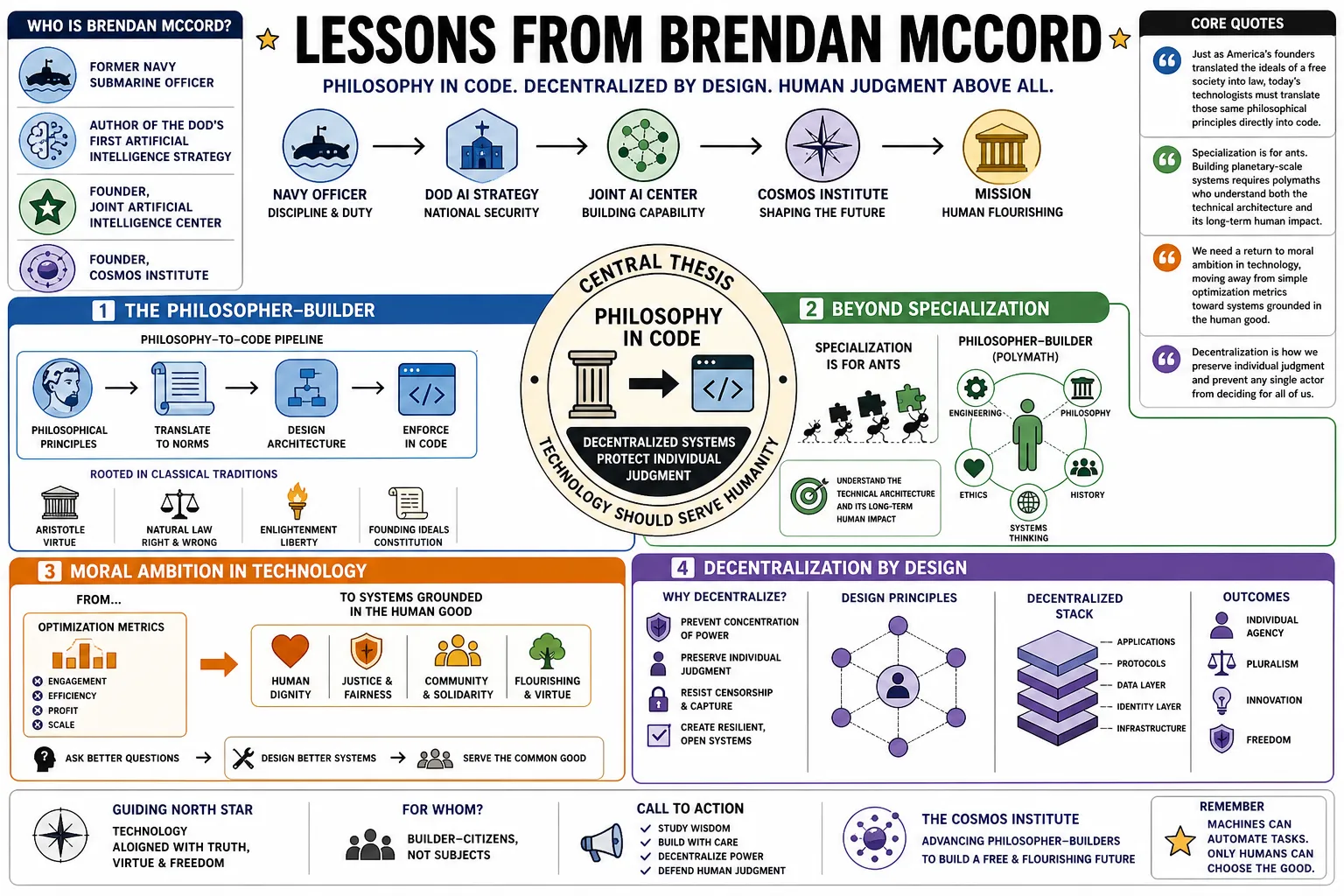
Brendan McCord is a former Navy submarine officer who authored the Department of Defense's first artificial intelligence strategy and founded the Joint Artificial Intelligence Center. He later established the Cosmos Institute to promote the concept of "philosopher-builders," arguing that technologists must embed classical philosophy directly into code to prevent machines from making moral decisions for humans. This profile collects his core ideas on how to build decentralized technology that resists central control and preserves individual judgment.
Part 1: The "Philosopher-Builder" and the Cosmos Institute
- On the philosophy-to-code pipeline: "Just as America's founders translated the ideals of a free society into law, today’s technologists must translate those same philosophical principles directly into code." — Cosmos Institute: AI & Human Flourishing]
- On the danger of specialization: "Specialization is for ants. Building planetary-scale systems requires polymaths who understand both the technical architecture and its long-term human impact." — Joe Lonsdale: Blog & Perspectives]
- On moral ambition in Silicon Valley: "We need a return to moral ambition in technology, moving away from simple optimization metrics toward systems grounded in the timeless wisdom of Western civilization." — Johnathan Bi: About & Great Books Series]
- On the founding of the Cosmos Institute: "The institute was built to cultivate 'philosopher-builders' who can guide AI development toward human flourishing rather than mere automation." — Chartwell Speakers: Brendan McCord Profile]
- On bridging two disciplines: "We cannot leave the future of AI solely to pure philosophers or pure engineers; the future belongs to those comfortable with both Aristotle and PyTorch." — Cosmos Institute: AI & Human Flourishing]
- On the legacy of Cicero: "The historical archetype for the technologist should be Cicero—a man of deep philosophical inquiry who was equally committed to action and statecraft." — Cosmos Institute on Substack: Essays Archive]
- On the function of wisdom: "The true function of wisdom in engineering is the capacity to discriminate between good and evil in the systems we choose to scale." — Cosmos Institute: AI & Human Flourishing]
- On open-source software: "Abstract philosophical concepts like autonomy and decentralization are meaningless until they are explicitly compiled into open-source software and transparent algorithms." — University of Oxford: Overview]
- On dogmatism in tech: "I look at dogmatism as a form of brain death that prevents builders from seeing the human consequences of their platforms." — Joe Lonsdale: Blog & Perspectives]
- On funding new paradigms: "Through fellowships and grants, we must financially back researchers who pair technical excellence with a rigorous defense of human agency." — Chartwell Speakers: Brendan McCord Profile]
Part 2: Cosmos vs. Taxis: Two Visions of AI
- On spontaneous order (Cosmos): "Cosmos is order that emerges organically from below, representing a decentralized approach to AI where tools empower individual interactions rather than centralized mandates." — Cosmos Institute: AI & Human Flourishing]
- On planned order (Taxis): "Taxis is the 'Philosopher King' model of AI—top-down, centralized control that assumes a single intelligent system can design a perfect blueprint for society." — Cosmos Institute on Substack: Essays Archive]
- On Hayekian knowledge: "Knowledge is generated through evolution, protected through decentralized challenge, and best utilized where it naturally resides—at the edges of the network." — Cosmos Institute: AI & Human Flourishing]
- On the illusion of perfect control: "The desire for perfect control over human behavior through AI is a dangerous trap that inevitably hollows out individual agency." — Johnathan Bi: About & Great Books Series]
- On resisting centralization: "We must actively build systems that resist capture and central surveillance, prioritizing distributed networks over monolithic models." — Panmure House: Programmes & Adam Smith Legacy]
- On scenario agnosticism: "Instead of trying to predict or perfectly control every future state of AI, we should focus on building resilient, decentralized architectures capable of adapting to the unknown." — Chartwell Speakers: Brendan McCord Profile]
- On the nature of complex systems: "Planetary-scale technologies cannot be safely managed through top-down mandates; their safety emerges from the distributed resilience of their users." — Big Think: The Future of Technology & Humanity]
- On the danger of centralized AI: "When AI governance defaults to Taxis, it inevitably becomes a mechanism for surveillance rather than a tool for human empowerment." — Cosmos Institute on Substack: Essays Archive]
- On building for edges: "The most robust AI architectures are those that distribute computation and decision-making power to the extreme edges of the network." — Forbes: Innovation & Technology]
Part 3: Project Maven and the Department of Defense
- On the founding of the JAIC: "Establishing the Joint Artificial Intelligence Center required cutting through institutional red tape to translate theoretical research into concrete operational capabilities." — FedScoop: Defense Tech & National Security]
- On authoring the DoD AI Strategy: "The inaugural strategy focused heavily on balancing speed and agility with the mandatory deployment of ethically-guided capabilities." — Defense One: National Security Policy]
- On the legacy of Project Maven: "Maven demonstrated that the Department of Defense could move beyond legacy acquisition models to field computer vision tools at the speed of commercial technology." — Chartwell Speakers: Brendan McCord Profile]
- On ethical AI principles in defense: "Developing the Pentagon's Ethical Principles for Artificial Intelligence was a necessary prerequisite for scaling machine learning responsibly in high-stakes environments." — Chartwell Speakers: Brendan McCord Profile]
- On National Mission Initiatives: "To create real impact, we established National Mission Initiatives that forced different silos within the military to collaborate on shared, urgent AI applications." — FedScoop: Defense Tech & National Security]
- On bridging Silicon Valley and the Pentagon: "The primary challenge at the Defense Innovation Unit was creating a shared language between technologists focused on disruption and a military focused on stability." — Big Think: The Future of Technology & Humanity]
- On transitioning prototypes to programs: "The true test of an innovation unit is not building a successful prototype, but successfully injecting that prototype into the permanent institutional bloodstream." — Defense One: National Security Policy]
- On the CHIPS and Science Act: "The earliest prototypes for what became the CHIPS Act were born from a realization that software advantages are meaningless without secure hardware supply chains." — Chartwell Speakers: Brendan McCord Profile]
- On the 'Third Offset Strategy': "AI represents the core of the Third Offset, shifting the military's advantage from pure hardware volume to speed of analysis and decision superiority." — Chartwell Speakers: Brendan McCord Profile]
Part 4: The Threat of "Soft Despotism" and "Autocomplete for Life"
- On the autocomplete for life: "AI threatens to become an 'autocomplete for life,' stepping beyond suggesting our next word to suggesting our next action, job, and relationship." — Cosmos Institute on Substack: Essays Archive]
- On Tocquevillian soft despotism: "The most realistic danger of AI is a soft despotism that does not crush the human will, but rather softens, bends, and guides it until it becomes obsolete." — Cosmos Institute: AI & Human Flourishing]
- On cognitive atrophy: "By routinely outsourcing small decisions to algorithms for the sake of convenience, we risk the permanent atrophy of our capacity for independent judgment." — Joe Lonsdale: Blog & Perspectives]
- On the illusion of convenience: "When technology removes all friction from decision-making, it simultaneously removes the effort required to form a distinct personal identity." — Cosmos Institute on Substack: Essays Archive]
- On AI deference: "As machines become more articulate, humans increasingly defer to them on moral and aesthetic judgments, abdicating our responsibility to think." — Panmure House: Programmes & Adam Smith Legacy]
- On the value of internal mind: "Your mind is ultimately all you have. If AI begins doing the heavy lifting of reasoning for you, you forfeit your core humanity." — Johnathan Bi: About & Great Books Series]
- On the race to stay useful: "The anxiety of trying to remain economically 'useful' against superior models is a trap that degrades human dignity." — Cosmos Institute on Substack: Essays Archive]
- On the automation of purpose: "We must fiercely protect the domain of purpose-setting; AI can help execute our goals, but it must never be allowed to select them." — Cosmos Institute: AI & Human Flourishing]
- On frictionless living: "A frictionless life guided by predictive algorithms is ultimately a life devoid of the struggles that generate wisdom." — Forbes: Innovation & Technology]
- On algorithmic conformity: "When millions of people rely on the same few models for advice, we risk an unprecedented homogenization of human thought and culture." — Big Think: The Future of Technology & Humanity]
Part 5: Human Autonomy and "Bildung" (Self-Authorship)
- On the concept of Bildung: "The Prussian tradition of Bildung emphasizes self-cultivation and self-authorship, a concept that must remain at the center of how we design educational AI." — Cosmos Institute on Substack: Essays Archive]
- On the practice of agency: "Human autonomy is not a default state that AI can simply protect; it is a lived practice that must be continuously exercised." — Cosmos Institute: AI & Human Flourishing]
- On instrumental technology: "Technology must remain strictly instrumental—a set of tools designed to enhance human potential rather than an oracle that dictates human behavior." — Johnathan Bi: About & Great Books Series]
- On designing for friction: "In some domains, we must deliberately design 'positive friction' into AI systems to force users to pause and exercise moral reasoning." — Panmure House: Programmes & Adam Smith Legacy]
- On protecting the inner life: "The ultimate goal of decentralized technology is to erect a barrier around the individual's inner life, shielding it from external algorithmic optimization." — Cosmos Institute on Substack: Essays Archive]
- On self-direction: "A flourishing society requires citizens capable of self-direction, meaning AI tools must be evaluated by whether they increase or decrease our independent capabilities." — Chartwell Speakers: Brendan McCord Profile]
- On the limits of efficiency: "If we prioritize efficiency above all else, we will inevitably engineer systems that bypass the slow, messy process of human growth." — Big Think: The Future of Technology & Humanity]
- On AI as a sparring partner: "The highest use of artificial intelligence is not as a replacement for human intellect, but as an adversarial sparring partner that sharpens our reasoning." — University of Oxford: Overview]
- On true human flourishing: "Flourishing is not the absence of difficulty provided by a machine, but the active, rigorous engagement with reality." — Cosmos Institute: AI & Human Flourishing]
Part 6: Epistemology, Truth, and the Existential Risk Debate
- On the existential risk movement: "The existential pessimist framework is essentially three philosophies in a trench coat: pure rationalism, effective altruism, and rigid long-termism." — Joe Lonsdale: Blog & Perspectives]
- On the dangers of EA: "Over-indexing on narrow utilitarianism and extreme risk avoidance often leads directly to calls for centralized, global surveillance." — Cosmos Institute: AI & Human Flourishing]
- On the epistemic shift: "AI is fundamentally altering the traditional infrastructure of human knowledge, shifting us from a paradigm of careful generation to instantaneous, massive dissemination." — Cosmos Institute on Substack: Essays Archive]
- On truth-seeking: "The ability to inquire openly and correct errors is the foundation of science; AI models must be designed to facilitate this truth-seeking rather than enforcing a consensus." — Cosmos Institute: AI & Human Flourishing]
- On the cost of risk-zero: "Demanding a 'risk-zero' environment for artificial intelligence deployment is a mathematical impossibility that stifles the very innovation needed to solve structural problems." — Johnathan Bi: About & Great Books Series]
- On the illusion of neutrality: "There is no epistemologically neutral algorithm; every model contains the embedded philosophical assumptions of the engineers who aligned it." — University of Oxford: Overview]
- On decentralized truth: "Truth is more reliably arrived at through the clash of multiple, decentralized models rather than the output of a single, highly regulated 'safe' oracle." — Panmure House: Programmes & Adam Smith Legacy]
- On the limits of rationalism: "Pure rationalism fails to account for the tacit, uncodifiable knowledge that exists within human traditions and institutions." — Cosmos Institute on Substack: Essays Archive]
- On human judgment: "The final node in any epistemic network must remain human judgment, as algorithms cannot bear the moral weight of being wrong." — Big Think: The Future of Technology & Humanity]
Part 7: Decision-Making, Probability, and the Submarine Experience
- On underwater lessons: "Spending 610 days underwater teaches you that operating in high-stakes, isolated environments demands a profound reliance on decentralized trust." — Chartwell Speakers: Brendan McCord Profile]
- On probabilistic thinking: "Thinking in binary terms of yes/no or black/white often leads to tragedy; we must build systems that understand and communicate in a probabilistic world." — Joe Lonsdale: Blog & Perspectives]
- On imperfect information: "The most critical leadership decisions are always made with imperfect information; AI should clarify the uncertainty, not pretend to eliminate it." — Brendan McCord: Official Profile]
- On the failure of central planning: "A submarine crew survives because the systems are designed for local resilience, proving that rigid central planning fails under acute stress." — Chartwell Speakers: Brendan McCord Profile]
- On stress-testing models: "Models, like naval crews, must be subjected to extreme, unpredicted edge cases to discover their true operational boundaries." — Big Think: The Future of Technology & Humanity]
- On accountability in crisis: "When a system fails under pressure, the architecture must ensure that human accountability is clear, immediate, and unavoidable." — Defense One: National Security Policy]
- On the fog of data: "In modern conflict, the problem is rarely a lack of data, but the overwhelming fog generated by an inability to parse signal from noise at speed." — Chartwell Speakers: Brendan McCord Profile]
- On building for failure: "Engineers must assume that their systems will eventually be compromised or fail; true security lies in how gracefully the system degrades." — FedScoop: Defense Tech & National Security]
- On leadership under pressure: "The highest form of operational leadership is remaining calm enough to question your own assumptions when the data confirms your worst fears." — Brendan McCord: Official Profile]
Part 8: Technology, Statecraft, and the Future of Entrepreneurship
- On the dual nature of startups: "Successful AI entrepreneurship requires balancing the rapid iteration of commercial markets with a deep respect for the long-term implications of the product." — Brendan McCord: Official Profile]
- On enterprise strategy: "For large organizations, an effective AI strategy is less about adopting specific tools and more about reorganizing data architectures to allow for continuous adaptation." — Chartwell Speakers: Brendan McCord Profile]
- On acquiring innovation: "Acquisitions in the AI space fail when the acquiring enterprise attempts to assimilate the startup's technology without adopting its speed of execution." — Forbes: Innovation & Technology]
- On the role of policy: "Government policy should not dictate the specific architectures of AI, but rather establish the broad, pro-liberty guardrails within which innovation occurs." — Cosmos Institute: AI & Human Flourishing]
- On technological statecraft: "We have entered an era of technological statecraft, where the geopolitical balance of power is determined by the speed of private sector software development." — Chartwell Speakers: Brendan McCord Profile]
- On competing with adversaries: "The U.S. advantage lies in our decentralized, open-market approach to innovation; attempting to beat state-directed economies by copying their centralized models is a guaranteed failure." — Defense One: National Security Policy]
- On the value of open source: "Open-source AI is a critical matter of national security, as it ensures that fundamental capabilities remain transparent, scrutinized, and broadly distributed." — University of Oxford: Overview]
- On commercializing defense tech: "The most effective defense technologies are those that have a dual-use commercial application, ensuring they are continuously hardened by market forces." — FedScoop: Defense Tech & National Security]
- On the future of the firm: "AI will drastically reduce the transaction costs of coordinating labor, leading to leaner, highly-leveraged companies built around a few philosopher-builders." — Big Think: The Future of Technology & Humanity]
- On the ultimate goal: "The end state of all technological progress must not be a perfectly managed world, but a world that maximizes the capacity for human agency and virtue." — Cosmos Institute on Substack: Essays Archive]