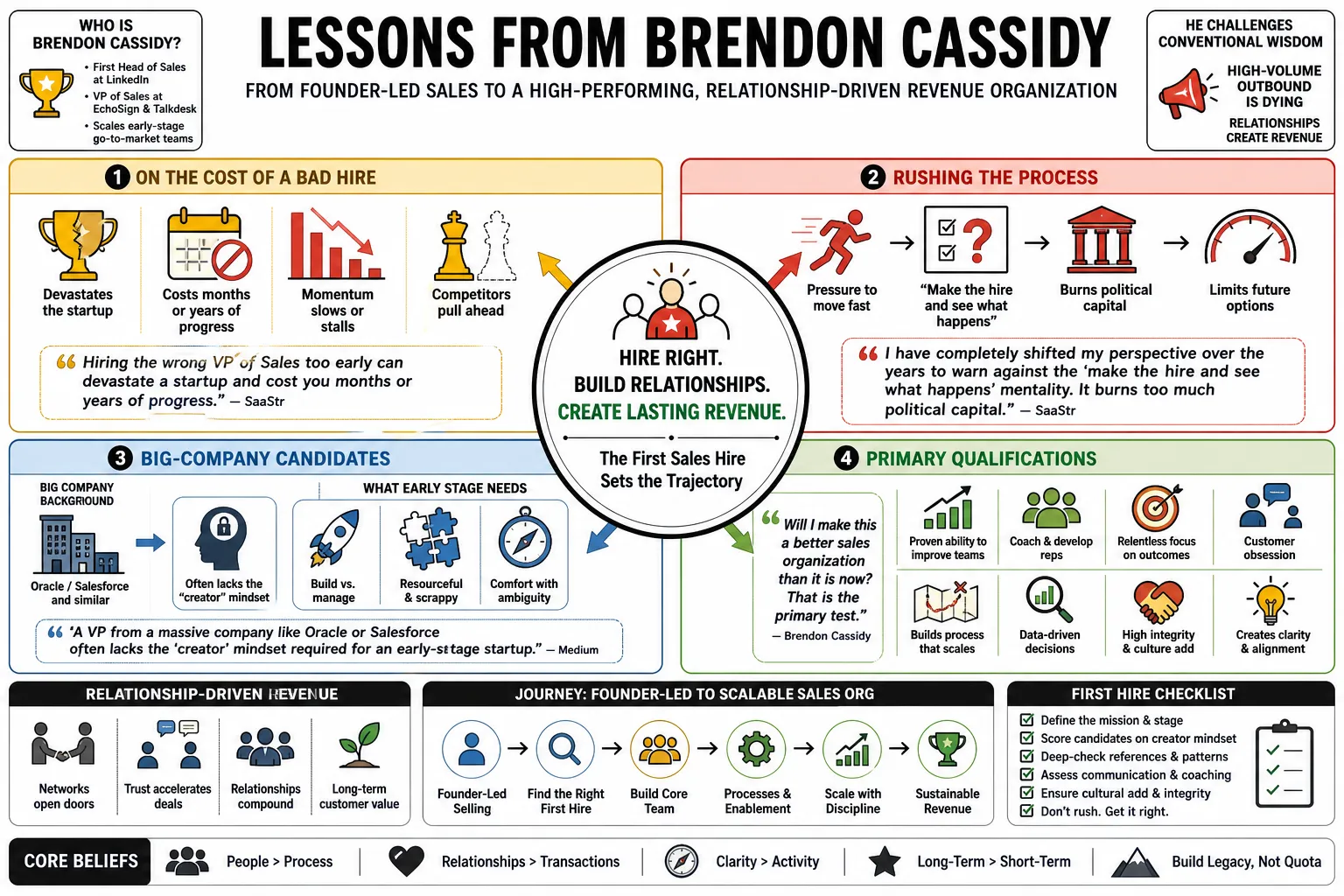
Brendon Cassidy was the 15th employee and first head of sales at LinkedIn, 10th employee and VP of Sales at EchoSign, and fifth employee and VP of Sales at Talkdesk. He later advised startups on hiring sales leaders and co-founded Cosell. — SaaStr: "The Playbook to Hiring Your First VP of Sales and Not Screwing it Up with Brendon Cassidy" (video + transcript).
Part 1: Hiring the First Sales Leader
- On the Odds of a First VP of Sales: Cassidy: "Roughly about eight out of ten first VP Sales hires for startups will also fail," and if you get it wrong "you're going to lose one year of your startup life." — SaaStr: "The Playbook to Hiring Your First VP of Sales and Not Screwing it Up with Brendon Cassidy" (video + transcript).
- On Finding a Friend: Step one, Cassidy says, is to "find somebody that's been a VP of Sales before successfully in a startup" and make that person "an independent arbiter of that process." — SaaStr: "The Playbook to Hiring Your First VP of Sales and Not Screwing it Up with Brendon Cassidy" (video + transcript).
- On an Objective Voice: Cassidy: investors and search firms "have an agenda… to get somebody in place and check that box as fast as possible," so "have an objective voice with experience. Without it, you're likely to make a mistake." — SaaStr: "The Playbook to Hiring Your First VP of Sales and Not Screwing it Up with Brendon Cassidy" (video + transcript).
- On the Ideal Profile: Cassidy's ideal is a startup VP who has scaled and exited; an acceptable profile is "someone that's been a proven success building through your stage and is ready to go beyond." — SaaStr: "The Playbook to Hiring Your First VP of Sales and Not Screwing it Up with Brendon Cassidy" (video + transcript).
- On Big-Company Candidates: Cassidy: "last resort is somebody out of a big company like Salesforce, Oracle," people you're not comfortable putting into a scenario "without any brand, without customers, without potentially even a pitch and a message." — SaaStr: "The Playbook to Hiring Your First VP of Sales and Not Screwing it Up with Brendon Cassidy" (video + transcript).
- On Aiming High, Low and Middle: Cassidy: "you should be talking to all those levels in parallel," because the odds of landing the dream candidate are low and the best recruiters work "over six months, a year, sometimes more." — SaaStr: "The Playbook to Hiring Your First VP of Sales and Not Screwing it Up with Brendon Cassidy" (video + transcript).
- On No Hire Being Better: Cassidy: "Don't just check the box because the board told you to… You take as long as you need. And in my opinion, no hire is better than the wrong hire." — SaaStr: "The Playbook to Hiring Your First VP of Sales and Not Screwing it Up with Brendon Cassidy" (video + transcript).
- On Who Is Coming With Them: Cassidy: "who's coming with them is a huge factor for me. You're not just vetting the candidate, but you're also vetting the people that they would potentially bring with them." — SaaStr: "The Playbook to Hiring Your First VP of Sales and Not Screwing it Up with Brendon Cassidy" (video + transcript).
- On Younger Leaders With a Team: Cassidy: "I would hire somebody younger, less experienced, but they had four or five great people they could bring with them." — SaaStr: "The Playbook to Hiring Your First VP of Sales and Not Screwing it Up with Brendon Cassidy" (video + transcript).
- On Not Panicking: Cassidy: "I used to be a proponent of make the hire. Make the hire, give it three months. If it doesn't work, pull the rip cord. Not now," because you lose so much political capital and time as a founder. — SaaStr: "The Playbook to Hiring Your First VP of Sales and Not Screwing it Up with Brendon Cassidy" (video + transcript).
Part 2: Transitioning from Founder-Led Sales
- On Promoting From Within: Cassidy suggests that if you have doubts "maybe you can promote from within," a manager to director, a director to head of, or a head of to VP, "but make the absolute right hire." — SaaStr: "The Playbook to Hiring Your First VP of Sales and Not Screwing it Up with Brendon Cassidy" (video + transcript).
- On Everyone Knowing: Cassidy: "most of the time when a startup hires a VP of Sales that's the wrong hire, everybody knows. Right? Everybody knows, all the employees know, all the salespeople know." — SaaStr: "The Playbook to Hiring Your First VP of Sales and Not Screwing it Up with Brendon Cassidy" (video + transcript).
- On Being a Fighter: Asked what matters beyond experience, Cassidy says "you got to have a fighter on some level" and someone who is a "relentless recruiter." — SaaStr: "The Playbook to Hiring Your First VP of Sales and Not Screwing it Up with Brendon Cassidy" (video + transcript).
- On a Pathological Meritocracy: Cassidy: "I think you have to have no taste for politics. There's no place for politics and bureaucracy. It's like a pathological meritocracy." — SaaStr: "The Playbook to Hiring Your First VP of Sales and Not Screwing it Up with Brendon Cassidy" (video + transcript).
- On Liking the Founder: Cassidy: "A founder that you truly like and truly respect is critical. I would say that's number one for me personally." — SaaStr: "The Playbook to Hiring Your First VP of Sales and Not Screwing it Up with Brendon Cassidy" (video + transcript).
- On Stretch VPs Proving They Can Hire: Brendon Cassidy: "Stretch VPs have to prove they can hire, period. If they can’t they’re dead." — The Benefits of Hiring a Stretch VP of Sales (and The Risks) | SaaStrAI.
- On Watching the First 30 Days: Brendon Cassidy: "Be worried if they bring no one in within 30 days." — The Benefits of Hiring a Stretch VP of Sales (and The Risks) | SaaStrAI.
- On Revenue Tilting Upward: Brendon Cassidy: "Revenue has to tilt upwards within 3 months. Otherwise move on." — The Benefits of Hiring a Stretch VP of Sales (and The Risks) | SaaStrAI.
- On Hiring a VP of Sales: Brendon Cassidy: "Hiring a VP of Sales in a startup is an incredibly hard thing." — The Benefits of Hiring a Stretch VP of Sales (and The Risks) | SaaStrAI.
- On Hiring the VP's Number Two: Brendon Cassidy: "But hire the VP’s #2. Trust me. You’ll be better off." — The Benefits of Hiring a Stretch VP of Sales (and The Risks) | SaaStrAI.
Part 3: Building the Initial Sales Team
- On Hiring SDRs Before AEs: Cassidy: "If you have no leads, don't hire account executives. Hire SDRs." — SaaStr AMA: "Building Your First SDR Team with Brendon Cassidy and Kyle Porter" (2015).
- On the Return of the Cold Call: Cassidy: "The re-emergence of the cold call as an integral part of the workflow is undeniable." — SaaStr AMA: "Building Your First SDR Team with Brendon Cassidy and Kyle Porter" (2015).
- On Growth Without Leads: Cassidy: "If you have no leads, don't expect yourself to be growing 60 percent month over month out of the gate." — SaaStr AMA: "Building Your First SDR Team with Brendon Cassidy and Kyle Porter" (2015).
- On Outbound Fatigue: Cassidy: "I do think at some point, you're going to hit some sort of fatigue if you're 100 percent outbound," unless price points support slower sales cycles, so "there has to be a component on both sides." — SaaStr AMA: "Building Your First SDR Team with Brendon Cassidy and Kyle Porter" (2015).
- On Hiring Sales Development Early: Cassidy: "if you don't have any marketing-driven demand early, then you should hire a VP or head of sales development early." — SaaStr AMA: "Building Your First SDR Team with Brendon Cassidy and Kyle Porter" (2015).
- On Keeping Sales Focused on Sales: Cassidy, on making a sales development leader early: "you do want sales focused on sales as much as possible." — SaaStr AMA: "Building Your First SDR Team with Brendon Cassidy and Kyle Porter" (2015).
- On the Death of the Rolodex: On why AEs should not drive their own pipeline, Cassidy calls it "death of the Rolodex and the traditional enterprise selling mentality," and says "Unless you have a Viva type deal ASP, then you'll burn through that Rolodex really quick." — SaaStr AMA: "Building Your First SDR Team with Brendon Cassidy and Kyle Porter" (2015).
- On First Fruits Versus the Bounty: Cassidy: "The first fruits you should see in 60 days, 90 days. Seeing the first fruits versus seeing the bounty, are two completely different things." — SaaStr AMA: "Building Your First SDR Team with Brendon Cassidy and Kyle Porter" (2015).
- On Nine to Twelve Months: Cassidy says great sales development leaders "they'll tell you it takes 9-12 months to get their SDR organization running the way they want to run it." — SaaStr AMA: "Building Your First SDR Team with Brendon Cassidy and Kyle Porter" (2015).
- On Longer Sales Cycles: Cassidy: "I've never seen a scenario where it took shorter or even equivalent," and people who claim otherwise "they're full of it most of the time." — SaaStr AMA: "Building Your First SDR Team with Brendon Cassidy and Kyle Porter" (2015).
Part 4: The Fall of Traditional Outbound
- On Prospecting Not Being a Numbers Game: Cassidy: "prospecting can't just be a numbers game." — CustomerThink: Sales Pipeline Radio Episode 239, Q&A with Brendon Cassidy of CoSell.io (2021).
- On Brute Force: Cassidy: "Every problem has a brute force solution, which is just more emails, more cold calls, whatever it is, that's not true and there's a cost to that." — CustomerThink: Sales Pipeline Radio Episode 239, Q&A with Brendon Cassidy of CoSell.io (2021).
- On the Full-Stack Seller: Cassidy: "the concept of a full stack account executive or a full stack salesperson has essentially gone out the window." — CustomerThink: Sales Pipeline Radio Episode 239, Q&A with Brendon Cassidy of CoSell.io (2021).
- On Separation of Church and State: Cassidy: "we've moved into this separation of church and state model around sales where you have the SDR demand gen side and then you have the sales side." — CustomerThink: Sales Pipeline Radio Episode 239, Q&A with Brendon Cassidy of CoSell.io (2021).
- On the Inherent Advantage of Introductions: Cassidy: "If you're in the door through an introduction, a qualified introduction from somebody that the prospect knows, you have an inherent advantage." — CustomerThink: Sales Pipeline Radio Episode 239, Q&A with Brendon Cassidy of CoSell.io (2021).
- On Marketing Alongside Outbound: Brendon Cassidy: "I do believe as great as the outbound evolution has been, marketing plays a role, and there has to be a component on both sides." — SaaStr AMA: Building Your First SDR Team with Brendon Cassidy (EchoSign/LinkedIn) and Kyle Porter (SalesLoft) | SaaStrAI.
- On Outbound Fatigue: Brendon Cassidy: "I do think at some point, you’re going to hit some sort of fatigue if you’re 100 percent outbound, unless you have such high price points that support maybe a little bit slower sales cycle, and some other factors there." — SaaStr AMA: Building Your First SDR Team with Brendon Cassidy (EchoSign/LinkedIn) and Kyle Porter (SalesLoft) | SaaStrAI.
- On Simplifying at Every Turn: Brendon Cassidy: "Bottom line: the focus needs to be on simplifying at every turn, driving strong black and white themes, and hustling 24 hours a day, 7 days a week." — How We Increased Sales Nearly 100% In One Quarter | SaaStrAI.
- On Coachable SDRs: Brendon Cassidy: "people that have the characteristics that are coachable that you can mold and develop in the way that you do it" — www.youtube.com/watch?v=i9101jnEN80.
Part 5: Pipeline Generation in the Modern Era
- On Partners With Parallel Motions: Cassidy on CoSell: "if I can find a company that has a parallel go-to-market motion with me, meaning they are selling to the same people I am but we're not competing against them, why would I not want to join forces with them?" — CustomerThink: Sales Pipeline Radio Episode 239, Q&A with Brendon Cassidy of CoSell.io (2021).
- On Low-Hanging Fruit: Cassidy calls partner overlap "the lowest hanging fruit I can possibly imagine from a sales and marketing standpoint in the last 20 years." — CustomerThink: Sales Pipeline Radio Episode 239, Q&A with Brendon Cassidy of CoSell.io (2021).
- On Another 10,000 Emails: Cassidy: the alternative to finding overlap is "Let's go send another 10,000 emails. And that seems to be the mentality and changing that behavior for me is the most important thing I could do in my career." — CustomerThink: Sales Pipeline Radio Episode 239, Q&A with Brendon Cassidy of CoSell.io (2021).
- On Knowing the Customer's Psychology: Brendon Cassidy: "you should know what their problems are and what their psychology is before you ever get on the" — www.youtube.com/watch?v=i9101jnEN80.
- On Partner Managers Alone: Brendon Cassidy: "You can’t get it through a single partner manager trying to mine deals through partners while you have 30 salespeople over here going their own way." — Sales Pipeline Radio, Episode 239: Q & A Brendon Cassidy @CoSell_io | CustomerThink.
- On Hiring Off the Street: Brendon Cassidy: "your first sales hires are just off the street it's a bad sign" — www.youtube.com/watch?v=i9101jnEN80.
- On Sales Resumes: Brendon Cassidy: "I've never seen a sales resume that was 100% honest and so it's really really hard to assess salespeople" — www.youtube.com/watch?v=i9101jnEN80.
- On a Unanimous Panel: Brendon Cassidy: "we would say it has to be unanimous all of us have to sign off on this person" — www.youtube.com/watch?v=i9101jnEN80.
- On Hiring in Network: Brendon Cassidy: "obviously I want to hire in Network for my first three to five hires" — www.youtube.com/watch?v=i9101jnEN80.
Part 6: Sales Compensation and Culture
- On the EchoSign Model: Brendon Cassidy: "I would say the echosign model is a great model for times like this" — www.youtube.com/watch?v=i9101jnEN80.
- On Paying a High Commission Rate: Brendon Cassidy: "The only way good people are going to come to your company is if you pay them a high commission rate." — 10 Rules to Being a VP of Sales in a Startup | SaaStrAI.
- On Equal Opportunity: Brendon Cassidy: "What’s most important is that salespeople have an equivalent opportunity to be successful." — How We Increased Sales Nearly 100% In One Quarter | SaaStrAI.
- On Proven Internal Talent: Brendon Cassidy: "taking the people that have proven they can do it" — www.youtube.com/watch?v=i9101jnEN80.
- On Feeling a Missed Commit: Brendon Cassidy: "they have to feel that or what's the point of committing deals" — www.youtube.com/watch?v=i9101jnEN80.
- On Quarters as Darkness: Brendon Cassidy: "In a startup, quarters are like living in darkness for 60 days." — Your Quickest Way to Grow Faster: Move from Quarterly to Monthly Quotas. Today. Now. | SaaStrAI.
- On Complexity and Excuses: Brendon Cassidy: "Trying to make it more complex in a startup creates more excuses for failure." — 10 Rules to Being a VP of Sales in a Startup | SaaStrAI.
- On Monthly Quotas: Brendon Cassidy: "So if your ASP is under 80K, and your average sales cycle is 4 months or less, which is mostly every SaaS startup ever, months are better." — Your Quickest Way to Grow Faster: Move from Quarterly to Monthly Quotas. Today. Now. | SaaStrAI.
- On Structure and Culture: Brendon Cassidy: "Your job is to create a structure and culture that breeds success and hopefully…you know…some fun" — 10 Rules to Being a VP of Sales in a Startup | SaaStrAI.
Part 7: Startup Survival and Legacy
- On Legacy: Brendon Cassidy: "Your legacy will be significantly defined by the people you have hired, trained, and mentored." — Brendon Cassidy on Medium: The Only Capital that Endures is Relationship Capital.
- On Startup Odds: Brendon Cassidy: "Understand that 90 out of the 100 startups you talk to are going to fail." — 10 Rules to Being a VP of Sales in a Startup | SaaStrAI.
- On Highs and Lows: Brendon Cassidy: "There will be spectacular highs followed by excruciating lows." — 10 Rules to Being a VP of Sales in a Startup | SaaStrAI.
- On Locking In Primary Themes: Brendon Cassidy: "HackerRank has a lot to show and sell, and needed to step back and lock in on primary themes and messaging." — How We Increased Sales Nearly 100% In One Quarter | SaaStrAI.
- On Prospect Feedback: Brendon Cassidy: "You want to be on those calls, because the things you’re hearing back from those prospects, that’s like product feedback, sentiment, it’s all these things that matter to the heart and soul of an organization." — SaaStr AMA: Building Your First SDR Team with Brendon Cassidy (EchoSign/LinkedIn) and Kyle Porter (SalesLoft) | SaaStrAI.
- On Hard Days: Brendon Cassidy: "I was very early at LinkedIn and, guess what: There were days like that." — Brendon Cassidy on Medium: Get Off Your Ass. Wipe Off the Blood. Get Back in the Fight..
- On No Particular Genius: Brendon Cassidy: "In my book, none of these changes required any particular genius." — How We Increased Sales Nearly 100% In One Quarter | SaaStrAI.
- On Listening to Every Call: Brendon Cassidy: "get them on your head have them listen to every call that you have on the books" — www.youtube.com/watch?v=i9101jnEN80.
Part 8: Lessons from LinkedIn, EchoSign, and Talkdesk
- On Joining LinkedIn Early: Brendon Cassidy: "I was the 15th employee for LinkedIn and their first head of sales, joining the company back in late 2005 when everybody thought it was a spam company." — The Playbook to Hiring Your First VP of Sales and Not Screwing it Up with Brendon Cassidy (Video + Transcript) | SaaStrAI.
- On Growing Like Crazy: Brendon Cassidy: "We built an amazing team, we grew like crazy, and were acquired by Adobe." — Brendon Cassidy on Medium: Don’t Chase Your Own Tail.
- On Advising Startups: Brendon Cassidy: "And so, I consult and advise for startups about 35 startups over the last three, three and a half years." — The Playbook to Hiring Your First VP of Sales and Not Screwing it Up with Brendon Cassidy (Video + Transcript) | SaaStrAI.
- On Handicapping Startups: Brendon Cassidy: "It was a great training ground to learn how to handicap a startup’s chances for success or failure." — 10 Rules to Being a VP of Sales in a Startup | SaaStrAI.
- On Doing This Every Day: Brendon Cassidy: "I do this literally every day with a wide range of startups, helping them in and around hiring a VP of Sales, maybe replacing a VP of Sales." — The Playbook to Hiring Your First VP of Sales and Not Screwing it Up with Brendon Cassidy (Video + Transcript) | SaaStrAI.
- On Starting as a Recruiter: Brendon Cassidy: "I started my career as a tech recruiter, working exclusively with venture-backed startups from 2000-2003." — 10 Rules to Being a VP of Sales in a Startup | SaaStrAI.
- On Joint Partner and Sales Effort: Brendon Cassidy: "So this is going to have to be a joint effort between the partner side of the business and the sales side of the business because the sales side is the only way you can really get distribution for this." — Sales Pipeline Radio, Episode 239: Q & A Brendon Cassidy @CoSell_io | CustomerThink.
- On Repeating Yourself: Brendon Cassidy: "Because if you keep doing the same thing over and over you stop learning." — Brendon Cassidy on Medium: Don’t Chase Your Own Tail.