Brian Chesky is Airbnb’s co-founder and CEO and a Rhode Island School of Design graduate. His design training shapes how he thinks about products, organizations, culture, and leadership. The lessons below focus on his directly documented ideas about hands-on leadership, company design, crisis management, long-term responsibility, and human connection. — Airbnb leadership profile ↗
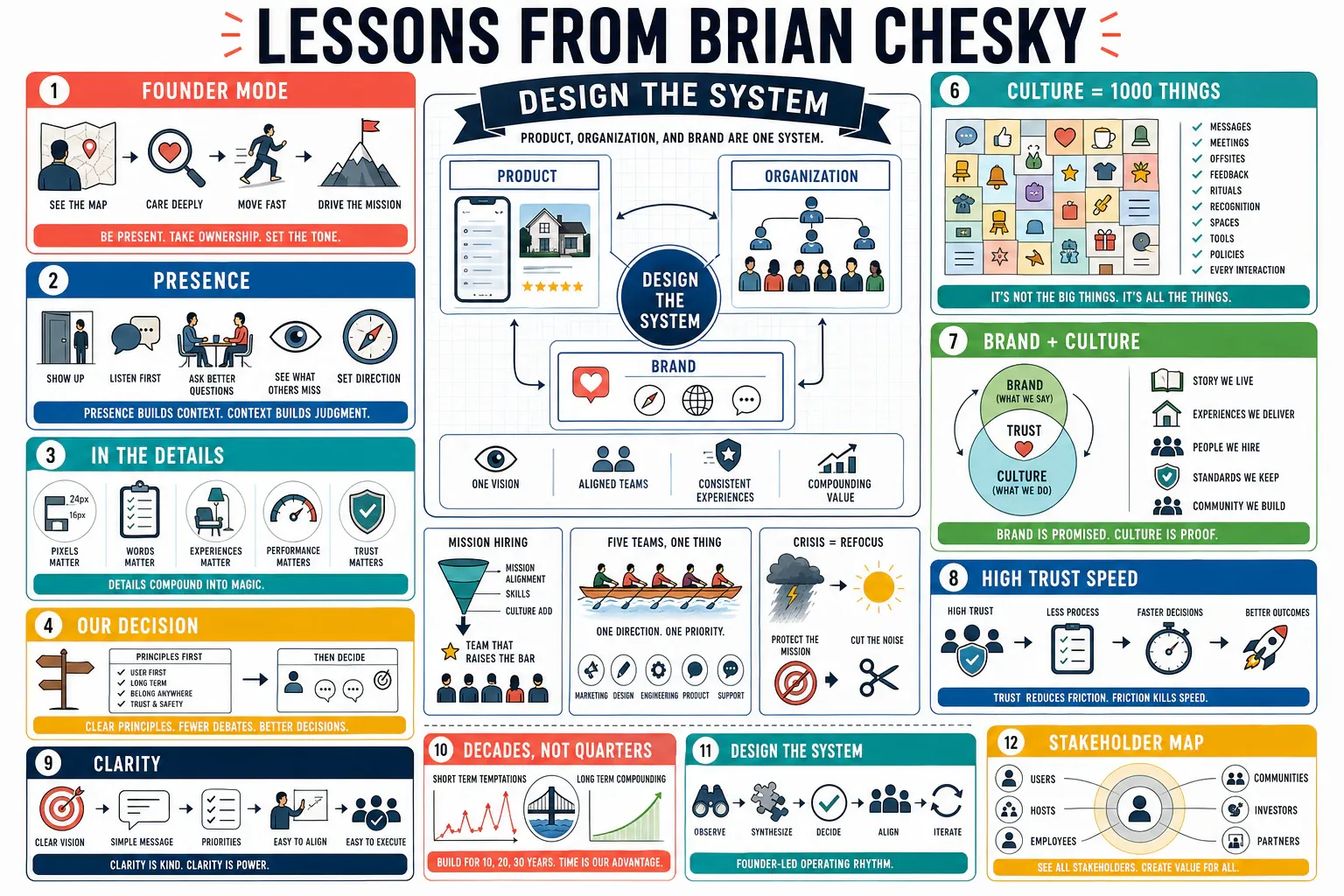
On Unique Leadership Style & "Founder Mode"
- On Leadership Presence: Chesky argues that great leadership is presence, not absence: leaders should stay close to the work without dictating every move. — WIRED conversation ↗ · A Bit of Optimism ↗ · Lenny’s Podcast ↗.
- On Knowing the Work: A responsible board stays close enough to a CEO’s work to judge it; Chesky argues that a CEO owes teams the same informed attention. — Lenny’s Podcast ↗.
- On Micromanagement: Being in the details means working through problems with people; it does not require telling them exactly what to do. — WIRED conversation ↗.
- On Shared Decisions: Chesky rejects the choice between “your decision” and “my decision.” Strong leadership treats the work as a partnership. — A Bit of Optimism ↗.
- On Emotional Tone: In a crisis, the psychology of the leader becomes the psychology of the organization, so grounded optimism and decisiveness matter. — A Bit of Optimism ↗ · Masters of Scale ↗.
- On Leading Authentically: The pandemic pushed Chesky to stop apologizing for wanting to run Airbnb as a designer and to rebuild the company around that conviction. — Figma Config interview ↗ · Lenny’s Podcast ↗.
- On Belief: Chesky calls belief one of a leader’s greatest gifts: seeing more potential in people and challenging them to reach it. — A Bit of Optimism ↗.
On Management and Company Culture
- On Culture as Repetition: Culture is built through thousands of ordinary acts—how a company hires, writes, decides, collaborates, and lives its values. — Brian Chesky’s culture essay ↗
- On Culture and Brand: Chesky describes culture as a company’s internal principles and brand as the external promise those principles eventually produce. — Y Combinator lecture ↗.
- On Trust and Process: Strong culture lets people act independently because shared values guide judgment; weak culture must compensate with heavier rules and process. — Brian Chesky’s culture essay ↗.
- On Employee Advocacy: A company’s external reputation ultimately depends on the people inside it, making employees its most credible brand advocates. — Y Combinator lecture ↗.
- On Functional Expertise: Every leader should understand the work they lead; managing people without understanding their domain separates development from the work itself. — Lenny’s Podcast ↗.
- On Focus: Chesky would rather assign several focused teams to one priority than ask one team to carry several competing priorities. — Lenny’s Podcast ↗.
- On Clarity: People want clear direction and the ability to row together quickly; autonomy without a shared direction creates fragmentation. — Lenny’s Podcast ↗.
- On Mission-Driven Hiring: Chesky distinguishes missionaries from mercenaries and treats commitment to the mission as a serious hiring criterion. — Y Combinator lecture ↗.
- On Team Size: Adding people can slow a project through coordination cost; Chesky favors fewer, more senior people concentrated on fewer priorities. — Lenny’s Podcast ↗.
- On the Waterline: A CEO must first watch anything that could sink the company, then concentrate personal attention on the few areas where they add unusual value. — Vanity Fair conversation ↗.
On Running the Company and Strategy
- On Time Horizon: Chesky argues that a company should be built to endure beyond the next quarter, while still making short-term decisions that advance its long-term vision. — Airbnb open letter ↗.
- On Stakeholders: Airbnb should balance the interests of employees and shareholders, guests and hosts, and the wider communities affected by the company. — Airbnb open letter ↗.
- On Defining Crises: Chesky used Andy Grove’s dictum—that great companies are defined by crisis—to frame the pandemic as a test of Airbnb’s leadership and values. — A Bit of Optimism ↗.
- On Sudden Collapse: Chesky compared losing 80 percent of Airbnb’s revenue in eight weeks to a car traveling 80 miles an hour and slamming on the brakes. — Masters of Scale ↗.
- On Managing Yourself: Chesky says the hardest part of crisis leadership is managing your own psychology so fear does not paralyze the organization. — A Bit of Optimism ↗ · Masters of Scale ↗.
- On Early Love: Following Paul Graham’s advice, Airbnb first sought a small group of users who loved the product instead of a much larger group who merely liked it. — Y Combinator lecture ↗.
- On Product-Led Growth: Create an experience people love enough to tell others about; word of mouth follows from a product worth remembering. — Masters of Scale ↗.
- On Purpose: Chesky asks founders why their company deserves to exist and looks for an answer stronger than somebody else will do it if they do not. — Out of the Crisis ↗.
- On Human Connection: Chesky sees Airbnb’s larger purpose as helping rebuild community and real-world connection, not merely facilitating transactions. — Masters of Scale ↗.
- On Rebuilding: During the pandemic, Airbnb moved from divisions to functions, consolidated work onto one roadmap, cut most projects, and concentrated its strongest people on a few priorities. — Figma Config interview ↗ · Lenny’s Podcast ↗.
On the Importance of Design
- On Design as a System: For Chesky, design is more than appearance or a department; it is a way to simplify and shape the product, the organization, and how decisions get made. — Figma Config interview ↗ · WIRED ↗.
- On a Design Lens: Chesky applies design thinking to Airbnb’s product, roadmap, organizational structure, marketing, and operations—not only to interface details. — Figma Config interview ↗.
- On Design and Business: Chesky argues that a design-led company can improve business performance by reducing parts, projects, layers, and organizational friction. — Figma Config interview ↗.
- On a World of Your Own Design: RISD taught Chesky that human-made systems were designed by someone and could therefore be changed; entrepreneurship let him build a world around chosen values. — Startups.com interview ↗ · Figma Config ↗.
- On Design Partnership: Product managers remain important, but designers should help drive the product rather than serve only as executors of someone else’s specification. — Figma Config interview ↗.
- On Shipping with Pride: Chesky’s quality rule is simple: if the team would not put its name on the work, it should not ship. — Figma Config interview ↗ · Lenny’s Podcast ↗.
- On the 11-Star Exercise: Imagine an impossible, magical experience, then work backward to the ambitious version that is both memorable and feasible. — Masters of Scale ↗.
- On Product Love: The commercial foundation is straightforward: make something people love, keep improving it, and run the business efficiently enough to sustain that work. — A Bit of Optimism ↗.
- On Heart and Imagination: Businesses should make room for creativity alongside analysis; it need not drive every choice, but it must be part of the conversation. — Fast Company interview ↗.
Other Foundational Learnings
- On the Earliest Stage: Chesky jokes that, before traction, the difference between being an entrepreneur and being unemployed can feel like a state of mind. — Jordan Harbinger interview ↗.
- On Conviction: Chesky learned to stop apologizing for how he wanted to run Airbnb and to rely on the principles most natural to him when conditions were darkest. — Figma Config interview ↗.
- On Courage Before Pressure: Courage does not become easier as a company grows; tomorrow may bring more resources, but it also brings more constraints and pressure. — Out of the Crisis ↗.
- On First Principles: Chesky calls dogma the death of entrepreneurship and urges founders to understand underlying principles instead of copying old playbooks. — Out of the Crisis ↗.
- On Creativity at the Table: Creativity should not dictate every business decision, but it must be represented when the organization frames problems and considers alternatives. — Fast Company interview ↗.
- On Seeing Potential: Drawing on John Wooden, Chesky argues that a leader’s job is to see potential people may not yet see in themselves and help them reach it. — Lenny’s Podcast ↗.
- On Connection: Chesky treats loneliness and disconnection as a major social challenge and sees community-building as central to Airbnb’s long-term purpose. — Masters of Scale ↗.
- On Continuous Evolution: Chesky argues that companies are in the change business: preserve a few enduring principles, but remain willing to change everything else. — Out of the Crisis ↗.
Sources
- WIRED: The Evolution of Airbnb
- Lenny’s Podcast: Brian Chesky’s New Playbook
- A Bit of Optimism: The Secret Art of Micromanagement
- Y Combinator: Culture with Brian Chesky and Alfred Lin
- Brian Chesky: Don’t Fuck Up the Culture
- Airbnb: Open Letter on Building a 21st-Century Company
- Masters of Scale: We Died and Were Reborn
- Figma: Navigating the Intersection of Design and Business
- Masters of Scale: Do Things That Don’t Scale
- The Jordan Harbinger Show: Lessons Airbnb Learned to Survive the Pandemic
- Out of the Crisis: Brian Chesky, Part 2
- Startups.com: An Unbelievable Journey
- Vanity Fair: The New Establishment Summit
- Fast Company: Why More Creatives Should Lead Major Companies