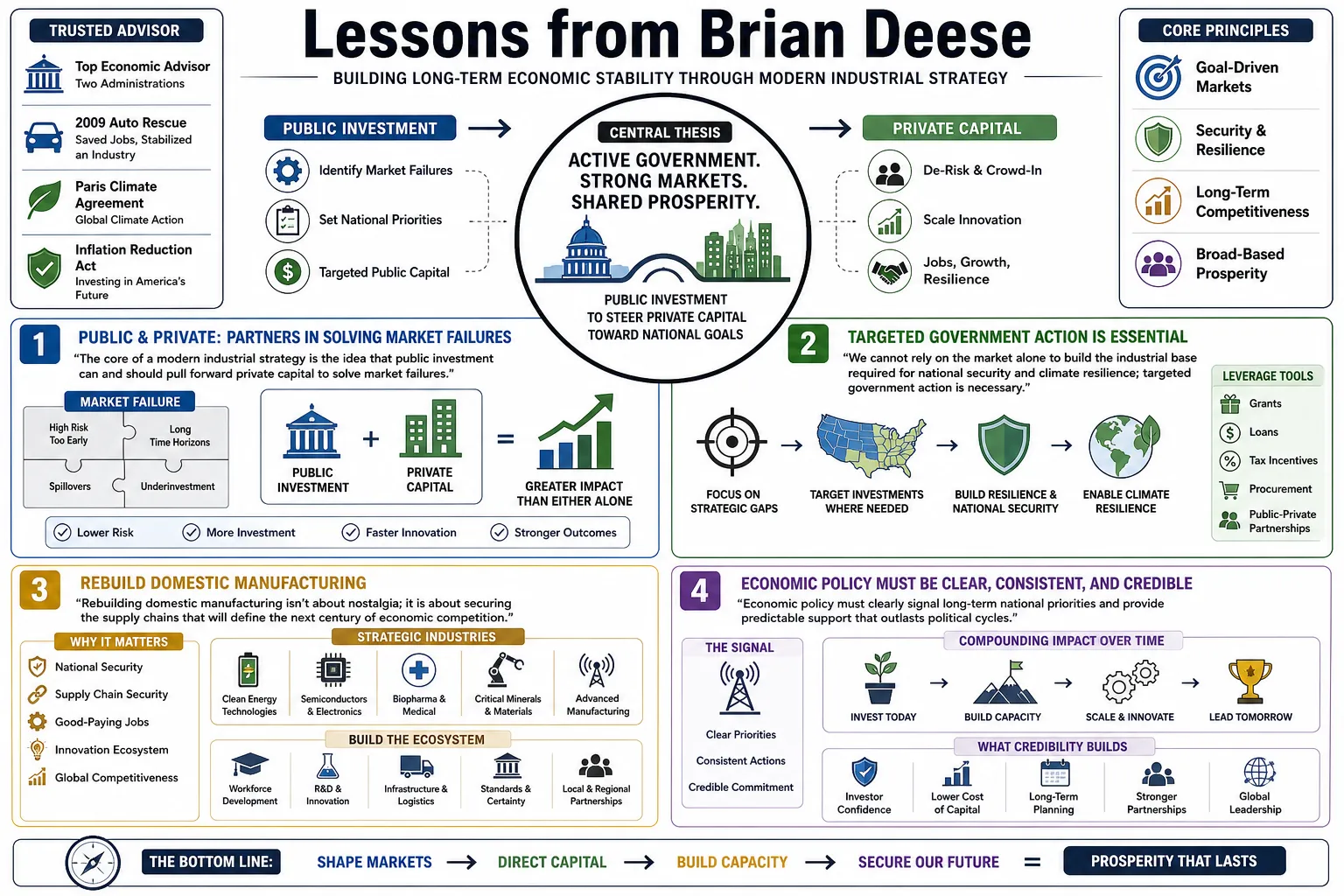
Lessons from Brian Deese
Brian Deese was the thirteenth Director of the National Economic Council under President Biden. Earlier he was President Obama's senior adviser for climate and energy policy and global head of sustainable investing at BlackRock. — Masters in Business (Bloomberg): "Transcript: Brian Deese, NEC Director" (2021).
Part 1: Modern Industrial Strategy
- On Underinvestment: Deese: "the private market on its own, private actors operating to maximize their own utility, will end up under investing in areas of the economy that have strategic and economic significance." — Volts: "Hearing from the author of Biden's industrial strategy" (2023, transcript).
- On Crowding In: Deese: "by using targeted public investment you can unlock greater economic opportunity and crowd in greater private investment in those areas." — Volts: "Hearing from the author of Biden's industrial strategy" (2023, transcript).
- On Not Replacing the Private Sector: Deese: modern industrial strategy "uses public investment to crowd in more private investment, and make sure that the cumulative benefits of this investment strengthen our national bottom line." — AEA: "U.S. Industrial Strategy: remarks by NEC Director Deese, USTR Tai, Treasury Deputy Secretary Adeyemo" (2022).
- On Winners and Losers: Deese: "This is not about having government pick winners and losers." — AEA: "U.S. Industrial Strategy: remarks by NEC Director Deese, USTR Tai, Treasury Deputy Secretary Adeyemo" (2022).
- On the Animating Vision: Deese: "There's a strong animating vision that unifies these laws: a modern American industrial strategy." — AEA: "U.S. Industrial Strategy: remarks by NEC Director Deese, USTR Tai, Treasury Deputy Secretary Adeyemo" (2022).
- On Where Private Industry Falls Short: Deese: it "identifies areas where relying on private industry, on its own, will not mobilize the investment necessary to achieve our core economic and national security interests." — AEA: "U.S. Industrial Strategy: remarks by NEC Director Deese, USTR Tai, Treasury Deputy Secretary Adeyemo" (2022).
- On Public Foundations: Deese points to "the interstate highway system to the intercontinental railroad, where public investments in laying the foundation for private capital helped unlock greater productivity." — Volts: "Hearing from the author of Biden's industrial strategy" (2023, transcript).
- On Modern Supply-Side Economics: Deese describes "making investments to expand our labor supply, build our human capital, renew our public infrastructure, and enhance our economic capacity through R&D and green investments." — AEA: "U.S. Industrial Strategy: remarks by NEC Director Deese, USTR Tai, Treasury Deputy Secretary Adeyemo" (2022).
- On a Different Role for Government: Deese: "these are not your typical market failures. These failures require a different role for government." — Atlantic Council: "Brian Deese on Biden's vision for a twenty-first-century American industrial strategy" (2021, transcript).
- On Permitting: Deese: "we do need to reform and change the way that we do permitting. That's not just an issue of federal permitting, it's state and local." — Volts: "Hearing from the author of Biden's industrial strategy" (2023, transcript).
Part 2: The Clean Energy Transition
- On the Climate Challenge: Deese: "The scale, complexity, and urgency of the climate challenge gets to the heart of why having a forward-looking industrial strategy is so important." — Atlantic Council: "Brian Deese on Biden's vision for a twenty-first-century American industrial strategy" (2021, transcript).
- On Unleashing Private Markets: Deese: public-sector policy and investment are "needed to help unleash the ingenuity of private markets, rapidly mobilizing resources toward decarbonization." — Atlantic Council: "Brian Deese on Biden's vision for a twenty-first-century American industrial strategy" (2021, transcript).
- On a Growing Global Market: Deese: "globally clean energy is going to be one of the fastest-growing markets, whether in vehicles or in the production of clean technologies." — Atlantic Council: "Brian Deese on Biden's vision for a twenty-first-century American industrial strategy" (2021, transcript).
- On Strength at Home: Deese: "Our strength and the robustness of our industry at home will dictate how much of that global market share we can win." — Atlantic Council: "Brian Deese on Biden's vision for a twenty-first-century American industrial strategy" (2021, transcript).
- On Equity: Deese: "equity must run through everything that we do. We must learn from our historical mistakes. Prior economic transformations in the United States have not brought everyone along." — Atlantic Council: "Brian Deese on Biden's vision for a twenty-first-century American industrial strategy" (2021, transcript).
- On Staying Engaged: On the Paris Agreement in 2017, Deese said stepping back "is going to first and foremost put the United States in an impaired position." — Carbon Brief: "The Carbon Brief Interview: Brian Deese" (2017).
- On Unicorns and Fairytales: Deese on limiting warming: "You don't have to believe in unicorns and fairytales to see how that could happen, but we're behind." — Carbon Brief: "The Carbon Brief Interview: Brian Deese" (2017).
- On the Deficit: On the Inflation Reduction Act, Deese says "it actually will bring down the federal deficit." — NPR: "Inflation Reduction Act aims to lower costs in multiple areas of the economy" (2022).
- On Complementing the Fed: Deese: the deficit reduction "will be complementary to what the Federal Reserve is trying to do on inflation." — NPR: "Inflation Reduction Act aims to lower costs in multiple areas of the economy" (2022).
Part 3: The 2009 Auto Industry Rescue
- On Helping Dealers Through Restructuring: Brian Deese: "this step taken today could more than double the number of dealers, auto dealers, eligible for the SBA 7(a) loan program, which is a really important expansion at a time when dealers in the industry overall is going through a very difficult restructuring process." — The American Presidency Project: Press Briefing on Small Business Association Expansion of Eligibility for Loans for Small Business by Eric Zarnikow, Associate Administrator for Capital Access, SBA, and Brian Deese, Economic Advisor to the President | The American Presidency Project.
- On Building the Technologies of the Future Here: Brian Deese: "the administration has also taken a set of -- made a set of investments and made a set of decisions to try to help build a long term, new industry in the United States that’s not just about building the cars of the future, but making sure that the technologies of the future are designed here and made here." — Press Gaggle by Press Secretary Robert Gibbs and Special Assistant to the President for Economic Policy Brian Deese en route Detroit, MI | whitehouse.gov.
- On Independent Company Decisions: Brian Deese: "the decisions that this company, its independent board and its management are making are their decisions." — Press Gaggle by Press Secretary Robert Gibbs and Special Assistant to the President for Economic Policy Brian Deese en route Detroit, MI | whitehouse.gov.
- On Taxpayer Returns: Brian Deese: "if you look at the trend in the projections of the return to taxpayers from this investment, it has been consistently improving." — Press Gaggle by Press Secretary Robert Gibbs and Special Assistant to the President for Economic Policy Brian Deese en route Detroit, MI | whitehouse.gov.
Part 4: Sustainable Investing and Capital Markets
- On Climate Risk as Investment Risk: Brian Deese: "I think the place that we start is with the basic view that climate risk is investment risk." — February 12, 2020 | Video | Amanpour & Company | PBS.
- On Where Climate Risk Falls: Brian Deese: "So, as we look at that question of climate risk, we look at those industries and those areas that are the most likely to be affected." — February 12, 2020 | Video | Amanpour & Company | PBS.
- On Long-Term Financial Outcomes: Brian Deese: "we think about all these issues in the context of what will affect long-term return and what will generate the best long-term financial outcomes for our clients." — February 12, 2020 | Video | Amanpour & Company | PBS.
- On Thermal Coal: Brian Deese: "we think that the investment risks are large enough that in our active portfolios where we have discretion, it’s not worth holding." — February 12, 2020 | Video | Amanpour & Company | PBS.
- On Sustainable Index Versions: Brian Deese: "we have committed to creating sustainable versions of all of the major flagship indices that we offer, so if a client wants to invest with sustainable orientation, they have the ability to do that." — February 12, 2020 | Video | Amanpour & Company | PBS.
- On Engaging Companies: Brian Deese: "we’ll engage directly with them on behalf of our clients to reinforce the importance of the sustainability related issues to long-term issues." — February 12, 2020 | Video | Amanpour & Company | PBS.
Part 5: Infrastructure and Supply Chain Resilience
- On Brittle Supply Chains: Deese: "the embedded risk that we have now seen made explicit around brittle and just in time supply chains." — Volts: "Hearing from the author of Biden's industrial strategy" (2023, transcript).
- On Vulnerability Built Over Decades: Deese: "that vulnerability was exposed by that pandemic, and really sort of built up over the course of years and decades." — Council on Foreign Relations: C. Peter McColough Series on International Economics with Brian Deese (2022, transcript).
- On Unwillingness to Invest: Deese ties it to "an endemic unwillingness of this country to make public investments in ways that generate more productivity, and make the U.S. a more attractive place to invest." — Council on Foreign Relations: C. Peter McColough Series on International Economics with Brian Deese (2022, transcript).
- On Chokepoints: Deese describes "supply chains with multiple chokepoints and bottlenecks that have been unexpected and unanticipated to date." — Atlantic Council: "Brian Deese on Biden's vision for a twenty-first-century American industrial strategy" (2021, transcript).
- On Moving Faster: Deese hopes for "an openness and acceptance, but an enthusiasm around trying to move more quickly rather than putting up roadblocks." — Volts: "Hearing from the author of Biden's industrial strategy" (2023, transcript).
- On Risk Across Value Chains: Brian Deese: "But the issue of risk actually extends far beyond that, to companies in the value chain of energy production, in transportation, in logistics and supply chains around the world." — February 12, 2020 | Video | Amanpour & Company | PBS.
- On Broadband for All Americans: Brian Deese: "In transportation, in energy, in the new digital economy by providing broadband and high-speed internet to all Americans." — C. Peter McColough Series on International Economics With Brian Deese | Council on Foreign Relations.
- On Bipartisan Majorities: Brian Deese: "And in both cases, what you see is large bipartisan majorities—or, bipartisan majorities in Congress supporting the policy direction." — C. Peter McColough Series on International Economics With Brian Deese | Council on Foreign Relations.
- On Workers at the Center: Brian Deese: "But also, the historically equitable nature of this labor market recovery is something that, again, connects to this idea that the President has always centered on, which is putting workers and families at the center of his economic policy." — Press Briefing by Press Secretary Karine Jean-Pierre and National Economic Council Director Brian Deese | The American Presidency Project.
Part 6: Economic Statecraft and Geopolitics
- On China's Rise: Deese: "China's rise in the global economy has been achieved through non market economic means in many instances." — Volts: "Hearing from the author of Biden's industrial strategy" (2023, transcript).
- On Two Answers: Deese gives two reasons for the shift: "The first is the rise of China in the global economic system. And the second is the embedded risk that we have now seen made explicit around brittle and just in time supply chains." — Volts: "Hearing from the author of Biden's industrial strategy" (2023, transcript).
- On Homegrown Capacity: Deese: "there's clear lessons and clear outcomes where having homegrown industrial capacity and the technological and the innovation benefits that come from that is an absolute necessity." — Volts: "Hearing from the author of Biden's industrial strategy" (2023, transcript).
- On Competitors Changing: Deese: "our competitors in a globally competitive market have changed. Principally China, but other countries as well." — Council on Foreign Relations: C. Peter McColough Series on International Economics with Brian Deese (2022, transcript).
- On International Trade Obligations: Brian Deese: "everything we are doing is consistent with our international trade obligations." — C. Peter McColough Series on International Economics With Brian Deese | Council on Foreign Relations.
- On Public Investment With High Returns: Brian Deese: "It’s about investing in our physical infrastructure, our R&D, our human capital areas where we know public investment has a high return, using tools like federal procurement to try to accelerate those goals." — C. Peter McColough Series on International Economics With Brian Deese | Council on Foreign Relations.
- On Partnerships With Allies: Brian Deese: "But having clear partnerships with allies and partners that share our values is an important part of that strategy." — C. Peter McColough Series on International Economics With Brian Deese | Council on Foreign Relations.
- On a Non-Market Environment: Brian Deese: "Principally China, but other countries as well are not—no longer operating in a global environment where there is a free and unfettered market." — C. Peter McColough Series on International Economics With Brian Deese | Council on Foreign Relations.
Part 7: Inflation and Macroeconomic Policy
- On Supply-Side Constraints: On inflation, Deese says the focus is to "help to accelerate the normalization of the supply-side constraints." — Council on Foreign Relations: C. Peter McColough Series on International Economics with Brian Deese (2022, transcript).
- On Scarring: Deese: "a slow recovery, a slow labor market recovery, has extraordinary negative scarring effects for workers, for regions of the country." — Atlantic Council: "Brian Deese on Biden's vision for a twenty-first-century American industrial strategy" (2021, transcript).
- On a Strong Labor Market: Deese: "The labor market is historically strong," with "very strong wage growth as well, particularly for the bottom portion of the income distribution." — Council on Foreign Relations: C. Peter McColough Series on International Economics with Brian Deese (2022, transcript).
- On Fiscal Policy's Aim: Deese: fiscal policy "has been around trying to achieve that strong growth that positions the U.S. to tackle pandemic-related challenges from a position of strength, reduce scarring, help lift lower- and middle-class people up." — Council on Foreign Relations: C. Peter McColough Series on International Economics with Brian Deese (2022, transcript).
- On Monetary Policy: Deese: "monetary policy, acting independently, has tools and tools in place to address that." — Council on Foreign Relations: C. Peter McColough Series on International Economics with Brian Deese (2022, transcript).
- On What Competition Drives: Deese: fair and open competition "drives better outcomes — lower prices, higher wages, more innovation, more economic growth." — Masters in Business (Bloomberg): "Transcript: Brian Deese, NEC Director" (2021).
- On Concentration: Deese: "our economy has gotten less competitive. We have a larger number of our industries that are now more concentrated than they were 20 or 30 years ago." — Masters in Business (Bloomberg): "Transcript: Brian Deese, NEC Director" (2021).
- On Being Pro-Competition: Deese: "this is not about being sort of pro-business or anti-business, this is about being pro-competition." — Masters in Business (Bloomberg): "Transcript: Brian Deese, NEC Director" (2021).
- On Removing Barriers: On over-the-counter hearing aids, Deese says "removing a barrier like that will make it cheaper and, hopefully, will generate more innovation and more opportunity for new business entrants." — Masters in Business (Bloomberg): "Transcript: Brian Deese, NEC Director" (2021).
Part 8: The Role of Government and Markets
- On the NEC's Role: Deese: "the more natural analog is the National Security Council." — Masters in Business (Bloomberg): "Transcript: Brian Deese, NEC Director" (2021).
- On Coordinating: Deese: "The National Economic Council is really designed to coordinate, bringing those views to the table, but also connecting them to the legislative and political realities that we're operating in." — Masters in Business (Bloomberg): "Transcript: Brian Deese, NEC Director" (2021).
- On Public-Private Coordination: Deese: "this coordination between the public and the private sector is critical to solving these asymmetries of information." — Atlantic Council: "Brian Deese on Biden's vision for a twenty-first-century American industrial strategy" (2021, transcript).
- On New Models: Deese: "we are going to need new models of public-private collaboration." — Atlantic Council: "Brian Deese on Biden's vision for a twenty-first-century American industrial strategy" (2021, transcript).
- On Neither Side Alone: Deese: "The public sector can't discern when to intervene on its own and the private sector is struggling to manage through rapidly changing demand." — Atlantic Council: "Brian Deese on Biden's vision for a twenty-first-century American industrial strategy" (2021, transcript).
- On Not Re-Shoring Everything: Deese: "It's neither feasible nor advisable for us to re-shore all of our supply chains. Resilience does not mean closing ourselves to the rest of the world." — Atlantic Council: "Brian Deese on Biden's vision for a twenty-first-century American industrial strategy" (2021, transcript).
- On Allies: Deese: "Partnerships with our allies that promote more stable access to key inputs while improving environmental sustainability and workers' rights is essential." — Atlantic Council: "Brian Deese on Biden's vision for a twenty-first-century American industrial strategy" (2021, transcript).
- On Leading-Edge Semiconductors: Deese: "there are areas like leading-edge semiconductor production where we in the United States do need to have that homegrown capacity." — Volts: "Hearing from the author of Biden's industrial strategy" (2023, transcript).
- On Diversification: Deese: "once you have that capacity and you have more diversification of players who are capable of doing it, you're reducing your vulnerability." — Volts: "Hearing from the author of Biden's industrial strategy" (2023, transcript).
- On Keeping Commitments: On the Paris Agreement, Deese said "Great countries keep their commitments." — Carbon Brief: "The Carbon Brief Interview: Brian Deese" (2017).