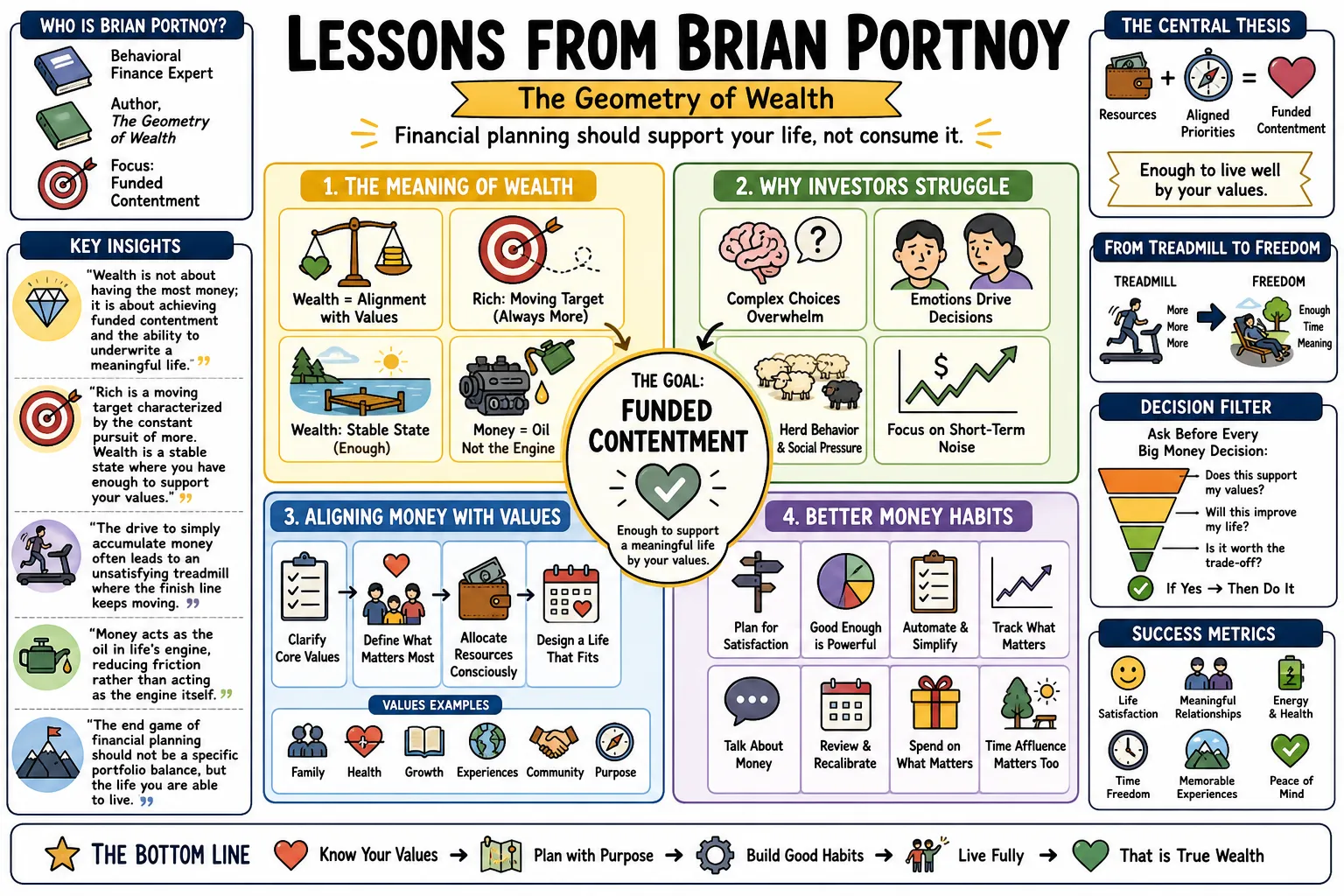
Lessons from Brian Portnoy
Brian Portnoy is a behavioral finance author and the founder of Shaping Wealth. He wrote The Investor's Paradox and The Geometry of Wealth, and co-edited How I Invest My Money with Josh Brown. — Boldin Podcast Episode 75: "A Holistic Approach" (2024, transcript).
Part 1: The Meaning of Wealth
- On True Wealth: Portnoy: "I define true wealth as the ability to underwrite a meaningful life." He calls the phrase "deliberately loaded" and says it invites the questions of what a meaningful life is and what it means to underwrite one. — Rational Reminder Episode 102: "Underwriting a Meaningful Life" (2020, transcript).
- On Rich Versus Wealthy: Portnoy: "rich is a number and wealth is a mindset." — The Psychology of Money with Brian Portnoy (2023, transcript).
- On Quantity and Quality: Portnoy on money: "We're taught to think of it quantitatively, but it's very much a qualitative experience." — Rational Reminder Episode 102: "Underwriting a Meaningful Life" (2020, transcript).
- On Money and Emotion: Portnoy: "I think money is much more of an emotional lightning rod than people give it credit for." He adds that "Money captures many of the things in life that we grapple with hope, joy, fear, regret, envy". — Rational Reminder Episode 102: "Underwriting a Meaningful Life" (2020, transcript).
- On the Treadmill: Portnoy on the hedonic treadmill: "no matter how fast you sprint on a treadmill, you're not going to get any further than you are right now." — Rational Reminder Episode 102: "Underwriting a Meaningful Life" (2020, transcript).
- On Goals: Portnoy: "goals are, in some ways, less important than people make them out to be." — Rational Reminder Episode 102: "Underwriting a Meaningful Life" (2020, transcript).
- On Neighbors: Portnoy recalls J.P. Morgan's line that "nothing corrupts your financial judgment more than the sight of your neighbor getting rich." He adds: "We are social primates." — Rational Reminder Episode 102: "Underwriting a Meaningful Life" (2020, transcript).
- On Talking About Money: Portnoy on teaching financial literacy: "money is not Lord Voldemort, that money is something that we can approach and that we can talk about while at the same time acknowledging that it makes us nervous for a reason." — Rational Reminder Episode 102: "Underwriting a Meaningful Life" (2020, transcript).
- On Funded Contentment: Portnoy: "wealthy is the ability to underwrite a life that's meaningful to you, however you choose to define that, and however you revise that over time through life's unpredictable ups and downs, and the term funded contentment captures that." — Boldin Podcast Episode 75: "A Holistic Approach" (2024, transcript).
Part 2: The Geometry of Wealth
- On the Argument of the Book: Portnoy: "circle, triangle, square, purpose, priorities, decisions, that is the argument of the book. The rest is detail." — Rational Reminder Episode 102: "Underwriting a Meaningful Life" (2020, transcript).
- On the Circle: Portnoy: "we define our purpose at any moment in time. It's a circle because we're never done figuring that out." — Rational Reminder Episode 102: "Underwriting a Meaningful Life" (2020, transcript).
- On the Triangle: Portnoy: "The triangle was built on a stack of three things that I call protect, match, and reach." — Rational Reminder Episode 102: "Underwriting a Meaningful Life" (2020, transcript).
- On Protecting First: Portnoy: "Protect is being less wrong, thinking about risk before return and having that smartly calibrated." — Rational Reminder Episode 102: "Underwriting a Meaningful Life" (2020, transcript).
- On Survival: Portnoy: "those who think about risk first tend to do better. So, survive before you thrive." — Rational Reminder Episode 102: "Underwriting a Meaningful Life" (2020, transcript).
- On Asking What Could Go Wrong: Portnoy: "why don't we first think about what could go wrong here?" — Rational Reminder Episode 102: "Underwriting a Meaningful Life" (2020, transcript).
- On a Clear Mind and Dirty Hands: Portnoy says that between advisor and client, "we need to calibrate purpose and planning and that you have to have both a clear mind and dirty hands." — Rational Reminder Episode 102: "Underwriting a Meaningful Life" (2020, transcript).
- On a Bedrock for Goals: Portnoy: "if we can in a step prior to goals think about, well, what are the deeper sources of meaning that I'm trying to achieve here, we create a bedrock for those ephemeral goals that creates a much more robust financial planning process." — Rational Reminder Episode 102: "Underwriting a Meaningful Life" (2020, transcript).
- On Useful Models: Portnoy: "I love the line that all models are wrong, but some are useful." He says he wanted "to create a useful model for people to think about true wealth." — ReSolve Riffs: "Underwriting Well Being" (transcript).
- On the Personal Model: Portnoy: "the Geometry of Wealth, the circle, triangle, square, that's my personal mental model for living a good life." — Rational Reminder Episode 102: "Underwriting a Meaningful Life" (2020, transcript).
Part 3: The Investor's Paradox
- On Meeting Expectations: Portnoy on The Investor's Paradox: "a successful investment is one that meets your expectations as opposed to beats the market or beats your neighbor's portfolio". — Rational Reminder Episode 102: "Underwriting a Meaningful Life" (2020, transcript).
- On Point Estimates: Portnoy: "We're wired to love point estimates." He says the world "doesn't work that way" and that we should think in ranges of outcomes. — Rational Reminder Episode 102: "Underwriting a Meaningful Life" (2020, transcript).
- On the Cost of Changing Your Mind: Portnoy on liquidity: "For real people, we can just say, Well, what's the cost of changing your mind?" He notes that with a daily-traded fund "you can demonstrate terrible behavior every day." — Rational Reminder Episode 102: "Underwriting a Meaningful Life" (2020, transcript).
- On Information and Choice: Portnoy: "I don't think we've ever had to process more information, or have more choice available to us than at any point before in recorded human history." — ReSolve Riffs: "Underwriting Well Being" (transcript).
- On Funds as Relationships: Portnoy on allocators: "A mutual fund might have a ticker but it's not really a security. It's a relationship of trust." — ReSolve Riffs: "Underwriting Well Being" (transcript).
- On Hedge Funds: Portnoy: "Hedge funds hedge." He adds: "The challenge about talking about hedge funds is that it's not an asset class." — Rational Reminder Episode 102: "Underwriting a Meaningful Life" (2020, transcript).
- On Expectations Management: Portnoy on due diligence and complex investments: "The key is expectations management." — Rational Reminder Episode 102: "Underwriting a Meaningful Life" (2020, transcript).
- On Active Managers: Portnoy: "something like 80 to 90% of active managers over any rolling time period, one, three, five, 10 years do not beat their benchmark." — Rational Reminder Episode 102: "Underwriting a Meaningful Life" (2020, transcript).
- On Choice Overload: Portnoy, citing The Paradox of Choice: "the more choice we get, the more miserable we become. We also have something called decision fatigue as well as choice paralysis." — Rational Reminder Episode 102: "Underwriting a Meaningful Life" (2020, transcript).
- On the Cereal Aisle: Portnoy: "You're at the market. There's a hundred different types of breakfast cereal. You're like, I don't know what I want. You just walk away." — Rational Reminder Episode 102: "Underwriting a Meaningful Life" (2020, transcript).
Part 4: The Psychology of Money
- On Time Travelers: Portnoy: "we are time travelers of a sort although we never got the manual." — Rational Reminder Episode 102: "Underwriting a Meaningful Life" (2020, transcript).
- On the Happiness Equation: Portnoy: "when things meet or exceed your expectations, you're pretty happy, and when they don't, you're not." He summarizes it as "happiness equals reality minus expectations." — ReSolve Riffs: "Underwriting Well Being" (transcript).
- On Expecting Less: Portnoy pushes back on the advice to expect less: "to say, well just expect less, you pretty quickly suck the joy out of life because there is something inherently joyful about growth and about change." — ReSolve Riffs: "Underwriting Well Being" (transcript).
- On Self-Knowledge: Portnoy: "Knowing yourself is the key to being a good investor and generally to being good with money." — Rational Reminder Episode 102: "Underwriting a Meaningful Life" (2020, transcript).
- On Selling in Panics: Portnoy: "If we generally buy high and sell low, the opposite of what we're supposed to do based on that survival fight versus flight mentality, then, when the market goes down, we tend to sell." — Rational Reminder Episode 102: "Underwriting a Meaningful Life" (2020, transcript).
- On the Flows After 2008: Portnoy says that after the market fell more than 50%, "positive flows back into mutual funds, equity mutual funds didn't turn positive until 2014." — Rational Reminder Episode 102: "Underwriting a Meaningful Life" (2020, transcript).
- On Waiting for Comfort: Portnoy says of investors who wait until the market feels comfortable: "All they're doing is foregoing gains." — Rational Reminder Episode 102: "Underwriting a Meaningful Life" (2020, transcript).
- On Crisis and Time Horizons: Portnoy: "What happens in a crisis is that ability to look longer term collapses." — Rational Reminder Episode 102: "Underwriting a Meaningful Life" (2020, transcript).
- On History: Portnoy: "I think it's always different. History doesn't repeat, but people do." — Rational Reminder Episode 102: "Underwriting a Meaningful Life" (2020, transcript).
Part 5: The Four Dimensions of Contentment
- On the Four Cs: Portnoy: "I call it the four Cs, connection, control, context, and competence." — Rational Reminder Episode 102: "Underwriting a Meaningful Life" (2020, transcript).
- On Connection: Portnoy: "probably the deepest source of meaning in our life is our connection to others." — ReSolve Riffs: "Underwriting Well Being" (transcript).
- On Context: Portnoy describes context as "that sense that you're living for something beyond yourself not just your family but a bigger idea, your country, your religion, your sports team, whatever it might be." — Rational Reminder Episode 102: "Underwriting a Meaningful Life" (2020, transcript).
- On Holistic Wellbeing: Portnoy: "The framework that I abide by that we coach on for holistic wellbeing has four parts, physical, emotional, spiritual, and financial". — Boldin Podcast Episode 75: "A Holistic Approach" (2024, transcript).
- On Financial Wellness: Portnoy: "One thing I noticed in its broad absence was financial wellness." — ReSolve Riffs: "Underwriting Well Being" (transcript).
- On Uncertainty: Portnoy: "a lot of the joy in life comes from its uncertainty, the ability to explore and discover and be on an adventure." — Rational Reminder Episode 102: "Underwriting a Meaningful Life" (2020, transcript).
- On Emotions as Information: Portnoy: "Emotions are actually the richest source of information that we have." He adds that "rather than take emotions out of investing, out of money life, what we want to do is put emotions into money life." — The Psychology of Money with Brian Portnoy (2023, transcript).
Part 6: How the Experts Invest
Part 7: Financial Planning as Life Planning
- On Adaptive Simplicity: Portnoy: "Adaptive simplicity is simply the notion that we don't know what's going to happen." — Rational Reminder Episode 102: "Underwriting a Meaningful Life" (2020, transcript).
- On Permission: Portnoy: "once you accept that we don't know what's going to happen and really nobody else has figured it out too, you have a wide space of license or permission to go do your thing." — Rational Reminder Episode 102: "Underwriting a Meaningful Life" (2020, transcript).
- On Pencil and Pen: Portnoy on retirement: "we immediately become ghost writers for our client's authentic voice as they tell their story in pencil not pen because it's going to get erased and rewritten." — Rational Reminder Episode 102: "Underwriting a Meaningful Life" (2020, transcript).
- On Planning for Pivots: Portnoy suggests advisors say: "We're going to try our best to prepare for what we know might happen," but "there's going to be things that we don't anticipate, and we're going to have to pivot". — Rational Reminder Episode 102: "Underwriting a Meaningful Life" (2020, transcript).
- On Decumulation: Portnoy: "There's nothing in efficient markets theory or in portfolio theory or what David Swensen does at Yale that tells me how I should do that." — Rational Reminder Episode 102: "Underwriting a Meaningful Life" (2020, transcript).
- On the Wrinkles in Goals: Portnoy: "Goals are a very good thing. Without goals, we're probably in bad shape." The wrinkles, he says, are that "when we achieve them, we tend not to be as happy as we think we're going to be." — Rational Reminder Episode 102: "Underwriting a Meaningful Life" (2020, transcript).
- On Read, Write, Edit: Portnoy describes storytelling for advisors as a three-step process: "what I call read, write, edit." — The Psychology of Money with Brian Portnoy (2023, transcript).
Part 8: The Financial Advice Industry
- On Coaching: Portnoy: "one way I think about it is to replace the word advisor with coach". — Rational Reminder Episode 102: "Underwriting a Meaningful Life" (2020, transcript).
- On the Worst Version of Yourself: Portnoy: "the real juice in the squeeze here is that you consistently can help people avoid being the worst version of themselves at the worst possible times." — Rational Reminder Episode 102: "Underwriting a Meaningful Life" (2020, transcript).
- On Rigor and Empathy: Portnoy: "If you combine rigor and empathy together, we're all in a position to do great things for people, but most of the work remains to be done." — Rational Reminder Episode 102: "Underwriting a Meaningful Life" (2020, transcript).
- On Talking Less About Money: Portnoy: "I think the less you talk to your financial advisor about money, the better the relationship is going." — Boldin Podcast Episode 75: "A Holistic Approach" (2024, transcript).
- On Pathologizing Behavior: Portnoy on behavioral biases: "we are pathologizing normal, understandable human behavior." — Boldin Podcast Episode 75: "A Holistic Approach" (2024, transcript).
- On Normal: Portnoy: "we kind of have a joke that no one's ever allowed to use the word rational or irrational. The only word that you can use is normal." — The Psychology of Money with Brian Portnoy (2023, transcript).
- On Feeling Seen: Portnoy says advisors who use the storytelling method hear that clients "feel like they are more seen, more heard, more understood than they've ever been before". — The Psychology of Money with Brian Portnoy (2023, transcript).
- On the Word Irrational: Portnoy: "irrational is an economist's fancy word for stupid". — Boldin Podcast Episode 75: "A Holistic Approach" (2024, transcript).