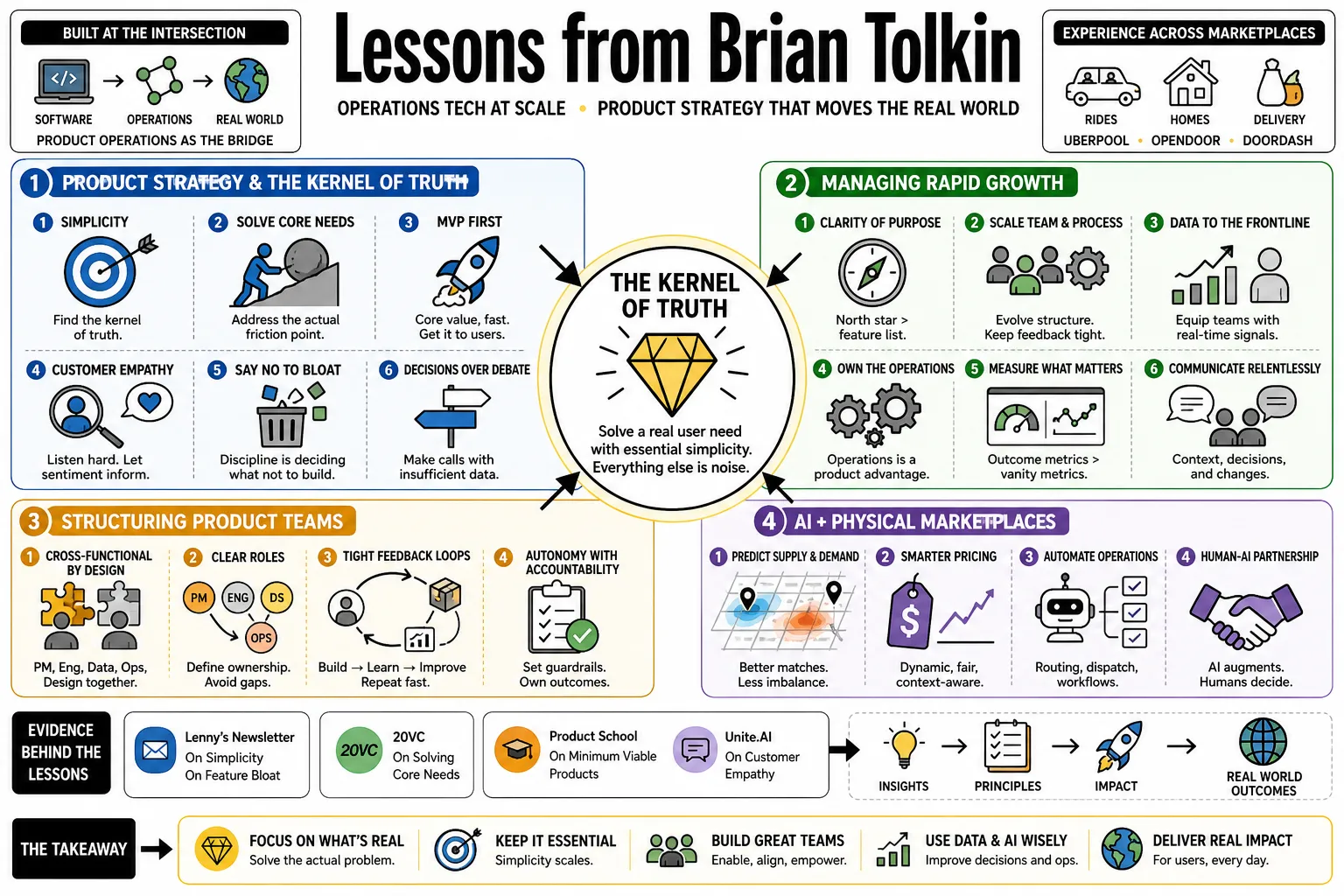
Lessons from Brian Tolkin
Brian Tolkin is Head of Product at Opendoor. He joined Uber as employee 100, started on the operations team, moved into product, led the launch of uberPOOL and started Uber's product operations function. — Podcast: "Lessons from scaling Uber and Opendoor" with Brian Tolkin (2024, transcript).
Part 1: Product Strategy and The Kernel of Truth
- On the Core Job: Tolkin: "the core job is to understand what really matters". — Podcast: "Lessons from scaling Uber and Opendoor" with Brian Tolkin (2024, transcript).
- On Inputs From Everywhere: Tolkin: "you are going to get a lot of inputs around what people think about your product, what people think you should do next." — Podcast: "Lessons from scaling Uber and Opendoor" with Brian Tolkin (2024, transcript).
- On Saying No: Tolkin: "unfortunately that means saying no to maybe what sounds like some good ideas along the way". — Podcast: "Lessons from scaling Uber and Opendoor" with Brian Tolkin (2024, transcript).
- On Where Tech Leverage Sits: Tolkin: "where's the kernel of what really matters that tech can uniquely solve? And let's go do that and be comfortable with other fires maybe burning." — Podcast: "Lessons from scaling Uber and Opendoor" with Brian Tolkin (2024, transcript).
- On Early Uber Focus: On early Uber, Tolkin says the network came down to connecting a rider and a driver, pricing the transaction and collecting payment: "until we do that really well, all the other stuff is noise." — Podcast: "Lessons from scaling Uber and Opendoor" with Brian Tolkin (2024, transcript).
- On Writing Ideas Down: Tolkin: "part of the job is making sure the people who present those ideas are heard and respected and know that it's at least somewhere where it was considered." — Podcast: "Lessons from scaling Uber and Opendoor" with Brian Tolkin (2024, transcript).
- On the One-Pager: Tolkin on one-pagers: "people get wrong where the one pager is the solution description not the problem statement". — Podcast: "Brian Tolkin, Head of Product @Opendoor: How to Hire the Best Product Teams" (2025, transcript).
- On Problem Definition: Tolkin: "the important thing to get right is the problem definition the why". — Podcast: "Brian Tolkin, Head of Product @Opendoor: How to Hire the Best Product Teams" (2025, transcript).
- On What Fades Away: On Uber's early product, Tolkin says that once a car is available at a reasonable price, "if you can do that all the other stuff all the other product nuances like kind of fade away". — Podcast: "Brian Tolkin, Head of Product @Opendoor: How to Hire the Best Product Teams" (2025, transcript).
- On Being Surprised: Tolkin: "customers, products, people can surprise you." — Podcast: "Lessons from scaling Uber and Opendoor" with Brian Tolkin (2024, transcript).
Part 2: Product Operations: The Twin Turbine
- On Twin Turbines: Tolkin: "like a twin turbine jet plane where you can fly the plane on one engine for a little bit if you need to, but it's operating most efficiently and effectively if both are working together". — Podcast: "Lessons from scaling Uber and Opendoor" with Brian Tolkin (2024, transcript).
- On What Ops Teaches: Tolkin: "Starting on the operations side gave a really deep understanding of how the business actually works." — Podcast: "Lessons from scaling Uber and Opendoor" with Brian Tolkin (2024, transcript).
- On Mutual Respect: Tolkin: "there's just got to be mutual respect. Both functions have their time and their place and their skillsets". — Podcast: "Lessons from scaling Uber and Opendoor" with Brian Tolkin (2024, transcript).
- On Harmony: Tolkin: "if it's seen more as a harmony instead of a competition, I think that's really, really helpful". — Podcast: "Lessons from scaling Uber and Opendoor" with Brian Tolkin (2024, transcript).
- On Local Knowledge: Tolkin: "a PM sitting in San Francisco can't be in Opendoor's case 50 markets, walking houses every single day". — Podcast: "Lessons from scaling Uber and Opendoor" with Brian Tolkin (2024, transcript).
- On Product Operations: Tolkin describes Uber's solution to a weak feedback loop: "a new function called product operations who had accountability and reported into operations but physically sat with and operated much like a member of the product team". — Podcast: "Lessons from scaling Uber and Opendoor" with Brian Tolkin (2024, transcript).
- On Entropy: Tolkin: "the real world has entropy and it's hard and it's messy". — Podcast: "Lessons from scaling Uber and Opendoor" with Brian Tolkin (2024, transcript).
- On Humans and Computers: Tolkin: "Computers are deterministic, but humans aren't, right? And so building products that have a little bit more flex or a little bit more fail safes in case those things happen becomes a little bit more of a paramount." — Podcast: "Lessons from scaling Uber and Opendoor" with Brian Tolkin (2024, transcript).
- On Doing Things That Don't Scale: Tolkin: "do things that don't scale and then scale the things that you're doing." — Podcast: "Lessons from scaling Uber and Opendoor" with Brian Tolkin (2024, transcript).
- On Scaling With Technology: Tolkin on Uber's driver onboarding: "technology is uniquely good at scaling." — Podcast: "Lessons from scaling Uber and Opendoor" with Brian Tolkin (2024, transcript).
Part 3: Scaling at Uber: Launching UberPool
- On the Name UberX: Tolkin on the origin of UberX: "So what do you put in some placeholder? X. So UberX and then the company was moving quickly enough, the product got the green light". — Podcast: "Lessons from scaling Uber and Opendoor" with Brian Tolkin (2024, transcript).
- On Early Driver Onboarding: Tolkin: "every driver was individually onboarded in a 90 minute to a two-hour in-person in the office onboarding". — Podcast: "Lessons from scaling Uber and Opendoor" with Brian Tolkin (2024, transcript).
- On Breaking Points: Tolkin on scaling onboarding: "suddenly your system breaks and it's like, okay, we have reached the point where operational system improvements is no longer viable." — Podcast: "Lessons from scaling Uber and Opendoor" with Brian Tolkin (2024, transcript).
- On Manual Surge: Tolkin: surge pricing "was very much a human in the loop system or a very manual system where GMs in every city would control basically the parameters in which surge would operate". — Podcast: "Lessons from scaling Uber and Opendoor" with Brian Tolkin (2024, transcript).
- On Local Teams: Tolkin gives one reason for manual surge: "this belief that local city teams know their cities best". — Podcast: "Lessons from scaling Uber and Opendoor" with Brian Tolkin (2024, transcript).
- On Launching in Chengdu: Tolkin on launching uberPOOL in China: "I slept about 30 minutes that night" and the team "launched just in the nick of time." — Podcast: "Lessons from scaling Uber and Opendoor" with Brian Tolkin (2024, transcript).
- On Liquidity: Tolkin on the first uberPOOL launch: "we very quickly realized that back to what the kernel of truth is here is liquidity is the only thing that matters." — Podcast: "Lessons from scaling Uber and Opendoor" with Brian Tolkin (2024, transcript).
- On Not Getting Too Cute: Tolkin on the first uberPOOL beta: "don't overthink it, don't try to get too cute." — Podcast: "Lessons from scaling Uber and Opendoor" with Brian Tolkin (2024, transcript).
- On Underlying Data: Tolkin on China: "underlying data like understanding the components that make your work that make your product work really really matter". — Podcast: "Brian Tolkin, Head of Product @Opendoor: How to Hire the Best Product Teams" (2025, transcript).
- On the Default to uberPOOL: Tolkin on making uberPOOL the default: "I think in this case we prioritized too aggressively to One Direction". — Podcast: "Brian Tolkin, Head of Product @Opendoor: How to Hire the Best Product Teams" (2025, transcript).
Part 4: Real Estate and Opendoor Innovation
- On What Opendoor Is: Tolkin: "we're a digital platform to buy and sell real estate." — Podcast: "Lessons from scaling Uber and Opendoor" with Brian Tolkin (2024, transcript).
- On the Seller Product: Tolkin: "The core product today is a seller focused product where people can go online, enter some information about their home, and we'll make an all cash offer to be able to sell simplicity and certainty." — Podcast: "Lessons from scaling Uber and Opendoor" with Brian Tolkin (2024, transcript).
- On Real Estate and Innovation: Tolkin: "Real estate is the last sector of the U.S. economy that has yet to really benefit from innovation." — Unite.AI: "Brian Tolkin, Head of Product at Opendoor" interview.
- On Online Transactions: Tolkin: "less than 1% of residential real estate transactions happen online." — Unite.AI: "Brian Tolkin, Head of Product at Opendoor" interview.
- On Needing to Move: Tolkin: "In slow markets or fast markets, people need to move. The commonality is that they are looking for an easier way to do it". — Unite.AI: "Brian Tolkin, Head of Product at Opendoor" interview.
- On Pausing During COVID: Tolkin on March 2020: "we actually turned off the core business and we stopped buying homes for a few months." — Podcast: "Lessons from scaling Uber and Opendoor" with Brian Tolkin (2024, transcript).
- On Virtualizing the Process: Tolkin: "we took those few months and then came out the other side and had virtualized the whole process." — Podcast: "Lessons from scaling Uber and Opendoor" with Brian Tolkin (2024, transcript).
- On Vertical Integration: Tolkin: "you have to be really good at pricing. You have to be really good at product, you have to be really good at the operations." — Podcast: "Lessons from scaling Uber and Opendoor" with Brian Tolkin (2024, transcript).
- On Competitors: Tolkin: "being competition aware, but not necessarily competition focused." — Podcast: "Lessons from scaling Uber and Opendoor" with Brian Tolkin (2024, transcript).
Part 5: Applied AI and Machine Learning in Product
- On Pricing Models: Tolkin: "Our pricing models are the backbone of the company and are what enable us to provide home offers in minutes." — Unite.AI: "Brian Tolkin, Head of Product at Opendoor" interview.
- On Early AI Use: Tolkin: "We've been incorporating AI and ML applications into our business from the beginning." — Unite.AI: "Brian Tolkin, Head of Product at Opendoor" interview.
- On Subjective Data: Tolkin: "We're able to use traditionally subjective data like the level of datedness of the finishings and turn it into structured data". — Unite.AI: "Brian Tolkin, Head of Product at Opendoor" interview.
- On Photo Questions: Tolkin: "we added a new step within the seller questionnaire, where we ask customers to evaluate a series of home photos with varied conditions, and then select the one that looks most like theirs." — Unite.AI: "Brian Tolkin, Head of Product at Opendoor" interview.
- On Building a Dataset: Tolkin: "Our team at Opendoor has spent the last 10 years building a high-quality dataset, and we're constantly expanding it to make the most competitive offers possible." — Unite.AI: "Brian Tolkin, Head of Product at Opendoor" interview.
- On Human Expertise: Tolkin: "Then we layer on human expertise, so that our model factors in insights from our team of data scientists, engineers, and pricing experts". — Unite.AI: "Brian Tolkin, Head of Product at Opendoor" interview.
- On an AI Assistant: Tolkin: "we introduced a SMS-based AI tool that pairs AI with our human expertise". — Unite.AI: "Brian Tolkin, Head of Product at Opendoor" interview.
- On What AI Won't Change: Tolkin: "what won't change is actually the core of the PM job which is you got to go talk to users you got to go figure out what people want". — Podcast: "Brian Tolkin, Head of Product @Opendoor: How to Hire the Best Product Teams" (2025, transcript).
- On Collapsing the Cycle: Tolkin: "I think AI completely collapses that cycle and accelerates a lot of The Upfront up funnel work". — Podcast: "Brian Tolkin, Head of Product @Opendoor: How to Hire the Best Product Teams" (2025, transcript).
Part 6: Leadership and Staying Calm Under Pressure
- On Reflecting Stress: Tolkin: "when you reflect the stress onto your teams, everybody tenses up and tightens up." — Podcast: "Lessons from scaling Uber and Opendoor" with Brian Tolkin (2024, transcript).
- On Outcomes Under Stress: Tolkin: stress "counterintuitively doesn't produce better outcomes." — Podcast: "Lessons from scaling Uber and Opendoor" with Brian Tolkin (2024, transcript).
- On Perspective: Tolkin: "you're never as good as you think you are. You're never as bad as you think you are." — Podcast: "Lessons from scaling Uber and Opendoor" with Brian Tolkin (2024, transcript).
- On Exposure: Tolkin on stressful moments: "exposing yourself to them, not running from them and then learning from them so that the next time it comes around you can say, Hey, I've been here before." — Podcast: "Lessons from scaling Uber and Opendoor" with Brian Tolkin (2024, transcript).
- On Fire Drills: Tolkin on early Uber: "Everything felt like a fire drill all the time." — Podcast: "Lessons from scaling Uber and Opendoor" with Brian Tolkin (2024, transcript).
- On Firing Squads: Tolkin: "Product reviews hopefully are not feeling like firing squads." — Podcast: "Lessons from scaling Uber and Opendoor" with Brian Tolkin (2024, transcript).
- On Proximity to Problems: Tolkin: "the people closest to the problems also have the best context to solve that problem." — Podcast: "Lessons from scaling Uber and Opendoor" with Brian Tolkin (2024, transcript).
- On Depth of Attention: Tolkin: "they think about this problem 40, 50, 60 hours a week, and you might think about this problem three hours a week." — Podcast: "Lessons from scaling Uber and Opendoor" with Brian Tolkin (2024, transcript).
- On Ideas Versus Mandates: Tolkin on senior voices in a review: "hey, this is an idea. This is not a mandate, this is a thought." — Podcast: "Lessons from scaling Uber and Opendoor" with Brian Tolkin (2024, transcript).
Part 7: Hiring and Building Product Teams
- On PM Types: Tolkin: "not all PMS are created equal". — Podcast: "Brian Tolkin, Head of Product @Opendoor: How to Hire the Best Product Teams" (2025, transcript).
- On PM-Team Fit: Tolkin: "it's sort of the same way you have founder market fit right you have like PM team fit". — Podcast: "Brian Tolkin, Head of Product @Opendoor: How to Hire the Best Product Teams" (2025, transcript).
- On Hiring Your Strategy: Tolkin, quoting a colleague: "you hire your strategy right and so the person you pick to play that role will dictate how that person defines you know the success". — Podcast: "Brian Tolkin, Head of Product @Opendoor: How to Hire the Best Product Teams" (2025, transcript).
- On Ambiguity in the Role: Tolkin on hires that fail: "the ambiguity of the role and the ambiguity of the challenge was above that person's ability to distill". — Podcast: "Brian Tolkin, Head of Product @Opendoor: How to Hire the Best Product Teams" (2025, transcript).
- On Work Products: Tolkin: "I do believe some type of work product is very helpful". — Podcast: "Brian Tolkin, Head of Product @Opendoor: How to Hire the Best Product Teams" (2025, transcript).
- On Past Colleagues: Tolkin on assessing candidates: "the best best is people you've worked with before". — Podcast: "Brian Tolkin, Head of Product @Opendoor: How to Hire the Best Product Teams" (2025, transcript).
- On the Core Product: Tolkin on going from one product to many: "you can't degrade your core product to build a new product". — Podcast: "Brian Tolkin, Head of Product @Opendoor: How to Hire the Best Product Teams" (2025, transcript).
- On a Contained Sandbox: Tolkin: "by giving new products a little bit of a Sandbox a contained sandbox". — Podcast: "Brian Tolkin, Head of Product @Opendoor: How to Hire the Best Product Teams" (2025, transcript).
- On the CEO as CPO: Asked whether the CEO should always be the CPO, Tolkin answers: "no but in the early stages yes". — Podcast: "Brian Tolkin, Head of Product @Opendoor: How to Hire the Best Product Teams" (2025, transcript).
Part 8: Continuous Improvement and Execution
- On Power Analysis: Tolkin: "don't just force yourself into A/B testing without running the power analysis". — Podcast: "Lessons from scaling Uber and Opendoor" with Brian Tolkin (2024, transcript).
- On Pretending to Get Answers: Tolkin: "the only mistake here is thinking you'll get an answer in a month when you won't, and then pretending you do". — Podcast: "Lessons from scaling Uber and Opendoor" with Brian Tolkin (2024, transcript).
- On Conviction: Tolkin: "experimentation is all about increasing your conviction in the problem or the solution." — Podcast: "Lessons from scaling Uber and Opendoor" with Brian Tolkin (2024, transcript).
- On Talking to Customers: Tolkin on building conviction without an A/B test: "The first best, most obvious is talk to more customers." — Podcast: "Lessons from scaling Uber and Opendoor" with Brian Tolkin (2024, transcript).
- On False Precision: Tolkin: "you shouldn't spend time trying to get false precision". — Podcast: "Lessons from scaling Uber and Opendoor" with Brian Tolkin (2024, transcript).
- On Humility: Tolkin: "there's definitely a humility to say if you can, if it's relatively easy to test your assumptions or test your hypotheses. That is always better to gut check yourself." — Podcast: "Lessons from scaling Uber and Opendoor" with Brian Tolkin (2024, transcript).
- On Feedback Loops: Tolkin on shipping on intuition: "do you have a reasonable feedback loop to understand whether or not you are correct?" — Podcast: "Lessons from scaling Uber and Opendoor" with Brian Tolkin (2024, transcript).
- On Talking to Users as Data: Tolkin: "talking to users is data like that is real". — Podcast: "Brian Tolkin, Head of Product @Opendoor: How to Hire the Best Product Teams" (2025, transcript).
- On Slower Decisions: Tolkin: "very rarely does a slower decision lead to a better outcome". — Podcast: "Brian Tolkin, Head of Product @Opendoor: How to Hire the Best Product Teams" (2025, transcript).