Bruce Greenwald is an economist and authority on value investing who spent decades teaching at Columbia Business School. Known for modernizing the frameworks of Benjamin Graham and David Dodd, he shifted the focus of modern investing away from speculative forecasting and toward measurable earnings power and structural barriers to entry. This profile catalogs his specific frameworks for valuation, competitive advantage, strategy, and macroeconomic reality.
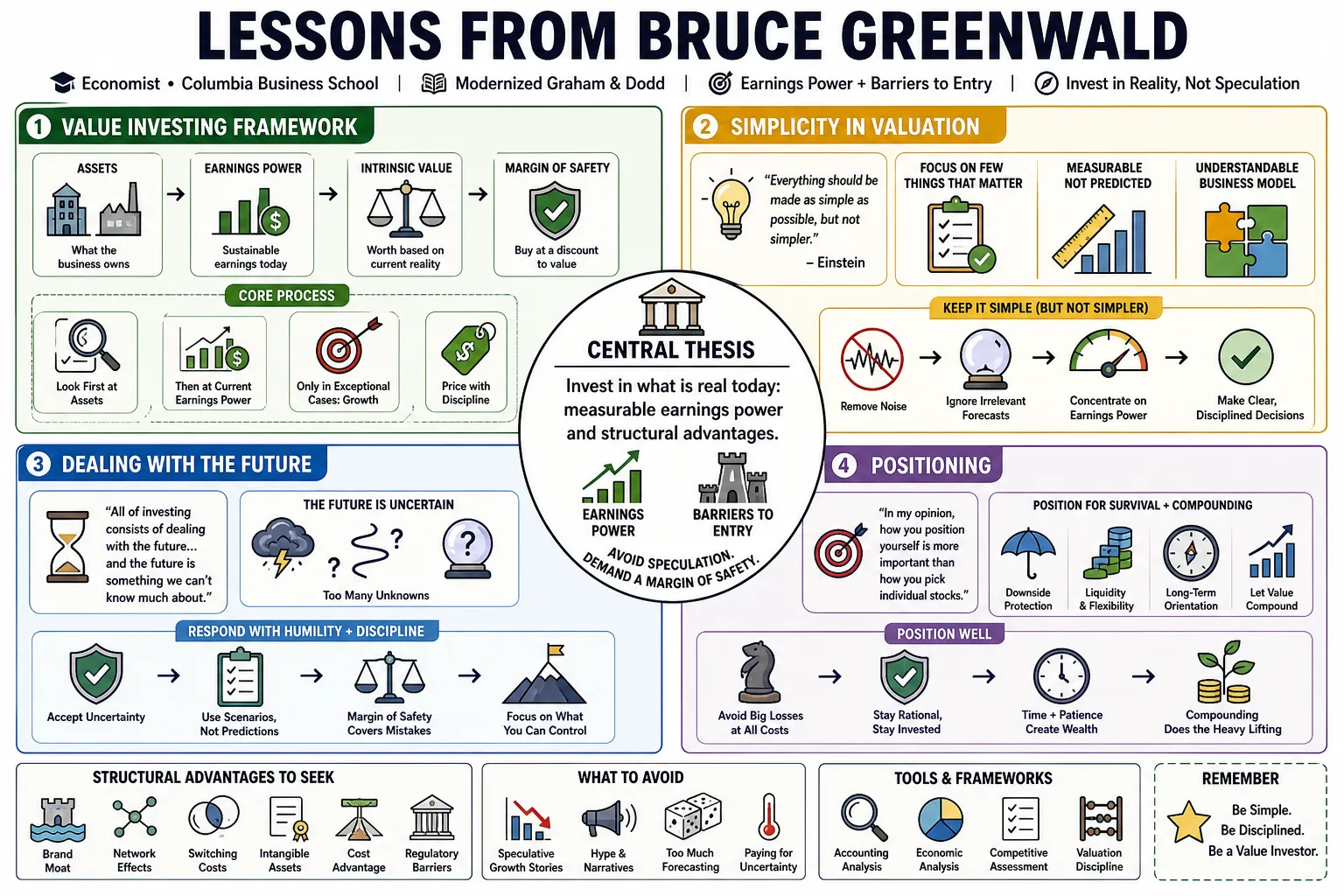
Part 1: Value Investing Framework
- On Ugly Stocks: Greenwald: "you will do much better with ugly diseased stocks than glamorous stocks." — Greenwald interview on how to improve your value investing strategy (2018, interview text).
- On Loss Aversion: Greenwald: "People have always shied away from ugly diseased opportunities. So you can take advantage of their loss aversion." — Greenwald interview on how to improve your value investing strategy (2018, interview text).
- On Overconfidence: Greenwald: "people think they know much more than they do." — Greenwald interview on how to improve your value investing strategy (2018, interview text).
- On Mispricing Glamour: Greenwald: "It exaggerates the value of glamorous stocks and radically and consistently undervalues diseased stocks." — Greenwald interview on how to improve your value investing strategy (2018, interview text).
- On Waiting for Bargains: Greenwald: "you have to have the discipline to wait for bargains you can't get bored and just take off". — Value Investing interview with Erin Bellissimo (video transcript).
- On Looking Intelligently: Greenwald on the first principle of value investing: "you've got to look intelligently for opportunities you're not going to look at every possible investment and every possible security". — Value Investing interview with Erin Bellissimo (video transcript).
- On Knowing What You Are Buying: Greenwald: "you have to know what you're buying that you have to know the value of what you're paying for not perfectly but as best you can". — Value Investing interview with Erin Bellissimo (video transcript).
- On Timing a Book: Greenwald: "The first edition came out in 1999 when everybody said value investing was dead. Then the second edition has just come out when everybody again says value investing is dead." — MOI Global: Bruce Greenwald on the Future of Value-Oriented Investing (December 2020 interview transcript, Internet Archive snapshot of the retired page).
- On Starting With the Balance Sheet: Greenwald: "We start with the balance sheet, which doesn't project anything." — Greenwald interview on how to improve your value investing strategy (2018, interview text).
- On Ratio Valuations: Greenwald: "If everybody else is just doing ratio valuations, I'm not going to do better than them." — Greenwald interview on how to improve your value investing strategy (2018, interview text).
Part 2: Earnings Power Value (EPV)
- On Discounted Cash Flows: Greenwald: "They never look at the balance sheet. There is a fundamental stupidity about discounted-cash-flow valuations." — Greenwald interview on how to improve your value investing strategy (2018, interview text).
- On Good and Bad Information: Greenwald: "You are combining very good information, your estimate of near-term cash flow, with very bad information, your estimate of distant cash flow. When you add bad information to good information, bad dominates." — Greenwald interview on how to improve your value investing strategy (2018, interview text).
- On Earnings Power: Greenwald: "The second-most reliable piece of information is the profit-generating capacity of that business, normalized for accounting distortions and cyclical factors. Forget the growth and the forecasting. Let's look at what is there today." — Greenwald interview on how to improve your value investing strategy (2018, interview text).
- On Reproduction Value: Greenwald: "I can look at reproduction value, which is a hell of a lot better than some forecast 10 years into the future." — Greenwald interview on how to improve your value investing strategy (2018, interview text).
- On Three Checks: Greenwald on buying natural resources: "You want to make sure the asset value is there, make sure the earnings power value is there, and you want to make sure there is a margin of safety." — MOI Global: Bruce Greenwald on the Future of Value-Oriented Investing (December 2020 interview transcript, Internet Archive snapshot of the retired page).
- On Terminal Values: Greenwald: "Somewhere above 80% of all the value will be in the terminal value." — MOI Global: Bruce Greenwald on the Future of Value-Oriented Investing (December 2020 interview transcript, Internet Archive snapshot of the retired page).
- On Assets Above Earnings Power: Greenwald on a company whose asset value far exceeds its earnings power value: "The takeaway is that value is being destroyed by weak management." — Greenwald interview on how to improve your value investing strategy (2018, interview text).
- On Value Traps: Greenwald: "If they borrow to grow, they're destroying the capital. That's where value traps come from." — Greenwald interview on how to improve your value investing strategy (2018, interview text).
- On Growth Worth Zero: Greenwald: "Growth is worth zero, because competitors enter and drive the earnings down." — Greenwald interview on how to improve your value investing strategy (2018, interview text).
- On Natural Resources: Greenwald: "If you're going to buy natural resources intelligently, you must be a strict value investor and not look for growth at all." — MOI Global: Bruce Greenwald on the Future of Value-Oriented Investing (December 2020 interview transcript, Internet Archive snapshot of the retired page).
Part 3: Competitive Advantage and Moats
- On Barriers to Entry: Greenwald on the Coca-Cola case: "For that to be sustainable, there have to be barriers to entry." — Greenwald interview on how to improve your value investing strategy (2018, interview text).
- On Moats: Greenwald: "moats and franchises are identical". — Value Investing interview with Erin Bellissimo (video transcript).
- On Entry and Organic Growth: Greenwald: "a market with no barriers to entry for example if you have organic growth your sales will go up temporarily your earnings will go up but that's going to attract entrants". — Value Investing interview with Erin Bellissimo (video transcript).
- On Double Counting: Greenwald: "Powerful franchises are all in the earnings, presumably. If you give it a higher multiple, you're double counting." — MOI Global: Bruce Greenwald on the Future of Value-Oriented Investing (December 2020 interview transcript, Internet Archive snapshot of the retired page).
- On Durability: Greenwald: "What you care about is the durability of the franchise". — MOI Global: Bruce Greenwald on the Future of Value-Oriented Investing (December 2020 interview transcript, Internet Archive snapshot of the retired page).
- On a Lesson Students Resist: Greenwald: "One of the things I cannot beat out of my students is they say, “Oh, this is a powerful franchise, so I'll pay a higher multiple for it.”" — MOI Global: Bruce Greenwald on the Future of Value-Oriented Investing (December 2020 interview transcript, Internet Archive snapshot of the retired page).
- On Specialties: Greenwald: "everybody has got a limited number of specialties, and they ought to stick to that." — Greenwald interview on how to improve your value investing strategy (2018, interview text).
- On Generalists and Specialists: Greenwald: "you're not going to have a chance as a generalist against a specialist". — Value Investing interview with Erin Bellissimo (video transcript).
- On Who Survived: Greenwald: "the examples of the investors look at who survived the change from pre-1990 to post-1990 they are the people who specialize". — Value Investing interview with Erin Bellissimo (video transcript).
- On Specialized Investors: Greenwald: "If you look at the value investors whose performances have not deteriorated, they tend to be the ones who are specialized in this environment." — MOI Global: Bruce Greenwald on the Future of Value-Oriented Investing (December 2020 interview transcript, Internet Archive snapshot of the retired page).
Part 4: Growth vs. Value
- On When Growth Adds Value: Greenwald: "if growth doesn't add value don't worry about it and growth only adds value in franchise businesses where companies earn more than the cost of capital". — Value Investing interview with Erin Bellissimo (video transcript).
- On Approaches to Growth: Greenwald: "the distinction is not one between growth and value but between a growth approach to growth and a value approach to growth." — Value Investing interview with Erin Bellissimo (video transcript).
- On Valuing Growth: Greenwald: "you're not going to be able to calculate a value the only way you're going to invest sensibly in growth is to look at the price you're paying". — Value Investing interview with Erin Bellissimo (video transcript).
- On Value Investors and Growth Before 1990: Greenwald: "value investors who wouldn't pay for growth really did so well over that particular period". — Value Investing interview with Erin Bellissimo (video transcript).
- On the Shift Since 1990: Greenwald: "the dominant changes since 1990 have been in the opposite direction". — Value Investing interview with Erin Bellissimo (video transcript).
- On Local Services: Greenwald: "services are locally produced and consumed". — Value Investing interview with Erin Bellissimo (video transcript).
- On Mean Reversion: Greenwald: "Mean reversion is a characteristic of the timeframe you're talking about." — MOI Global: Bruce Greenwald on the Future of Value-Oriented Investing (December 2020 interview transcript, Internet Archive snapshot of the retired page).
- On Understanding Trends: Greenwald: "You better understand these trends in detail." — MOI Global: Bruce Greenwald on the Future of Value-Oriented Investing (December 2020 interview transcript, Internet Archive snapshot of the retired page).
- On Industry Knowledge: Greenwald: "You must start with detailed industry knowledge." — MOI Global: Bruce Greenwald on the Future of Value-Oriented Investing (December 2020 interview transcript, Internet Archive snapshot of the retired page).
Part 5: Strategy vs. Tactics
- On Primitive Value: Greenwald: "value has not done well, and sort of primitive value especially. Which is just low P/E, low market to book". — Greenwald interview excerpt on the changing landscape for traditional value investing (2020).
- On an Intangible Economy: Greenwald: "we are shifting from a real asset heavy manufacturing and industrial economy to a software, service driven economy where really most of the capital is intangible." — Greenwald interview excerpt on the changing landscape for traditional value investing (2020).
- On Tangible Book Value: Greenwald: "people who are going to try and look at traditional tangible book value are going to miss most of where the value is across firms". — Greenwald interview excerpt on the changing landscape for traditional value investing (2020).
- On Expensed Intangibles: Greenwald: "a lot of the accumulation of intangibles, acquiring a book of business, developing a product portfolio, gets expensed." — Greenwald interview excerpt on the changing landscape for traditional value investing (2020).
- On Building Your Own Statements: Greenwald: "they're going to have to construct income statements and balance sheets for themselves." — Greenwald interview excerpt on the changing landscape for traditional value investing (2020).
- On Real Assets: Greenwald: "Assets are overwhelmingly intangibles these days." — MOI Global: Bruce Greenwald on the Future of Value-Oriented Investing (December 2020 interview transcript, Internet Archive snapshot of the retired page).
- On Globalization and Competition: Greenwald: "between 1950 and 1990 is globalization markets are getting bigger and as they get bigger they get easier to enter and they become more competitive". — Value Investing interview with Erin Bellissimo (video transcript).
- On Adding Specialization: Greenwald: "you're going to have to add specialization to the standard value orientation that value investors are familiar with". — Value Investing interview with Erin Bellissimo (video transcript).
- On Too Narrow a View: Greenwald on the first edition: "we really had too narrow a view of what good valuation looked like". — Value Investing interview with Erin Bellissimo (video transcript).
Part 6: Management and Capital Allocation
- On Industry Reputation: Greenwald recalls Buffett: "when a management with a good reputation meets an industry with a bad reputation, it's invariably the reputation of the industry that survives." — MOI Global: Bruce Greenwald on the Future of Value-Oriented Investing (December 2020 interview transcript, Internet Archive snapshot of the retired page).
- On Value in the Future: Greenwald: "If you think of a growing firm and buying a growing firm, most of the value is way out there in the future." — MOI Global: Bruce Greenwald on the Future of Value-Oriented Investing (December 2020 interview transcript, Internet Archive snapshot of the retired page).
- On Longer Timeframes: Greenwald: "There are longer timeframes, and in those long timeframes you typically don't get mean reversion in profits." — MOI Global: Bruce Greenwald on the Future of Value-Oriented Investing (December 2020 interview transcript, Internet Archive snapshot of the retired page).
Part 7: Markets, Cycles, and Forecasting
- On a Different Situation: Greenwald: "This time fundamental changes in the economy will not go away; they are not temporarily crazy." — MOI Global: Bruce Greenwald on the Future of Value-Oriented Investing (December 2020 interview transcript, Internet Archive snapshot of the retired page).
- On 1999: Greenwald on 1999: "the valuations were completely devoid of any rationality". — MOI Global: Bruce Greenwald on the Future of Value-Oriented Investing (December 2020 interview transcript, Internet Archive snapshot of the retired page).
- On a Twenty-Year Cycle: Greenwald: "It's a 20-year cycle I've managed to hit at the peak both times." — MOI Global: Bruce Greenwald on the Future of Value-Oriented Investing (December 2020 interview transcript, Internet Archive snapshot of the retired page).
- On Business Cycles: Greenwald: "If you got high profits for a short period, they'll mean-revert over four to six years." — MOI Global: Bruce Greenwald on the Future of Value-Oriented Investing (December 2020 interview transcript, Internet Archive snapshot of the retired page).
- On Long Commodity Trends: Greenwald: "It's like people forget that over 200 years, commodity prices have continued to fall because they don't look at those long timeframes." — MOI Global: Bruce Greenwald on the Future of Value-Oriented Investing (December 2020 interview transcript, Internet Archive snapshot of the retired page).
- On Technology and Resources: Greenwald on commodities: "improvements in technology have won hands down for 200 years." — MOI Global: Bruce Greenwald on the Future of Value-Oriented Investing (December 2020 interview transcript, Internet Archive snapshot of the retired page).
Part 8: Macroeconomics and Globalization
- On Franchise Businesses: Greenwald: "we've gone to an environment where increasingly franchised businesses for which growth matters are the dominant part of the investment landscape". — Value Investing interview with Erin Bellissimo (video transcript).
- On Balkanized Markets: Greenwald: "you see a balkanization of these markets and niche markets and again niche markets are small markets that can be dominated". — Value Investing interview with Erin Bellissimo (video transcript).
- On Underperforming Value Investors: Greenwald: "a lot of traditional value investors have underperformed by 15 years or more". — Value Investing interview with Erin Bellissimo (video transcript).
- On Franchise Businesses in the Landscape: Greenwald: "that's made franchise businesses a much bigger part of the landscape". — Value Investing interview with Erin Bellissimo (video transcript).