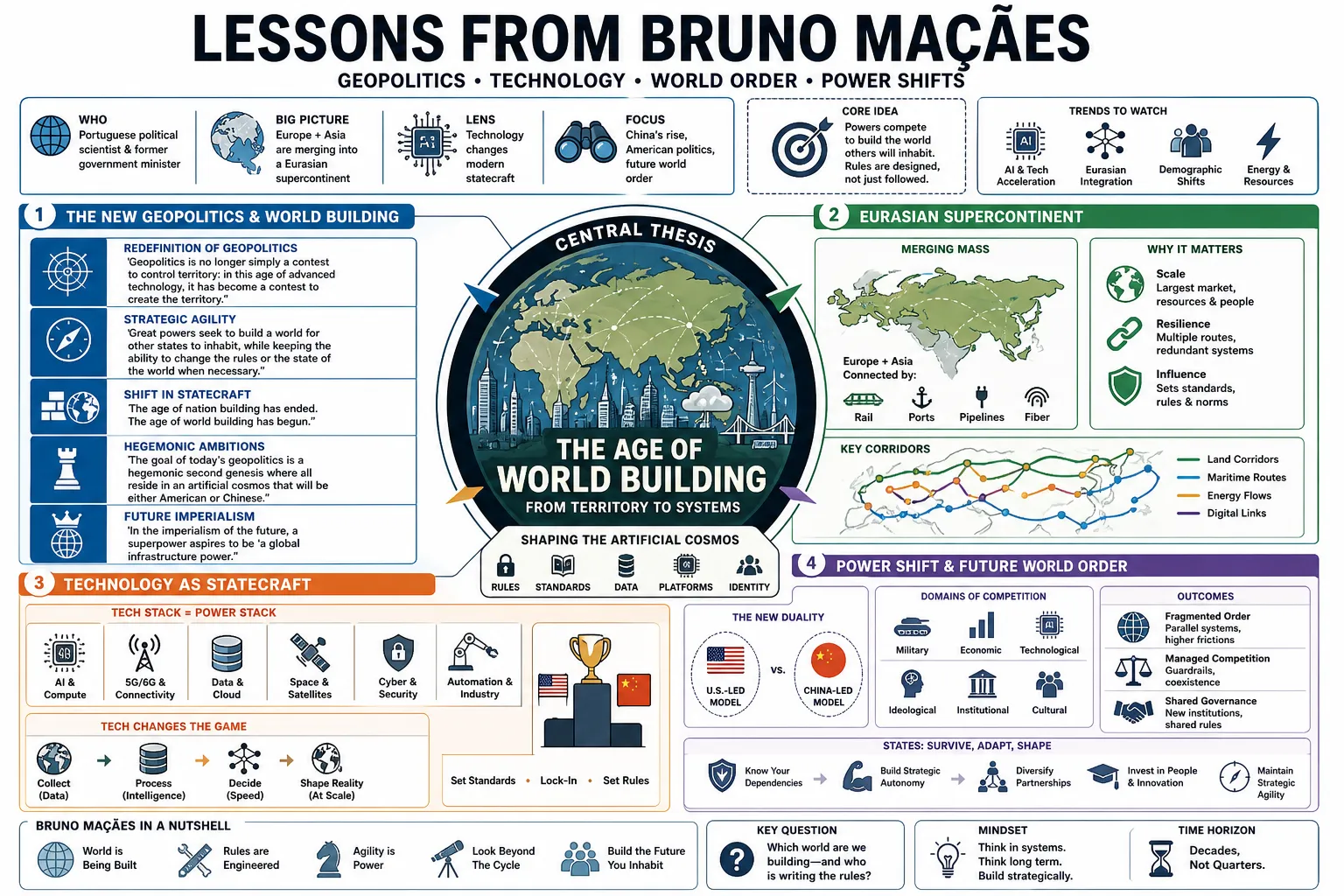
Lessons from Bruno Maçães
Bruno Maçães was Portugal's secretary of state for European affairs from 2013 to 2015. He is the author of The Dawn of Eurasia, Belt and Road, History Has Begun, Geopolitics for the End Time and World Builders. — Essay: "The Return of Civilizations".
Part 1: The New Geopolitics and World Building
- On the Power to Build a World: Maçães: "geopolitical power is essentially the power to build a world to build a virtual world where others have to operate that others have to inhabit." — Talk on World Builders at the 2025 Network State Conference (video transcript).
- On Building the Landscape: Maçães: "There's no greater power in the world than to build the landscape or the system within which others have to operate." — Talk on World Builders at the 2025 Network State Conference (video transcript).
- On a Built World Looking Natural: Maçães: "And it's even better if the others don't realize this is a built world. If the others think that it's the natural world, that is the inevitable world." — Talk on World Builders at the 2025 Network State Conference (video transcript).
- On God Mode: Maçães: "God mode is my definition of geopolitical power." — Talk on World Builders at the 2025 Network State Conference (video transcript).
- On Playing and Changing the Game: Maçães: "Political power is playing the game. God mode is changing the variables of the game state through the control panel of the game." — Talk on World Builders at the 2025 Network State Conference (video transcript).
- On Coding the Game: Maçães: "A superpower codes the game. A normal power plays the game." — Talk on World Builders at the 2025 Network State Conference (video transcript).
- On Geopolitics and Technology: Maçães: "Geopolitics and technology in my book are synonyms. There is no difference between geopolitics and technology." — Talk on World Builders at the 2025 Network State Conference (video transcript).
- On Building the Territory: Maçães on the technology wars: "we are no longer fighting for territory we are building the territory". — Lecture: "Geopolitics From the Pandemic to the Climate Crisis" (2022, video transcript).
- On Living in a World Built by Others: Maçães: "the question is who will build it and who will have to live in a world built by others". — Lecture: "Geopolitics From the Pandemic to the Climate Crisis" (2022, video transcript).
- On an Entry in a Computer: Maçães on Russia's frozen reserves: "Russia had 300 billion in central bank reserves, not in cash. This is just an entry in a computer in Frankfurt or in the New York Fed." — Talk on World Builders at the 2025 Network State Conference (video transcript).
Part 2: The Myth of Western Supremacy
- On Competing Models: Maçães: "we no longer have a dominant model we have alternative models". — Podcast conversation on Geopolitics for the End Time (2021, video transcript).
- On China's Own Terms: Maçães: "china is not becoming western or european but it is becoming a great power on its own terms". — Podcast conversation on Geopolitics for the End Time (2021, video transcript).
- On Three Pillars: On the Chinese model, Maçães says "you have to combine these three pillars": collectivism, pragmatism and technology. — Podcast conversation on Geopolitics for the End Time (2021, video transcript).
- On the Indian Tradition: Maçães: "why should the indian tradition be understood and made to fit within liberalism when the indian tradition is thousands of years old". — Podcast conversation on Geopolitics for the End Time (2021, video transcript).
- On Liberalism's Solutions: Maçães: "liberalism was excellent providing solutions a hundred years ago but now it's increasingly struggling". — Podcast conversation on Geopolitics for the End Time (2021, video transcript).
- On Post-Liberalism: Maçães: "this is no longer the age of the universal victory of liberalism. This is the age of post-liberalism." — Festival talk: History Has Begun (2020, video transcript).
- On Civilization Versus Identity: Maçães: "Civilization needs to be distinguished from any notion of religious, ethnic or national identity." — Essay: "The Return of Civilizations".
- On Universal Values: Maçães: "Liberals wanted their political values to be accepted universally, much like a scientific theory enjoys universal validity." — Essay: "The Return of Civilizations".
- On Politics and Science: Maçães: "The failure of the liberal program reveals that politics is not a science, nor can it ever become a science." — Essay: "The Return of Civilizations".
Part 3: Eurasia as the New Center
- On the Shape of Eurasia: Maçães: "what shape do we give to Eurasia as a whole". — Podcast conversation on History Has Begun (2024, video transcript).
- On Asking the Right Question: Maçães on his book on Eurasia: "to ask the question and to identify the right question that was the purpose of the book". — Podcast conversation on History Has Begun (2024, video transcript).
- On China as a Civilization State: Maçães: "As a civilization state, China is organized around culture rather than politics." — Essay: "The Attack of the Civilization State".
- On Protecting a Tradition: Maçães: "Linked to a civilization, the state has the paramount task of protecting a specific cultural tradition." — Essay: "The Attack of the Civilization State".
- On Civilizations Rather Than Nations: Maçães quotes India's Ram Madhav: "From now on, Asia will rule the world, and that changes everything because in Asia, we have civilizations rather than nations." — Essay: "The Attack of the Civilization State".
- On Culture and Citizenship: Maçães: "For a civilization state, cultural ties are potentially more important than the mere legal status of citizenship." — Essay: "The Attack of the Civilization State".
- On the End of a Myth: Maçães: "The myth that China is destined to be assimilated to a Western model of political society is over." — Essay: "The Attack of the Civilization State".
- On What Defines a Civilization State: Maçães: "What distinguishes a civilization state is its ability to provide an overarching framework for social and political life and therefore a viable or plausible alternative to the liberalism of the West." — Essay: "The Return of Civilizations".
- On Ideas, Not Blood and Soil: Maçães: "The civilization state is built on ideas, not “blood and soil.”" — Essay: "The Return of Civilizations".
- On the Natural Political World: Maçães: "The world of the civilization state is the natural political world." — Essay: "The Attack of the Civilization State".
Part 4: China and the Belt and Road
- On Technological Power: Maçães on China: "it's a regime that understands itself in terms of fast technological progress and understands power as being fundamentally technological". — Podcast conversation on Geopolitics for the End Time (2021, video transcript).
- On Practice Before Theory: Maçães on China: "a very strong element of pragmatism practice before theory". — Podcast conversation on Geopolitics for the End Time (2021, video transcript).
- On Moving With History: Maçães on Deng Xiaoping's sayings: "we don't have a theory we move with history we move with new developments and we adapt to those new developments". — Podcast conversation on Geopolitics for the End Time (2021, video transcript).
- On the Climate Race: Maçães: "china announced ambitious climate goals precisely because it believes this is in many respects where the competition for the 21st century will be decided". — Lecture: "Geopolitics From the Pandemic to the Climate Crisis" (2022, video transcript).
- On the Technological Order: Maçães: "if you believe that changes in the global hierarchy power are not the result of great wars but the result of fundamental transformations in what i call in the book the technological order". — Lecture: "Geopolitics From the Pandemic to the Climate Crisis" (2022, video transcript).
- On Mastering Steam: On Britain's rise, Maçães asks whether it came from a war or because "it knew how to master the new energy technologies of the first industrial revolution steam in particular". — Lecture: "Geopolitics From the Pandemic to the Climate Crisis" (2022, video transcript).
- On China as a Civilization: Maçães on his visits to Beijing: "Always remember that China is a civilization rather than a nation-state." — Essay: "The Attack of the Civilization State".
- On a Special Path: Maçães: "the Chinese would be treading their own “Sonderweg” — special path." — Essay: "The Attack of the Civilization State".
- On Network States Controlled From Outside: Maçães: "the United States or China are already network states but they are network states controlled from outside the network." — Talk on World Builders at the 2025 Network State Conference (video transcript).
Part 5: American Virtualism and Reality
- On Virtualism and Experience: Maçães: "Political virtualism is all about the experience. It's supposed to be exciting, wild, and heated but it's not supposed to turn into reality." — Interview: "The American Dream and the power of virtualism" (2024).
- On Experience Without Costs: Maçães: "It shall give you the experience without the costs of the real experience." — Interview: "The American Dream and the power of virtualism" (2024).
- On Disney World: Maçães: "That's why we go to Disney World. That's why we go to a movie." — Interview: "The American Dream and the power of virtualism" (2024).
- On Virtual Money: Maçães: "the concept of money that has become dominant, particularly in America, is money as virtual money rather than money as a store value". — Interview: "The American Dream and the power of virtualism" (2024).
- On Checks and Balances: Maçães: "The checks and balances can be interpreted as a mechanism to prevent any of these fictional worlds from becoming all-powerful." — Interview: "The American Dream and the power of virtualism" (2024).
- On Religion as Role-Play: Maçães: "the reason why this can happen without turning the system into a theocracy is that these forms of religious experience are understood more or less explicitly as forms of role-play. Virtualism again." — Interview: "The American Dream and the power of virtualism" (2024).
- On Reagan: Maçães on Ronald Reagan: "He understood how to play a role and he played it with such intensity that it felt completely real." — Interview: "The American Dream and the power of virtualism" (2024).
- On Replacing Reality With Fiction: Maçães on virtualism: "As a program, it does not attempt to obfuscate or manipulate political reality. It replaces reality with fiction." — Essay: "Some brief comments on political virtualism".
- On Actors and Directors: Maçães: "If you are an actor on the stage, you must play the role that was written for you, but if you are a director and script writer you have much more freedom." — Interview: "The American Dream and the power of virtualism" (2024).
- On Democracy and Immersion: Maçães on preventing virtual worlds from sliding into reality: "democracy is going to be very helpful for this purpose". — Podcast conversation on History Has Begun (2024, video transcript).
Part 6: Technology, AI, and Power
- On Rebuilding the World: Maçães on Huawei: there was a sense that its companies "would be able to rebuild the world to create a new networked global landscape". — Lecture: "Geopolitics From the Pandemic to the Climate Crisis" (2022, video transcript).
- On a World Built by China: Maçães, on American reactions: "we cannot live in a world that china will build". — Lecture: "Geopolitics From the Pandemic to the Climate Crisis" (2022, video transcript).
- On Building the Framework: Maçães to builders: "you're not just building some gadgets. You're building the framework within which human life and political life take place." — Talk on World Builders at the 2025 Network State Conference (video transcript).
- On Coding Versus Playing: Maçães: "Your opponent is playing a video game, you are coding it." — Talk on World Builders at the 2025 Network State Conference (video transcript).
- On Decentralized Power: Maçães: "Power has to be decentralized. Power has to be democratic". — Talk on World Builders at the 2025 Network State Conference (video transcript).
- On Technology and Organization: Maçães on the pandemic: "we cannot think about technology as just about the final product". — Festival conversation on Geopolitics for the End Time (2022, video transcript).
- On Energy Flows: Maçães: "fossil fuels are energy stocks not energy flows". — Podcast conversation on the geopolitics of 2024 and beyond (2024, video transcript).
- On Solar Having No Moving Parts: Maçães on solar: "there are no moving parts there's no turbin there's no waste". — Podcast conversation on the geopolitics of 2024 and beyond (2024, video transcript).
- On Entropy: Maçães: "solar energy does not increase anthropy but reduces it". — Podcast conversation on the geopolitics of 2024 and beyond (2024, video transcript).
Part 7: The Fragility of Global Order
- On Theories of Stasis: Maçães: "the theories we have are the exact opposite the main ways we have of understanding the world are theories of conclusion definitiveness of stasis". — Lecture: "Geopolitics From the Pandemic to the Climate Crisis" (2022, video transcript).
- On the Clash of Civilizations: Maçães: "when you think about huntington's clash of civilizations it's the opposite of a theory of change". — Lecture: "Geopolitics From the Pandemic to the Climate Crisis" (2022, video transcript).
- On Profound Change: Maçães: "moment of profound change in the structure of the global system". — Lecture: "Geopolitics From the Pandemic to the Climate Crisis" (2022, video transcript).
- On Unnatural Creatures: Maçães: "we are becoming unnatural creatures in an unnatural world". — Lecture: "Geopolitics From the Pandemic to the Climate Crisis" (2022, video transcript).
- On Each Actor Building Its Own System: Maçães: "each powerful actor in the global system is building its own system". — Lecture: "Geopolitics From the Pandemic to the Climate Crisis" (2022, video transcript).
- On Natural Needs Coming Undone: Maçães: "this system of natural needs is coming undone because we no longer live in a world that can be called natural". — Lecture: "Geopolitics From the Pandemic to the Climate Crisis" (2022, video transcript).
- On the Nation-State World: Maçães: "a world of hundreds of nation-states defined by political boundaries, pitted against each other and often reliant on violent ideologies of supremacy and dominance — is the product, or rather the excrescence, of liberal universalism." — Essay: "The Return of Civilizations".
- On the Connection to the Earth: Maçães: "we're going back the connection to the earth because of climate change because of the pandemic the external environment is becoming important again". — Podcast conversation on Geopolitics for the End Time (2021, video transcript).
- On the External Environment: Maçães: "it's not territory in the old sense but still is the external environment". — Podcast conversation on Geopolitics for the End Time (2021, video transcript).
Part 8: Climate Change and the State of Nature
- On a Dangerous Nature: Maçães: "we live in a world where the challenge does not come fundamentally from technology we live in a world where the challenge comes fundamentally from a dangerous nature". — Festival conversation on Geopolitics for the End Time (2022, video transcript).
- On an Inert Nature: Maçães: "nature is not this inert passive object completely under our control". — Festival conversation on Geopolitics for the End Time (2022, video transcript).
- On a Powerful Beast: Maçães: "nature during the pandemic and i think during climate change showed itself to be a powerful beast". — Festival conversation on Geopolitics for the End Time (2022, video transcript).
- On an Unpredictable Nature: Maçães: "nature is a much more active much more unpredictable". — Festival conversation on Geopolitics for the End Time (2022, video transcript).
- On the Anthropocene: Maçães: "what we have is in fact the beginning of the anthropocene the beginning of a world that is built from scratch by human beings". — Lecture: "Geopolitics From the Pandemic to the Climate Crisis" (2022, video transcript).
- On Geoengineering: Maçães: "the response to climate change is moving towards ideas of geoengineering of increased control of the natural environment". — Lecture: "Geopolitics From the Pandemic to the Climate Crisis" (2022, video transcript).
- On Resisting Climate Change: Maçães: "who will be better able to resist the impact of climate change". — Lecture: "Geopolitics From the Pandemic to the Climate Crisis" (2022, video transcript).
- On Resilience: Maçães: "who will show more resilience". — Lecture: "Geopolitics From the Pandemic to the Climate Crisis" (2022, video transcript).
- On the Possibilities of Collective Power: Maçães on what Covid taught: "it was really about the incredible possibilities of political power and Collective power". — Podcast conversation on History Has Begun (2024, video transcript).