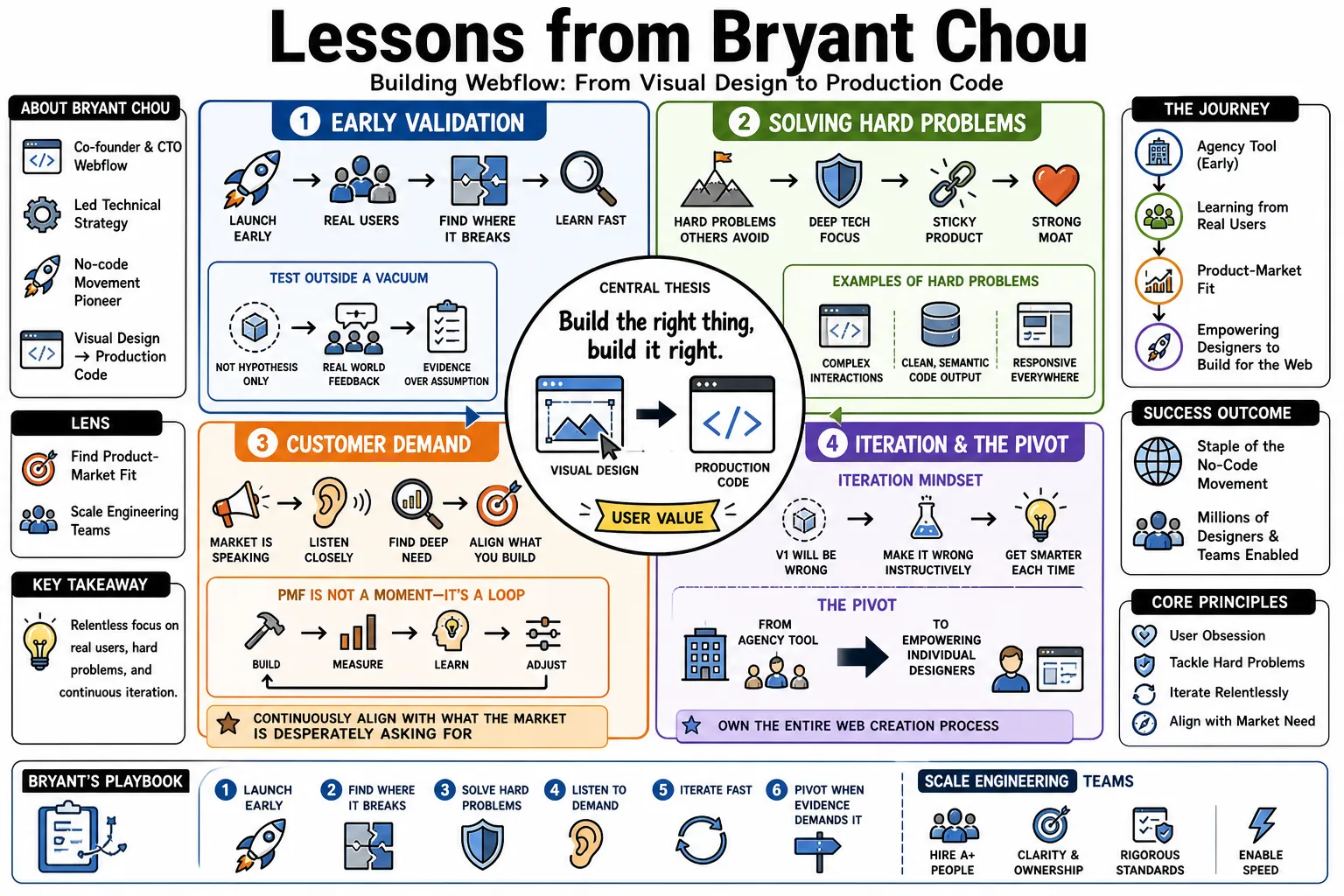
Lessons from Bryant Chou
Bryant Chou is a co-founder and the founding CTO of Webflow, a no-code visual web design platform. He is also a founder of the mobile video ad company Vungle. — Podcast: "From a narrow ICP to a wide-open market" with Bryant Chou (transcript).
Part 1: Product-Market Fit
- On Knowing the Problem: Chou: "the three of us had a deep understanding for the problems that we were solving for and the fact that we each tried and failed at building websites for clients." — Podcast: "From a narrow ICP to a wide-open market" with Bryant Chou (transcript).
- On a Too-Broad Application: Chou on the first YC application: "it was just too broad. It was so horizontal." — Podcast: "From a narrow ICP to a wide-open market" with Bryant Chou (transcript).
- On Precise Pain Points: Chou: "I don't think any of the YC partners at the time felt like we had a really firm grasp of the precise pain points that were looking to solve." — Podcast: "From a narrow ICP to a wide-open market" with Bryant Chou (transcript).
- On Two Disciplines: Chou: "we were trying to bring together two disciplines that never existed together." — Podcast: "From a narrow ICP to a wide-open market" with Bryant Chou (transcript).
- On One Window: Chou: "we only had one window to convince people that Webflow could even exist because there were so many previous failed attempts to build something like Webflow". — Podcast: "From a narrow ICP to a wide-open market" with Bryant Chou (transcript).
- On a Narrow Niche: Chou: "we focused on that particular niche because we felt like they could become the unicorns of the future with Webflow." — Podcast: "From a narrow ICP to a wide-open market" with Bryant Chou (transcript).
- On Underestimating the Market: Chou: "even to this day we are underestimating how big this market is". — Podcast: "From a narrow ICP to a wide-open market" with Bryant Chou (transcript).
- On Polish Winning Skeptics: Chou: "as soon as they tried it and they saw like how polished everything was, how clean everything looked, how responsive, how fast everything was, and how integrated everything was." — Podcast: "From a narrow ICP to a wide-open market" with Bryant Chou (transcript).
- On a Proof of Concept: Chou on the 2013 preview: "we took the core concepts of web design and web development, and we essentially built a proof of concept of how webflow would work." — Podcast: "From a narrow ICP to a wide-open market" with Bryant Chou (transcript).
- On Product as Growth: Chou: "we kind of treated product development as growth". — Podcast: "From a narrow ICP to a wide-open market" with Bryant Chou (transcript).
Part 2: Marketing and Growth
- On Late Marketing: Chou: "we only started marketing in 2016 and it was just very light content marketing". — Podcast: "From a narrow ICP to a wide-open market" with Bryant Chou (transcript).
- On Self-Serve Only: Chou: "we have no sales. All of our customers are self-serve. Even our biggest customers, like Dell." — Founder Coffee: Interview with Webflow's co-founder Bryant Chou (transcript).
- On One Designer Starting It: Chou on how Dell grew to 55 users: "one designer found out about Webflow, tried it for a specific project". — Founder Coffee: Interview with Webflow's co-founder Bryant Chou (transcript).
- On Ignoring the Status Quo: Chou: "I tried to do everything without the regard of the status quo." — Founder Coffee: Interview with Webflow's co-founder Bryant Chou (transcript).
- On Being Mistaken for Others: Chou: "A lot of people look at Webflow and they're like, oh, it's just another Squarespace." — Founder Coffee: Interview with Webflow's co-founder Bryant Chou (transcript).
- On Taking on Growth: Chou on moving half his time to marketing: "somebody needed to look at growth and marketing." — Founder Coffee: Interview with Webflow's co-founder Bryant Chou (transcript).
- On Features as Ammunition: Chou to his marketing team: "Hey guys, like this is our ammunition." — Podcast: "From a narrow ICP to a wide-open market" with Bryant Chou (transcript).
- On the Question of the Problem: Chou recalls Intuit's CEO interrupting product presentations: "what problem are you looking to solve?" — Podcast: "From a narrow ICP to a wide-open market" with Bryant Chou (transcript).
- On Go-to-Market Early: Chou's advice to himself five years earlier: "start surrounding yourselves with the go-to-market expertise in the very early stages of your product development." — Founder Coffee: Interview with Webflow's co-founder Bryant Chou (transcript).
- On Catering to the Persona: Chou: "figuring out how to cater your product and technology to solve for it that way". — Founder Coffee: Interview with Webflow's co-founder Bryant Chou (transcript).
Part 3: Customer Empathy
- On the First Day at Intuit: Chou on Intuit's onboarding: "30 minutes into your first day on your new job, you think you're gonna be firing up your development environment or setting up, you know, with the HR systems, no, you're actually out the door." — Podcast: "From a narrow ICP to a wide-open market" with Bryant Chou (transcript).
- On Watching Customers: Chou: "actually going to their house or their home office or their office place and literally sitting down and watching them use QuickBooks". — Podcast: "From a narrow ICP to a wide-open market" with Bryant Chou (transcript).
- On Execs Who Care: Chou: "these are execs that actually care about what we think". — Podcast: "From a narrow ICP to a wide-open market" with Bryant Chou (transcript).
- On Building Near the Customer: Chou: "I just got a lot more value building much closer to the customer." — Podcast: "From a narrow ICP to a wide-open market" with Bryant Chou (transcript).
- On Root Cause Analysis: Chou: "Something that I learned at Intuit from one of my mentors was root cause analysis." — Podcast: "From a narrow ICP to a wide-open market" with Bryant Chou (transcript).
- On Getting to the Root: Chou: "a very simple framework to teach your team about how you get to the root of what your customers are saying". — Podcast: "From a narrow ICP to a wide-open market" with Bryant Chou (transcript).
- On Five Whys: Chou on his mentor: "he was the one that taught me five whys how to, you know, talk to customers". — Podcast: "From a narrow ICP to a wide-open market" with Bryant Chou (transcript).
- On Love Letters: Chou on early support tickets: "every so often we'd get a love letter, right?" — Podcast: "From a narrow ICP to a wide-open market" with Bryant Chou (transcript).
- On Founders Doing Support: Chou: "all the founders were doing customer support tickets". — Podcast: "From a narrow ICP to a wide-open market" with Bryant Chou (transcript).
- On a Founder's Vision: Chou: "There's no amount of rationalizing, there's no amount of customer research that will prevent a founder from executing on that person's vision." — Podcast: "From a narrow ICP to a wide-open market" with Bryant Chou (transcript).
Part 4: The No-Code Movement
- On Abstracting Code: Chou: "we have a tool that essentially abstracts away the complexity of code – specifically HTML and CSS." — Founder Coffee: Interview with Webflow's co-founder Bryant Chou (transcript).
- On Circles and Squares: Chou: "A lot of products like Dreamweaver made it really easy for people to draw circles and squares, and then magically, it would turn it into HTML and CSS." — Founder Coffee: Interview with Webflow's co-founder Bryant Chou (transcript).
- On Unnecessary Complexity: Chou: "I thought the technologies of writing CSS and HTML are just unnecessarily complicated." — Founder Coffee: Interview with Webflow's co-founder Bryant Chou (transcript).
- On Production Quality Code: Chou: "all the code that anyone creates in a Webflow project is, in my opinion, and a lot of other people's opinion, production quality." — Founder Coffee: Interview with Webflow's co-founder Bryant Chou (transcript).
- On Building Webflow With Webflow: Chou: "we actually used Webflow to build Webflow". — Founder Coffee: Interview with Webflow's co-founder Bryant Chou (transcript).
- On the Mission: Chou: "the mission that we have, which is to empower anyone to build software visually, is a mission that has all the right ingredients." — Founder Coffee: Interview with Webflow's co-founder Bryant Chou (transcript).
- On an Infinite Roadmap: Chou: "Webflow literally has an infinitely large roadmap." — Founder Coffee: Interview with Webflow's co-founder Bryant Chou (transcript).
- On Scaling the Company: Chou: "the company also needs to scale. We need to find ways of operating better." — Podcast: "From a narrow ICP to a wide-open market" with Bryant Chou (transcript).
- On Extending Webflow's Power: Chou: "We want to bring webflow to more places. We want to expand its power. We want to deepen its power." — Podcast: "From a narrow ICP to a wide-open market" with Bryant Chou (transcript).
Part 5: Engineering and Technical Leadership
- On Becoming a Technical Leader: Chou: "an individual contributor for the first couple of years, and then as our team grew and grew, became more a technical leader". — Founder Coffee: Interview with Webflow's co-founder Bryant Chou (transcript).
- On Not Coding Anymore: Chou: "my engineers don't really like it when I code anymore." — Founder Coffee: Interview with Webflow's co-founder Bryant Chou (transcript).
- On GitHub Issues: Chou: "I write a lot of GitHub issues about things that I think we should hack on." — Founder Coffee: Interview with Webflow's co-founder Bryant Chou (transcript).
- On Roadmap Prioritization: Chou: "I spend a lot of time on the prioritization of a product roadmap and the allocation of engineers". — Founder Coffee: Interview with Webflow's co-founder Bryant Chou (transcript).
- On the Most Important Thing: Chou: "is this the most important thing that we're working on and why". — Founder Coffee: Interview with Webflow's co-founder Bryant Chou (transcript).
- On Moving Into Growth: Chou: "I actually transitioned half of my time to growth marketing." — Founder Coffee: Interview with Webflow's co-founder Bryant Chou (transcript).
Part 6: Fundraising and Bootstrapping
- On the Hiring Rule: Chou on how Webflow hired off revenue: "Is it more than our expenses? If yes, we can hire If no, don't." — Podcast: "From a narrow ICP to a wide-open market" with Bryant Chou (transcript).
- On Being Semi-Bootstrapped: Chou: "we're semi-bootstrapped at this point". — Founder Coffee: Interview with Webflow's co-founder Bryant Chou (transcript).
- On the Standard Funding Path: Chou: "the common approach for founders in Silicon Valley is to raise the seed round, you know, 18 months later, raise the series A, 18 months later, raise the series B". — Podcast: "From a narrow ICP to a wide-open market" with Bryant Chou (transcript).
Part 7: Company Culture and Hiring
- On Remote as an Advantage: Chou: "we look at remote as an advantage, given that we're semi-bootstrapped at this point". — Founder Coffee: Interview with Webflow's co-founder Bryant Chou (transcript).
- On Compensation Arbitrage: Chou: "some engineers are pushing $400,000-450,000 a year in total compensation". — Founder Coffee: Interview with Webflow's co-founder Bryant Chou (transcript).
- On a Company at an Inflection Point: Chou: "My day probably looks quite similar to any other founder that's involved in a company that's at an inflexion point." — Founder Coffee: Interview with Webflow's co-founder Bryant Chou (transcript).
- On Growth in Headcount: Chou: "Webflow's at 80 employees. Two years ago, it was at 35." — Founder Coffee: Interview with Webflow's co-founder Bryant Chou (transcript).
- On Operations: Chou: "our operations are huge. How we want to grow the company is a really, really big focus of ours right now." — Founder Coffee: Interview with Webflow's co-founder Bryant Chou (transcript).
- On the Wishy-Washy Years: Chou: "in the wishy-washy years of webflow, was we needed just more rigor and we just needed to find other modes of operating past initial product market fit." — Podcast: "From a narrow ICP to a wide-open market" with Bryant Chou (transcript).
- On Designers: Chou: "designers are important. They're a really critical part of the process." — Podcast: "From a narrow ICP to a wide-open market" with Bryant Chou (transcript).
- On Control Over Production: Chou: "designers want to feel control over the production process as well. They don't want to feel like they're throwing something over the wall." — Podcast: "From a narrow ICP to a wide-open market" with Bryant Chou (transcript).
Part 8: The Founder's Journey
- On the Entrepreneurial Spirit: Chou on Intuit's culture: "it really unleashed the entrepreneurial spirit inside of me actually." — Podcast: "From a narrow ICP to a wide-open market" with Bryant Chou (transcript).
- On a Belief That It Should Exist: Chou: "I have a belief that this needs to exist and we should just do it." — Podcast: "From a narrow ICP to a wide-open market" with Bryant Chou (transcript).
- On the Founder Superpower: Chou: "founders have a superpower, which is when you know, you know, and a founder's role in the company is to be able to push through the status quo". — Podcast: "From a narrow ICP to a wide-open market" with Bryant Chou (transcript).
- On the Last Company: Chou on how long he will work on Webflow: "I honestly am approaching Webflow as the last company that I ever start." — Founder Coffee: Interview with Webflow's co-founder Bryant Chou (transcript).
- On Choosing Computer Engineering: Chou: "I essentially just happened on computer engineering because I liked to play computer games." — Founder Coffee: Interview with Webflow's co-founder Bryant Chou (transcript).
- On His Grandfather: Chou on his grandfather: "he taught me resilience. He taught me determination." — Podcast: "From a narrow ICP to a wide-open market" with Bryant Chou (transcript).
- On a Senior Thesis: Chou: "Vlad, who's the CEO and my co-founder, actually had Webflow as his senior thesis project back in college." — Founder Coffee: Interview with Webflow's co-founder Bryant Chou (transcript).
- On Backend Experience: Chou: "I've been a product builder for the past 10 years, and I mainly specialized in backend technology." — Founder Coffee: Interview with Webflow's co-founder Bryant Chou (transcript).
- On the Worst Part of the Job: Chou on front-end work: "I felt like it was the worst part of my job or the worst part of building a product." — Founder Coffee: Interview with Webflow's co-founder Bryant Chou (transcript).