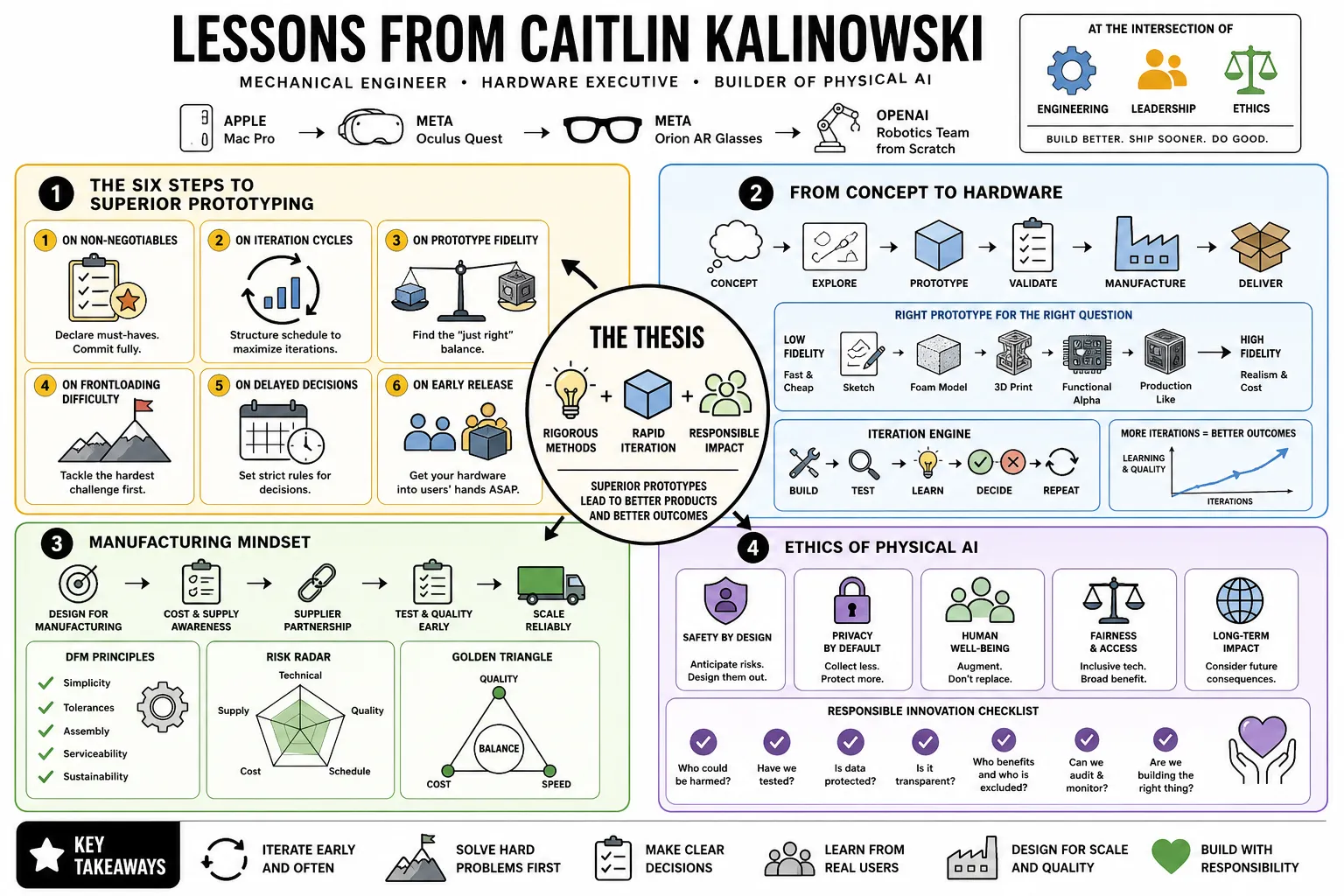
Lessons from Caitlin Kalinowski
Caitlin Kalinowski is a mechanical engineer and hardware executive who led development at Apple, Meta, and OpenAI. She helped design the Mac Pro, Oculus Quest, and Meta's Orion AR glasses before building OpenAI's robotics team from scratch. This profile covers her methods for prototyping, manufacturing, and handling the ethics of physical AI.
Part 1: The Six Steps to Superior Prototyping
- On non-negotiables: "You have to declare your essential 'must-haves' before you start building, and you must commit to them fully." — First Round Review]
- On iteration cycles: "Structure your hardware development schedule specifically to maximize the number of prototype iterations." — First Round Review]
- On prototype fidelity: "Find the 'just right' balance; do not over-engineer a prototype when a simple foam model will answer the question." — Medium]
- On frontloading difficulty: "Tackle the hardest technical challenge first, even if it means delaying the easier components." — Ars Technica]
- On delayed decisions: "Establish strict guidelines for how and when decisions are finalized to prevent your development timeline from stalling." — First Round Review]
- On early release: "Get your hardware into users' hands as fast as possible to find out what you were wrong about." — Fast Company]
- On sunk costs: "Be willing to throw away a prototype if it proves the initial hypothesis was incorrect." — Medium]
- On defining success: "A prototype is only successful if it definitively answers the specific engineering question it was built to test." — Silicon Slopes]
- On isolation: "You cannot design a product in a vacuum and expect it to survive contact with actual human behavior." — First Round Review]
- On resource allocation: "Spend your highest-cost engineering hours on the features that define the product's core value proposition." — Ars Technica]
Part 2: Transitioning from VR to AR Hardware
- On form factor: "With AR glasses, the social acceptability of the hardware is exactly as important as the optics inside them." — Meta Quest]
- On mass adoption: "Virtual reality struggled to reach absolute mainstream scale because of the friction involved in putting a headset on." — Lenny Newsletter Archive]
- On weight distribution: "In wearable technology, a device that is perfectly balanced feels significantly lighter than one that is technically lighter but front-heavy." — Fast Company]
- On the Orion project: "Building true AR glasses requires inventing entirely new display paradigms and shrinking them down to the size of normal spectacles." — Ars Technica]
- On thermal management: "You cannot put a loud fan or a hot processor on someone's face; the thermal constraints dictate the entire industrial design." — Medium]
- On input methods: "Hand tracking and eye tracking are non-negotiable for AR because users will not carry a controller in public." — Meta Quest]
- On battery life: "Users expect day-long battery life from anything resembling glasses, which forces compromises in processing power." — Engadget]
- On display limitations: "Physics is the ultimate boundary in AR design; you cannot cheat the laws of optics." — Fast Company]
- On the Meta Quest legacy: "The Quest line proved that standalone, inside-out tracked headsets were the only viable path forward for consumer VR." — Ars Technica]
Part 3: The Frontier of Physical AI and Robotics
- On physical AI: "The next major wave of artificial intelligence will not happen on screens, it will happen in the physical world through robotics." — Lenny Newsletter Archive]
- On hardware latency: "An AI model can generate a response in milliseconds, but physical actuators and motors have hard mechanical limits." — Ars Technica]
- On robotic form: "Humanoid robots make sense because our entire world—stairs, doors, tools—is built for the human shape." — Medium]
- On training data: "Robots lack the infinite text data that LLMs rely on; we have to collect physical interaction data manually." — Lenny Newsletter Archive]
- On motor precision: "The gap between an AI knowing what to do and a robotic arm executing it smoothly is a massive engineering hurdle." — Engadget]
- On battery density: "Robotics will be constrained by battery chemistry until we can power heavy mechanical output for an entire workday." — Ars Technica]
- On edge computing: "Physical AI requires heavy onboard compute because relying on cloud servers introduces dangerous latency for moving machines." — Lenny Newsletter Archive]
- On sensor fusion: "A robot must interpret vision, sound, and touch simultaneously to navigate a messy human environment safely." — Medium]
- On the OpenAI hardware mandate: "Building a hardware division from scratch inside a software-first AI company requires a complete cultural reset." — Fast Company]
- On scaling production: "Mass-producing intelligent robots will be an order of magnitude harder than manufacturing consumer electronics." — Engadget]
Part 4: Ethics and Guardrails in Autonomous Systems
- On military applications: "Entering partnerships that allow for lethal autonomy without human authorization crosses a line that technologists should refuse to cross." — Medium]
- On surveillance: "Hardware capable of widespread surveillance must have built-in, unalterable constraints to protect civil liberties." — Ars Technica]
- On principled resignation: "Sometimes the only way to enforce your ethical boundaries is to walk away from a project you care about." — Fast Company]
- On AI oversight: "Deploying physical AI requires strict judicial and ethical oversight, rather than corporate self-regulation." — Medium]
- On safety margins: "When a software bug occurs, an app crashes. When a physical AI bug occurs, someone can get physically injured." — Lenny Newsletter Archive]
- On opaque algorithms: "We cannot put autonomous machines into public spaces if we cannot explain exactly why they made a specific movement." — Engadget]
- On defense contracts: "Companies must be completely transparent with their employees about how their technology will be used by defense agencies." — Ars Technica]
- On the speed of deployment: "The pressure to ship AI products fast should never override the necessity of physical safety testing." — Fast Company]
- On engineering responsibility: "Engineers are entirely responsible for the consequences of the systems they put into the world." — Medium]
Part 5: Engineering Leadership and Decision Making
- On cross-functional friction: "Hardware and software teams naturally fight because they operate on completely different timelines; leadership is about translating between them." — Silicon Slopes]
- On communicating complexity: "A good engineering leader can explain a deeply technical constraint to a non-technical executive in three sentences or less." — Teach the Geek]
- On failing fast: "Create a culture where engineers are rewarded for finding the flaw in their own design quickly." — First Round Review]
- On hiring criteria: "I look for engineers who are obsessed with how things break, rather than how they work when everything goes right." — Medium]
- On technical debt: "In hardware, technical debt manifests as physical tooling costs that you cannot patch with an update later." — Ars Technica]
- On scope creep: "Saying no to a new feature late in the development cycle is the most important job of a hardware lead." — Fast Company]
- On team structure: "Keep prototyping teams as small as possible until the core physics of the device are proven." — First Round Review]
- On managing risk: "Identify the top three reasons the product will fail and assign your best engineers to those specific problems." — Medium]
- On public speaking: "Engineers must learn to present their work effectively, or their ideas will be sidelined by worse ideas presented better." — Teach the Geek]
- On setting deadlines: "Artificial deadlines are necessary in hardware to force uncomfortable decisions about what to cut." — Silicon Slopes]
Part 6: Building Resilient Hardware Supply Chains
- On component sourcing: "Startups must secure their supply chains years in advance, or they will be locked out by larger competitors." — Lenny Newsletter Archive]
- On manufacturing scale: "A design that works perfectly for a hundred units will often fail entirely when scaled to ten million." — Ars Technica]
- On the memory market: "Hardware companies must prepare for sudden price shocks in components like memory and adjust their margins accordingly." — Lenny Newsletter Archive]
- On factory relationships: "You cannot manage a manufacturing line via email; you have to physically stand on the factory floor with the operators." — Medium]
- On custom silicon: "Designing your own chips is expensive and painful, but it is often the only way to achieve the necessary power targets." — Fast Company]
- On tolerance stacking: "Most manufacturing failures happen because the acceptable variations in multiple components stack up to create an unusable final product." — First Round Review]
- On shipping logistics: "Do not design a product box that results in paying to ship empty air across the ocean." — Medium]
- On yield rates: "A slight aesthetic design change can drop factory yield rates by thirty percent, destroying the product's profitability." — Ars Technica]
- On supplier transparency: "Treat your component suppliers as engineering partners to get priority when shortages hit." — Silicon Slopes]
Part 7: Diversity and the Human Element in Tech
- On inclusive design: "If your engineering team lacks diversity, your hardware will physically exclude entire demographics of users." — Wogrammer on X]
- On mentorship: "Senior women in engineering have an obligation to pull the next generation up behind them." — Medium]
- On workplace culture: "A toxic team culture will always eventually manifest as flaws in the final product." — Fast Company]
- On physical ergonomics: "Testing a wearable device only on standard male head sizes guarantees it will be painful for half your audience." — Ars Technica]
- On representation: "You cannot build products for a global market with a homogeneous group of engineers sitting in Silicon Valley." — Wogrammer on X]
- On retention: "Tech companies focus heavily on hiring diverse talent, but fail to create an environment that keeps them there." — Medium]
- On feedback loops: "Create channels where junior engineers feel safe pointing out fundamental flaws in a senior engineer's design." — Silicon Slopes]
- On intersectionality: "Diversity initiatives must go beyond gender to include race, background, and physical ability to be effective." — Fast Company]
- On structural barriers: "We have to dismantle the invisible hurdles that prevent women from advancing into hardware leadership roles." — Wogrammer on X]
Part 8: Working Alongside Industry Titans
- On Apple's precision: "The Mac Pro and MacBook Air teams operated on a level of millimeter precision that ruined you for ordinary hardware." — Ars Technica]
- On Steve Jobs: "He proved that consumers will pay a premium for hardware that feels emotionally resonant rather than just functional." — Lenny Newsletter Archive]
- On unibody manufacturing: "The original unibody MacBook Pro completely changed how the industry approached milling aluminum at scale." — Medium]
- On Mark Zuckerberg: "His willingness to commit massive long-term capital to Reality Labs is what kept consumer VR alive during the lean years." — Lenny Newsletter Archive]
- On Meta's agility: "Unlike traditional hardware companies, Meta was willing to aggressively break things in software to support new hardware features." — Fast Company]
- On Sam Altman: "He understands that to solve AGI, you eventually have to give the models a physical body to interact with the real world." — Lenny Newsletter Archive]
- On shifting focus: "Moving from Apple's established supply chains to Oculus's startup environment required unlearning a decade of standard procedures." — Silicon Slopes]
- On corporate pacing: "Hardware development at a software company like Meta requires constantly defending your timeline against software engineers who ship code daily." — Ars Technica]
- On industry influence: "Working under multiple visionary founders teaches you that intense focus is the only thing that actually ships great products." — Lenny Newsletter Archive]