Cal Newport, Georgetown University’s Provost’s Distinguished Professor of Computer Science and a founding faculty member of its Center for Digital Ethics, has become a prominent voice in the discourse on work, technology, and the pursuit of a meaningful life. Through his bestselling books, he offers a counter-narrative to the prevailing culture of distraction and passion-fueled career planning. His philosophy centers on focused work, the strategic development of valuable skills, the intentional use of technology, and slow productivity.
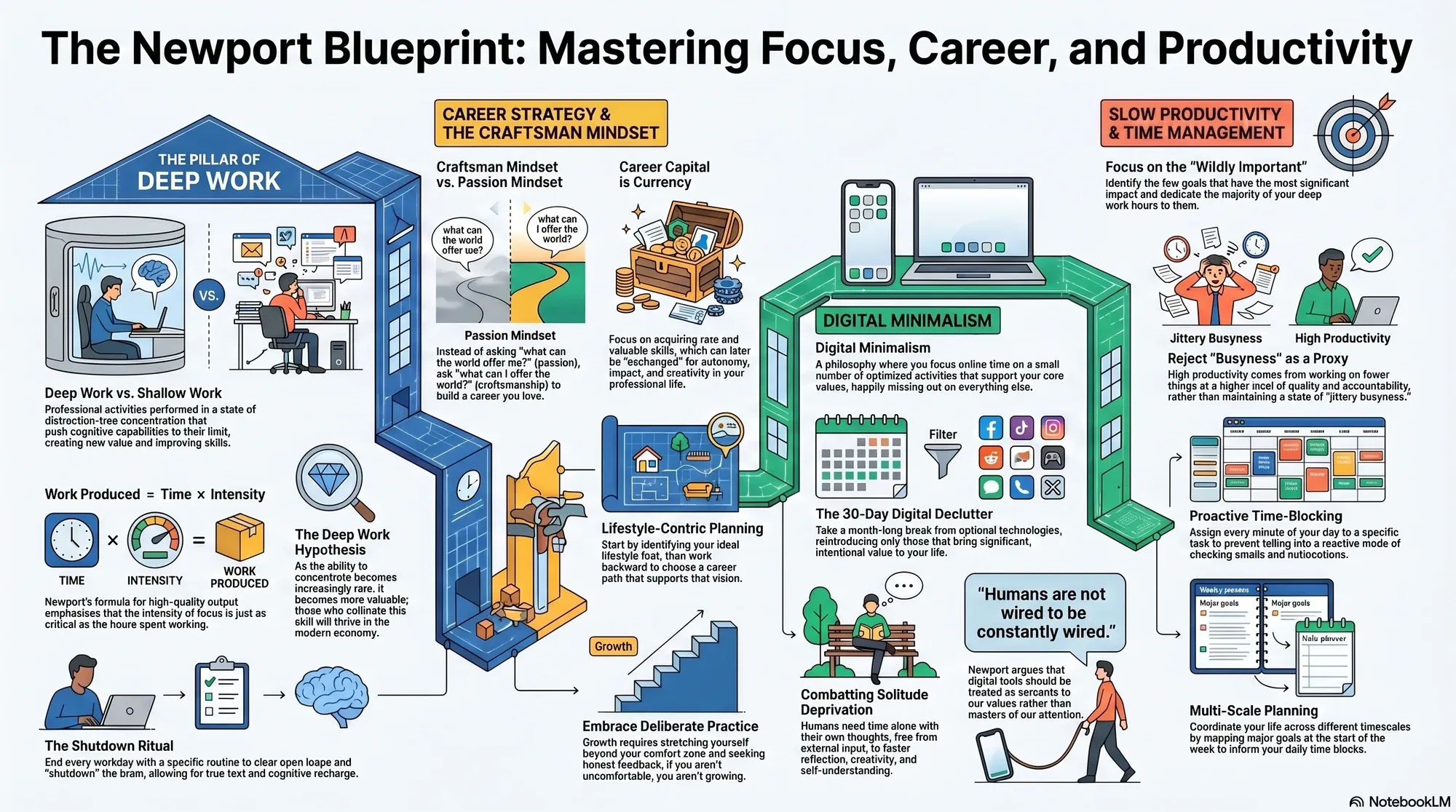
On Deep Work & Focus
The cornerstone of Newport's philosophy, "Deep Work," argues that the ability to concentrate without distraction is becoming increasingly rare and valuable.
Quotes:
- "Deep Work: Professional activities performed in a state of distraction-free concentration that push your cognitive capabilities to their limit. These efforts create new value, improve your skill, and are hard to replicate." [1][2]
- "The Deep Work Hypothesis: The ability to perform deep work is becoming increasingly rare at exactly the same time it is becoming increasingly valuable in our economy. As a consequence, the few who cultivate this skill, and then make it the core of their working life, will thrive." [1][3]
- "Who you are, what you think, feel, and do, what you love—is the sum of what you focus on." [1][3]
- "To learn hard things quickly, you must focus intensely without distraction. To learn, in other words, is an act of deep work." [1]
- "Less mental clutter means more mental resources available for deep thinking." [1][3]
- "Human beings, it seems, are at their best when immersed deeply in something challenging." [1]
- "Efforts to deepen your focus will struggle if you don't simultaneously wean your mind from a dependence on distraction." [3][4]
- "When you work, work hard. When you're done, be done." [5]
- "High-Quality Work Produced = (Time Spent) x (Intensity of Focus)." [2]
- "To simply wait and be bored has become a novel experience in modern life, but from the perspective of concentration training, it's incredibly valuable." [1][3]
- "Spend enough time in a state of frenetic shallowness and you permanently reduce your capacity to perform deep work." [2]
Learnings:
- Schedule Deep Work Blocks: Instead of letting your day be dictated by reactive tasks, proactively schedule 60-90 minute blocks for deep, focused work on your most important tasks. [6][7]
- Embrace Boredom: Don't reflexively reach for your phone at the slightest hint of boredom. Training your mind to be comfortable with a lack of stimulation builds your capacity for focus. [6]
- Create Deep Work Rituals: Develop routines to signal the start of a deep work session, such as clearing your desk, getting a specific beverage, or closing all browser tabs. This minimizes the willpower needed to start. [1][7]
- The Shutdown Ritual: At the end of the workday, create a shutdown ritual to fully disconnect. This might involve reviewing your task list for the next day, ensuring there are no open loops, and saying a phrase like "shutdown complete." This allows your brain to truly rest and recharge. [4][5]
- On Human Satisfaction: "Few satisfactions are more uniquely human than the slow extraction of new understanding, illuminated through the steady attention of your mind’s eye." — Forget Chatbots. You Need a Notebook.
- On The cost of context switching: Constantly answering messages might feel like harmless work, but the cognitive cost of a diverse inbox is actually what exhausts us most. — The Jordan Harbinger Show - Cal Newport: Reclaiming Time and Focus with Slow Productivity
On Career Strategy
Newport challenges the popular "follow your passion" mantra, advocating instead for a "craftsman mindset."
Quotes:
- "Passion comes after you put in the hard work to become excellent at something valuable, not before." [3][8]
- "If you want to love what you do, abandon the passion mindset ('what can the world offer me?') and instead adopt the craftsman mindset ('what can I offer the world?')." [3][8]
- "If you don't produce, you won't thrive—no matter how skilled or talented you are." [1][3]
- "Be so good they can't ignore you." (A quote from Steve Martin that Newport champions). [9]
- "No one owes you a great career, it argues; you need to earn it—and the process won't be easy." [3][8]
- "Working right trumps finding the right work." [9]
- "The things that make a great job great...are rare and valuable. If you want them in your working life, you need something rare and valuable to offer in return." [10]
- "A job... is a way to pay the bills, a career is a path towards increasingly better work, and a calling is work that's an important part of your life and a vital part of your identity." [1][10]
Learnings:
- Develop Career Capital: Focus on acquiring rare and valuable skills. This "career capital" is what you can later exchange for desirable traits in your career, such as autonomy, impact, and creativity. [8][9]
- The Craftsman Mindset: Approach your work with a focus on quality and craftsmanship. Instead of asking if your job is your passion, ask how you can become better at your job. [6][11]
- Lifestyle-Centric Career Planning: Instead of starting with a vague passion, work backward from a concrete vision of your ideal lifestyle. Identify what kind of life you want, and then determine what career paths can support it. [12][13]
- Embrace Deliberate Practice: To build skills effectively, you must engage in deliberate practice—stretching yourself beyond your comfort zone and seeking honest feedback. [1][8] If you're not uncomfortable, you're likely not growing. [14]
- On Career capital: "As you get better at something, the more say you get over the way your life unfolds." — The Tim Ferriss Show #722 (Slow Productivity)
On Digital Technology & Minimalism
Newport argues for an intentional and minimalist approach to technology, viewing digital tools as servants rather than masters.
Quotes:
- "Digital Minimalism: A philosophy of technology use in which you focus your online time on a small number of carefully selected and optimized activities that strongly support things you value, and then happily miss out on everything else." [1][3]
- "Simply put, humans are not wired to be constantly wired." [1][3]
- "The tycoons of social media have to stop pretending that they're friendly nerd gods building a better world and admit they're just tobacco farmers in T-shirts selling an addictive product to children." [1]
- "The urge to check Twitter or refresh Reddit becomes a nervous twitch that shatters uninterrupted time into shards too small to support the presence necessary for an intentional life." [1][3]
- "Digital minimalists see new technologies as tools to be used to support things they deeply value—not as sources of value themselves." [1][15]
- "You cannot expect an app designed to be addictive to respect your time and attention." [16]
- "Solitude Deprivation: A state in which you spend close to zero time alone with your own thoughts and free from input from other minds." [1][3]
- "Clutter is costly. It's not just the physical clutter in your home—it's the digital clutter in your life that steals your time, energy, and focus." [16]
Learnings:
- Conduct a Digital Declutter: Take a 30-day break from optional technologies in your life. After the break, reintroduce only those that bring significant value and align with your goals, and establish clear rules for their use.
- Reclaim Leisure: Replace low-quality digital distractions with high-quality leisure activities that are often more active, creative, and fulfilling, such as hobbies, exercise, or learning a new skill. [16]
- Practice Solitude: Regularly spend time alone with your own thoughts, free from external input. This is crucial for reflection, creativity, and self-understanding. [15][16]
- On Digital Distraction: "The problem facing knowledge work in our current moment is not that we’re lacking sufficiently powerful technologies. It’s instead that we’re already distracted by so many digital tools that there’s no time left to really open the throttle on our brains." — Forget Chatbots. You Need a Notebook.
- On The Illusion of AI Productivity: AI tools, like email before them, risk making us busier with shallow tasks rather than helping us produce high-value output that moves the needle. — Why Hasn’t AI Made Work Easier?
- On Practical AI: Practical AI improvements that simplify and organize digital chores—like filtering out the noise in our inboxes—are more immediately useful than chasing completely autonomous AI agents. — Why Can’t AI Empty My Inbox?
On Productivity & Time Management
Newport's approach to productivity is about doing fewer things better and rejecting the culture of "busyness as a proxy for productivity."
Quotes:
- "Clarity about what matters provides clarity about what does not." [1][3]
- "The more you try to do, the less you actually accomplish." [1][5]
- "Deciding what not to do is as important as deciding what to do." [17]
- "This is what ultimately matters: where you end up, not the speed at which you get there, or the number of people you impress with your jittery busyness along the way." [17]
- "In the knowledge sector, working on fewer things, but doing each thing with more quality and accountability, can be the foundation for significantly more productivity." [18]
- "The title of this book, A World Without Email, turns out to be just an approachable shorthand for the more accurate portrayal of my vision: A World Without the Hyperactive Hive Mind Workflow." [19]
- "Slow Productivity Rejects Busyness. Slow productivity rejects busyness, seeing overload as an obstacle to producing results that matter, not a badge of pride." [20]
- "We've become so used to the idea that the only reward for getting better is moving toward higher income and increased responsibilities that we forget that the fruits of pursuing quality can also be harvested in the form of a more sustainable lifestyle." [17][20]
Learnings:
- Time-Blocking: Plan your day by assigning every minute to a specific task. This proactive approach to scheduling prevents you from falling into a reactive mode of checking email and responding to notifications. [21][22]
- Multi-Scale Planning: Organize your plans on different timescales (e.g., weekly, daily). At the beginning of each week, map out your major goals and deadlines, which then informs your daily time blocks. [23]
- Focus on the "Wildly Important": Identify the few goals that will have the most significant impact and dedicate the majority of your deep work hours to them. This provides clarity and prevents your energy from being fragmented across too many initiatives. [1][5]
- Constrain Your Commitments: A key part of time management is being very careful about what you say "yes" to. Simplify what's on your plate to make the job of planning and executing easier. [23]
Learn more:
- Top 200 Cal Newport Quotes (2025 Update) - QuoteFancy
- Quotes from Cal Newport's Deep Work book - GitHub Gist
- Quotes by Cal Newport (Author of Deep Work) - Goodreads
- Deep Work Quotes by Cal Newport - Goodreads
- 13 Quotes & Lessons From 'Deep Work' that Will Change Your Productivity Forever
- Deep Work: 8 Focus-Enhancing Strategies from Cal Newport to Boost Productivity | by Yakira Yedidia | Mr. Plan ₿ Publication | Medium
- How To Manage Your Time: 5 Secrets Backed By Research - Barking Up The Wrong Tree
- So Good They Can't Ignore You Quotes by Cal Newport - Goodreads
- 12 Cal Newport Quotes from 'So Good They Can't Ignore You'
- So Good They Can't Ignore You Quotes by Cal Newport(page 4 of 21) - Goodreads
- Mastering Your Career: Lessons from Cal Newport's 'So Good They Can't Ignore You'
- Cal Newport's Top Advice For Young People Starting Their Careers - YouTube
- The Most Important Piece of Career Advice You Probably Never Heard - Cal Newport
- Top Quotes: So Good They Can't Ignore You: Why Skills Trump Passion in the Quest for Work You Love” — Cal Newport - Austin Rose
- Digital Minimalism Quotes by Cal Newport - Goodreads
- 10 Quotes from Digital Minimalism That Will Help You Reclaim Your Focus | by Mohit Mistry
- 10 Best Quotes from 'Slow Productivity' by Cal Newport - Book Fave
- Best Quotes Of A World Without Email With Page Numbers By Cal Newport - Bookey
- Cal Newport Quote: “The title of this book, A World Without Email, turns out to be just an approachable shorthand for the more accurate...” - QuoteFancy
- Best Quotes From Slow Productivity by Cal Newport - Summrize Book Summaries
- Mastering Time Blocking: A Guide to Cal Newport's Planner for Optimal Productivity
- Dr. Cal Newport: How to Enhance Focus and Improve Productivity - Recall
- Core Idea: Time Management - YouTube
- On Hard Work Without Burnout: Deep and meaningful results require consistent, disciplined effort over a long period, not exhausting 14-hour days or sacrificing your health. Focus intensely in reasonable bursts rather than succumbing to unfocused freneticism. — Does Work-Life Balance Make You Mediocre?
- On Managing workload: You cannot rely on others to manage your workload for you; when you tell people you are busy, they will still hand off tasks to get them off their own plates. — The Tim Ferriss Show #722 (Slow Productivity)
- On Pseudo productivity: In knowledge work, we have mistakenly adopted visible activity as a proxy for productive effort, a flawed heuristic that leads to burnout rather than results. — The Jordan Harbinger Show - Cal Newport: Reclaiming Time and Focus with Slow Productivity
- On True quality: Exceptional quality requires doing fewer things; you cannot maintain the manic energy of juggling 100 projects if you are truly obsessed with doing something well. — The Tim Ferriss Show #722 (Slow Productivity)
- On Value: "Busyness doesn't produce high value." — The Tim Ferriss Show #722 (Slow Productivity)
- On Slow productivity: "Slow productivity produces good stuff. It doesn't just make the workers happier. It doesn't just make you happier. You produce better stuff. I mean, your company has more profit. Your clients are happier. You can charge more for the services you offer, so it's not zero sum. It's more win-win than anything else." — The Tim Ferriss Show #722 (Slow Productivity)