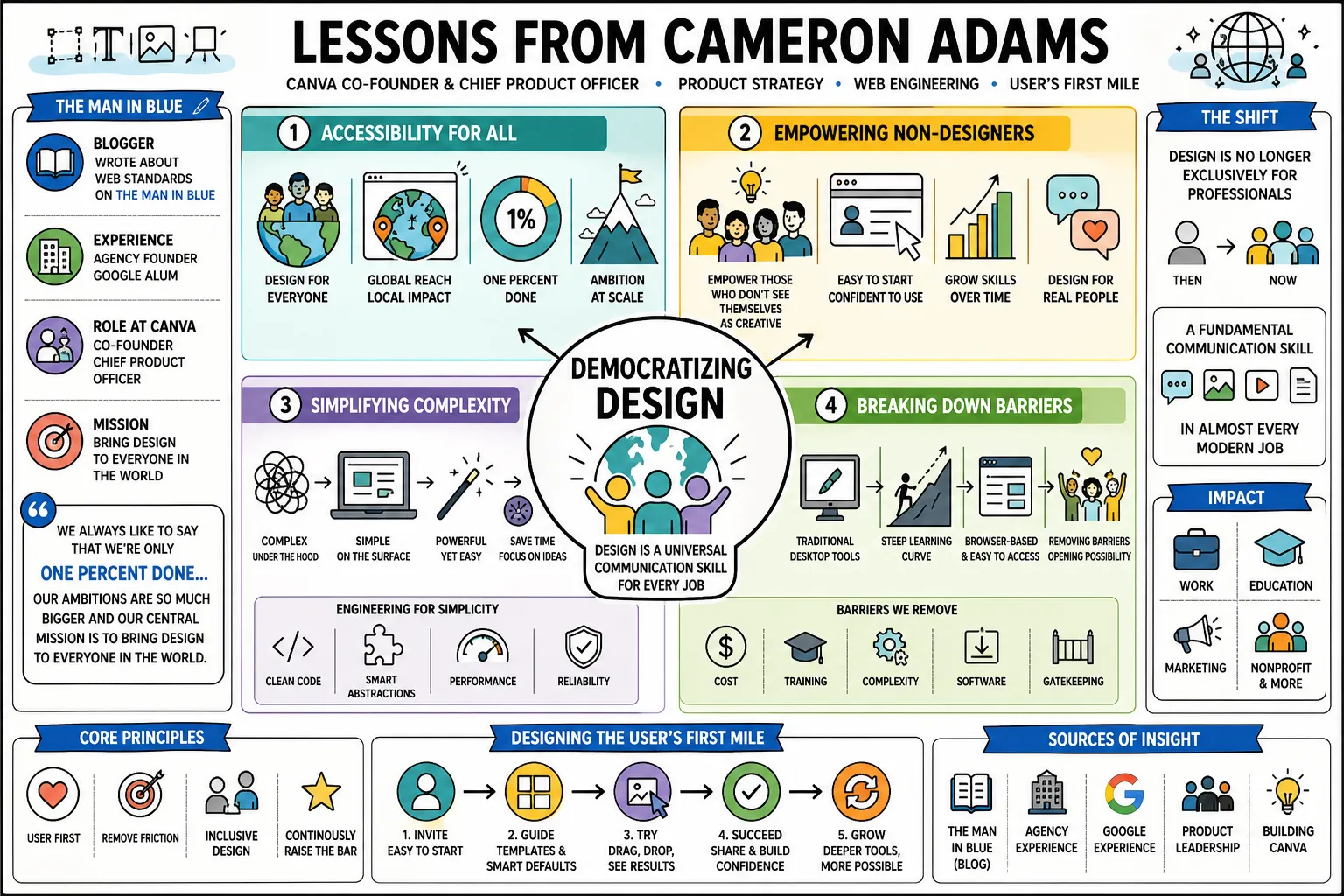
Lessons from Cameron Adams
Cameron Adams is the co-founder and Chief Product Officer of Canva. — Canva Co-Founder Cameron Adams' biggest lessons.
Part 1: Democratizing Design
- On Solving a Real Problem: Cameron Adams: "A lot of people come up with really unique ideas, but in order to build a business on top of an idea, it needs to solve a real problem." — Canva Co-Founder Cameron Adams' biggest lessons.
- On Explaining Why You Do What You Do: Cameron Adams: "Communicating the big picture around why you do what you do can lead to a massive shift in pride, support, and motivation from both your team and community and add a new level of meaning to your work." — Canva Co-Founder Cameron Adams' biggest lessons.
- On Values in Action: Cameron Adams: "Gone are the days of ping pong tables and other gimmicky perks – today, people want to work for companies that align with their values, and whose values move beyond rhetoric and are actually put into action every day." — Canva Co-Founder Cameron Adams' biggest lessons.
- On Listening to Your Community: Cameron Adams: "You need to be constantly listening to your community and coming up with new, imaginative ways of evolving your product or service to meet their needs (and defy their expectations)." — Canva Co-Founder Cameron Adams' biggest lessons.
- On Internationalisation and Localisation: Cameron Adams: "Very broadly speaking, internationalisation is about the nuts of bolts of offering your product in different languages, whereas localisation is about making it appropriate for every users’ context and culture." — Canva Co-Founder Cameron Adams' biggest lessons.
- On Protecting Your Culture While Growing: Cameron Adams: "At a fast-growing startup, this happens quickly and you can lessen the risk of losing your organizational identity by being really clear on what your culture is and how your team can live it." — Canva Co-Founder Cameron Adams' biggest lessons.
- On Polish in a First Product: Cameron Adams: "You've got limited resources, you've got limited time, so you need to put out a product that's polished enough that people feel like they can use it and trust it." — How Canva leveraged unconventional growth levers to grow to $42B | Cameron Adams (Co-founder & CPO).
- On the Product Iteration Loop: Cameron Adams: "I think that product iteration loop that we had was really important because it was fast and it was a really strong signal of quality and finding the right thing to build." — How Canva leveraged unconventional growth levers to grow to $42B | Cameron Adams (Co-founder & CPO).
- On Being Profitable: Cameron Adams: "Since then, we've put a premium on being a profitable company, making sure that we don't need funding, that we can run the company without having to go to someone else and put our hand out." — How Canva leveraged unconventional growth levers to grow to $42B | Cameron Adams (Co-founder & CPO).
- On Creative Tools: Cameron Adams: "I'd always been really interested in creative tools, helping people unlock their innate creativity, which a lot of us don't realize we have." — How Canva leveraged unconventional growth levers to grow to $42B | Cameron Adams (Co-founder & CPO).
Part 2: Product Strategy and Problem Solving
- On Finding a Key User Group First: Cameron Adams: "We quickly identified them as a key user group that the first product needed to be suited for in terms of all the features that they needed, and B, to then start building a community around it." — How Canva leveraged unconventional growth levers to grow to $42B | Cameron Adams (Co-founder & CPO).
- On Early Community Returns: Cameron Adams: "We started seeing returns on that within three months, and it scaled up over the next couple of years to become a massive driving engine for us, and it still is a massive source of traffic for us." — How Canva leveraged unconventional growth levers to grow to $42B | Cameron Adams (Co-founder & CPO).
- On Thinking Beyond Your First Market: Cameron Adams: "You're never going to create a scaled online company just thinking about that market." — How Canva leveraged unconventional growth levers to grow to $42B | Cameron Adams (Co-founder & CPO).
- On Access Regardless of Means: Cameron Adams: "It’s part of our ethos that we want people to have access to this tool, no matter if they can afford it or not." — The Jay Kim Show #106: Cameron Adams (transcript).
- On Distilling a Complex Process: Cameron Adams: "So we wanted to distill that down into one app that you could use that did it all and did it in such a simple way that anyone could approach it and get great results." — The Jay Kim Show #106: Cameron Adams (transcript).
- On Being Your Own Barometer: Cameron Adams: "For the first six months, we mostly just used ourselves as the barometer for what the product should be and how it feels and what the quality was." — How Canva leveraged unconventional growth levers to grow to $42B | Cameron Adams (Co-founder & CPO).
- On Localization: Cameron Adams: "We've also focused a lot on internationalization and localization where people haven't." — How Canva leveraged unconventional growth levers to grow to $42B | Cameron Adams (Co-founder & CPO).
- On More Than Pretty Graphics: Cameron Adams: "Not just something that created some pretty graphics, but a tool that helped you rally people together, express your ideas and get things done." — How Canva leveraged unconventional growth levers to grow to $42B | Cameron Adams (Co-founder & CPO).
- On Getting Feedback Quickly: Cameron Adams: "You also need to get it out quick enough so that you're getting feedback and responding to it and helping you find your direction." — How Canva leveraged unconventional growth levers to grow to $42B | Cameron Adams (Co-founder & CPO).
Part 3: Artificial Intelligence and Human Creativity
- On Helping Everyone Realize Ideas: Cameron Adams: "It’s our next move in helping everyone realize their ideas, regardless of how much technical training they have." — Building a $49B Design Powerhouse: Interview with Canva Co-Founder Cameron Adams (quoted remarks).
- On Concrete AI Examples: Cameron Adams: "Rather than big lofty vision statements, people need actual examples of how AI can make a difference to their teams and their work." — Welcome to Prompted: New Podcast from Canva co-founder Cameron Adams (Prompted newsletter by Cameron Adams).
- On Imagination as the Differentiator: Cameron Adams: "Even as AI improves, what sets us apart is how we imagine, question and collaborate." — Welcome to Prompted: New Podcast from Canva co-founder Cameron Adams (Prompted newsletter by Cameron Adams).
- On Getting to 80%: Cameron Adams: "It helps me get to 80% sooner, helps me organise disparate, loosely connected thoughts, and generally distill the noise to figure out what matters." — Why AI slop is just intelligence without imagination (Prompted newsletter by Cameron Adams).
- On Less Hype: Cameron Adams: "More tangible tips, less overblown hype." — Welcome to Prompted: New Podcast from Canva co-founder Cameron Adams (Prompted newsletter by Cameron Adams).
- On Editable AI Output: Cameron Adams: "The tools that keep imagination front and centre will also make editing your AI work easy, with precise regeneration, structured layers, and movable elements instead of locked pixels you either accept whole or throw away." — Why AI slop is just intelligence without imagination (Prompted newsletter by Cameron Adams).
- On Slop: Cameron Adams: "Slop is intelligence without imagination." — Why AI slop is just intelligence without imagination (Prompted newsletter by Cameron Adams).
- On Being Honest About Your Process: Cameron Adams: "I also think that if more people in my position are honest about their process, the more useful this conversation gets." — Good writing always takes work. AI changed where the work happens. (Prompted newsletter by Cameron Adams).
- On Changing to Keep a Voice: Cameron Adams: "To maintain a unique voice (or, if you’re a business: a unique brand) and introduce new ideas we will always need to change, adapt, and move on." — Why AI slop is just intelligence without imagination (Prompted newsletter by Cameron Adams).
- On Reaching Everyone: Cameron Adams: "The question now is how you get these tools to hundreds of millions of people in ways that actually work for them, not just the ones who know how to structure a.MD file to hook up a long-polling calendar bot to an MCP server." — We gave 5,000 people a week off to learn AI. (Prompted newsletter by Cameron Adams).
Part 4: Startup Growth and Conviction
- On Launching Early: Cameron Adams: "At the time, the Lean Startup book had just come out, so everyone was Lean Startup, like just launch the first HTML page you can think of and iterate upon it." — How Canva leveraged unconventional growth levers to grow to $42B | Cameron Adams (Co-founder & CPO).
- On Community as Advocates: Cameron Adams: "I think in terms of growth, really focusing on that early community and being responsive to them, building them up as your advocates and your evangelists, making them feel like they're part of the team so that they're really willing to talk about your product and take it to other people is incredibly important." — How Canva leveraged unconventional growth levers to grow to $42B | Cameron Adams (Co-founder & CPO).
- On Seeing the Loop: Cameron Adams: "From those tweets, other people got interested and brought them in, and we could really tangibly see that loop happening." — How Canva leveraged unconventional growth levers to grow to $42B | Cameron Adams (Co-founder & CPO).
- On Being One Percent Done: Cameron Adams: "We always like to say that we’re only one percent done … and it’s pretty much true most of the time …." — One Percent Done: Cameron Adams (part 1).
- On Landing Pages for Jobs to Be Done: Cameron Adams: "We created landing pages that really spoke to people's jobs to be done when they landed on that page." — How Canva leveraged unconventional growth levers to grow to $42B | Cameron Adams (Co-founder & CPO).
- On Funding and Control: Cameron Adams: "We don't want to be in that position again where we critically need funds and someone else can determine the trajectory of our business." — How Canva leveraged unconventional growth levers to grow to $42B | Cameron Adams (Co-founder & CPO).
- On Launch Day: Cameron Adams: "The launch is probably the least important thing when you're looking at a journey of 10, 20 years." — How Canva leveraged unconventional growth levers to grow to $42B | Cameron Adams (Co-founder & CPO).
- On Knowing Your Gaps: Cameron Adams: "One of the key things that I'd identified through Fluent was that I had no business skills whatsoever." — How Canva leveraged unconventional growth levers to grow to $42B | Cameron Adams (Co-founder & CPO).
- On the Editor Rewrite: Cameron Adams: "There was this one period where we decided to rewrite our entire editor code base, which was particularly trying." — How Canva leveraged unconventional growth levers to grow to $42B | Cameron Adams (Co-founder & CPO).
Part 5: Engineering and Prototyping
- On Prototyping the Experience: Cameron Adams: "Mel and I spent that three months prototyping the product and figuring out the experience." — How Canva leveraged unconventional growth levers to grow to $42B | Cameron Adams (Co-founder & CPO).
- On Mobile Timing: Cameron Adams: "Mobile hadn't quite taken off when we launched, so it wasn't imperative that we had a mobile product when we launched, but I definitely think we could have done it earlier." — How Canva leveraged unconventional growth levers to grow to $42B | Cameron Adams (Co-founder & CPO).
- On What the Browser Could Do: Cameron Adams: "Lars, my boss from Google, told me to go talk to them about technology and what was possible in the browser." — The Jay Kim Show #106: Cameron Adams (transcript).
- On Cross-Discipline Teams: Cameron Adams: "The most compelling projects came from teams that spanned disciplines (like marketers paired with engineers) and this dedicated week allowed them to connect and create together without the pressure of deadlines." — We gave 5,000 people a week off to learn AI. (Prompted newsletter by Cameron Adams).
Part 6: Leadership and Company Culture
- On Fewer, Memorable Values: Cameron Adams: "So we originally started with 12 values that no one could remember, and we’ve now zeroed those down into six that really matter to us and that we’re constantly communicating, particularly the new people who come to Canva." — The Jay Kim Show #106: Cameron Adams (transcript).
- On Teams as Mini Startups: Cameron Adams: "We set up our team structure such that each team has the resources to operate almost like a mini startup, and they can make their own decisions, set their own crazy big goals, and get stuff done without having to go through too many layers of decision-making." — The Jay Kim Show #106: Cameron Adams (transcript).
- On Onboarding: Cameron Adams: "Anyone who is new to Canva goes through a very well thought out onboarding process where we pair them up with someone on their team who looks after them." — The Jay Kim Show #106: Cameron Adams (transcript).
- On Partners Who Fill Your Gaps: Cameron Adams: "I think you really have to know what you’re good at as an individual and also what you’re not so good at, and you need to find the supporting partners that fill in those gap and the partners whose gaps you fill in as well." — The Jay Kim Show #106: Cameron Adams (transcript).
- On Scale Breaking Things: Cameron Adams: "Roughly, every time you double, stuff just starts breaking." — The Jay Kim Show #106: Cameron Adams (transcript).
Part 7: The Early Days of Canva
- On a Fast Courtship: Cameron Adams: "I think we officially spent two hours in person, two separate Skype chats, and that was it." — How Canva leveraged unconventional growth levers to grow to $42B | Cameron Adams (Co-founder & CPO).
- On Failed Pitching: Cameron Adams: "Ultimately, we didn’t come out with any money, but fortunately, my old boss at Google introduced me to a woman called Melanie Perkins who had been running a school yearbook business at the time." — The Jay Kim Show #106: Cameron Adams (transcript).
- On Taking Investor Money: Cameron Adams: "We were originally going to bootstrap, but we thought since people were knocking down our door to give us cash that we might go talk to them." — How Canva leveraged unconventional growth levers to grow to $42B | Cameron Adams (Co-founder & CPO).
- On the Waiting List: Cameron Adams: "We also had a waiting list of about 15,000 people who had signed up already, not even knowing what Canva was about, so we're going to send out an email to them." — How Canva leveraged unconventional growth levers to grow to $42B | Cameron Adams (Co-founder & CPO).
- On Shared Product Philosophy: Cameron Adams: "Mel did a deep dive into the product that I was building, the email product, and really loved it." — How Canva leveraged unconventional growth levers to grow to $42B | Cameron Adams (Co-founder & CPO).
- On Fear of Being Beaten: Cameron Adams: "We were always worried that someone would launch exactly Canva before we did." — How Canva leveraged unconventional growth levers to grow to $42B | Cameron Adams (Co-founder & CPO).
Part 8: The Evolution of the Web and Design
- On the Web Arriving Late: Cameron Adams: "I think the web came a little bit later to Australia … then definitely in the United States." — One Percent Done: Cameron Adams (part 1).
- On Design for the Other 99 Percent: Cameron Adams: "We wanted to take design from this intimidating thing that only 1 percent of the world could do and make it accessible to the other 99 per cent who don’t have design training." — Building a $49B Design Powerhouse: Interview with Canva Co-Founder Cameron Adams (quoted remarks).
- On Designers and Canva: Cameron Adams: "We’ve actually had a really great reception from designers because we’ve seen that as people interact with design and start creating their own things, the demand for it and their understanding of it gets better and better." — The Jay Kim Show #106: Cameron Adams (transcript).
- On Writing Online: Cameron Adams: "I’ve been writing for a long time on there and put down my thoughts about design and creativity and starting a business." — The Jay Kim Show #106: Cameron Adams (transcript).
- On User-First Technology: Cameron Adams: "Technology and user experience should be held in tandem from the get-go, rather than thinking of UX as something you tack on at the end to make a tool look better." — Building a $49B Design Powerhouse: Interview with Canva Co-Founder Cameron Adams (quoted remarks).
- On Reaching Non-Designers: Cameron Adams: "Being able to bring visual design to people who had never even thought about tackling it before was really compelling, and that's what Mel wanted to do." — How Canva leveraged unconventional growth levers to grow to $42B | Cameron Adams (Co-founder & CPO).
- On Interactive and Fluid Work: Cameron Adams: "We’re building tools for a future of work that is more interactive, visual and fluid, and we’ve seen demand for this increase rapidly." — Building a $49B Design Powerhouse: Interview with Canva Co-Founder Cameron Adams (quoted remarks).
- On Timing User Feedback: Cameron Adams: "It’s about balance—go too early and the signals you get from a low-quality product won’t help you, but go too late and you’ve spent way too much time heading in the wrong direction." — Building a $49B Design Powerhouse: Interview with Canva Co-Founder Cameron Adams (quoted remarks).